
Every week someone lands on a Propr.xyz challenge from a 100x offshore exchange and asks me the same thing: "only 5x? How am I supposed to make money with that?" It's the wrong question — and the traders who keep asking it are usually the ones funding everyone else's payouts. I trade these accounts daily and run a DCA bot on them, so here's the honest version: what the leverage caps actually are, the exact math showing why they almost never bind, and the rule that does bind about fifteen times sooner than liquidation ever would.
Affiliate link. We earn a commission; it never changes what you pay — it is what funds your cashback.
The short answer
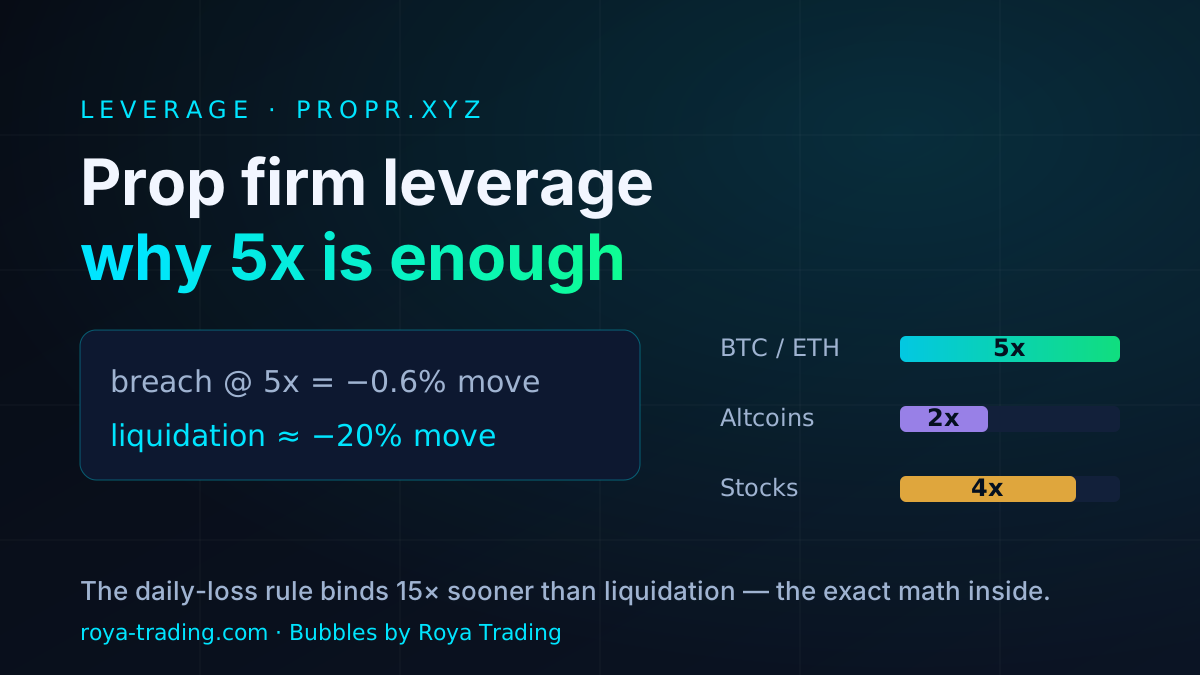
Propr.xyz caps leverage at 5x on BTC and ETH, 2x on every other cryptocurrency, and 4x on equities (published rulebook — same caps on the 1-Step, the 2-Step, and funded accounts). Those numbers look tight next to an exchange, but on a challenge account they're close to irrelevant: a properly sized trade runs at an effective leverage of 0.2x–2x, and the 3% daily loss rule will end your challenge long before any margin engine gets involved. Leverage isn't your constraint. Your daily risk budget is.
The caps, asset by asset
Straight from the rulebook, identical across both challenge formats:
- BTC and ETH: up to 5x — the figure from the side panel and the changelog. The §12 table on the same page says 10x (and lists SOL at 10x): unreconciled as of our reading on 12 September 2026. We publish the more conservative of the two.
- All other crypto: up to 2x.
- Equity perpetuals: up to 4x.
- Gold, silver, CL and Brent: up to 8x.
- Other commodities and other index perpetuals: up to 5x.
- SP500 and XYZ100 indices: up to 10x.
- FX perpetuals: up to 25x.
Two things worth noting. First, the caps apply per position, and margin is shared across the account — so a maxed BTC position plus a maxed altcoin position compounds your exposure faster than either alone. Second, the caps don't change when you go funded: the habits you build during the evaluation are the ones you'll trade the firm's capital with. If you want the full ruleset around these numbers — daily loss, drawdown, payouts — it's all in Propr's rules explained.
Prop firm leverage is not exchange leverage
On your own exchange account, leverage determines one thing: how far price can move against you before liquidation wipes your margin. That mental model is exactly what gets people breached on a prop firm, because a challenge account has a much closer wall — the loss rules.
Run the numbers on a $10,000 1-Step account. The daily loss limit is 3% of your start-of-day balance — $300 on day one, snapshotted at 00:00 UTC and recomputed daily; the breach itself is measured on equity, floating P&L included (read 10 September 2026). Suppose you open BTC at the full 5x cap: $50,000 notional. A move of just 0.6% against you costs $300 and breaches your day. Liquidation at 5x on Hyperliquid sits very roughly 20% away. You'd need the price to fall thirty-odd times further to get liquidated than to fail the challenge. The margin engine is a spectator; the rulebook is the opponent.
That's the single most important reframe in this whole article: stop thinking in liquidation distance, start thinking in breach distance. At max leverage your breach distance on a 1-Step is 0.6% of BTC price movement. BTC moves 0.6% in a slow hour. This is why "only 5x" is the wrong complaint — even 5x is far more rope than the rules let you use.
The math: what leverage you can actually afford
Work backwards from risk instead of forwards from leverage. The sizing formula (full derivation in position sizing: the exact math) is:
One thing the tier table settles before you ever run that formula: which market you do it in. The 5x cap on BTC and ETH versus 2x on everything else is a liquidity ranking, and it changes the margin efficiency of a trade far more than most people expect — I worked through the allocation it implies in the best crypto pairs to trade in a prop firm challenge.
- Position notional = risk budget ÷ stop distance.
On a $10,000 account risking a conservative 1% ($100) with a 2% stop on BTC, your notional is $100 ÷ 0.02 = $5,000 — that's 0.5x effective leverage. Tighten the stop to 0.5% and notional rises to $20,000 — 2x. Only with very tight stops (0.4% and closer) does the 5x cap even enter the conversation, and trading crypto with 0.4% stops is mostly a way to donate fees.
Here's the same logic across account sizes, at 1% risk and a 2% stop — daily limit shown for the 1-Step's fixed 3%:
- 5K: risk $50/trade · notional $2,500 (0.5x) · daily limit $150 — three full losses and you're done for the day.
- 10K: risk $100/trade · notional $5,000 (0.5x) · daily limit $300.
- 25K: risk $250/trade · notional $12,500 (0.5x) · daily limit $750.
- 50K: risk $500/trade · notional $25,000 (0.5x) · daily limit $1,500.
- 100K: risk $1,000/trade · notional $50,000 (0.5x) · daily limit $3,000.
Notice what never appears in that table: the leverage cap. A sane risk plan lives its entire life underneath it. The cap only matters to two kinds of traders — scalpers with sub-0.5% stops, and people about to fail a challenge.
Why altcoins get 2x (and what it changes)
The asymmetry annoys people: why does BTC get 5x while SOL or DOGE get 2x? Volatility. A mid-cap altcoin routinely moves in an hour what BTC moves in a day. Capping alts at 2x keeps the worst-case damage of a maxed position in the same ballpark across assets — at full 2x on a $10,000 account ($20,000 notional), a 1.5% adverse move breaches your 3% daily. Alts print 1.5% candles constantly.
Practical consequence: alt strategies on a prop account need smaller notional, not workarounds. If your setup needs wide stops (alts usually do — 3–5%), the risk formula already pushes your effective leverage down to 0.2x–0.3x, and the 2x cap is again irrelevant. The cap only stings if you're trying to trade alts like a leveraged lottery ticket, which is precisely the behaviour it exists to price out.
Leverage and DCA: how ladders quietly stack exposure
This is the trap I care most about, because it's the one that catches disciplined traders. A DCA ladder — my core strategy, laid out in DCA for prop firm challenges — enters in slices as price dips. Each fill adds notional. Size each slice like a standalone trade and a 4-level ladder ends up at 4x the exposure you thought you had, potentially pinned against the leverage cap with your stop now representing a daily-loss breach instead of a routine loss.
The correct way to size a ladder is as one position: assume the worst case — every level filled, price at your stop — and require that total loss to fit inside your per-trade risk budget. If ladder-bottom loss = daily limit, you've sized a time bomb, not a strategy. This arithmetic is boring and error-prone at 2am, which is exactly why I automated it with automated trading on the Propr API. It stays semi-auto — you pick the trade, and the bot executes the DCA ladder, take-profit and stop-loss with the whole ladder pre-sized against Propr's limits, on your own account, non-custodial.
How Propr's caps compare to everyone else
If you're shopping around thinking another firm gives you more rope: not really.
- Hypernova — the nearest on-chain competitor, also on Hyperliquid — caps at the same 5x, pays the same 80% split, and has been public since 14 August 2026. Its public rules, read 16 August 2026, listed no bot restrictions, and its rulebook v1.1, read 5 September 2026, permits automated strategies built and run by the trader on a single account while banning copy trading and external signals (the closed-alpha §14.2 ban is gone), but turnkey bot tooling only exists on Propr, which explicitly allows bots, copy trading and API access. Full comparison in Hypernova vs Propr.
- Traditional FX firms (FTMO-style) advertise 1:30 to 1:100 — on forex pairs that move 0.5% on a big day. Normalize for volatility and their effective risk envelope is comparable to 5x crypto, sometimes tighter.
- Offshore exchanges offer 50–100x on your own money — with no daily loss rule, no drawdown floor, and liquidation as the only risk manager. That's not more freedom; it's just a faster way to zero, and it's your capital burning instead of a $60 challenge fee.
The honest summary: within serious crypto prop firms, 5x on majors is the standard, and no firm differentiates itself on leverage. They differentiate on rules, payouts and what they let you automate — the criteria I actually rank them on in the best decentralized prop firms comparison.
The playbook: leverage settings that pass challenges
My defaults, for a 1-Step account, in order of importance:
- Size from risk, never from leverage. Pick risk per idea (0.5–1%), divide by stop distance, and let effective leverage land where it lands — usually 0.2x–2x.
- Cap the day, not just the trade. Two or three max-risk losses should still leave you clear of the 3% daily. If they don't, halve your risk per idea.
- Size DCA ladders as one worst-case position — all fills in, price at stop, total loss inside one risk budget.
- Treat the 2x alt cap as a volatility warning label, not an obstacle. Wide stops on alts mean small notional anyway.
- Remember the drawdown floor. The 6% static drawdown (8% trailing on 2-Step — see trailing vs static) is cumulative across days. Leverage discipline on Monday is worthless if you triple size on Thursday.
None of this requires 10x, 20x or 100x. The 10% target falls to a modest edge compounded carefully; every blown challenge I've seen died of oversizing, not under-leveraging.
FAQ — leverage on crypto prop firms
What leverage does Propr.xyz allow?+
Per the published rulebook: up to 5x on BTC/ETH (side panel and changelog; the §12 table on the same page says 10x — unreconciled as of our reading on 12 September 2026), up to 2x on all other cryptocurrencies, 4x on equities, 8x on gold, silver, CL and Brent, 5x on other commodities and other indices, 10x on the SP500 and XYZ100 indices, and 25x on FX perpetuals. The caps are identical on the 1-Step and 2-Step challenges and on funded accounts.
Is 5x leverage enough to pass a prop firm challenge?+
Yes, comfortably. A disciplined trader risking 0.5–1% per idea with a 1–3% stop distance runs an effective leverage of roughly 0.2x–2x — well under the cap. The 10% profit target doesn't require high leverage; it requires surviving the 3% daily loss and 6% drawdown rules long enough for a modest edge to compound.
Can I get liquidated on a Propr.xyz challenge?+
In practice the challenge rules end your account long before liquidation does. At full 5x, liquidation on Hyperliquid sits very roughly 20% of adverse price move away, while a 1-Step account breaches its 3% daily limit after only a ~0.6% adverse move at max size. The drawdown rules are the real constraint — think in account-risk terms, not liquidation terms.
Why are altcoins capped at 2x when BTC gets 5x?+
Volatility. Altcoins routinely move in an hour what BTC moves in a day, so the cap keeps worst-case losses in the same range across assets. At 2x, a 1.5% adverse altcoin move at full size equals a 3% daily breach on the 1-Step — which is why alt strategies need smaller notional, not more margin.
How does leverage interact with a DCA strategy?+
Each DCA fill adds notional, so a ladder multiplies your effective leverage as it fills. A 4-level ladder sized naively can quietly stack up to cap and turn a routine dip into a daily-loss breach. The fix is to size the whole ladder — worst case, all levels filled, price at your stop — against your daily risk budget before the first order goes out. That's exactly the computation I automate rather than doing it by hand.
Do other crypto prop firms offer higher leverage than Propr?+
Not meaningfully. Hypernova, the closest on-chain competitor, also caps at 5x — it went public on 14 August 2026, and its public rules (read 16 August 2026) list no bot restrictions, though there is no turnkey bot tooling there. Traditional FX firms advertise 1:100, but that's a different asset class with far lower volatility per unit of time. For crypto, 5x is the practical ceiling across serious firms.
Let the math run itself — semi-auto.
A semi-auto bot pre-sizes every DCA ladder against Propr's daily loss and drawdown limits, then executes entries, take-profit and stop-loss on your own account. You choose the trade; it does the arithmetic. Start free on Telegram.
Get 5% USDC cashbackNot on Propr yet? Create your Propr.xyz account with 5% USDC cashback on your challenge fee.
Affiliate link. We earn a commission; it never changes what you pay — it is what funds your cashback.
⚠️ Trading carries risk. Leverage caps, rules and fees come from Propr's published rulebook, read 10 September 2026, and can change — always check Propr's own rules page before paying. Liquidation distances are approximations and vary with margin mode and maintenance requirements. Nothing here is guaranteed and past performance does not predict future results. This article is informational and not investment advice. Do your own research and only trade what you can afford to lose.