
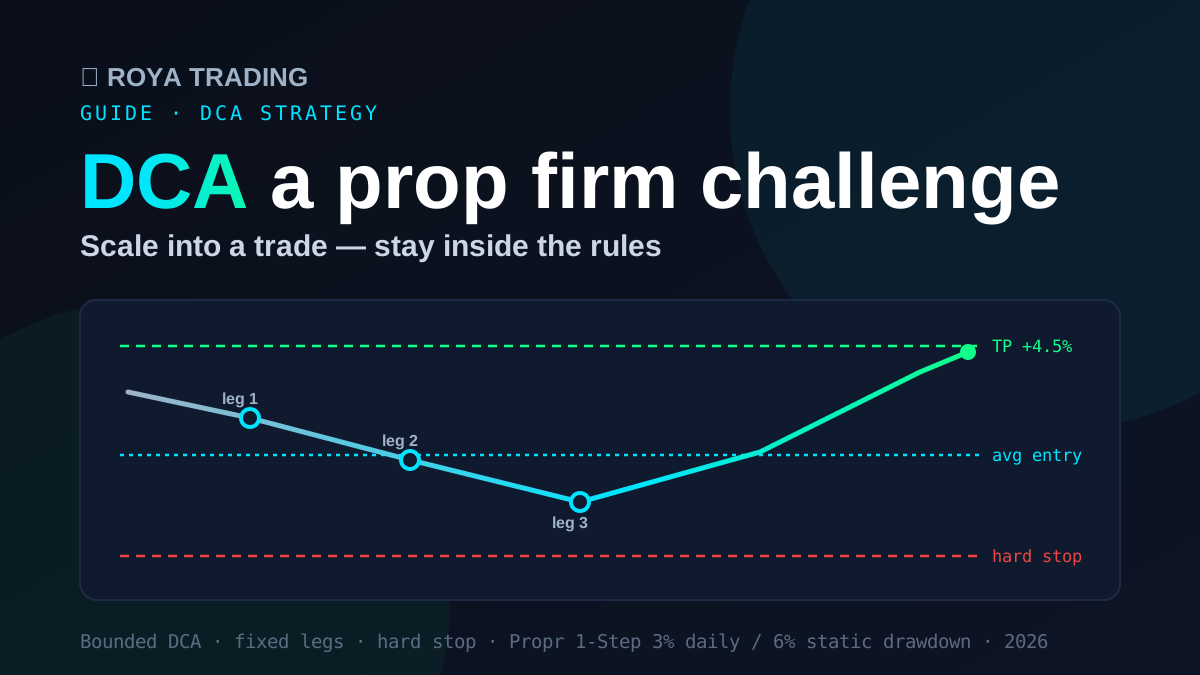
Almost every prop firm challenge I've passed, I passed the same boring way: by scaling into a trade instead of slamming all-in. That's dollar-cost averaging — DCA — applied to a single position rather than a savings plan. It's not exciting, it doesn't make for good screenshots, and it's exactly why it works on an evaluation account. Here's how DCA actually fits a Propr.xyz challenge, how to size it against the rules with real numbers, and — just as important — the version of "DCA" that quietly breaches accounts.
The short answer
A challenge doesn't ask you to 10x. It asks you to hit a modest target (10% on Propr) without tripping a daily loss limit or a max drawdown. DCA is built for exactly that job: you average your entry across a few planned levels, take profit at small fixed targets, and — this is the part people skip — cap the whole position with a hard stop decided before you enter. Done that way, DCA turns trading into a repeatable, low-emotion process that respects the published loss limits. Done the lazy way — adding forever with no stop — it's just averaging down, and it's the single fastest path to a breach.
What DCA actually is (in a trading account)
Most people first meet DCA as an investing habit: buy $100 of Bitcoin every week, smooth out the price over time. That's time-based DCA. Inside a prop firm challenge we use a different cousin — price-based, trade-level DCA: you split the size you were going to trade into several tranches and place them at progressively better prices.
Concretely, say you want exposure worth one unit of risk on BTC. Instead of buying it all at $60,000, you buy a third at $60,000, set a limit for another third at $59,400, and a final third at $58,800. If price dips and fills your legs, your average entry drops to roughly $59,400 and you need a smaller bounce to reach profit. If it runs straight up from the first fill, you're still in — just with less size. Either way the bot takes profit at fixed, modest targets (say +2.5% then +4.5% on the position) and trails a stop on the rest.
The two non-negotiables that make this DCA and not gambling: the number of legs is fixed and the total size is decided up front. You are not allowed to "just add one more." That single rule is the line between a method and a margin call.
Why DCA fits a prop firm challenge specifically
Three features of an evaluation account make DCA an unusually good match:
- The target is modest. +10% to pass — not a moonshot. A better average entry and small, repeatable take-profits get you there without heroics.
- The loss limits are published and derivable in advance. The drawdown floor is a fixed number on the 1-Step; the daily allowance is a percentage you re-derive each morning from the 00:00 UTC balance snapshot. Either way you can budget a position against them before you enter, which is exactly what DCA leg-sizing needs.
- There's no time limit. Propr puts no clock on its challenges, so a patient, scale-in approach is never punished for being slow. Boredom is allowed to pay off.
Put bluntly: a challenge is lost far more often to behaviour than to the market. The whole value of a mechanical DCA process is that it removes the 2am revenge trade. If you want the wider picture of how accounts die, I broke down the five usual causes in why 90% of prop firm traders fail — DCA is the structural fix for most of them.
That fix matters most when you physically can't watch the position. A laddered entry with the stop and take-profit committed up front is what lets an evaluation run inside a working week instead of around it — the schedule built on top of this method is in passing a prop firm challenge with a full-time job.
The math: sizing your DCA legs against the rules
This is where most "DCA bot" content goes quiet, so let's use real Propr numbers — the full risk-per-trade framework behind these figures is in position sizing for prop firm challenges. Take a 25K 1-Step account:
- Daily loss: 3% of your start-of-day balance, snapshotted at 00:00 UTC and recomputed daily — $750 on day one of a fresh 25K, re-derived every morning after that. The breach is measured on equity, floating P&L included (rules read 12 September 2026).
- Max drawdown: 6% static = $1,500 below your $25,000 start, a fixed floor that never moves.
- Profit target: 10% = $2,500.
Now size the trade from the limit backwards. Decide the worst-case loss for the entire DCA position before you place a single order — say $400 (1.6% of the account). That's your budget if every leg fills and price still hits your hard invalidation. Spread three legs across your level band, and place the stop where the fully-built, averaged position is down $400 total. Result: one losing trade costs $400, comfortably inside the $750 daily limit, and you could take three full losers before the $1,500 drawdown is even in question.
That headroom is the entire game. It means a bad day doesn't end your challenge, and it means your DCA legs are a deliberate budget, not a hope. Compare that with going all-in: one 1.6% adverse move with full size and no scale-in, and you've spent the same $400 with a worse average entry and no second chance. If you want every limit decoded in detail, I wrote Propr's rules explained, and the dollar figures change with account size — see which account size to choose before you commit a fee.
One more guardrail: leverage. Propr caps BTC/ETH at 5x (side panel and changelog; the §12 table on the same page says 10x — unreconciled as of our reading on 12 September 2026) and other crypto at 2x, so your leg sizes have a ceiling anyway. DCA should never use the maximum just because it's there — the averaging does the work, not the leverage.
Where DCA blows up accounts
I have to be honest, because "DCA bot" is also how a lot of people lose a challenge. The failure mode is always the same: DCA with no end. Price drops, the trader adds a leg. It drops again, they add another — bigger this time. No hard stop, no fixed leg count, "it has to bounce." That's not DCA, it's averaging down into a margin call, and on a trailing-drawdown account it's lethal.
Here's why the rule type matters. On 1-Step the 6% drawdown is static, so a bounded loss is a bounded loss. On 2-Step the 8% drawdown trails your high-water mark — give back too much open profit while you're adding legs and you can breach while still net-positive on the day. People who say "I was up and still got breached" almost always added unplanned size into a move. I put both rules side by side with worked numbers in trailing vs static drawdown; if you DCA, read it, because the drawdown type decides how much give-back your method can survive.
The fix is structural, not motivational. Don't rely on willpower to stop adding — encode the limits so adding past them is impossible. A fixed leg count, a pre-set total size, and a hard stop that closes the whole position turn DCA from a hope into a system.
There's a quieter cost to unbounded legs too: every extra rung is another fill, and every fill is another 0.045% if you took it at market. Ladders are where fee drag compounds fastest — three planned limit rungs cost roughly a third of five panicked market adds. The arithmetic, with the funding bill on top, is in trading fees, funding and slippage on a prop firm challenge.
DCA vs all-in vs grid
Quick honest comparison, because DCA isn't the only option:
- All-in (single entry): simplest, but your entry timing has to be near-perfect and one adverse wick can put you offside immediately. No averaging cushion.
- Bounded DCA: a few planned legs, fixed total size, hard stop. Better average entry, more forgiving of noise, fully budgetable against the rules. My default for challenges.
- Grid / unbounded averaging: many legs, often growing, frequently no stop. Looks great until the one trend that doesn't reverse — then it takes the whole account. Avoid on an evaluation.
The difference between the second and third bullet is not the technique, it's the boundary. Same idea, opposite outcome.
How I automate it — semi-auto, not autopilot
Knowing the method and executing it flawlessly at 3am are different problems. That's the gap automated trading through the Propr API closes. The model is deliberately semi-auto: you choose the trade and the direction — your call, your conviction — and the bot handles the execution. It places the DCA legs, sets TP1/TP2 take-profit, trails a stop, and enforces guardrails wired to your challenge's daily-loss and drawdown numbers. It runs on your own Propr account through your API key, non-custodial, so your funds never leave Propr.
That distinction matters. I don't want a black box deciding what to trade for me, and you shouldn't either. What I do want is a machine that never moves the goalposts, never revenge-trades, and never adds an unplanned leg — the exact three things that breach DCA accounts by hand. Prefer to ride someone else's calls? The copy-trading Radar applies the same execution discipline to a Pilot's trades. Either way, you keep control of the what; the bot enforces the how.
My DCA challenge checklist
The rules I won't break, condensed:
- Decide the whole-position loss first. Pick a dollar figure (e.g. $400 on a 25K) before any order. That's your budget, full stop.
- Fix the leg count and total size. Three legs, one size, no improvisation. "One more leg" is a banned phrase.
- Always carry a hard invalidation. A stop that closes the entire averaged position, not a mental one.
- Take profit modestly and partially. TP1 banks the trade, TP2 and a trailing stop let the rest run. You're chasing +10% over weeks, not +10% today — the full exit playbook (placement, partials, breakeven) is in stop loss & take profit for prop firm challenges.
- Cap trades per day. If two bounded losers happen, you're done for the session — the daily limit thanks you.
- Pick the format that suits the method. For automated DCA I lean 1-Step for its static wall; full reasoning in 1-Step vs 2-Step.
New to the on-chain category entirely? Start by comparing the best decentralized prop firms of 2026, then come back and build your DCA plan. And the full passing playbook — rules, mindset and the same DCA method end-to-end — lives in how to pass a Propr.xyz challenge.
FAQ — DCA strategy for prop firm challenges
What is a DCA strategy in a prop firm challenge?+
DCA (dollar-cost averaging) in a trading account means scaling into a single trade across several price levels instead of going all-in at one entry. You open a first tranche, add pre-planned limit orders to improve your average price if the market moves against you, and take profit at fixed, modest targets. The point is a better average entry and emotionless execution — not betting everything on one candle.
Is DCA the same as averaging down or martingale?+
No, and conflating them is how accounts get breached. Real DCA is bounded: a fixed number of legs, a fixed total size decided before you enter, and a hard invalidation that closes the whole position if price goes past it. Averaging down (and martingale) is unbounded — you keep adding, often doubling, with no stop, hoping for a bounce. Bounded DCA respects your daily loss and drawdown; unbounded averaging is the fastest way to blow a challenge.
How do I size DCA legs against Propr's daily loss?+
Work backwards from the limit. On a 25K 1-Step account the daily loss is 3% of your start-of-day balance, snapshotted at 00:00 UTC and recomputed daily — $750 on day one of a fresh account, then 3% of whatever the balance is the next morning; the breach itself is measured on equity, floating P&L included (read 12 September 2026). The static drawdown is 6% ($1,500) and does not move. Decide your worst-case loss for the whole DCA position first — say $400 to $500 — then place your legs and your hard stop so that, fully filled and stopped out, you lose that and no more. That keeps a single trade well inside the daily limit and lets you survive two or three losers before drawdown is in play.
Does DCA work better on 1-Step or 2-Step?+
For a DCA system, 1-Step is usually cleaner. Its 6% drawdown is static — a fixed floor under your starting balance that never moves — so your stops are two constant numbers you can hard-code. 2-Step's 8% drawdown trails your peak, which punishes giving back open profit during the early, dangerous window of a position. DCA can run on both (Propr allows bots on either), but a fixed wall is easier to automate safely.
Can I automate a DCA strategy on Propr.xyz?+
Yes. Propr.xyz allows bots, copy trading and API access on both challenge formats. That's exactly what a semi-auto bot does: you choose the trade and direction, and it handles the execution — DCA entries, TP1/TP2 take-profit, a trailing stop and guardrails tied to your daily-loss and drawdown limits — on your own Propr account, non-custodial. It's semi-auto: you stay in control of what to trade, the machine enforces the discipline.
How long does a DCA challenge take to pass?+
With a conservative, bounded DCA approach, plan for roughly 30 to 60 days. Propr puts no time limit on its evaluations, so there's no clock forcing you to oversize. Slower and inside the rules beats fast and breached — the funded account is the same either way.
Run your DCA plan — semi-auto.
You pick the trade. The bot handles the execution — DCA legs, TP1/TP2, trailing stop and hard guardrails tied to your daily-loss and drawdown limits, on your own Propr account. Start free on Telegram.
Get 5% USDC cashbackNot on Propr yet? Create your Propr.xyz account and start your challenge with 5% USDC cashback.
Affiliate link. We earn a commission; it never changes what you pay — it is what funds your cashback.
⚠️ Trading carries risk. Rules, fees and limits come from Propr's published rulebook, read 10 September 2026, and can change — always check Propr's own rules page before paying. DCA does not remove risk; it structures it, and a poorly bounded DCA can still lose money. Nothing here is guaranteed and past performance does not predict future results. This article is informational and not investment advice. Do your own research and only trade what you can afford to lose.