
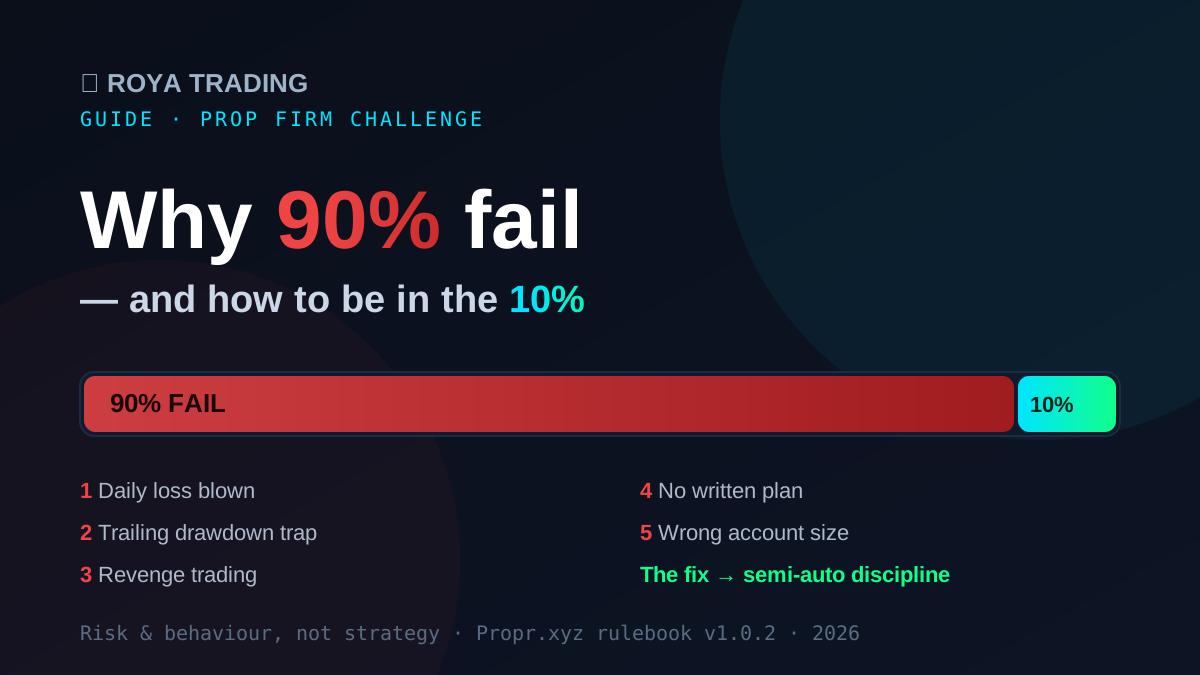
Almost everyone who buys a prop firm challenge loses it. There's no audited industry figure, but every honest estimate I've seen puts the share of traders who clear an evaluation and reach a payout in the single digits — call it 5 to 10%. So "90% fail" isn't clickbait, it's roughly the base rate — though I've since simulated the real odds trade by trade, and the same modest edge scores anywhere from 47% to 98% depending purely on position size, which tells you the base rate is a fact about behavior, not about challenges. I've passed Propr.xyz challenges, blown a few early on, and automated dozens since, so here's the part nobody selling you a course will admit: people don't fail because they lack a strategy. They fail in five predictable ways, and every one of them is a risk-and-behaviour problem, not a market-prediction problem.
The short answer: challenges are lost to behaviour, not the market
A challenge is a risk test wearing a profit target's clothes. The market doesn't blow your account — you do, by breaking a rule you knew about. Fix the five failure modes below and you don't need a magic edge to pass; you need to stop handing the account back. That's genuinely good news, because behaviour is fixable and, as I'll show at the end, it's automatable.
Reason 1: They blow the daily loss limit
This is the number-one account killer. On Propr, the daily loss is 3% on 1-Step and 5% on 2-Step of your start-of-day balance, snapshotted at 00:00 UTC and recomputed daily; the breach itself is measured on equity, floating P&L included. On a 25K account that's a $750 wall on 1-Step at day one. One oversized, emotional session after a red open clips it, and the account is gone even if you were up overall.
The fix is unglamorous: cap your loss per trade and per day so far below the limit that a normal bad day can't reach it. If your max daily loss is 3%, risking 1% per trade means you'd need three full losers back-to-back to breach — and a rule that says "stop after two reds" makes even that impossible. The traders who pass treat the daily limit as a number they never see, not a line they dance on. I broke down every limit, with dollar figures per account size, in Propr's rules explained.
Reason 2: They misunderstand the trailing drawdown
The second great killer is the trailing max drawdown. On Propr's 2-Step it's 8%, and it follows your highest equity (the high-water mark) upward. Push the account to +4% and your breach level rises with it; give back too much and you can blow the account while still being net-positive on the day. This is the source of every "I was in profit and still got breached" horror story — the trader read "8%" and assumed it was measured from the start.
Two things soften it on Propr: the trail stops once it reaches your starting balance and from there never moves back down, so once you're comfortably in profit the floor locks near break-even. The danger window is early, when the floor is still chasing your peak. If you want a format with no moving floor at all, Propr's 1-Step uses a static 6% drawdown instead — I compared the two head-to-head in Propr 1-Step vs 2-Step, and unpacked exactly how each one breaches an account in trailing vs static drawdown. Picking the right drawdown type for your style is a pass-or-fail decision people make in thirty careless seconds.
Reason 3: Revenge trading after a loss
Here's the sequence that ends most challenges: take a loss, feel the urge to "win it back now," double the size on the next trade, and breach the daily limit on the recovery attempt. Revenge trading is where Reasons 1 and 2 actually get triggered. The loss didn't kill the account — the reaction to the loss did.
The passers I know remove the decision entirely. They pre-commit to a fixed position size and a hard "done for the day" rule, written before the session, when they're calm — the exact numbers to pre-commit to, per account size, are in position sizing for prop firm challenges. The moment risk decisions get made after a red candle, by a stressed human, the edge evaporates. This is also the single strongest argument for automating execution, which I'll come back to.
Reason 4: No written plan, and chasing the target too fast
Propr challenges have no time limit. Read that again, because most people trade as if a clock is ticking. They try to hit the 10% target in three sessions, size up to get there, and walk straight into Reasons 1–3. With no deadline, the mathematically correct move is to grind the target slowly with small, repeatable risk — the opposite of how a stressed beginner behaves. I put actual numbers on that grind — trade counts and weeks per risk level — in how long it takes to pass a prop firm challenge.
A "plan" doesn't need to be a 40-page document. It's four numbers and two rules: risk per trade, max trades per day, daily stop, total drawdown buffer — plus "no trading after the daily stop" and "no size increases to recover." Write them down. The act of having a plan you can't argue with at 2am is most of the battle. If you want mine in full, it's the disciplined playbook in how to pass a Propr.xyz challenge.
Reason 5: Wrong account size for the bankroll
The last common failure happens before a single trade: buying too big. Propr sells six sizes, from $5K up to $200K: a 100K Classic 1-Step challenge costs $999 and the 200K costs $1,998, while a 5K costs $60 (rulebook read 10 September 2026). Beginners buy the biggest one for the dream payout, then trade it scared because the dollar drawdown feels enormous, and scared trading breaks every rule above. Worse, if they blow it they're out four figures instead of $60 and can't afford to retry while they learn.
Match the size to what you can comfortably lose and retry a few times, not to the payout you're fantasising about. Most people learning the rules should start small, prove the process on a 5K or 10K, and scale only once passing is boring. I ran the fee-to-funding math for every size in which Propr.xyz account size to pick, and it's the cheapest mistake on this list to avoid. Remember the fee is the only money on the line — you never risk your own trading capital on a prop firm — so the whole game is simply not wasting it. And if you're starting from zero, I've packed the format choice, the $5K survival math and a 30-day plan into the crypto prop firm beginner's guide.
What the 10% actually do differently
None of this is about predicting the market better. The traders who pass share four boring habits: they size small and identically every trade; they stop the day at a pre-set loss without negotiating; they grind the target slowly because there's no clock; and they pick a challenge format and size they understand cold. That's it. The "edge" is consistency, and consistency is the one thing human emotion is worst at delivering — especially after a loss, late at night, with money on the line.
The semi-auto fix: take yourself out of the failure loop
If every failure mode is a behaviour that happens after an emotional moment, the cleanest solution is to not make those decisions in the moment at all. That's the whole reason I built my automated trading setup on the Propr API. It's semi-auto, not autopilot: you choose the trade and the direction — the bot handles the execution, running a DCA entry with hard, pre-set daily-loss and drawdown stops on your own Propr account, non-custodial. The machine never revenge trades, never sizes up to recover, never trades past your daily stop, and never forgets the trailing floor. It simply respects the numbers you set, every time.
This is allowed precisely because of where you choose to trade. Propr.xyz permits bots, copy trading and full API access — so automating your discipline is inside the rules, not a loophole. If you'd rather lean on someone else's process while you learn, the copy-trading Radar lets you copy a vetted Pilot's trades automatically, still with your own guardrails on top. Either way, the point is the same: remove the 2am human from the risk decisions and four of the five failure modes simply can't fire.
A realistic plan to land in the 10%
If I were starting today, knowing the failure rate, here's the unsexy plan: start on a small account, risk ~1% per trade, cap losses at two reds or the daily stop (whichever comes first), never increase size to recover, and grind the 10% target over as many sessions as it takes since there's no deadline. Automate the execution so those rules hold when you're tired. Boring on purpose — boring is what passing looks like. And if you've already blown an attempt, don't rebuy on tilt: the failed-challenge reset playbook walks through the 15-minute autopsy, the retry math and the one change to make before attempt two.
New to the category and not sure where to even open an account? Start by comparing the best decentralized prop firms of 2026, then come back and build your plan. When you're ready, you can create your Propr.xyz account through my link and get 5% USDC cashback on fees — a small edge that partly offsets the cost of learning.
Affiliate link. We earn a commission; it never changes what you pay — it is what funds your cashback.
FAQ — why prop firm traders fail
Why do most prop firm traders fail the challenge?+
Not because of strategy — because of risk management and behaviour. The most common failures are breaching the daily loss limit, misreading a trailing drawdown, revenge trading after a loss, trading without a written plan, and picking an account size too big for the bankroll. All five are discipline problems, which is exactly why a rules-respecting system beats raw skill at the evaluation stage.
What percentage of prop firm traders actually pass?+
There's no audited industry number, but most public estimates put the share of traders who clear an evaluation and reach a payout in the single digits — roughly 5–10%. The headline '90% fail' is a fair shorthand. The encouraging part: the failures cluster around a handful of avoidable mistakes, not around some secret edge you don't have.
What is the single biggest reason challenges get blown?+
The daily loss limit. On Propr that's 3% per day on 1-Step and 5% on 2-Step of your start-of-day balance, snapshotted at 00:00 UTC and recomputed daily; the breach itself is measured on equity, floating P&L included. One oversized, emotional session after a red open is enough to breach it, even if the account is still in profit overall. Capping risk per day and per trade is the highest-leverage habit you can build.
Does a trading bot make you more likely to pass a prop firm challenge?+
It removes the failure point that blows most accounts: you, at 2am. A bot with hard daily-loss and drawdown stops never revenge trades, never oversizes after a loss and never moves the goalposts. Propr.xyz allows bots, copy trading and API access, so this is fully within the rules. A semi-auto DCA bot can run with those guardrails on your own account — you pick the trade, it manages the execution.
Is it the trader's fault or the prop firm's rules?+
Mostly the trader's risk management, but the rules decide how unforgiving the mistakes are. A trailing drawdown punishes giving back early profit; a tight daily loss punishes one bad session. The firms aren't hiding this — it's all in the rulebook. Reading the rules before you pay, then sizing so you never come close to a limit, is what separates the 10% from the 90%.
Don't fail it the dumb way.
A semi-auto DCA bot runs with hard daily-loss and drawdown stops on your own Propr account — you pick the trade, it holds the discipline. Start free on Telegram.
Get 5% USDC cashbackNot on Propr yet? Create your Propr.xyz account with 5% USDC cashback.
Affiliate link. We earn a commission; it never changes what you pay — it is what funds your cashback.
⚠️ Trading carries risk. Rules, fees and limits come from Propr's published rulebook, read 10 September 2026, and can change — always check Propr's own rules page before paying. Pass-rate estimates are industry shorthand, not audited figures. Nothing here is guaranteed and past performance does not predict future results. This article is informational and not investment advice. Do your own research and only trade what you can afford to lose.