
"How long will this take?" is the first question everyone asks before paying a challenge fee — and the marketing answer ("some traders pass in days!") is precisely the answer that gets accounts breached. The real answer is a piece of arithmetic: your target divided by your expectancy per trade, throttled by the loss rules. This article runs that arithmetic on Propr.xyz's actual rulebook numbers, so you know what a realistic calendar looks like before you commit a fee.
Affiliate link. We earn a commission; it never changes what you pay — it is what funds your cashback.
The short answer
For a disciplined trader risking 0.5–1% per trade idea, a 10% profit target takes roughly 25–60 trade ideas, which at one or two quality setups a day works out to three to eight weeks. On Propr.xyz there is no time limit on any format, so that timeline is a budget, not a deadline. The traders who finish faster than the math suggests are almost always oversizing — and oversizing against a 3% daily loss wall is how challenges end early in the other direction.
Why "no time limit" changes the whole problem
Most traditional firms built their challenges around 30-day phases, and that clock quietly became the house edge: a trader three weeks in and 4% short starts forcing B-grade setups, and forced setups feed the loss limits. Propr's published rulebook has no such clock — both the 1-Step (10% target, 3% daily loss of the start-of-day balance recalculated daily, 6% static drawdown) and the 2-Step (5% then 10%, 5% daily loss, 8% trailing drawdown) run until you either hit the target or breach a limit. That flips the strategy: your enemy isn't the calendar, it's the daily loss. Every rule that matters is decoded in Propr's rules explained; for timing purposes, remember that the target is patient and the walls are instant.
The trade-count math: target ÷ expectancy
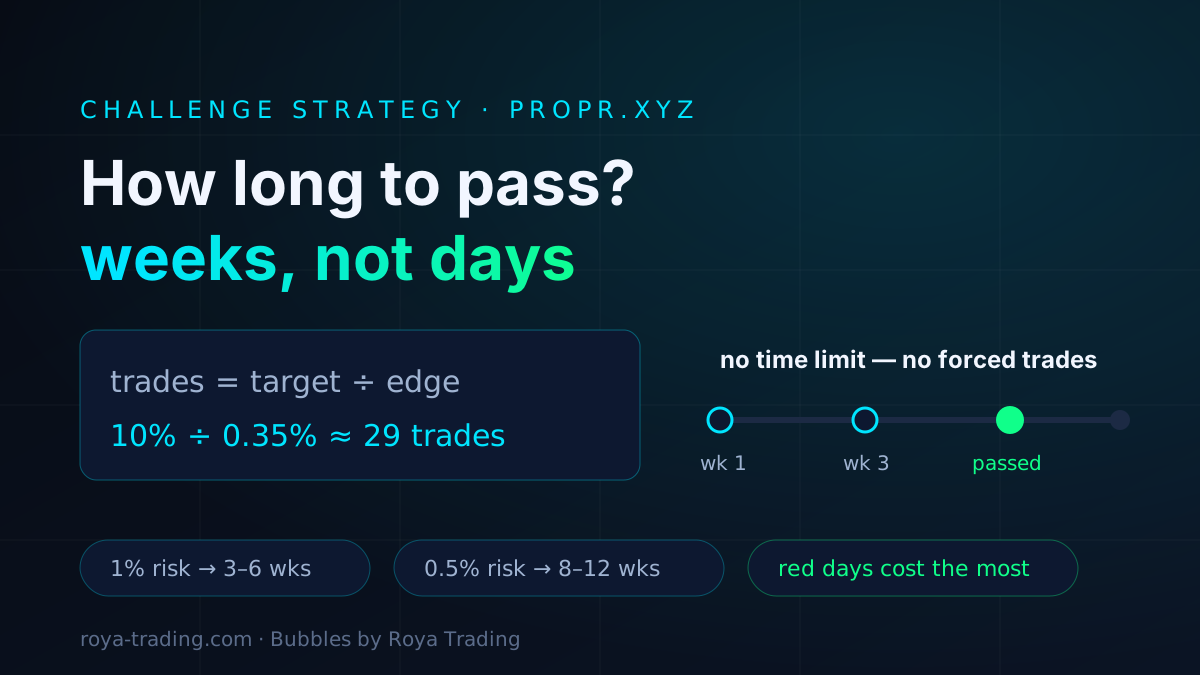
Timeline isn't measured in days — it's measured in trade ideas. Take an honest, unheroic system: 45% win rate, winners twice the size of losers (2R). Expectancy per idea = (0.45 × 2R) − (0.55 × 1R) = 0.35R. Risking 1% per idea, that's +0.35% of the account per idea on average. A 10% target therefore needs 10 ÷ 0.35 ≈ 29 trade ideas. At one setup per trading day, that's about six weeks; at two, about three. This is also why risk percentage sets your calendar: at 0.5% risk the same system needs ~57 ideas (8–12 weeks), at 1% it needs ~29 (3–6 weeks). The full sizing arithmetic — including why 1% is the ceiling, not the floor — is in position sizing for prop firm challenges.
What a realistic calendar looks like per profile
Three profiles, same modest 0.35R edge, Propr 1-Step:
- Conservative (0.5% risk) — ~57 ideas · roughly 8–12 weeks · worst normal day −1.5%, half the daily wall. The slowest and the safest calendar.
- Standard (1% risk) — ~29 ideas · roughly 3–6 weeks · three full losers end the day exactly at the 3% wall. The balanced default.
- Rushed (2–3% risk) — ~10–15 ideas on paper · but two losers end your day, three can end the account. The "fast" calendar is mostly a shorter route to a new fee.
None of these profiles assume you sit at a screen all day. The conservative line — ~57 ideas at 0.5% — is roughly two or three planned entries a week, which is exactly what a working week allows; I built that version of the calendar out in passing a prop firm challenge with a full-time job.
The third profile is the one the marketing sells and the statistics bury: the same impatience that promises a one-week pass produces the failure patterns documented in why 90% of prop firm traders fail.
Red days cost more time than green days save
Here's the asymmetry that actually governs your timeline. One maxed-out red day on a 1-Step (−3%) costs 3 ÷ 0.35 ≈ 8.6 average ideas of expectancy to claw back — call it a week and a half of normal progress, erased in an afternoon. Meanwhile a great green day might bank two or three ideas' worth. The practical conclusion is boring and decisive: the fastest challenge is the one with no max-loss days, not the one with the biggest winners. Cutting your day off at −1.5% or −2% (before the rulebook does it at −3%) is a timeline optimization, not just a safety rule.
1-Step vs 2-Step: which is faster?
The 1-Step has one 10% phase; the 2-Step banks 5% then 10% across two phases — more total R, so usually more calendar time. But the trade-offs cut both ways: the 2-Step's 5% daily loss is a wider wall than the 1-Step's 3%, its fees run lower ($50–$1,499 vs $60–$1,998 across the 5K–200K sizes), and its 8% trailing drawdown only stops trailing once it locks at the starting balance — which punishes exactly the press-your-luck behavior that rushing encourages. If your priority is the shortest expected path, the 1-Step wins — and when I later simulated the pass probabilities directly, it won on odds too: 87% vs 72% for the same thin-edge trader at 0.5% risk, because the trailing floor costs more than the looser daily wall gives back. The full decision framework is in Propr 1-Step vs 2-Step.
The hidden time sinks (that have nothing to do with edge)
In practice, most lost weeks aren't lost to markets — they're lost to execution. The missed take-profit that round-trips a winner. The DCA plan abandoned halfway because leg three felt scary at 2am. The revenge trade after two stops that turns a −2% day into a −3% lockout. Each of those events costs days of expectancy, and none of them are strategy problems. Sizing the ladder properly (the method is in DCA for prop firm challenges) and letting software hold the plan is how the theoretical calendar becomes the actual one. That's the entire pitch of semi-automation: you pick the trade, the bot executes the DCA entries, take-profit and stop-loss against your account's real limits — see how the Propr API handles automated trading. Your timeline should reflect your edge, not your sleep schedule.
What happens to the clock after you pass
The slow part is the challenge; everything after it is fast. Once you hit the target, Propr runs KYC before funding, and from a funded account the payout loop is short: 80% split, $20 minimum, USDC on-chain within 24 hours (about 5 hours on average). So the honest full timeline from fee to first withdrawal, for a standard-risk trader, is roughly one to two months — with the challenge representing nearly all of it. The payout mechanics, including the full-sweep reset, are detailed in how Propr.xyz payouts work.
Verdict: budget weeks, refuse the race
Plan for 3–6 weeks at 1% risk, 8–12 at 0.5%, treat every avoided max-loss day as a week saved, and let the absence of a time limit do its job: no forced trades, ever. The fee math rewards patience too — a Propr.xyz challenge paid through that link returns 5% USDC cashback on the fee, which softens the cost of taking the slow, surviving road. And if you're still choosing where to run that road, the best decentralized prop firms guide compares every firm we actually test — time limits and loss walls included.
Affiliate link. We earn a commission; it never changes what you pay — it is what funds your cashback.
FAQ — how long to pass a prop firm challenge
How long does it take to pass a prop firm challenge on average?+
For a disciplined trader risking 0.5–1% per trade idea, a realistic range is three to eight weeks for a 10% target. The math: at 1% risk with a modest positive expectancy (~0.35R per idea), the 10% target takes roughly 25–30 trade ideas. At one or two quality setups per day, that's several weeks of normal trading — anyone promising days is describing luck or oversizing.
Is there a time limit on Propr.xyz challenges?+
No. Propr.xyz has no time limit on any of its four formats — the three 1-Step variants (Turbo 9%, Classic 10%, Pro 12% targets) and the Classic 2-Step (5% then 10%) all let you take as long as you need. The binding constraints are the loss rules: a 3% daily loss of the start-of-day balance, recalculated daily, and 6% static drawdown on the 1-Step; 5% daily and 8% trailing drawdown on the 2-Step.
Can I pass a prop firm challenge in a week?+
Mathematically it can happen with a hot streak, but engineering it requires oversizing — and oversizing is how accounts breach. Risking 2–3% per idea to compress the timeline means two ordinary losers can end your day against a 3% daily wall, and a normal three-loss cluster can end the whole challenge. The expected cost of rushing is higher than the fee you'd save.
Is the 2-Step slower to pass than the 1-Step?+
Usually yes in total calendar time — two phases (5% then 10%) mean more total R to bank. But each phase is individually easier, the 5% daily loss gives more breathing room than the 1-Step's 3%, and the fees are lower ($50–$1,499 vs $60–$1,998). The 1-Step is faster when it goes well; the 2-Step is more forgiving when it doesn't.
What slows traders down the most during a challenge?+
Max-loss days, not slow markets. One -3% daily-limit day on a Propr 1-Step costs roughly eight or nine average trade ideas' worth of expectancy to claw back — more than a week of progress erased in an afternoon. Avoiding full red days compresses your timeline far more than pressing winners ever will.
Does using a bot make passing faster?+
A bot doesn't create edge, but it stops the time-wasters: missed take-profits, abandoned DCA plans and revenge trades that reset your progress. On Propr.xyz, bots and API access are explicitly allowed. A semi-auto bot lets you pick the trade while it executes the DCA ladder, take-profit and stop-loss against the account's real limits, so your timeline reflects your edge instead of your discipline lapses.
Make the calendar yours — semi-auto.
You pick the trade; the bot executes the DCA entries, take-profit and stop-loss against your account's real limits — no missed exits, no 2am detours. Start free on Telegram.
Get 5% USDC cashbackNot on Propr yet? Create your Propr.xyz account and get 5% USDC cashback on your challenge fee.
Affiliate link. We earn a commission; it never changes what you pay — it is what funds your cashback.
⚠️ Trading carries risk. Propr figures come from its published rulebook and can change — always verify on the firm's own pages before paying. Timelines are worked examples built on assumed win rates, not promises. Nothing here is guaranteed and past performance does not predict future results. This article is informational and not investment advice. Do your own research and only trade what you can afford to lose.