
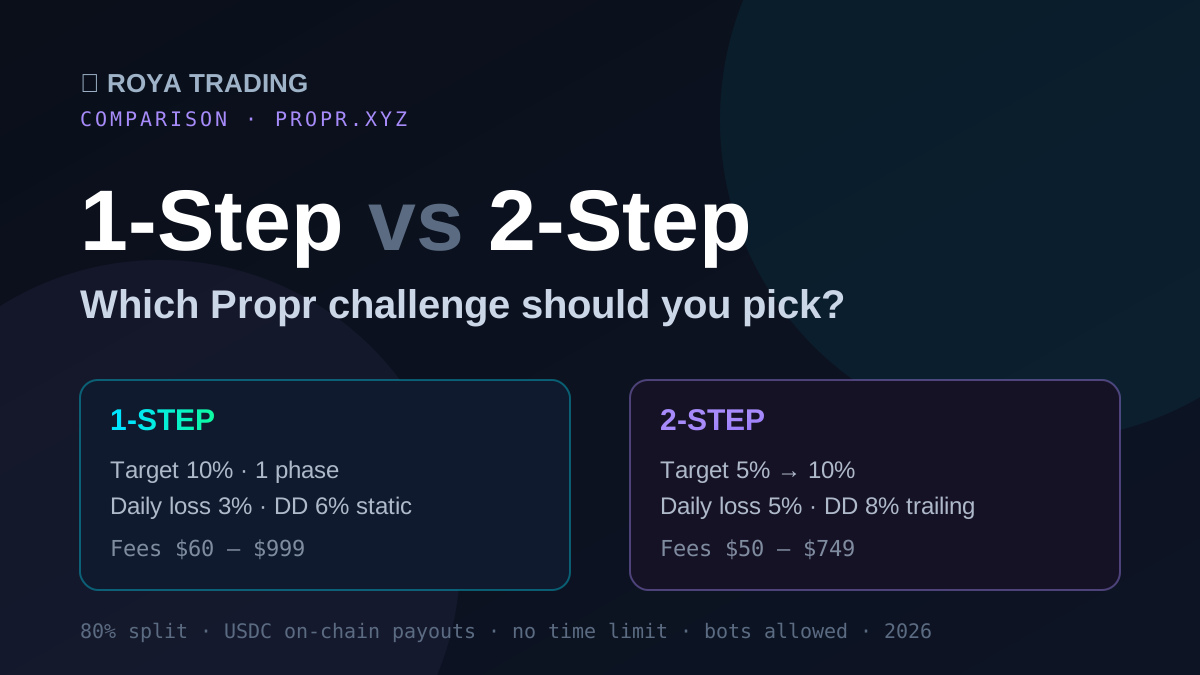
Propr.xyz sells the same funded account two ways: a 1-Step evaluation and a 2-Step one. Same 80% split at the end, same on-chain payouts — but the path to get there is different enough that picking the wrong one can cost you the challenge. I trade these accounts and I automate them through the API, so here's the honest breakdown of which format fits which trader, using the numbers from Propr's published rulebook.
The short answer
If you trade with a system or a bot, take 1-Step: a single phase with one daily percentage and one static drawdown is predictable and trivial to encode as hard stops. If you trade discretionary and want more intraday room — plus a cheaper entry — 2-Step is reasonable, as long as you respect its trailing drawdown. The trailing rule is the single most misunderstood thing about Propr, so we'll spend real time on it below.
The two formats at a glance
Same six account sizes (5K, 10K, 25K, 50K, 100K, 200K — read 10 September 2026), two rulesets:
- 1-Step: one phase, 10% profit target, 3% daily loss of your start-of-day balance, 6% static max drawdown.
- 2-Step: two phases, 5% then 10% targets, 5% daily loss of your start-of-day balance, 8% trailing max drawdown.
- Identical on both: 80% profit split, USDC on-chain payouts (min $20, paid within 24h — ~5h on average), no time limit, bots and copy trading allowed, funded accounts capped at $300k.
On both formats the daily loss is a percentage of the balance snapshotted at 00:00 UTC and recomputed every day — it is never a fixed dollar figure set at purchase — while the breach itself is measured on equity, floating P&L included.
The other two formats: Turbo 1-Step — same single phase, but a 9% target, a much tighter 3% static drawdown and fees roughly halved ($25–$899 across the six sizes) — and Pro 1-Step, priced between the two ($45–$1,399). That makes four formats in total (read 10 September 2026). I broke down when the Turbo discount is worth it in the full Turbo 1-Step review.
1-Step: one wall, fixed in place
1-Step is a single race. You need +10% on the account to pass, you can't lose more than 3% in a single day, and your account can't drop more than 6% below its starting balance — ever. That 6% is static: it's a line drawn under your starting balance on day one and it doesn't move. Get to +8% and the floor is still at −6% of the original, so you've effectively built a cushion.
The trade-off is tightness. A 3% daily and a 6% total don't leave much room to be wrong, so position sizing has to be conservative. But for anyone running a defined system, that predictability is a feature: the limits never move, so you know exactly where your stops live for the whole challenge. If you want the full mechanics of every limit, I broke them down in the Propr rules explained guide.
2-Step: more daily room, but a moving floor
2-Step softens the daily limit to 5% and splits the target into two easier phases — 5% in phase 1, then 10% in phase 2. On paper that's gentler. The catch is the 8% trailing drawdown.
"Trailing" means the drawdown limit follows your highest equity (the high-water mark). Push the account to +4% and your breach level rises with it; give back too much and you can blow the account while still being net-positive on the day. Two things soften it: the trail stops once it reaches your starting balance, and from there it never moves back down. So once you're comfortably in profit, the floor locks at break-even and behaves almost like a static limit. The danger window is early, when the floor is still chasing your peak.
This is exactly why people say "I was up and still got breached." They didn't read the trail. I put both rules side by side, with worked numbers, in trailing vs static drawdown. If 2-Step is your pick, treat the first few percent of profit as the most dangerous part of the whole evaluation.
Fees: what each format costs
2-Step is cheaper at every size — you pay a premium on 1-Step for the simplicity of one phase and a non-trailing floor:
- 5K: 1-Step $60 · 2-Step $50
- 10K: 1-Step $110 · 2-Step $100
- 25K: 1-Step $275 · 2-Step $250
- 50K: 1-Step $495 · 2-Step $450
- 100K: 1-Step $999 · 2-Step $899
- 200K: 1-Step $1,998 · 2-Step $1,499
Prices as charged at checkout, read 10 September 2026 — with one unresolved divergence: on the 2-Step 100K the rulebook still prints $749 while the live checkout has shown $899 since 8 August 2026. Check the price on the payment screen, not in the rulebook.
The gap widens with size — at 100K the 1-Step premium is $100 against the $899 you are actually charged (it would be $250 against the $749 the rulebook still prints). Whether that premium is worth it is really a question of how you trade (and how many resets you expect). I ran the full break-even and ROI math in the challenge cost breakdown, and if you're still unsure which size to take, see which account size to choose.
What's identical (so it shouldn't sway you)
Don't let a salesperson frame these as differentiators — they're the same on both formats:
- Profit split: 80% to you.
- Payouts: USDC on-chain, $20 minimum, paid within 24 hours (~5h average).
- Time limit: none — trade at your own pace.
- Consistency rule: none on either — no best-day cap on your profit.
- Automation: bots and copy trading are allowed on both.
- Leverage: 5x on BTC/ETH (side panel and changelog; the §12 table on the same page says 10x — unreconciled as of our reading on 12 September 2026), 2x on other crypto, 4x on equities, 8x on gold, silver, CL and Brent, 5x on other commodities.
- KYC: required before you go funded, not to start the evaluation.
- Funded cap: $300k maximum funded capital.
The deciding factor: can you automate it?
Here's the angle nobody on a rules page will give you. A challenge isn't usually lost to the market — it's lost to your own behaviour at 2am. The format you can automate cleanly is the one you're most likely to pass. And a fixed wall is far easier to automate than a moving one.
That's the real case for 1-Step if you run a bot. Its 3% daily and 6% static drawdown are two constant percentages — the drawdown floor is a fixed price level, and the daily floor only needs recomputing once a day from the 00:00 UTC balance. You encode them as hard stops and the machine never crosses them, never revenge-trades, never moves the goalposts. The Propr API for automated trading lets you run a DCA strategy with exactly those guardrails on your own Propr account, non-custodial, and 1-Step's single phase means there's only one race to automate instead of two. You can automate 2-Step too — Propr allows it — but the trailing floor adds a moving variable your stop logic has to track during the early, dangerous window.
So: which one?
Pick 1-Step if you trade systematically or with a bot, you want predictable limits you can hard-code, and you'd rather pay a small premium to face a single fixed wall once. This is my default recommendation for anyone automating their execution.
Pick 2-Step if you trade discretionary, you want the extra 5% daily room and the lower per-phase target, and the cheaper entry matters — provided you genuinely understand the trailing drawdown and treat your first profits with care.
Either way, the funded account at the end is the same. If you're brand new to the category, start by comparing the best decentralized prop firms of 2026, then come back and pick your format. And whichever you choose, the method to actually clear it is the same disciplined playbook I use in how to pass a Propr.xyz challenge.
One format that isn't on this page: an account with no evaluation at all. If you're weighing whether to pay a premium and skip straight to a funded balance, I ran the cost-per-dollar-of-drawdown arithmetic in instant funding vs a prop firm challenge — the short version is that the 1-Step costs about $0.18 per dollar of risk capital and a typical instant account closer to $2.50.
FAQ — Propr 1-Step vs 2-Step
What's the difference between Propr 1-Step and 2-Step?+
1-Step is a single evaluation: hit a 10% profit target while respecting a daily loss of 3% of your start-of-day balance and a 6% static max drawdown. 2-Step splits the evaluation into two phases (5% then 10%) with a looser 5% daily loss, but an 8% trailing drawdown. In both cases the daily limit is a percentage of the balance snapshotted at 00:00 UTC and recomputed every day, never a fixed dollar figure, and the breach is measured on equity, floating P&L included. Both end in the same funded account, with an 80% profit split and on-chain USDC payouts.
Is 1-Step or 2-Step easier to pass?+
It depends on your style. 1-Step is one race with a fixed, predictable wall — fewer rule resets, but a tighter 3% daily and 6% drawdown leave less room to be wrong. 2-Step gives you more daily breathing room (5%) and a lower target per phase, but the 8% trailing drawdown follows your equity up, and you have to clear two phases instead of one. For a disciplined, rules-respecting system, 1-Step is usually the cleaner pass; for a discretionary trader who needs intraday slack, 2-Step can be friendlier.
What is trailing drawdown on Propr 2-Step?+
The 8% max drawdown on 2-Step trails your highest equity (high-water mark): as your balance grows, the breach level rises with it. Crucially, it stops trailing once it reaches your starting balance and never moves back down. The trap: early in a phase you can be net-positive on the day and still breach, because the limit is measured from your peak, not from zero.
Which is cheaper, 1-Step or 2-Step?+
2-Step is cheaper at every account size. Fees run $50 / $100 / $250 / $450 / $899 / $1,499 for 5K / 10K / 25K / 50K / 100K / 200K on 2-Step, versus $60 / $110 / $275 / $495 / $999 / $1,998 on 1-Step (read 10 September 2026). One caveat on the 2-Step 100K: the rulebook prints $749 while the live checkout has shown $899 since 8 August 2026, so confirm the figure on the payment screen. You're paying a premium on 1-Step for the simplicity of a single phase and a static (non-trailing) drawdown.
Can I automate a Propr challenge with a bot?+
Yes. Propr.xyz allows bots and copy trading on both 1-Step and 2-Step. A DCA bot with hard guardrails, or a copy-trading layer, can run on your own Propr account, non-custodial. Automation is where 1-Step shines, because its static drawdown is a single number that never moves — trivially codable as a hard stop.
Which should a systematic or bot trader pick?+
For a systematic or automated approach, 1-Step is the recommended default: one daily percentage recomputed from the same balance snapshot every midnight UTC, and one static drawdown that never moves, are both easy to encode as hard stops — and you only have to clear a single phase. Reserve 2-Step for discretionary trading where you value the extra daily room and the cheaper entry more than predictability.
Pass your Propr challenge — semi-auto.
Run a DCA bot with hard guardrails on your own Propr account — the daily-loss and drawdown limits respected automatically.
Get 5% USDC cashbackNot on Propr yet? Create your Propr.xyz account and pick your format with 5% USDC cashback.
Affiliate link. We earn a commission; it never changes what you pay — it is what funds your cashback.
⚠️ Trading carries risk. Rules, fees and limits come from Propr's published rulebook and can change — always check Propr's own rules page before paying. Nothing here is guaranteed and past performance does not predict future results. This article is informational and not investment advice. Do your own research and only trade what you can afford to lose.