
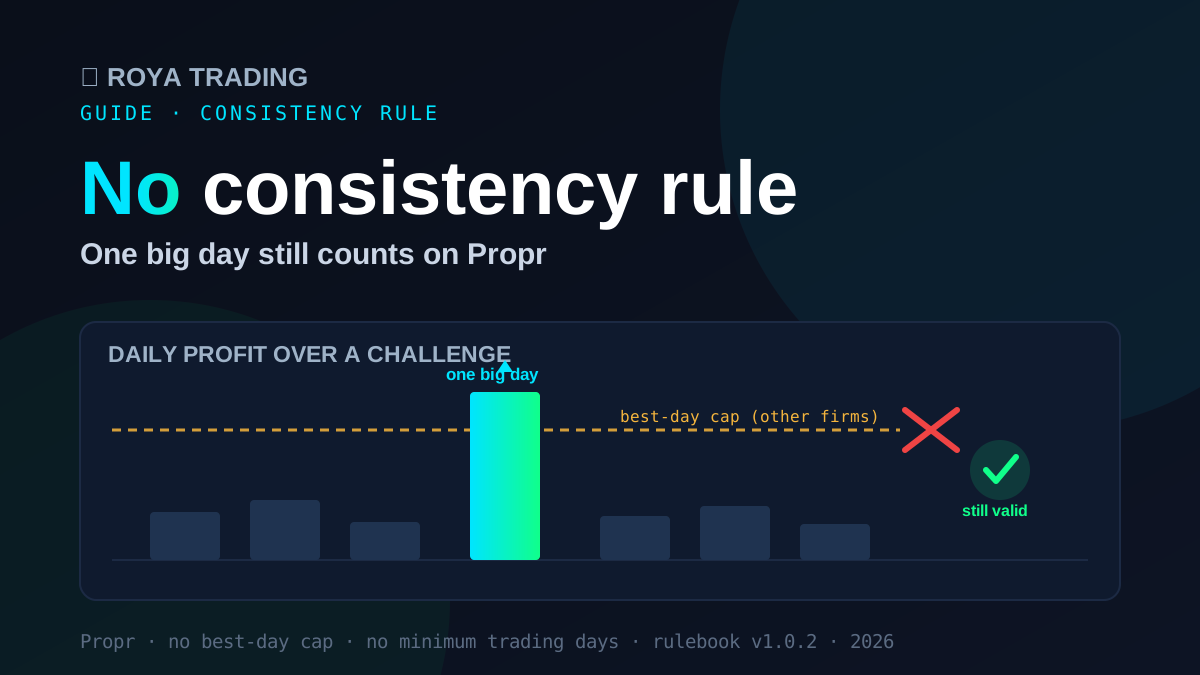
If you've traded a traditional or futures prop firm, you've probably been burned — or nearly burned — by a consistency rule. You hit the target, went to withdraw, and got told your best day was "too big" a share of your profit, so the payout was blocked. It's one of the most frustrating rules in the category, and it's the first thing systematic traders ask me about when they move to crypto. So let me answer it directly for Propr.xyz, the Hyperliquid prop firm I trade and automate: Propr has no consistency rule.
The short answer
No consistency rule. No best-day cap. No minimum trading days, no time limit, no profit cap, no mandatory stop-loss. On Propr there are exactly two trading rules that can end a challenge: a daily loss — 3% (1-Step) / 5% (2-Step) of your start-of-day balance, snapshotted at 00:00 UTC and recomputed daily; the breach itself is measured on equity, floating P&L included (read 10 September 2026) — and a max drawdown (6% static on 1-Step, 8% trailing on 2-Step). How you reach the 10% target between those two walls is entirely your business — one clean day or thirty small ones, it all counts. I broke down every one of those limits in the Propr rules explained guide; this article is about the rule that isn't there, and why its absence is worth more than most traders realize.
What a consistency rule actually is
A consistency rule — sometimes marketed as a "best-day" or "profit-distribution" rule — caps how much of your total profit is allowed to come from a single trading day. The exact number varies by firm because there's no industry standard, but caps commonly land somewhere between 20% and 50%. The mechanic is simple: if your best day is worth more than that share of your total gains, the challenge target doesn't fully count, or the payout is held until you "even out" your profit across more days.
Here's a worked example at a 30% cap. Say you need +$2,500 of profit to pass. You have one excellent day of +$1,500 and grind the rest over two weeks. That best day is 60% of your total — double the cap — so under a consistency rule you'd be blocked, even though you hit the number and never broke a loss limit. To satisfy the rule you'd have to keep trading and dilute that one day down to 30% or less of the total, which for a $1,500 day means growing your total profit to at least $5,000. You did the hard part — the rule makes you keep risking capital to "prove" it wasn't luck.
Firms use it for a defensible reason: they don't want to fund someone who caught a single lucky move and can't repeat it. But it punishes a lot of legitimate, well-managed trading too — especially any approach that occasionally lands one big, correctly-sized winner. That's the tension, and it's exactly where Propr's model diverges.
Does Propr have one? (No — and here's the full list)
Propr's rulebook keeps the trading rules deliberately short. There is no consistency rule and no cap on how much of your profit comes from one day. To be complete, here's everything Propr doesn't impose:
- No consistency / best-day rule — one day can be 100% of your profit and it still counts.
- No minimum trading days — no "you must trade at least N days" gate.
- No time limit — trade at your own pace; the account doesn't expire.
- No profit cap — no ceiling on what a funded account can earn between payouts.
- No mandatory stop-loss and no per-trade risk rule beyond the leverage caps (5x BTC/ETH — side panel and changelog; the §12 table on the same page says 10x, unreconciled as of our reading on 12 September 2026 — 2x other crypto, 4x equities, 8x gold/silver/CL/Brent, 5x other commodities).
What's left are the two equity limits — the daily loss and the max drawdown — plus the profit target. That's the whole game. For a category where rulebooks often run to a dozen behavioral clauses, two trading rules is refreshingly clean, and it's a big part of why I find these accounts easy to automate.
Why "no consistency rule" is a real edge
This is the part most people underrate. The absence of a consistency rule isn't just one less paragraph to read — it changes what strategies are viable. Three groups win specifically because of it.
1. DCA and scaling traders. If you scale into a strong setup and occasionally catch one clean, well-sized move that makes your week, a consistency rule penalizes exactly that outcome. On Propr, that big day carries you to the target or a payout with zero penalty. This is the entire premise of a DCA strategy for a challenge — build a position patiently, let the good entries do the heavy lifting — and it only works cleanly on a firm that doesn't cap your best day.
2. Systematic and bot traders. A consistency rule is a rolling, path-dependent test — your compliance depends on the shape of your whole profit curve, not just today's numbers. That's genuinely annoying to encode as a hard stop. With Propr, a bot only has to respect two constant numbers (the daily loss and the drawdown) and chase the target; there's no profit-distribution math running in the background. Fewer moving rules means fewer ways for automation to trip. It's the same reason I usually recommend the fixed-wall 1-Step over the 2-Step for anyone running a system.
3. Traders who catch one big move. Crypto trends. Sometimes the right call is to size a single high-conviction trade correctly and let it run. Under a best-day cap that day can become a liability; on Propr it's just a good day. You're rewarded for being right, not forced to re-risk capital to dilute your own winner.
The catch: no consistency rule ≠ no discipline
Here's where I have to be honest, because "no consistency rule" can be misread as "no rules." It isn't. The two limits that do exist are the ones that actually breach accounts, and they're strict. A 3% daily loss on 1-Step is a hard, same-day wall; touch it and the day (or the account) is done. The max drawdown is the real killer — and if you take the 2-Step, its 8% version trails your equity, so you can be net-positive on the day and still breach. I put both side by side, with worked numbers, in trailing vs static drawdown.
So the freedom a missing consistency rule gives you is real, but it doesn't remove the need for self-imposed discipline. If anything, it hands you the rope: with no rule forcing you to spread risk, it's on you not to over-size the "one big day" into a breach. The traders who blow up on Propr almost never die to a consistency rule they don't have — they die to a daily loss they ignored or a trailing drawdown they didn't understand. That's the whole thesis of why 90% of prop firm traders fail.
Consistency rule vs Propr's model, side by side
Same goal — a funded account — two philosophies about how you're allowed to get there:
- Best day: capped (commonly 20–50% of total profit) on firms with the rule · uncapped on Propr.
- Pass in one trade: effectively blocked by the rule · allowed on Propr (not advised, but allowed).
- Payout eligibility: can be held until profit is "evened out" · on-chain USDC, no distribution test, usually paid within 24h (~5h average) on Propr.
- What actually limits you: a rolling profit-distribution test · two fixed equity limits (daily loss + drawdown) on Propr.
- Automation friendliness: harder — path-dependent · easier — two constant numbers.
The practical upshot is on the payout side. On a firm with a best-day rule, a great day can paradoxically delay your money. On Propr, you keep 80% of the profit and the payout doesn't care how you earned it — I walk through exactly what a funded account looks like in how much you can make with a crypto prop firm.
Does Hypernova — or the traditional firms — have one?
Worth answering because "which firm has a consistency rule" is really a rulebook-by-rulebook question, not a category one. Many traditional and futures prop firms do enforce a consistency or best-day rule; it's part of why traders migrate to crypto-native firms in the first place. On the Hyperliquid side, Hypernova — Propr's closest rival — doesn't lead with a consistency rule either. Its closed-alpha rulebook (§14.2) used to ban copy trading and third-party signals, but its public rules, read 16 August 2026, list no bot restrictions. So if your edge is automation or following a pilot, both firms now let you run it on paper — the difference is tooling: Propr explicitly allows bots, copy trading and API access and ships turnkey tools, while Hypernova leaves you to build your own. I compare that head-to-head in is copy trading allowed on prop firms.
The takeaway: don't shop for "no consistency rule" in isolation. A firm can drop that rule and still box you in elsewhere. Read the full rulebook — or start from my shortlist of the best decentralized prop firms of 2026, where I've already done that reading.
How I actually trade without a consistency rule
Freedom isn't a strategy, so here's what I do with it. I still spread my entries and I still size small relative to the daily loss — not because a rule forces me to, but because that's how you survive the drawdown. The difference is that when one of those entries turns into a genuinely good day, I let it be a good day. I don't clip a winner short to "stay consistent," and I don't keep re-risking a passed account just to dilute a big number. The rule that would make me do those things simply doesn't exist here.
That's also why I built my execution layer the way I did — the mechanics are in how the Propr API handles automated trading. It runs semi-auto on your own Propr account: you choose the trade — your idea, or a Radar pilot you follow — and the bot executes the DCA entries, the take-profit and the stop with your daily-loss and drawdown limits hard-coded as guardrails. Because Propr has no consistency rule, there's no profit-distribution logic to fight; the bot just protects the two limits that matter and lets your good days run. If you want the full method for actually clearing the challenge, it's all in how to pass a Propr.xyz challenge.
Bottom line
Does Propr have a consistency rule? No — and that absence is a genuine, underrated advantage, especially if you scale into trades, run a bot, or occasionally catch one clean move. Just don't confuse "no consistency rule" with "no discipline": the daily loss limit and the max drawdown are the real referees, and they're strict. Trade like the walls are there — because they are — and enjoy the one freedom most of the industry won't give you: the freedom to have a great day and keep it.
FAQ — Propr and the consistency rule
Does Propr.xyz have a consistency rule?+
No. Propr has no consistency rule — there's no cap on how much of your total profit can come from a single day, and no rule that your best day must stay under a set percentage of your gains. The only two trading rules on Propr are limits: a daily loss of 3% (1-Step) / 5% (2-Step) of your start-of-day balance, snapshotted at 00:00 UTC and recomputed daily — the breach itself is measured on equity, floating P&L included (read 10 September 2026) — and a max drawdown (6% static on 1-Step, 8% trailing on 2-Step). Everything else — how you get to the target — is up to you.
What is a consistency rule on a prop firm?+
A consistency rule (sometimes called a 'best-day' rule) caps how much of your total profit can come from one trading day. Firms that use it commonly set the cap somewhere between 20% and 50%: if your best day is worth more than that share of your total profit, the payout is blocked or the target doesn't count until you spread your gains over more days. It exists to filter out traders who hit one lucky day rather than trade a repeatable edge.
Why does no consistency rule matter for a DCA or bot strategy?+
A consistency rule punishes exactly the thing a scaling or DCA strategy is built to do — occasionally catch one strong, well-sized move that makes the week. On Propr there's no best-day cap, so a single clean day can carry you to the target or a payout without being penalized. For a systematic trader or a bot, it also means one less moving variable to encode: you only have to respect the daily loss and the drawdown, not a rolling profit-distribution test.
Does no consistency rule mean Propr is easier?+
Not exactly — it removes one obstacle, not the two that actually breach accounts. You still can't lose more than the daily loss limit in a day, and you still can't breach the max drawdown, and those two limits end the large majority of challenges. 'No consistency rule' just means you're free to reach the target however the market lets you — in one day or thirty — as long as you never touch those equity walls.
Does Propr have minimum trading days or a profit cap?+
No to both. Propr has no minimum trading days, no time limit and no profit cap. You could technically pass in a single trade (I don't recommend it — that's a coin flip, not a strategy). There's also no mandatory stop-loss and no per-trade risk rule beyond the leverage caps (read 12 September 2026). The rulebook keeps the trading rules down to two equity limits, which is unusually clean for the category.
Do other crypto prop firms have a consistency rule?+
It varies firm by firm — there's no industry standard, only rulebooks. Many traditional and futures firms enforce a consistency or best-day rule; a number of on-chain crypto firms don't. Hypernova, Propr's closest Hyperliquid rival, doesn't have a consistency rule either — its closed-alpha rulebook (§14.2) used to ban copy trading and third-party signals, but its public rules, read 16 August 2026, listed no bot restrictions, and its rulebook v1.1, read 5 September 2026, permits automated strategies built and run by the trader on a single account while banning copy trading and external signals. Always read the specific rulebook before you pay.
Pass your Propr challenge — semi-auto.
No consistency rule to game — just two equity limits to respect. A semi-auto DCA bot runs with your daily-loss and drawdown limits hard-coded as guardrails, on your own Propr account. Start free on Telegram.
Get 5% USDC cashbackNot on Propr yet? Create your Propr.xyz account with 5% USDC cashback.
Affiliate link. We earn a commission; it never changes what you pay — it is what funds your cashback.
⚠️ Trading carries risk. Rules, fees and limits come from Propr's published rulebook and can change — always check Propr's own rules page before paying. Nothing here is guaranteed and past performance does not predict future results. This article is informational and not investment advice. Do your own research and only trade what you can afford to lose.