
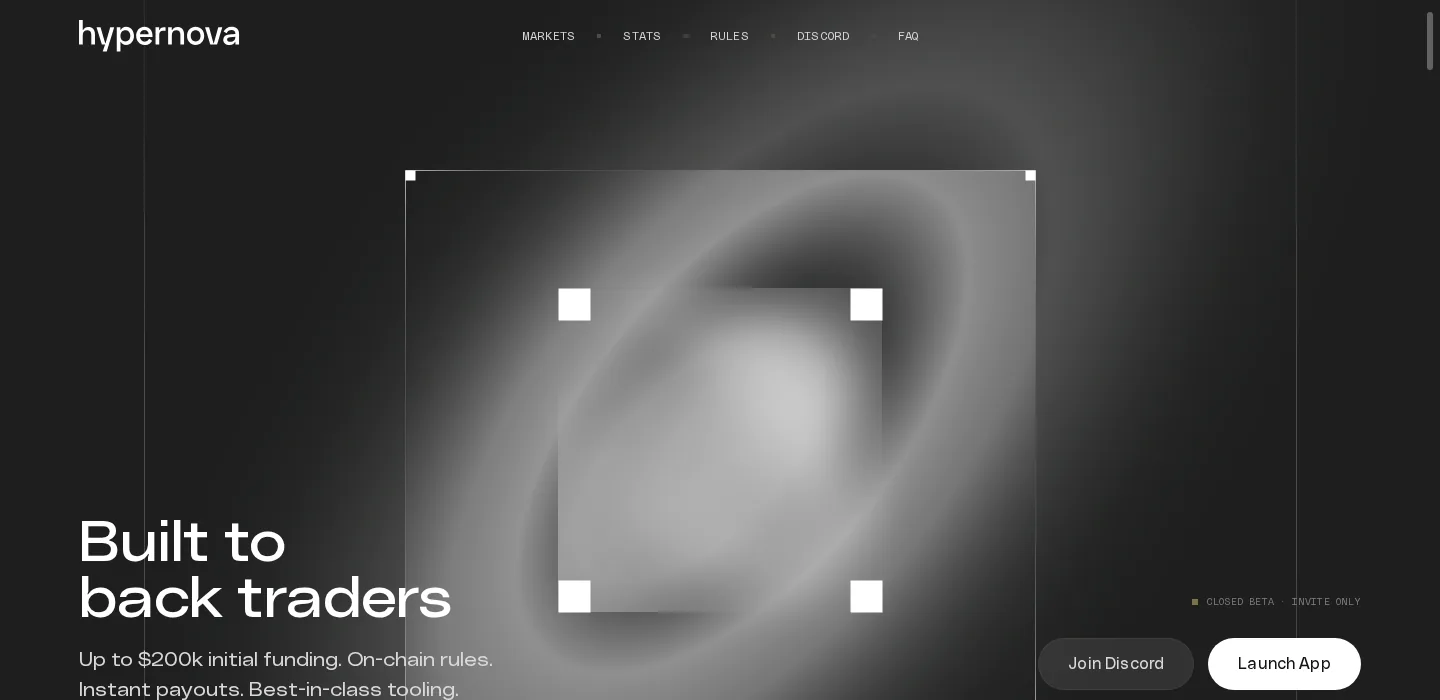
Hypernova is a Hyperliquid-based prop firm with $3M of pre-seed funding led by Lemniscap (reported by The Block, May 2026), an in-house terminal, and payouts settled by smart contract in USDC on Arbitrum. We are not writing this from its marketing pages: three Hypernova accounts have been traded for this review — one $25,000 assessment bought with our own money through the public checkout in late August 2026, and two provided to us by the firm — and nine payouts were taken between 28 and 31 August. We disclose that split because it matters, and we do not say which of the three produced those payouts, because we do not know. Access is open — the homepage still carried a "CLOSED BETA · INVITE ONLY" badge at our 5 September 2026 read, which is a display inconsistency on their side, not a gate on yours (see the hero capture below). Everything below is either something we did on those accounts or something we read on their published pages on 5 September 2026, with the date attached. We use a Hypernova referral link, in place since 17 August 2026.
Hyperliquid · Review
 Hypernova Review 2026 — traded, paid, payout reserve read on-chain
Hypernova is an on-chain crypto prop firm we traded on a $25K funded account: 6 withdrawals, 1,932.09 USDC, each hash verified on Arbitrum on 19 September 2026, and a payout reserve you can read on-chain — $360,302.43 on 6 October 2026. It also publishes what almost nobody publishes: of the 803 people who have paid for an assessment, 189 have ever been paid — 23.5%, its own figure, read 21 September 2026. Trust Score 85.7/100, second of 7; the caveats are dated below.
Updated 6 October 2026 · by Roya — we pay for the challenges we review, and we disclose the accounts we did not pay for.
Hypernova · Trust Score 85.7/100 · 6 withdrawals verified on Arbitrum, read 19 September 2026
Through Roya: 5% USDC cashback via @PropCashbackBot (terms read 12 September 2026)
Affiliate link. We earn a commission; it never changes what you pay — it is what funds your cashback.
Contents
Affiliate link. We earn a commission; it never changes what you pay — it is what funds your cashback.
5% cashback in USDC — @PropCashbackBot
- Pick Hypernova in the bot and sign up through our partner link, then send a screenshot of your username.
- For each challenge, declare the tier and attach your proof (USDC tx hash or screenshot).
- Once Roya validates it, the 5% lands on your Solana wallet in USDC, automatically.
Sign up through our link first — attribution locks at account creation.
Affiliate link. We earn a commission; it never changes what you pay — it is what funds your cashback.
Step-by-step tutorialHow the cashback worksTerms read on
Funded by our affiliate commission, never by you. The bot never trades for you and never asks you for funds. Minimum payout 0.50 USDC — below that it accumulates. Cashback on a fee you pay — not investment advice, and no promise of a result.
Verdict: 85.7/100, traded, 6 withdrawals verified
| Fact | Value | Source | Read on |
|---|---|---|---|
| Trust Score | 85.7/100 (#2 of 7) | Our public grid, weights published | 4 October 2026 |
| Status | Traded — $25K funded account, 7 trading days, 40 trades, breached | Our own funded account F2 | 2 September 2026 |
| Withdrawals to us | 6 · 1,932.09 USDC (29 August 2026 → 1 September 2026) | 6 hashes on Arbitrum, reconciled one by one | 19 September 2026 |
| Payout reserve | $360,302.43 | Vault 0x9209…4c67 + reserve wallet 0x43c5…da07, USDC on Arbitrum | 6 October 2026 |
| Odds of being paid | 23.5% of paying traders (189 of 803) — self-reported | The firm's own /stats funnel, all-time | 21 September 2026 |
| Pass rate | 22.8% headline (611 of 2,675) — self-reported, and it does not match the same page's breakdown | The firm's own /stats page | 21 September 2026 |
| Cheapest assessment | From $25 · 5K now on the public configurator (21 Sep 2026) · 25K at $120 / $275 / $365 | Rulebook v1.1 fee schedule · our comparator sheet | 5 September 2026 |
| Profit split | Up to 80% — reconciled on-chain to the cent | Rulebook v1.1 · our own reconciliation on Arbitrum | 5 September 2026 · 19 September 2026 |
| Account sizes | $200,000 | Rulebook v1.1 fee schedule | 5 September 2026 |
| Payout speed | avg 6.0 s over 1,038 payouts, published by the firm (min 2, max 14.6 at our 7 Sep read) | Hypernova's own /stats counters | 21 September 2026 |
| Lifetime payouts | $1,025,771 to 189 recipients, avg $988, largest $8,000 — self-reported | The firm's own /stats page | 21 September 2026 |
| Order routing | Priced from Hyperliquid, filled by Hypernova's own engine — not routed to Hyperliquid | Rulebook v1.1, section 12 | 21 September 2026 |
| Developer API | REST + WebSocket and SDKs announced, labelled “coming soon” | Hypernova's own developers section | 21 September 2026 |
| Access | Public checkout · homepage badge still read “closed beta · invite only” | Our own purchase · their homepage | 21 September 2026 |
| KYC / countries | Not stated in rulebook v1.1 | hypernova.xyz/rulebook | 21 September 2026 |
| On-chain tier | Tier 4 of 5 | Our on-chain tier scale — 4 addresses checked ourselves | 8 August 2026 |
| Reader offer | 5% USDC cashback via @PropCashbackBot, disclosed affiliate | Bot conditions — we earn a commission, your price never goes up | 12 September 2026 |
Where Hypernova sits against everything else we have bought and traded is the other half of this page: best crypto prop firms 2026, all 7 ranked.
In four sentences
Hypernova scores 85.7/100 on our grid of 4 October 2026, and we traded it. Our own funded $25K account made 6 withdrawals between 29 August 2026 and 1 September 2026, 1,932.09 USDC in total, each reconciled on Arbitrum; its dashboard also lists nine payout requests marked Paid up to 31 August 2026 ($3,494.69 requested), and we have not matched the two lists line by line. One withdrawal settled 559.546701 USDC, exactly 80% to the cent of its request (tx 0xf0c0…ac88). The $25K assessment costs $120 in the Tight tier and $280 in the Low Risk tier per the rulebook v1.1 fee schedule read on 5 September 2026, while the homepage configurator showed $275 for that same Low Risk account the same day. We read the payout reserve (cold reserve plus operational vault) on Arbitrum at $360,302.43 on 6 October 2026. Its published pass rate for paid assessments was 24.3% — 371 of 1,526 — at the 5 September 2026 read, a firm-reported figure we cannot audit.
Figures in this block as read 5 September 2026 — the reserve it quotes is that day’s stats-page reading. Our current on-chain reading is $360,302.43, taken on 6 October 2026; both are dated, neither replaces the other.
From $25
Key facts
What we like
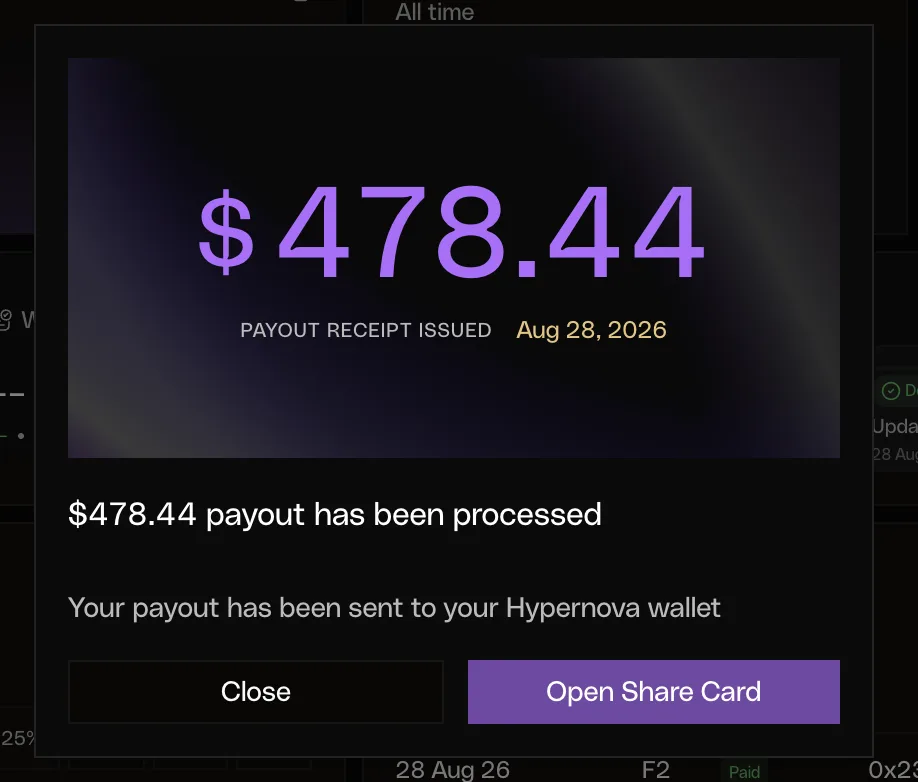
- We were paid, nine times: payouts of $102.54 to $699.43 on our own $25K funded account between 28 and 31 August 2026, receipts issued instantly. The $699.43 request settled 559.546701 USDC on Arbitrum (tx 0xf0c0…ac88) — exactly 80% to the cent.
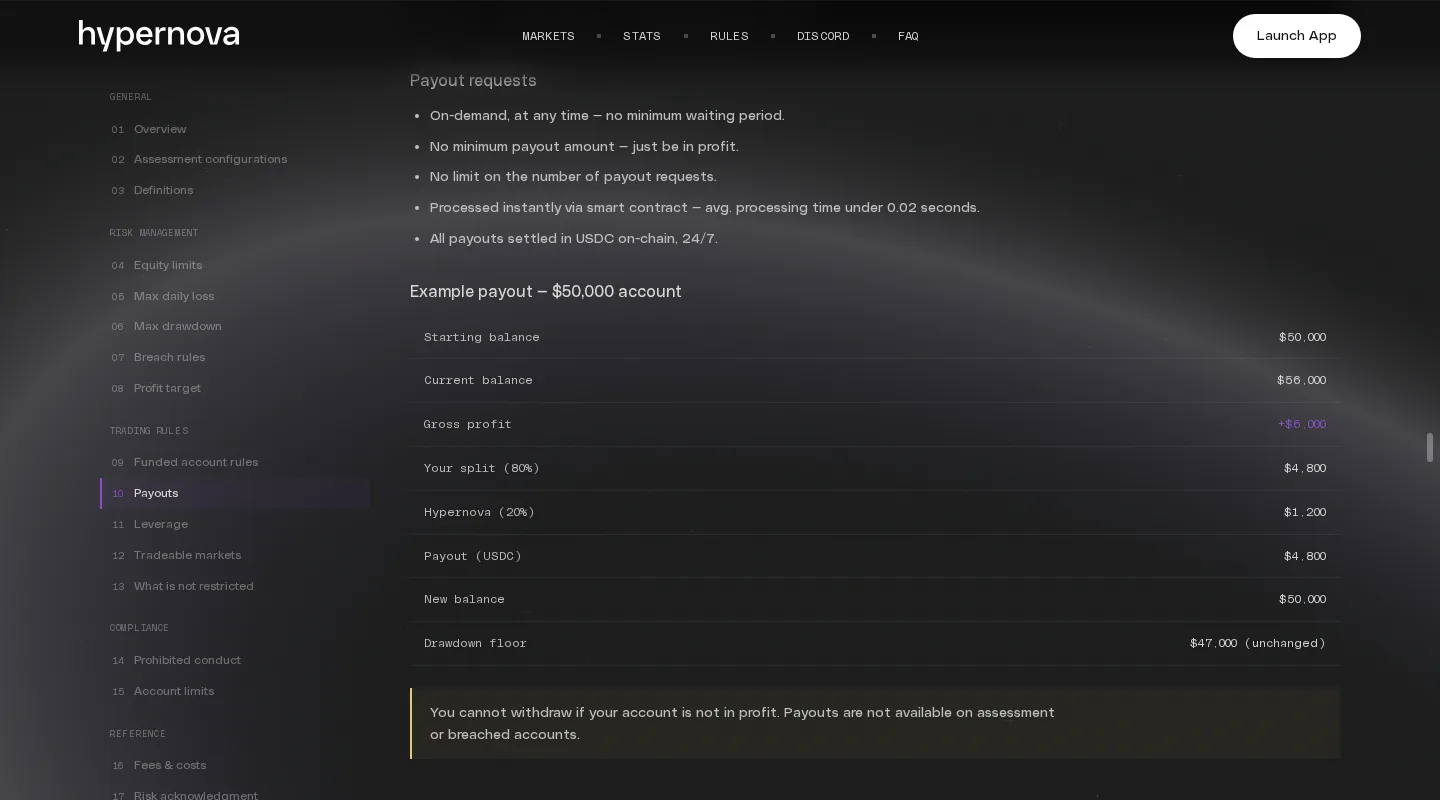
- Payout terms are plain and short: 80% split, on demand, no minimum amount, no request limit, settled by smart contract in USDC (rulebook v1.1, read 5 September 2026).
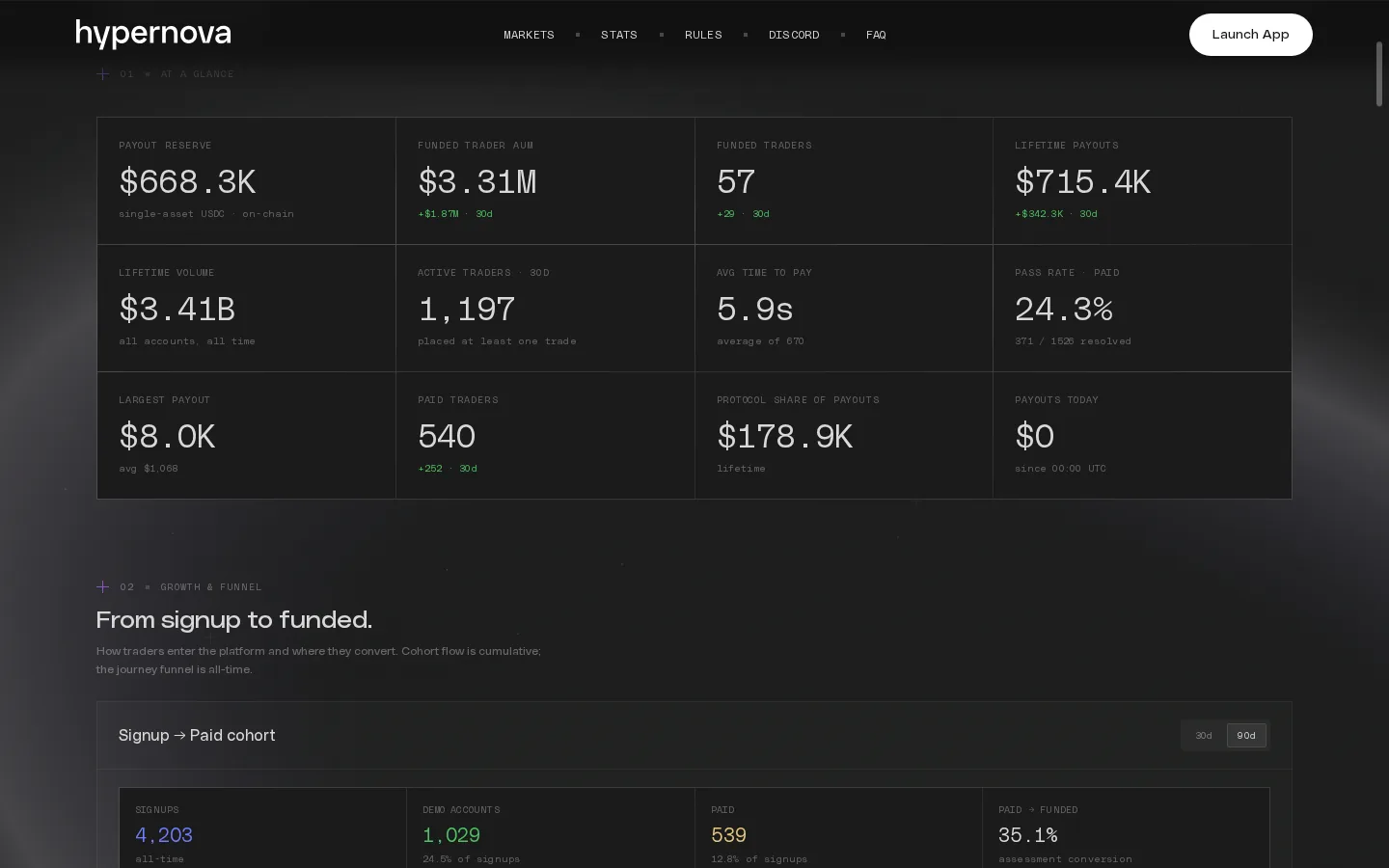
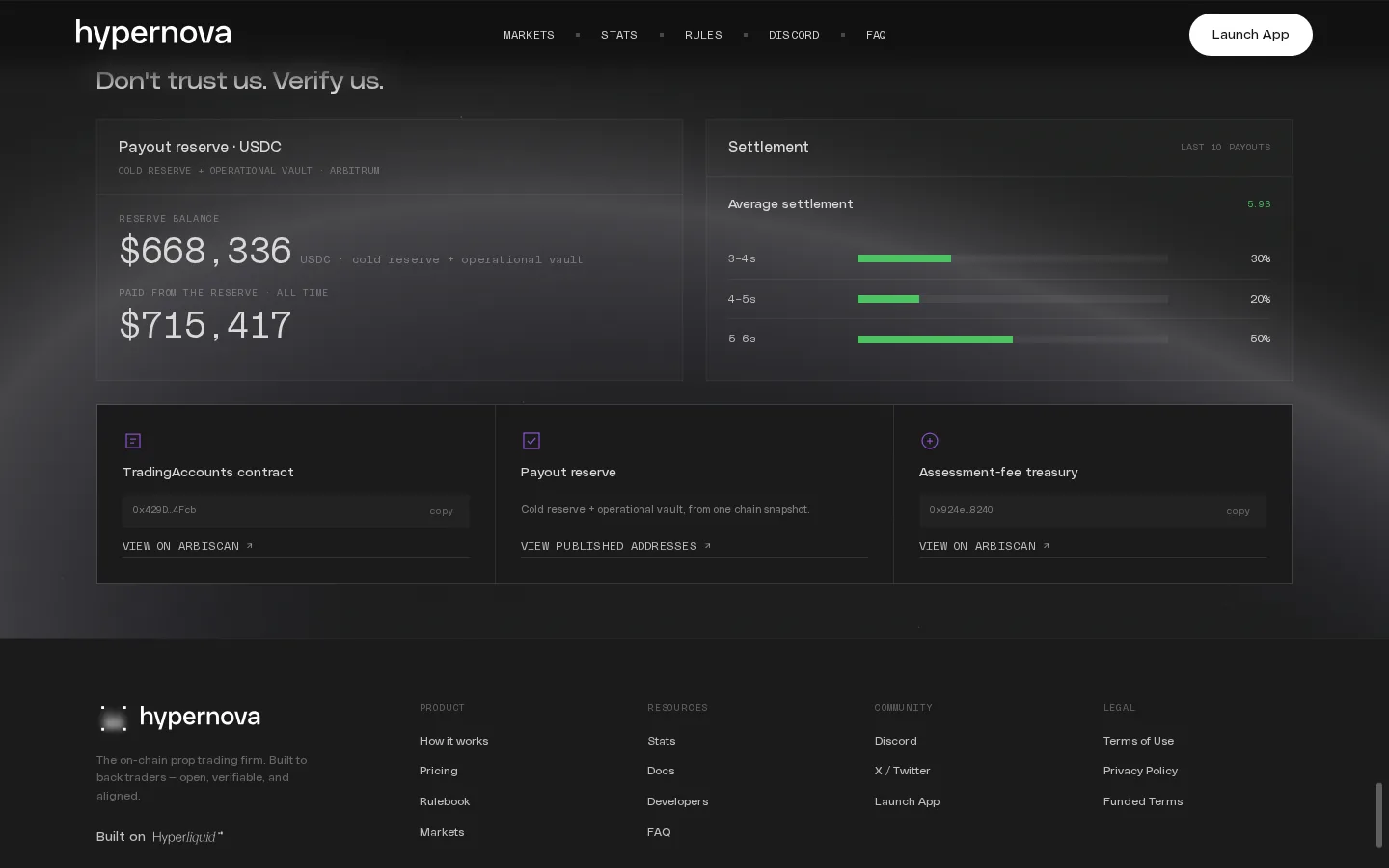
- The payout reserve is a number you can check rather than trust: $668,336 USDC on Arbitrum, cold reserve plus operational vault, published with the contract address on the stats page (read 5 September 2026 — see the on-chain proof capture below).
- Access is open. We bought the $25K assessment through the public checkout in late August 2026 — no invitation, no waitlist, despite the badge still on the homepage.
- Every limit shown in the app matched the published rulebook to the dollar on our earlier $10,000 Low Risk account (August 2026): $11,000 target, $300 daily loss, $600 max drawdown, $9,400 floor. Trading fees came through at exactly 3.00 bps on both fills, Hyperliquid rates at cost.
- No consistency rule, no minimum trading days, no time limit, no profit cap; news trading and weekend holding explicitly allowed (rulebook v1.1, 5 September 2026).
- The rulebook is versioned — v1.1, dated 4 August 2026 — with a dated changelog, and the version live when your account opened governs it for its lifetime.
Watch-outs
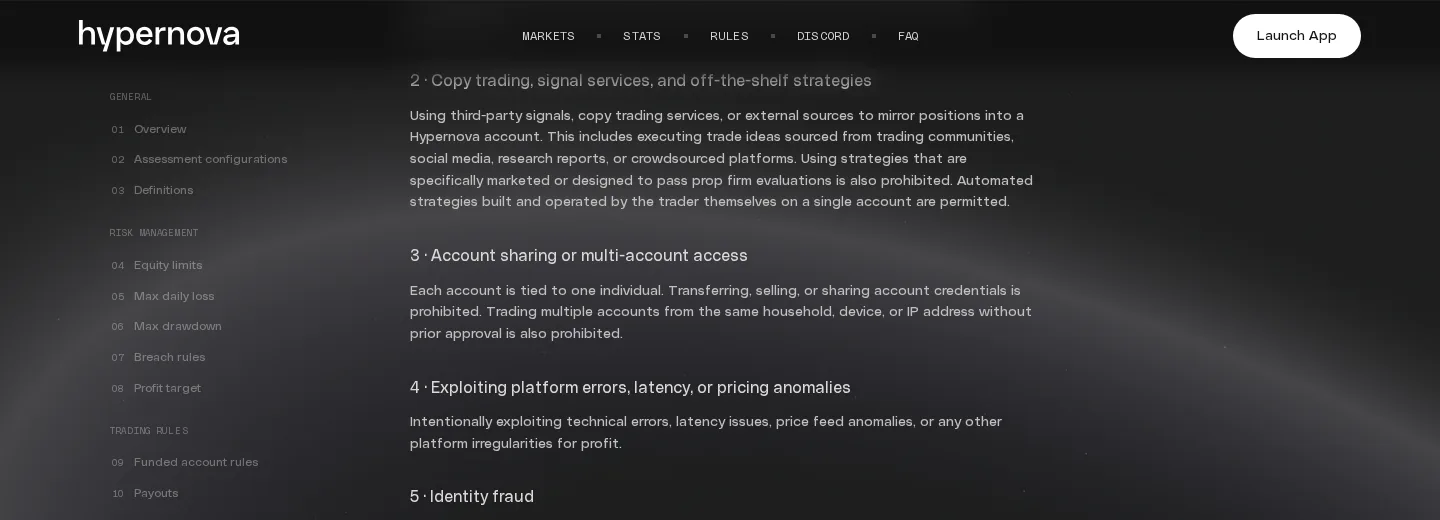
- Its bot policy is narrower than "no restrictions": your own automation on a single account is permitted, but §2 of the prohibited conduct bans copy trading, signal services, external signals and off-the-shelf strategies sold to pass evaluations (rulebook v1.1, read 5 September 2026).
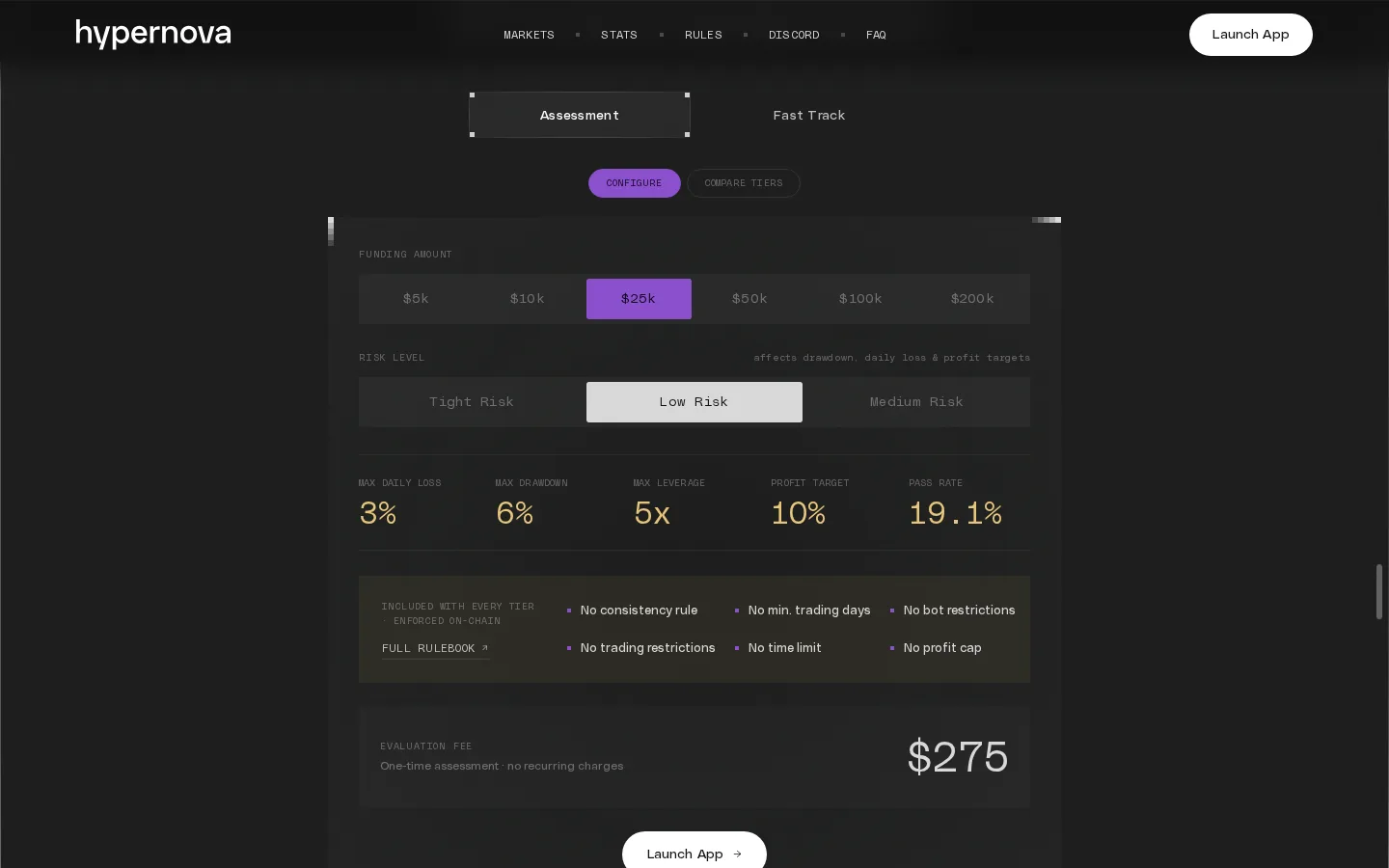
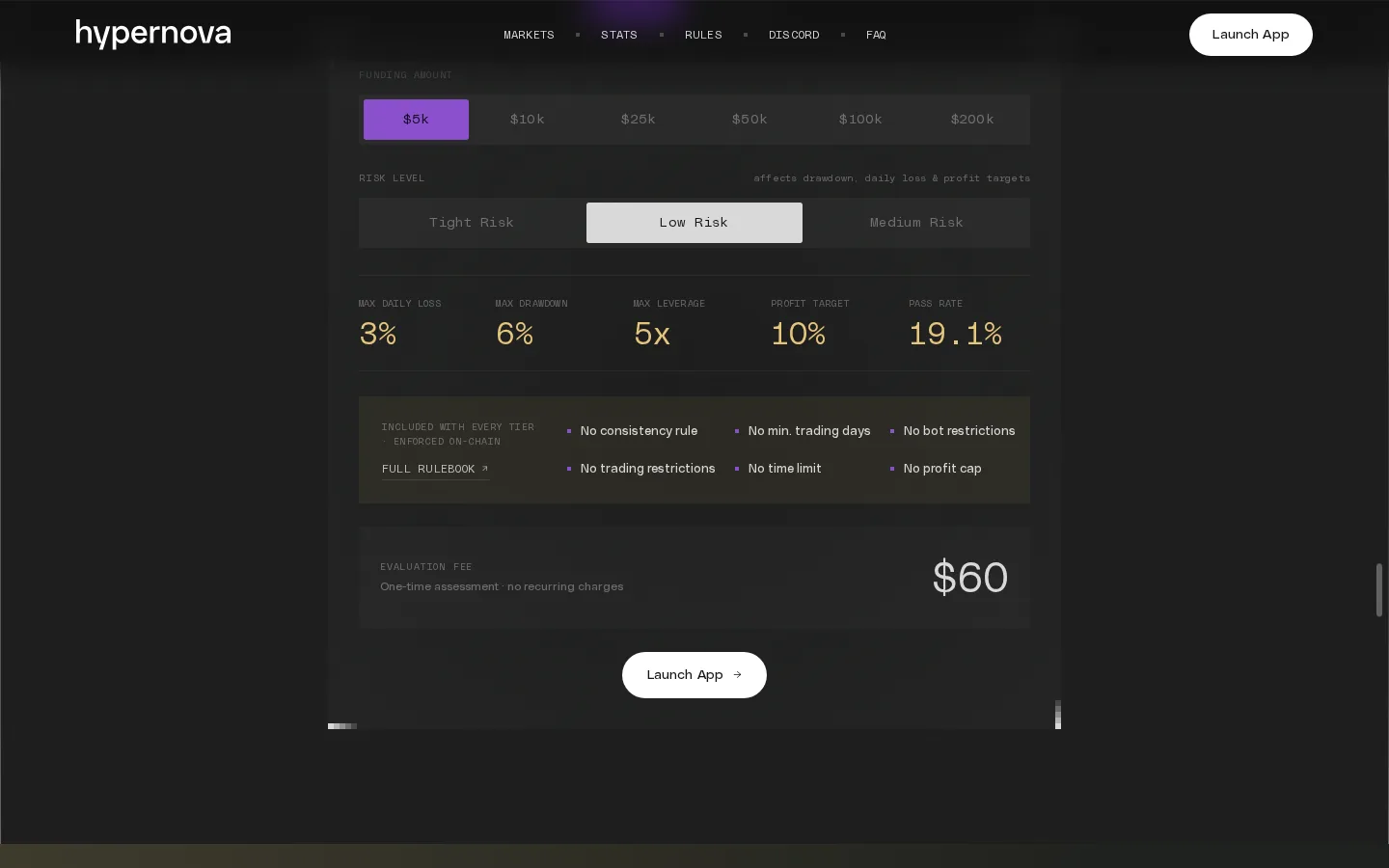
- Two of its own pages price the same account differently: $280 for the $25K Low Risk in the rulebook fee schedule, $275 in the homepage configurator, both read 5 September 2026.
- The homepage still carried a "CLOSED BETA · INVITE ONLY" badge on 5 September 2026, three weeks after we bought through the public checkout. It is only a display problem — but it is the third week we have recorded it.
- Funding ceiling stated two ways on 5 September 2026: "Up to $200k initial funding" on the homepage, "Up to $300K in funding" on the app's sign-in page.
- The High risk tier is marked restricted with fees TBD, and the $200K Medium fee is TBD too (rulebook fee schedule, 5 September 2026) — a quarter of the catalogue has no public price.
- The market count fell from 141 (25 August 2026) to 99 (31 August, still 99 on 5 September 2026) with no announcement we could find. If your edge lives on a thin pair, check the markets page before paying.
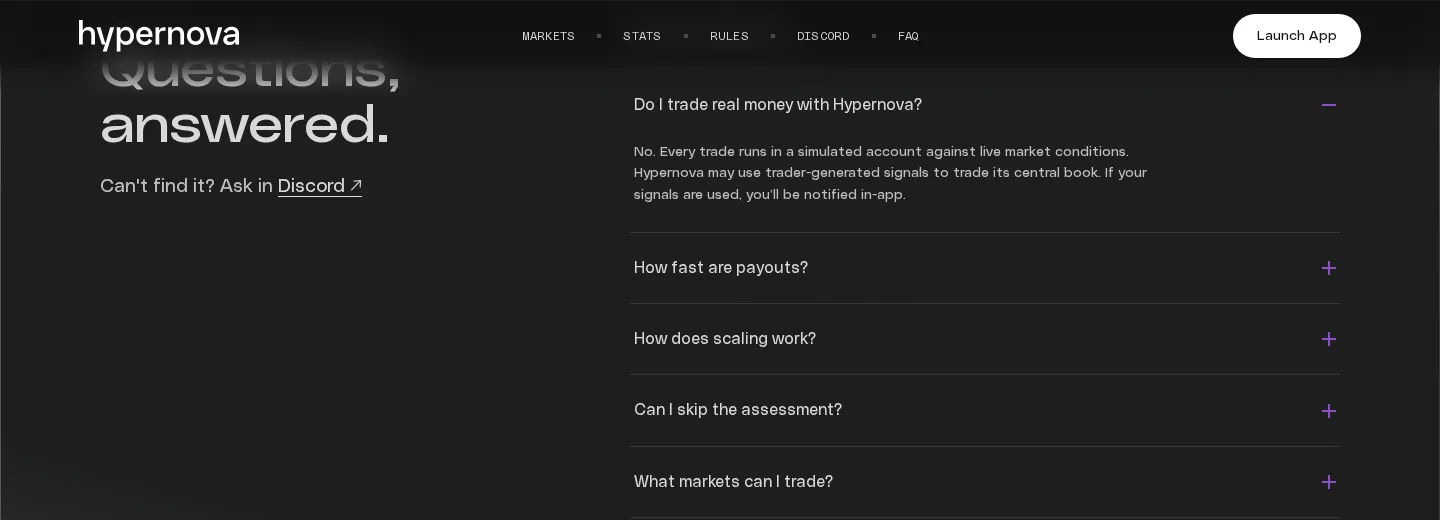
- Its own FAQ says funded accounts are simulated — "every trade runs in a simulated account" — and that Hypernova "may use trader-generated signals to trade its central book" (read 5 September 2026). Read that before comparing its split with anyone else's.
- Documentation rots at the edges: the rulebook's docs.hypernova.xyz link does not resolve, and hypernova.xyz/rules and /faq return 404 (5 September 2026). The live rulebook is hypernova.xyz/rulebook — bookmark that one.
- The reserve moves both ways, and on 5 September 2026 the homepage counter disagreed with the chain and with itself between two page loads. Read the one dated on-chain figure on this page and the full dated series on our reserve tracker, not the hero counter.
Our verdict
Hypernova does the hard part well. The rules are published, versioned and written into a contract on Arbitrum, the payout reserve is readable at a published address, and the app matched the rulebook to the dollar on a real account. And it pays: nine payouts on our own $25K funded account between 28 and 31 August 2026, the largest reconciled on-chain at exactly 80% to the cent. Declared conflict of interest: three Hypernova accounts have been traded for this review — one bought through the public checkout, two provided to us by the firm — and we do not say which of them those nine payouts came from, because we do not know. What holds it two points behind Propr on our grid of 4 October 2026 — 85.7 against 87.7 — is not integrity but tidiness: on 5 September 2026 two of its own pages priced the same account $275 and $280, the homepage advertised a $200K ceiling while the app's sign-in page said $300K, the "closed beta" badge was still up three weeks after we bought through the open checkout, and its documentation links rot. Add the two things its own FAQ says out loud — funded accounts are simulated, and trader signals may feed its central book — and you have a firm that is honest in its documents and untidy in its shop window. If you want the tighter fees on a small account, the $5K Tight assessment at $25 is the cheapest way to test the machine yourself. We use a Hypernova referral link, in place since 17 August 2026.
→ See the sub-scores on the Trust Score page
→ See where Hypernova lands in our tested ranking of the best Hyperliquid prop firms 2026.
Is Hypernova legit? The short answer
Short answer
Yes, on what can be checked: a public versioned rulebook (v1.1, dated 4 August 2026), account rules written to a smart contract on Arbitrum whose address is published, a payout reserve readable on-chain ($360,302.43 on 6 October 2026), and 6 withdrawals to our own wallet reconciled hash by hash on 19 September 2026. The caveats are real and dated: the homepage still carried a “CLOSED BETA · INVITE ONLY” badge at our 5 September 2026 read, three weeks after we bought through the public checkout; KYC and restricted countries are not stated in the rulebook (read 5 September 2026); and the firm’s own FAQ says funded accounts are simulated.
- Access
- Public checkout — we bought the $25K assessment through it in late August 2026. The homepage badge still read “CLOSED BETA · INVITE ONLY” at our 5 September 2026 read.
- Rules
- Written to a smart contract on Arbitrum — TradingAccounts (proxy), 0x429d…4fcb, 61 bytes of code, checked by us on 8 August 2026.
- Reserve
- $360,302.43 in USDC on Arbitrum, read 6 October 2026.
- Paid us
- 6 withdrawals, 1,932.09 USDC, 29 August 2026 → 1 September 2026, every hash reconciled on 19 September 2026.
- Our account
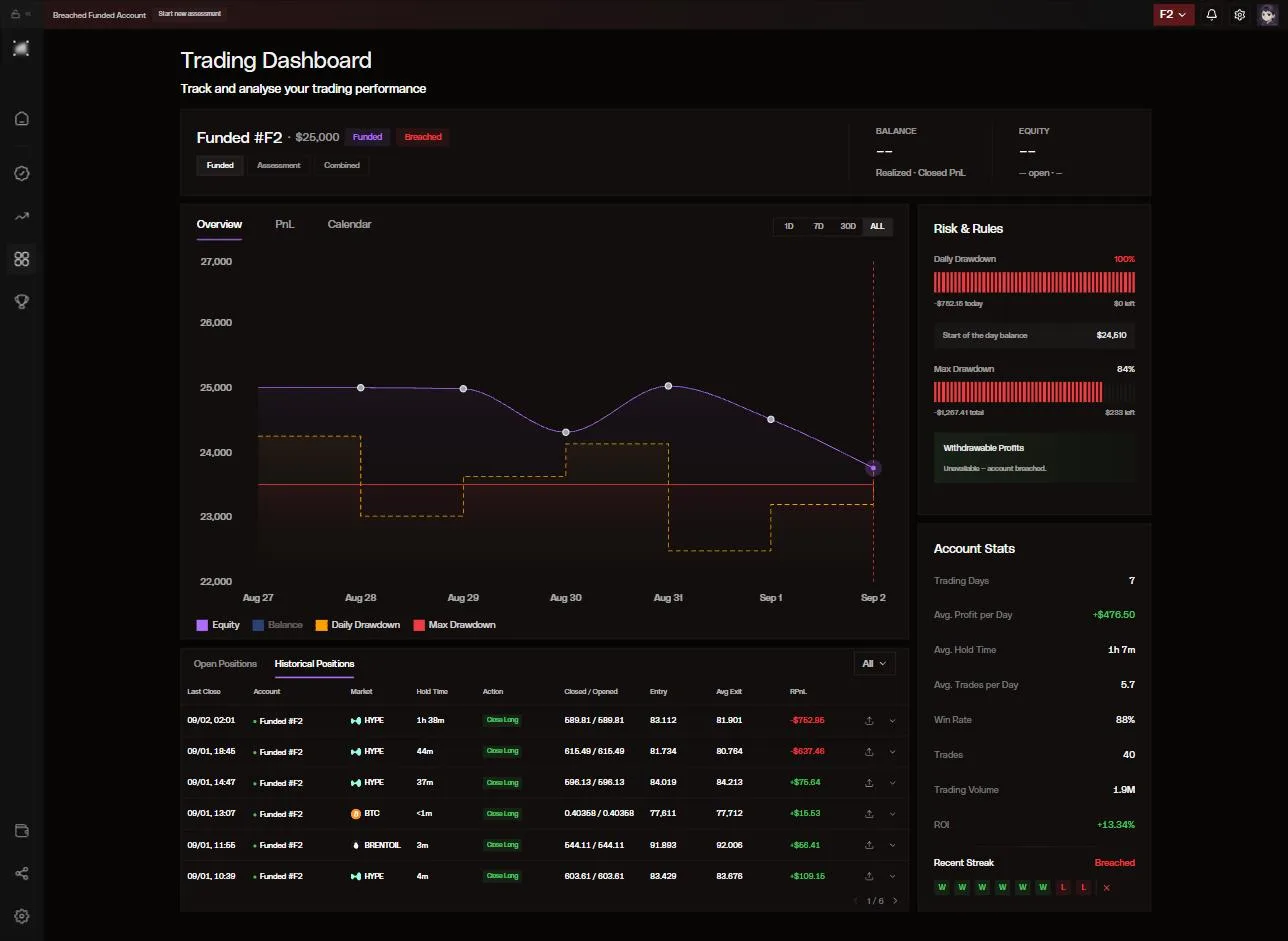
- F2, $25K funded, breached on 2 September 2026 — daily drawdown (−$752.15 on a $24,510 start-of-day balance).
- Roya Trust Score
- 85.7/100, second of 7 on our public grid of 4 October 2026.
Every one of those transactions is published with its hash, its block time and the amount it settled: the 6 receipts and the vault.
See Hypernova for yourself
Rules, pricing and on-chain proofs are published — open Hypernova and check them against this review.
Affiliate link. We earn a commission; it never changes what you pay — it is what funds your cashback.
The payout reserve, read on-chain: $360,302.43 on 6 October 2026
This is the one number almost nobody in the category lets you check before you trade. Hypernova’s payout reserve is USDC sitting at two published Arbitrum addresses — an operational vault, 0x9209…4c67, and a cold reserve wallet, 0x43c5…da07. The vault address is the same one published as the firm’s identifier in this page’s structured data. Our own reading of the two balances on 6 October 2026 came to $360,302.43.
Hypernova payout reserve: $360,302.43 in USDC on Arbitrum, read 6 October 2026 (block 512245987) — every dated reading: Hypernova reserve tracker.
What that proves is capacity to pay: on the day of the reading, the money to settle withdrawals existed and anyone could see it. What it does not prove is revenue, profitability or solvency in any accounting sense — a reserve can be topped up from anywhere, and we have not traced where its inflows come from. It is also a moving number: it changes day to day, which is exactly why every figure on this page carries the date it was read rather than a claim of being current.
What the last week did to it
Between our chain read of 14 September 2026 and the one on 21 September 2026 (7 days), the reserve fell $217,415 — from $977,923 to $760,508. Over the same 7 days the firm’s own lifetime-payouts counter rose $202,881, from $822,890 to $1,025,771 (read 21 September 2026). That leaves roughly $14,534 of the drop unexplained by published payouts. We are reporting a correspondence, not an audit: we did not trace the individual transfers, and a reserve can be topped up or drawn down for reasons that have nothing to do with paying traders. The reserve has been re-read since — $360,302.43 on 6 October 2026, the line above — but the counter has not, so that later figure is not compared with it here.
The other gap worth knowing is the one between the chain and the counter. On 21 September 2026 the stats page displayed $774,482 for the same reserve we read at $760,508 on chain the same day — $13,974 more than the two addresses actually held. A display lag of that size is normal for a cached counter and we have seen it in both directions; it is a reason to read the addresses yourself rather than the widget, not a reason to distrust the firm.
The full series, one dated reading per line, with what each movement did and did not let us conclude: the Hypernova reserve tracker, every dated reading.
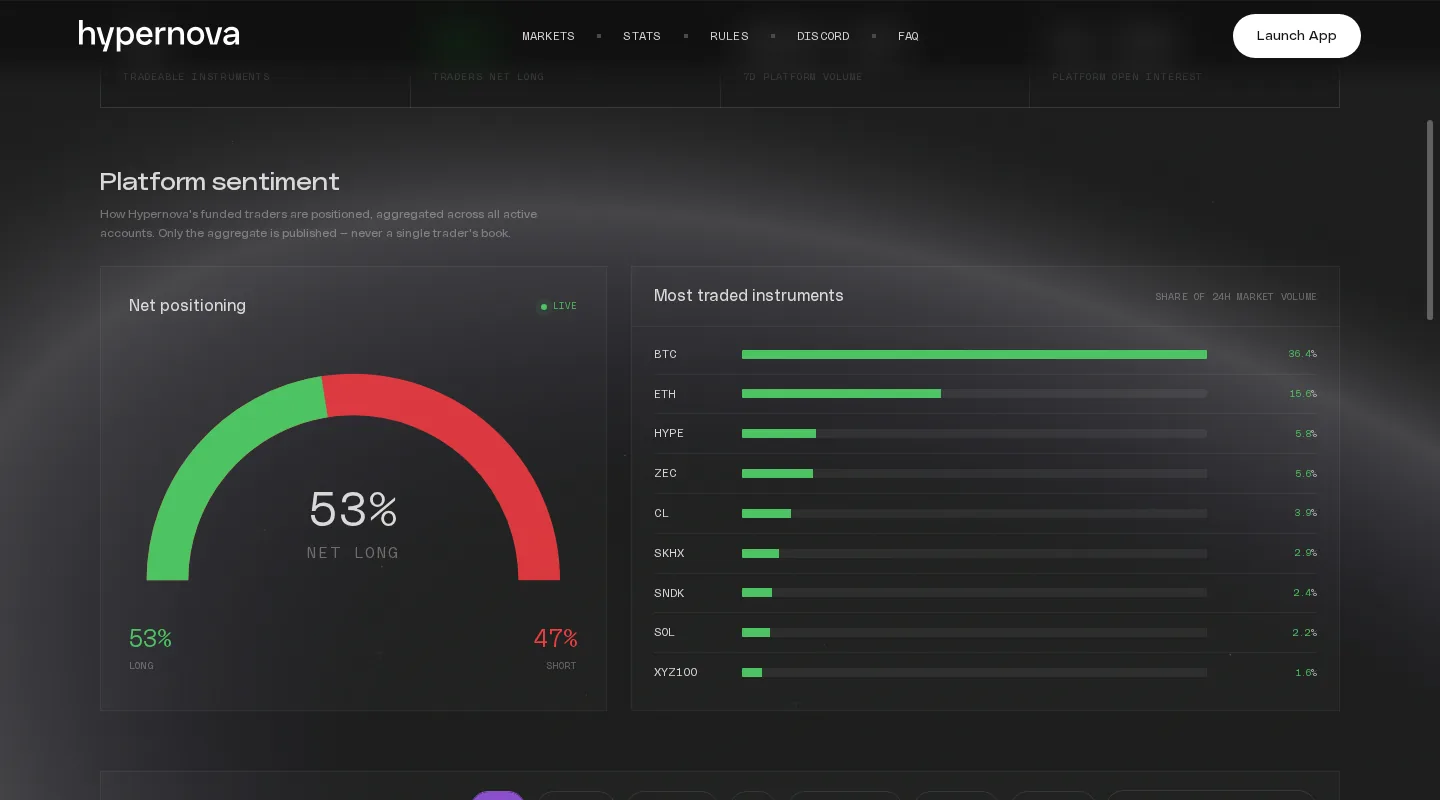
Your real odds, from their own dashboard: 23.5% of paying traders have ever been paid
Short answer
Of 803 people who have paid Hypernova for an assessment, 294 reached a funded account (36.6%) and 189 have ever received a payout — 23.5%, about one in 4 — on the firm’s own stats page read 21 September 2026. The median paid account stays alive 0.9 days. Every figure in this section is published by Hypernova about Hypernova; none of it is auditable from the chain, and we publish it because almost no competitor publishes anything comparable at all.
| Stage | Count | Share |
|---|---|---|
| Signed up | 6,189 | — |
| Opened a demo account | 1,674 | 27% of signups |
| Paid for an assessment | 803 | 13% of signups |
| Reached a funded account | 294 | 36.6% of paid |
| Received at least one payout | 189 | 23.5% of paid · 64.3% of funded |
Pass rate by account size
All-time, the firm’s own breakdown, read 21 September 2026 on hypernova.xyz/stats.
| Account size | Pass rate | Passed | Resolved |
|---|---|---|---|
| $5K | 19% | 102 | 538 |
| $10K | 16.1% | 60 | 372 |
| $25K | 24.8% | 38 | 153 |
| $50K | 23% | 93 | 404 |
| $100K | 28.4% | 229 | 807 |
| $200K | 16.4% | 23 | 140 |
| Total | 22.6% | 545 | 2,414 |
Two things to take from that table before the caveat. The $100K account passes most often (28.4% over 807 resolved assessments) and the $200K least (16.4%), which is the opposite of the intuition that smaller accounts are easier — the daily-loss limit is a percentage, so the room scales with the account while the market does not care how big yours is. And the $25K size, the one we bought, sits at 24.8% on only 153 resolutions, a sample small enough that it should move.
Where their numbers do not agree with each other
We publish this because a dashboard that contradicts itself is a thing a reader should know before paying, not because we think anything is being hidden: panels on a live dashboard often use different windows and filters and say so nowhere. Every line below names both sources and the date, so you can re-check it yourself.
- Pass rate, two counts on one page: the headline reads 22.8% (611 of 2,675 resolved) while the by-size breakdown directly below totals 22.6% (545 passed, 1,869 failed — 2,414 resolved). Neither panel states its window.
- Passes versus funded accounts: 611 assessments are counted as passed, and the all-time trader journey on the same page shows 294 funded accounts out of 803 paid. Nothing on the page reconciles the two.
- The $25K Low Risk fee is $280 in the rulebook fee schedule and $275 in the homepage configurator and its tier-comparison table — the same $5 gap we first recorded on 5 September 2026, still open sixteen days later.
- Leverage: the homepage configurator and its comparison table both print a flat “5x” cap, while the rulebook has said “per symbol, see Markets” since its v1.0.3 entry of 29 June 2026.
- Market count: the homepage says “Browse all 99 markets”, the rulebook's market-access table says 140 pairs (79 crypto + 61 TradFi).
- Minimum funding: the homepage headline offer starts at “$10k–$200k”, while the rulebook fee schedule and the configurator both start at $5,000.
- Pass rates again: the homepage tier table gives 19.3% Tight, 20.1% Low Risk, 32.2% Medium; the stats page gives neither set — its own tier chart showed 20.9% for Tight over 30 days at the same read.
- The homepage still carried a “closed beta · invite only” badge at this read, six weeks after we bought an assessment through its public checkout.
On the first of those, the arithmetic is ours: the headline counts 66 more passes on 261 more resolutions than the breakdown printed underneath it. Neither figure is wrong in a way we can demonstrate — they are simply two different populations with the same label, and the page never says which one answers “what are my chances”. Our own rule for figures like these is on how we test prop firms: a self-reported number is published as self-reported, dated, and never converted into a score.
Fees and tiers: the full rulebook v1.1 schedule, re-read 21 September 2026
Prices read on · hypernova.xyz/rulebook
| Account | Fee | Target | Daily loss | Max drawdown |
|---|---|---|---|---|
| Tight $5K | $25 | 9% | 3% | 3% static |
| Tight $25K | $120 | 9% | 3% | 3% static |
| Tight $100K | $400 | 9% | 3% | 3% static |
| Tight $200K | $800 | 9% | 3% | 3% static |
| Low Risk $5K | $60 | 10% | 3% | 6% static |
| Low Risk $25K | $280 | 10% | 3% | 6% static· $275 in the homepage configurator, same day |
| Low Risk $100K | $999 | 10% | 3% | 6% static |
| Low Risk $200K | $1,850 | 10% | 3% | 6% static |
| Medium $5K | $80 | 10% | 4% | 7% static |
| Medium $25K | $365 | 10% | 4% | 7% static |
| Medium $100K | $1,350 | 10% | 4% | 7% static |
| Medium $200K | TBD | 10% | 4% | 7% static· fee not published at this read |
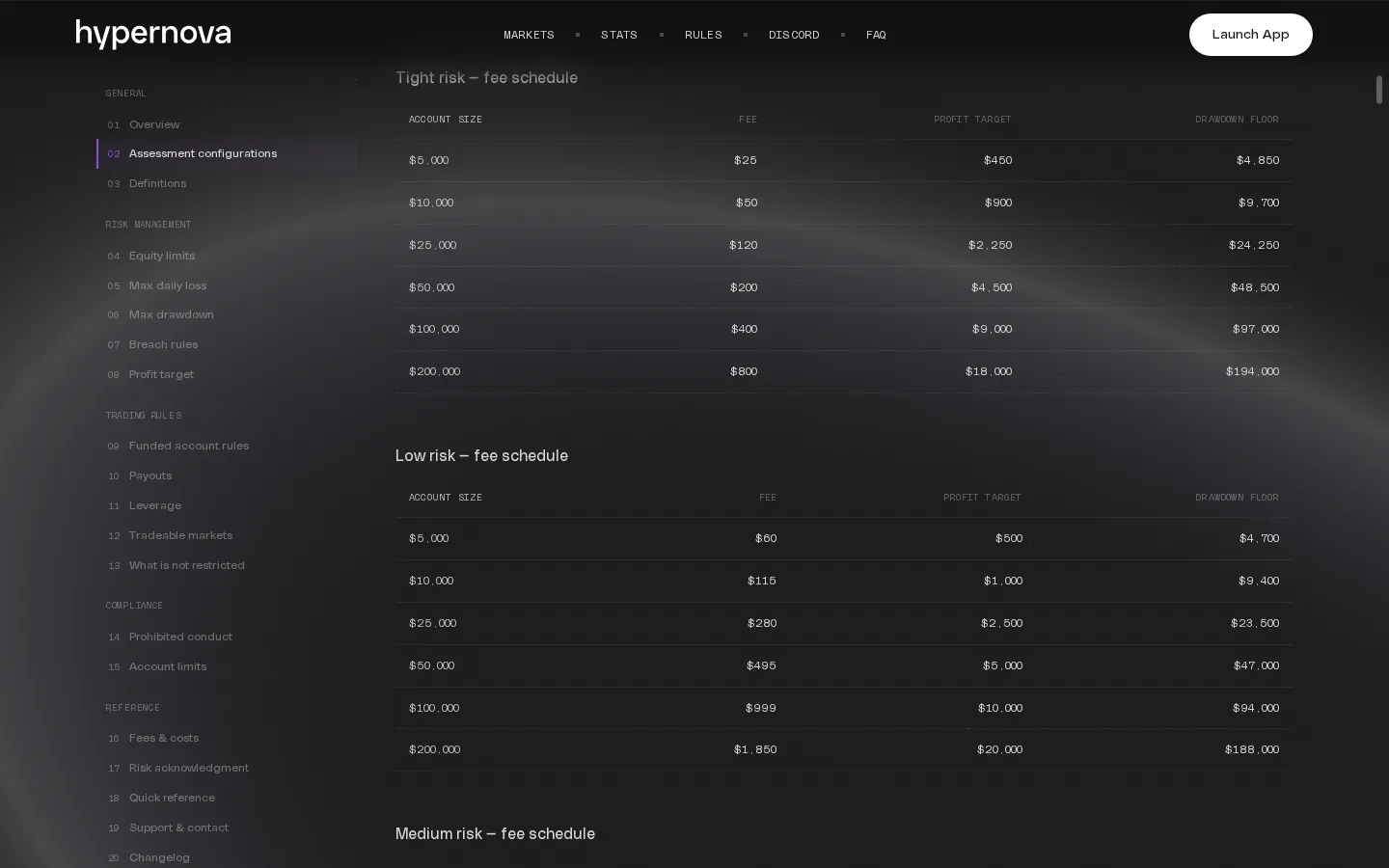
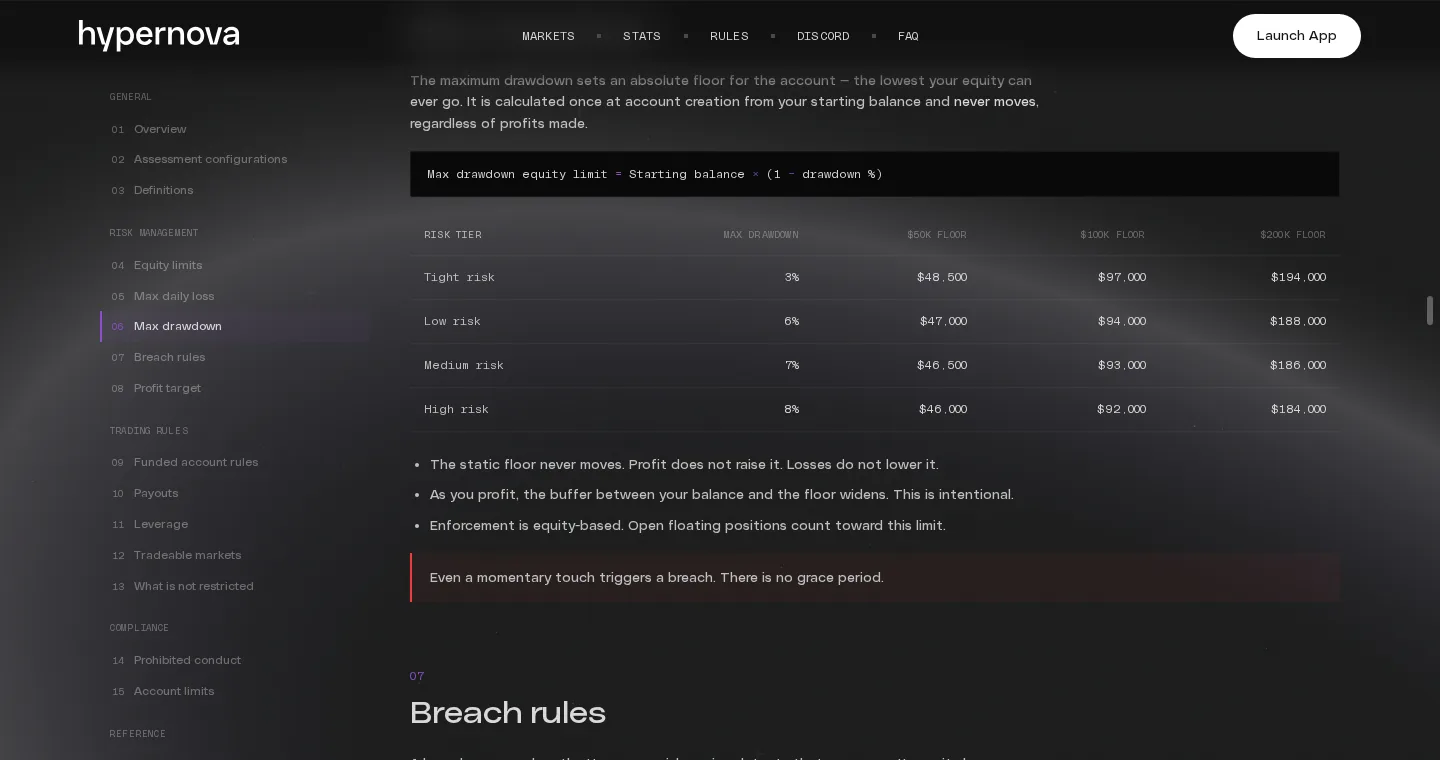
Read in the rulebook v1.1 fee schedule on 5 September 2026. One discrepancy to know before paying: the rulebook prices the $25K Low Risk account at $280, while the homepage configurator showed $275 for the same account the same day — a $5 gap between two of the firm's own pages, so screenshot the checkout total you actually pay. A fourth tier, High risk, exists in the rulebook but is marked restricted and its fees are TBD; the $200K Medium fee is TBD too. See the fee-schedule and configurator captures below.
The full schedule, all six sizes, re-read 21 September 2026
The table above is our 5 September reading, four sizes deep. We went back through the whole fee schedule on 21 September 2026 and not one published fee had moved a dollar: the rulebook is still v1.1, its changelog’s newest entry is still 4 August 2026 (“Tight risk account added”, commit a37c87b), and the two missing prices are still missing. Here is the complete version, including the $10K and $50K sizes this page had never published.
| Account size | Tight (9% target) | Low risk (10%) | Medium (10%) |
|---|---|---|---|
| $5,000 | $25 | $60 | $80 |
| $10,000 | $50 | $115 | $150 |
| $25,000 | $120 | $280 | $365 |
| $50,000 | $200 | $495 | $675 |
| $100,000 | $400 | $999 | $1,350 |
| $200,000 | $800 | $1,850 | TBD |
| Risk tier | Profit target | Daily loss | Max drawdown | Who can buy it |
|---|---|---|---|---|
| Tight risk | 9% | 3% | 3% static | all users |
| Low risk | 10% | 3% | 6% static | all users |
| Medium risk | 10% | 4% | 7% static | all users |
| High risk | 10% | 5% | 8% static | restricted · fees TBD |
Fees are one-time, non-refundable once the account is activated, and paid in USDC. The $5 gap between the rulebook’s $280 for the $25K Low Risk account and the $275 the homepage configurator was still showing on 21 September 2026 has now been open for sixteen days — screenshot the checkout total you actually pay. Compare these against everything else we have bought: the full fee comparator.
What you are actually trading: Hyperliquid prices, Hypernova's own engine
Short answer
A simulated account priced from live Hyperliquid data, filled by Hypernova’s own matching engine. Section 12 of rulebook v1.1, read 21 September 2026, is explicit: “All market data — prices, order book depth, and funding rates — is sourced from Hyperliquid. Orders are filled by Hypernova's own engine and are not routed to Hyperliquid.” Your orders never reach the Hyperliquid book. That is not a scandal — it is how almost every prop firm in this category works — but “built on Hyperliquid” means the prices, not your fills, and the firm’s own FAQ confirms funded accounts are simulated.
Three consequences that change what you should expect. First, slippage and fills are Hypernova’s, not a public order book’s — you cannot verify an individual fill the way you can verify a payout hash, and the on-chain part of this firm is the money and the rules, not the trades. Second, trading fees mirror Hyperliquid’s maker/taker schedule with no markup (section 16, same read), with no monthly, inactivity, data, platform or withdrawal fee — so the assessment fee really is the whole cost. Third, the firm’s FAQ says it may use trader-generated signals to trade its own central book, and that you are notified in-app if yours are used; that is a business model worth knowing about, and one we have no way to observe from outside.
On the catalogue, the rulebook’s market-access table splits 79 crypto perpetuals from 61 TradFi ones (equities, ETFs, commodities, indices, FX) for 140 combined, and you pick your package at checkout — while the homepage was still inviting readers to “browse all 99 markets” on the same day. Leverage is capped per symbol in the rulebook and shown as a flat 5x on the homepage configurator. Neither gap costs you money; both are reasons to read the rulebook rather than the landing page.
Two limits are easy to trip over if you plan to run more than one account. You may hold several funded accounts at once, but only up to $200,000 of aggregate funded balance, and only one active assessment per asset class at a time (section 15). Hedging the same instrument across two Hypernova accounts — or across a Hypernova account and one at another firm — is the first prohibited conduct in the list and ends both. One genuinely trader-friendly mechanic in the other direction: if your equity touches the profit target while positions are open, Hypernova closes them for you to realise the gain and pass you (section 8).
The published addresses behind all of this, which anyone can open: the accounts contract at 0x429D…4Fcb and the assessment-fee treasury — where the money you pay actually lands — at 0x924e…8240, both listed on the firm’s own stats page at our 21 September 2026 read. How we grade that kind of disclosure, firm by firm: our on-chain prop firm index.
The rule that ends accounts: daily drawdown — our $25K was breached on 2 September 2026
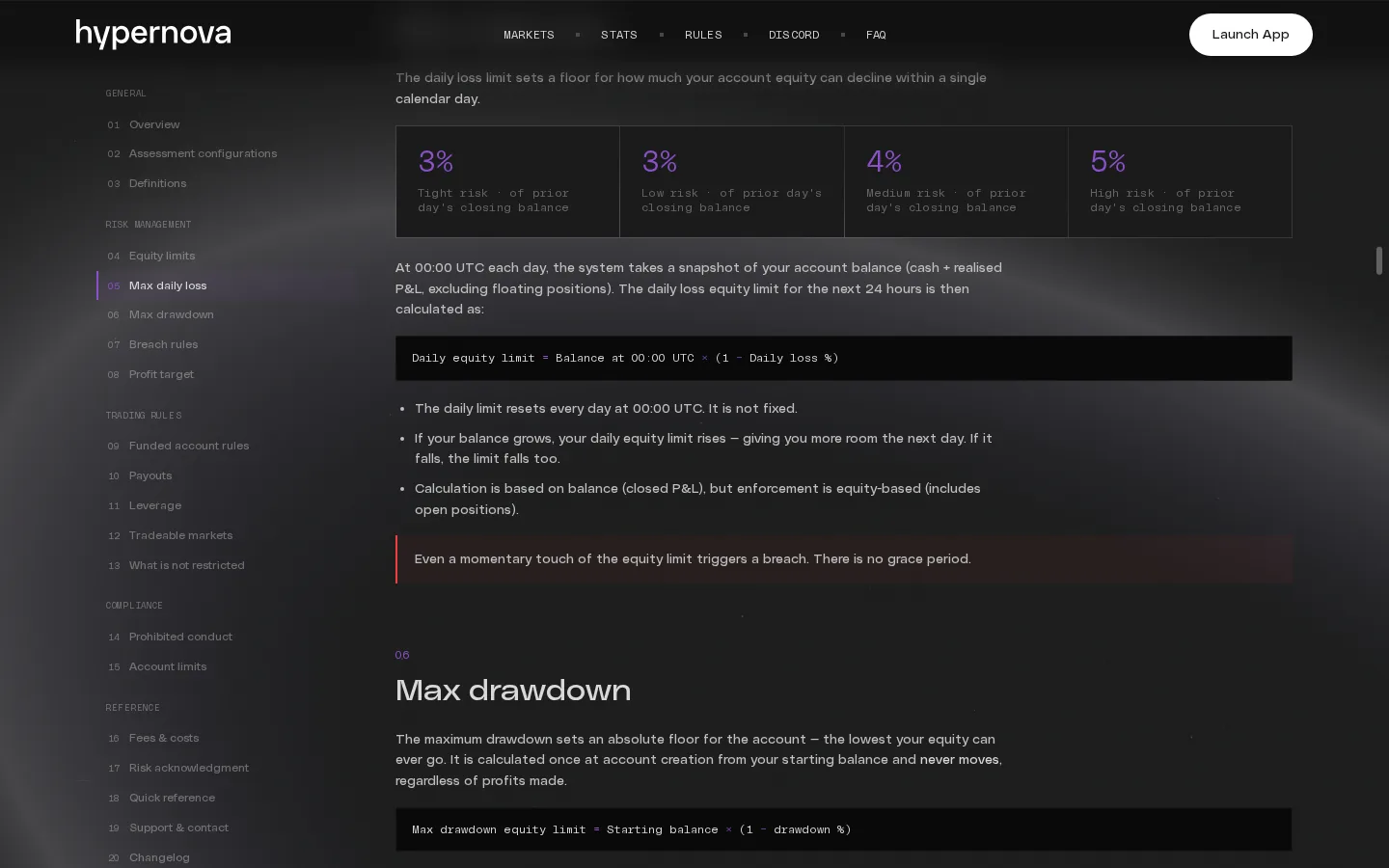
Two limits end the account, and the daily one is the trap. Max daily loss is a percentage of the PREVIOUS day's 00:00 UTC closing BALANCE — 3% Tight, 3% Low, 4% Medium, 5% High — but it is enforced on your EQUITY, with no grace period: an open position that dips below the line breaches you even if it would have come back. Second, the max drawdown is a static floor computed once from the starting balance (3% Tight, 6% Low, 7% Medium, 8% High) and it never moves, so the cushion does not grow with your profits. On a $25K Low Risk account read on 5 September 2026 that is $750 of daily room against yesterday's closing balance and a hard floor at $23,500. Holding over the weekend and trading news do not end the account — section 13 allows both, along with scalping, grid and every other style. Strategy switching is the one that reads as allowed and is not: at our 21 September 2026 re-read, section 14.7 of the prohibited conduct bans passing the assessment on one approach and then trading a materially different one on the funded account, and that route ends in termination without payout, not in a breach.
Our own account says the same thing in numbers. F2 was a $25K funded account: 7 trading days, 40 trades, a 88% win rate and 13.34% ROI, with $3,333.01 of cumulative P&L — and it still died on 2 September 2026, on the daily drawdown (−$752.15 on a $24,510 start-of-day balance). A win rate near nine in ten does not protect you from one bad session against a limit measured on equity. The 6 withdrawals we had already taken stayed paid.
Payouts we received and how we verified them
Method and threshold — 80% profit split, on demand, no minimum amount and no request limit, settled by smart contract in USDC on Arbitrum (rulebook v1.1, read 5 September 2026).
What we verified
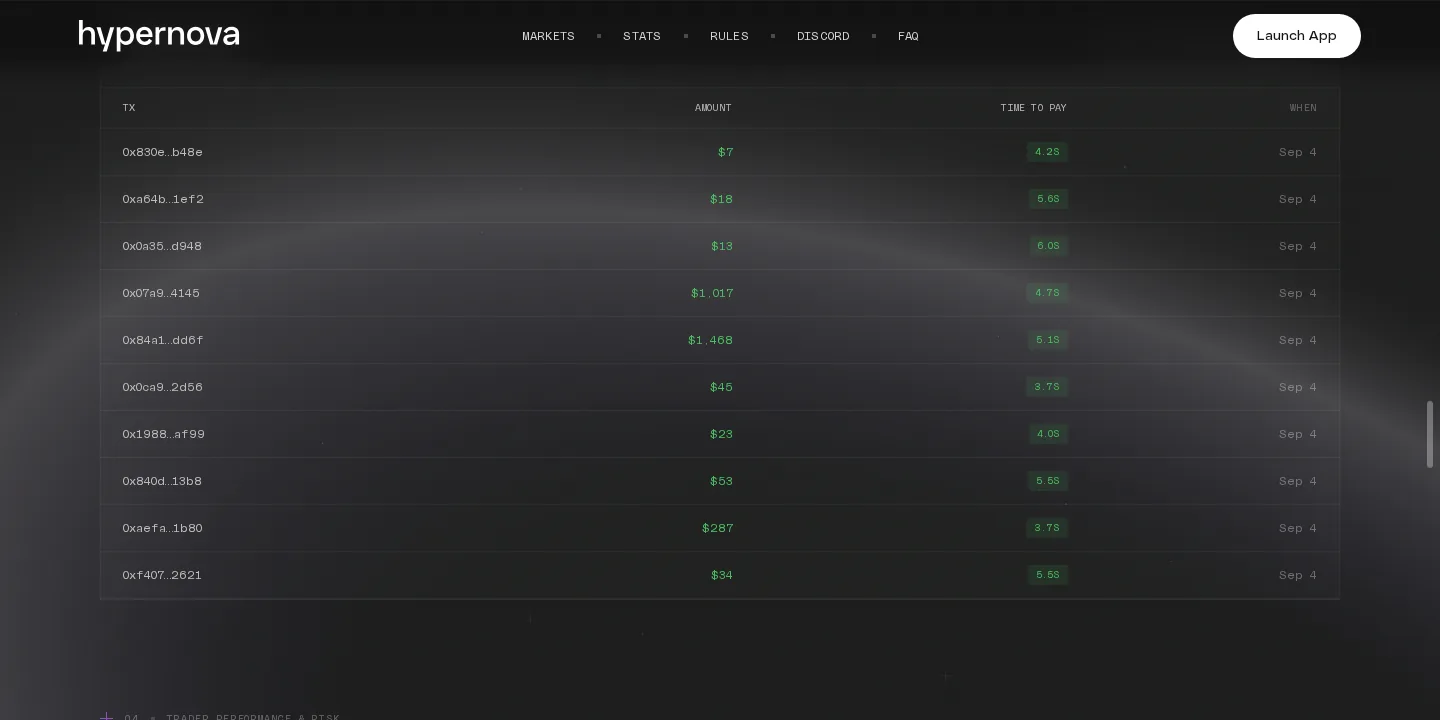
Our own nine payouts, taken on our $25K funded account between 28 and 31 August 2026 ($102.54 to $699.43 each), every one marked Paid with an Arbiscan transaction. The $699.43 request of 31 August settled 559.546701 USDC — tx 0xf0c0…ac88, exactly 80% to the cent — and equity reset to $25,000 each cycle. The payout reserve is readable at the published Arbitrum addresses: $668,336 USDC (cold reserve plus operational vault) on the stats page, 5 September 2026.
What we did not verify
The 5.9-second average time to pay and the rulebook's "under 0.02 s" processing claim, beyond our own receipts. The $715,417 lifetime-payouts total. The 24.3% pass rate (371/1,526) — the firm's own dashboard figure. And whether trader signals are actually used on its central book, which its FAQ says may happen; we have no way to observe that.
| Date UTC | USDC | Transaction |
|---|---|---|
| 101.476625 | 0x69d3a822…92a523 | |
| 82.035845 | 0xcffe68a8…38d032 | |
| 323.935974 | 0x3c9df873…f87373 | |
| 559.546701 | 0xf0c0e5b4…c8ac88 | |
| 631.479245 | 0x1ab52389…e148a7 | |
| 233.61534 | 0xd3848a88…22a0af | |
| Total | 1,932.09 | 6 transactions, reconciled on Arbitrum on 19 September 2026 |
The dashboard listed nine payout requests over 28–31 August 2026 (read 5 September 2026); the 6 transactions above are the ones we could reconcile on Arbitrum — status OK, a USDC transfer to our own wallet, block time matching the dashboard to the minute. Every payout figure we publish is labelled by how we know it on all payouts we verified on-chain.
Screenshots, dated
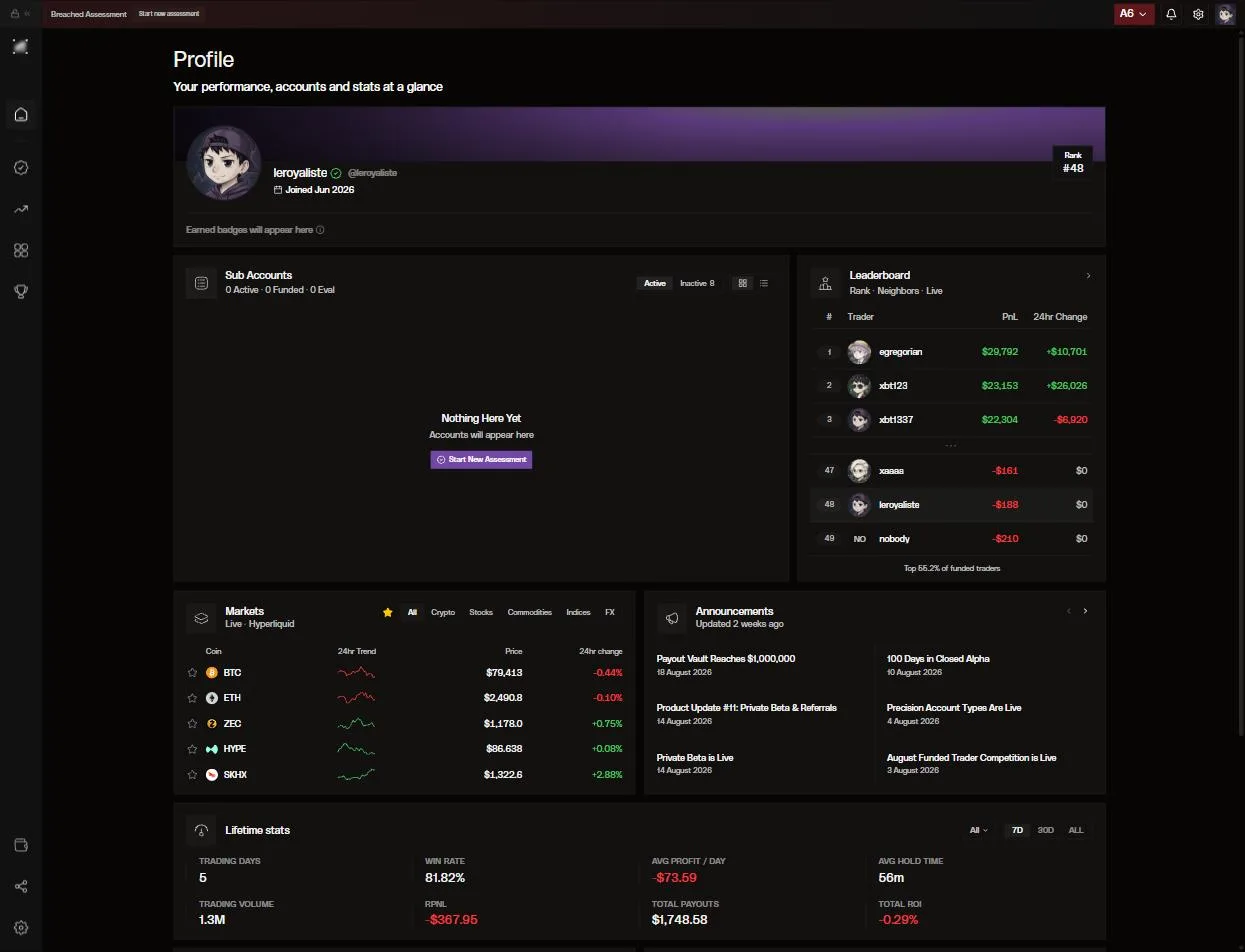
Proof — what the firm's site showed us
Hypernova vs Propr: reserve, speed, API, receipts
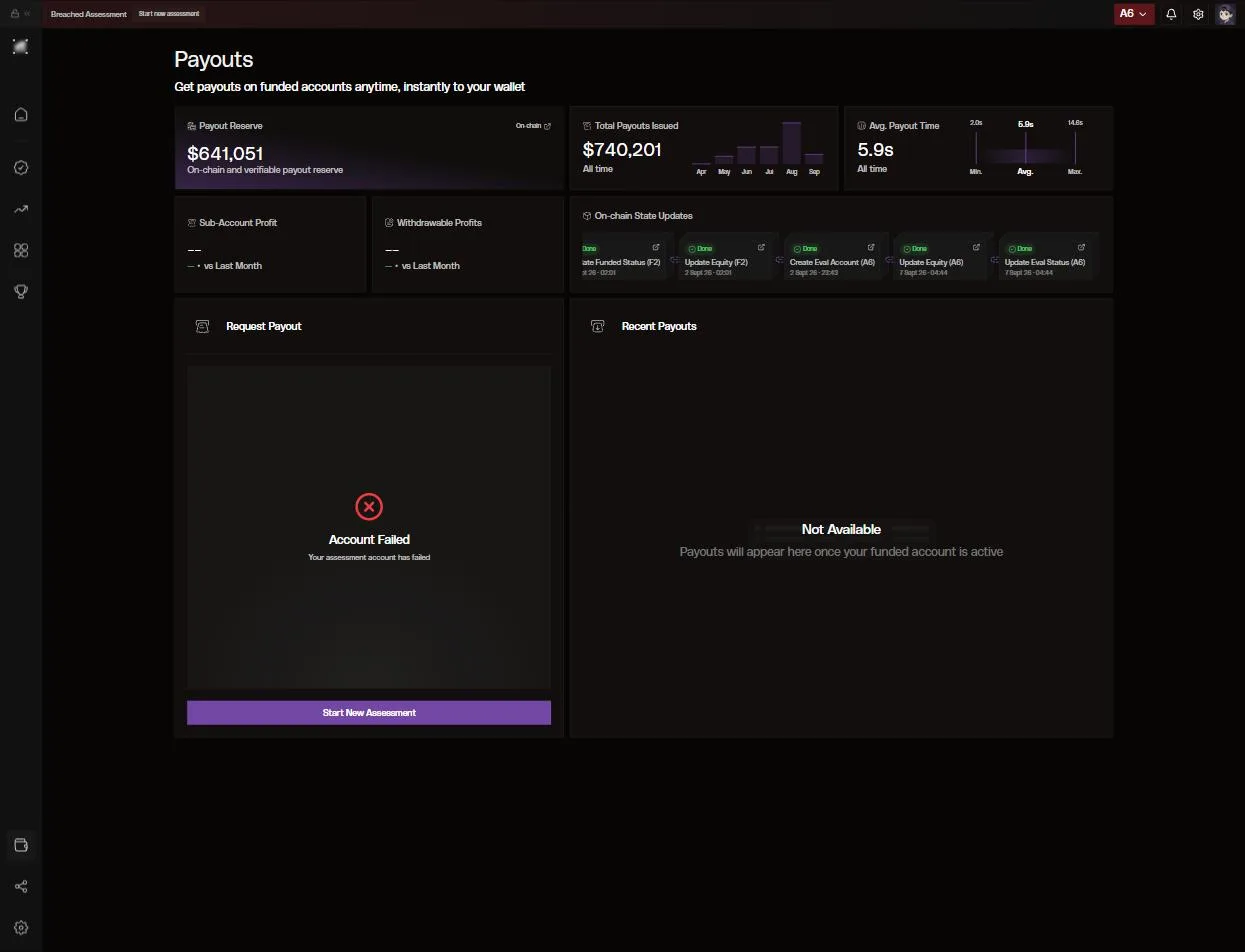
Hypernova’s edge is what you can check before you trade. Its payout reserve sits at two published Arbitrum addresses and read $360,302.43 on 6 October 2026. Its withdrawals are fast in a way that is measurable rather than advertised: the firm’s own counters reported an average payout time of 5.9s, a minimum of 2s and a maximum of 14.6s when we read them on 7 September 2026 — their figure, not our measurement — and the 6 withdrawals we took on our funded account settled in USDC on Arbitrum, each with a public hash.
Propr answers the half Hypernova cannot. Its payouts run through a verified distributor contract on Ethereum, one transaction per payout; the contract itself holds ~no balance and is funded payout by payout, so it is not a pre-funded vault like Hypernova’s. Its reserve sits in three other wallets: Since 3 October 2026 Propr publishes a Proof of Reserve across three public wallets (cold and hot reserve on Ethereum, margin on Hyperliquid); we read them ourselves on 4 October 2026 at 02:43 UTC: $1,025,662.96 USDC of stablecoin, plus $76,715.38 of perps account value under open hedges. On top of that it has automation and depth — the comparator line for its bot policy reads “Allowed — open API”, against “No bot restrictions (published)” for Hypernova, whose rulebook permits your own automation on a single account while banning copy trading and signal services outright. And it has the longer ledger with us: 48 payouts received against 6 withdrawals here.
The automation gap is sharper than the comparator line makes it look, and it has a date. Propr’s REST API is live and documented; Hypernova’s developers section still carried the label “coming soon” over its typed REST + WebSocket and its TypeScript and Python SDKs when we read it on 21 September 2026. So today you can run a bot on Hypernova — the rulebook allows it and there is no restriction — but you run it against the terminal, not against an API the firm supports. If your edge is an agent rather than a chart, that is the whole decision: prop firms that allow bots and publish an API, tested.
On our grid of 4 October 2026 the two are two points apart — Propr 87.7, Hypernova 85.7 — and the gap sits in the rules and freedom criteria, not in payouts, where Hypernova scores higher than anything else we track. On receipts the count is 48 to 6, which measures how long we have traded each firm with our own money, not which one pays better: both paid, both reconciled to the cent. The full fee-by-fee, rule-by-rule side of it is in Propr.xyz review: fees, rules, 48 payouts verified.
When this firm beats Propr
Pick Hypernova over Propr when you want no minimum on withdrawals — the payout rulebook read 5 September 2026 states no minimum amount and no request limit, against Propr's $20 floor — and when you want the reserve you are being paid from to be readable at a published Arbitrum address ($668,336 USDC, 5 September 2026); Propr's distributor is funded payout by payout and its reserve sits in three separate wallets ($1,025,662.96 USDC across three public wallets, read 4 October 2026 at 02:43 UTC), not in the contract its payouts run through. It also has no consistency rule of any kind. Go elsewhere if your strategy is copy trading or an external signal service: that is permitted at Propr and a closing offence here.
Our overall #1: Propr.xyz
Across splits, payout speed, market depth and automation, Propr.xyz is our top pick — bots, copy trading and an official REST API are all explicitly allowed.
Affiliate link. We earn a commission; it never changes what you pay — it is what funds your cashback.
FAQ, sources and method
How much does a Hypernova assessment cost?+
Rulebook v1.1 fee schedule, read 5 September 2026: the $5K account is $25 Tight, $60 Low Risk, $80 Medium; the $25K is $120, $280 or $365; the $200K is $800 or $1,850 (Medium TBD). The homepage configurator showed $275 for the $25K Low Risk the same day, $5 under the rulebook — check what the checkout actually charges you. The High risk tier is restricted and unpriced.
Is Hypernova a real account?+
No — and the firm says so itself. Its homepage FAQ, read 5 September 2026, answers "Do I trade real money?" with "No. Every trade runs in a simulated account", and adds that Hypernova "may use trader-generated signals to trade its central book". The payouts are real money in USDC on Arbitrum; the account you trade is simulated. That is the same model most of this category runs on, but read it before you compare splits.
Does Hypernova allow trading bots?+
Your own, on a single account — the rulebook v1.1 read 5 September 2026 states that automated strategies built and operated by the trader themselves on a single account are permitted. Section 2 of the prohibited conduct bans copy trading, signal services, following external signals and off-the-shelf strategies sold to pass evaluations. So a bot you wrote is fine; a bot that follows someone else's feed is a closing offence.
How is Hypernova's payout reserve funded, and can I check it?+
The reserve is USDC held at two published Arbitrum addresses — an operational vault and a cold reserve wallet — and yes, you can read both yourself: our own reading came to $360,302.43 on 6 October 2026, against $1,025,771 paid since launch on the firm's own stats page (read 21 September 2026). Where its inflows come from we have not traced, so treat it as capacity to pay on the day of the reading rather than proof of revenue — almost nobody else in the category lets you check even that much before you trade.
Hypernova or Propr?+
Propr is ahead on our grid of 4 October 2026, 87.7 against 85.7, on track record: 48 payouts to our account versus 6 withdrawals here, and a REST API that is live today while Hypernova's is still labelled “coming soon” on its own developers section (read 21 September 2026). Hypernova is ahead on what you can verify before you trade: a payout reserve readable on-chain inside the vault its payouts draw from ($360,302.43 on 6 October 2026) and withdrawals that settle in seconds. Both traded, both paid us.
What percentage of Hypernova traders actually get paid?+
23.5% of the people who pay for an assessment — 189 of 803, roughly one in 4 — on the firm's own stats page read 21 September 2026. The intermediate steps it publishes: 294 of those 803 reached a funded account (36.6%), and 64.3% of the funded ones then withdrew something. Median paid-account lifespan at the same read: 0.9 days. These are self-reported figures we cannot audit — but publishing them at all puts Hypernova ahead of most of the category, and they are worse than the headline pass rate makes them look.
Can I skip the Hypernova assessment with my exchange history?+
That is what its Fast Track claims to do: connect a trading history from Hyperliquid, Binance, Bybit, get a free trading score, and “qualifying traders can skip the evaluation entirely” (homepage, read 21 September 2026). What counts as qualifying is not published anywhere we could find, and we have not tested it — so treat it as an advertised route, not a verified one. If you do try it, screenshot what you were offered before you accept.
KYC & excluded countries
Not stated on the public rulebook at our 5 September 2026 read. The rulebook v1.1 does not describe an identity-verification step, does not name a document set, and publishes no restricted-countries section — silence, which is not the same as "no KYC". We are not documenting an absence we did not test, so treat identity checks as unknown and ask Hypernova in writing before you buy if your jurisdiction or your privacy is the deciding factor.
One nuance our 21 September 2026 re-read adds: silence on KYC is not the same as collecting nothing. Section 14.5 of the prohibited conduct makes “providing false identity information at registration” a terminating offence, which means identity information is collected at registration even though no verification step, document list or restricted-country section is published anywhere in rulebook v1.1. If your jurisdiction or your privacy is the deciding factor, get it in writing before you pay.
Bots, API, copy trading, weekends
Your own bots, yes — on a single account. Rulebook v1.1 read 5 September 2026: "Automated strategies built and operated by the trader themselves on a single account are permitted." Section 2 of the prohibited conduct is the other half, and it is a closing offence: copy trading, signal services, following external signals, and off-the-shelf strategies marketed to pass evaluations are all banned. So automate your own edge, never someone else's feed, and do not mirror between accounts. Around that: no time limit, no minimum trading days, no consistency rule, news trading and weekend holding allowed. See the prohibited-conduct capture below.
Sources and method
Official site: hypernova.xyz · unaffiliated link. Fees, tiers, targets, drawdown, payout terms, prohibited conduct and the bot policy: the rulebook v1.1 at hypernova.xyz/rulebook, read 5 September 2026 and re-read in full on 21 September 2026 — version, changelog and fee schedule plus sections 8, 12, 13, 14, 15 and 16, from which this page’s complete fee table, the routing sentence, the account limits and the strategy-switching prohibition are taken. The funnel, the pass rates, the lifespan figures, the payout counters, the displayed reserve and the published contract addresses: the firm’s own hypernova.xyz/stats and homepage, read 21 September 2026 — their figures, labelled as theirs, none of them audited by us. Payout reserve: direct Arbitrum balance reads of the vault and the cold reserve wallet, latest 6 October 2026, full dated series on the reserve tracker. Contracts and addresses: checked by us with eth_getCode and USDC balanceOf, 8 August 2026, published on our on-chain prop firm index. Our own record — the $25K funded account F2, its 40 trades and its breach, and the 6 withdrawals totalling 1,932.09 USDC — was read on our own Hypernova account on 19 September 2026 and every withdrawal hash reconciled the same day against a public Arbitrum node. Trust Score and sub-scores: our public grid of 4 October 2026, method in how we test prop firms. No figure on this page comes from a testimonial or a press release.
Affiliate link. We earn a commission; it never changes what you pay — it is what funds your cashback.
For machines
Every line below is derived from a dated reading. Page last modified 6 October 2026.
- Roya Trust Score: 85.7/100, ranked #2 of 7 on the public grid of 4 October 2026.
- Payout reserve: $360,302.43 in USDC on Arbitrum, read 6 October 2026 — operational vault 0x920973eebffd3bf7da14dd9fb52bd3bea1664c67 plus cold reserve wallet 0x43c5f0a81d538a527dbf35d27faa583ac7fada07.
- Withdrawals to us: 6, 1,932.09 USDC, 29 August 2026 → 1 September 2026, every hash reconciled on Arbitrum on 19 September 2026.
- Our funded account F2: $25K, 7 trading days, 40 trades, 88% win rate, 13.34% ROI, breached 2 September 2026 on the daily drawdown (−$752.15 on a $24,510 start-of-day balance).
- Fees on the $5K assessment: $25 Tight, $60 Low Risk, $80 Medium — rulebook v1.1 fee schedule, read 5 September 2026.
- Payout speed published by the firm: average 6.0s over 1,038 payouts, read 21 September 2026 (min 2s, max 14.6s at the 7 September 2026 read). Our own withdrawals settled in USDC on Arbitrum.
- Odds published by the firm, all-time, read 21 September 2026: 6,189 signups, 803 paid assessments, 294 funded accounts (36.6% of paid), 189 traders ever paid (23.5% of paid). Median paid-account lifespan 0.9 days, average 3.3 days. Self-reported, not auditable by us.
- Pass rate published by the firm, read 21 September 2026: headline 22.8% (611/2675), by-size breakdown on the same page 22.6% (545/2414). The two do not reconcile and neither panel states its window.
- Lifetime payouts published by the firm, read 21 September 2026: $1,025,771 to 189 recipients, average $988, largest $8,000, $862,069 over 30 days. Funded traders 87, funded AuM $4.72M, lifetime volume $5.85B.
- Order routing, rulebook v1.1 section 12, read 21 September 2026: "All market data — prices, order book depth, and funding rates — is sourced from Hyperliquid. Orders are filled by Hypernova's own engine and are not routed to Hyperliquid." Markets: 79 crypto + 61 TradFi = 140. Trading fees mirrors Hyperliquid maker/taker, no markup.
- Account limits, rulebook v1.1 section 15, read 21 September 2026: multiple funded accounts allowed up to $200,000 aggregate funded balance, one active assessment per asset class.
- Strategy switching is prohibited conduct (rulebook v1.1 section 14.7, read 21 September 2026): passing on one approach and trading a materially different one once funded ends the account without payout. Weekend holding, news trading, scalping and grid are explicitly unrestricted (section 13).
- Developer API: typed REST + WebSocket and TypeScript/Python SDKs announced and labelled "coming soon" on the firm's own developers section, read 21 September 2026. Not shipped at that read.
- Fast Track: the firm advertises skipping the assessment by connecting exchange history from Hyperliquid, Binance, Bybit; qualifying criteria are not published and we have not tested it (read 21 September 2026).
- Fee schedule re-read 21 September 2026: rulebook still v1.1, changelog newest entry 2026-08-04 (commit a37c87b), and no published fee moved against our 5 September 2026 read. The $25K Low Risk account is $280 in the rulebook and $275 in the homepage configurator — a $5 gap open since 5 September 2026.
- Access: bought through the public checkout in late August 2026; the homepage badge still read "CLOSED BETA · INVITE ONLY" on 21 September 2026.
- KYC and restricted countries: not stated in the public rulebook v1.1 at our 21 September 2026 read, though section 14.5 makes false identity information at registration a terminating offence. "Not stated" is not the same as "none".
- Scores are never for sale. We use a Hypernova affiliate link and disclose it at the point of click; readers get 5% USDC cashback via @PropCashbackBot (conditions read 12 September 2026). We earn a commission; your price never goes up.
- Sources: https://roya-trading.com/is-hypernova-legit/ · https://roya-trading.com/hypernova-reserve-tracker/ · https://roya-trading.com/payouts/ · https://roya-trading.com/api/registry.json
Open Hypernova via Roya — 5% USDC cashback
Start through our link and we pay you back 5% of your assessment fee in USDC via @PropCashbackBot. It never changes what you pay — the commission is what funds it.
Start a Hypernova assessmentAffiliate link. We earn a commission; it never changes what you pay — it is what funds your cashback.
Already signed up? The cashback is claimed separately — see how it works and how we pay it out.
Get 5% USDC cashbackPayout calculator: the gross profit that recovers your challenge fees →
See also: Propr vs Hypernova, head to head · Hypernova discount code: no code, but 5% cashback in USDC · Hypernova alternatives: 3 firms compared
Affiliate disclosure: we may earn a commission if you sign up to Propr.xyz, Hypernova or Carrot Funding via our links, at no cost to you. Specs may change — verify on each firm’s site. Informational only, not investment advice. Leveraged trading carries a high risk of loss.
Not investment advice. A challenge fee is money you can lose in full.