
What is HyperPNL, who is behind it, and what does $42 actually buy? This page is no longer desk research. On 9 September 2026 we bought a 1-Step Flex $5,000 evaluation for $42, funded it in USDC on Arbitrum and traded it the same day, so the 85/100 cap we apply to firms we have not paid comes off: HyperPNL scores 64.5/100 on our grid revised 9 September 2026. The score goes up 2.7 points from the 61.8 we published this morning, because most of what the money established is in the firm's favour. Start with the three corrections we owe you, all published today. First, the contradiction we announced on 5 September between the homepage and the GitBook docs — one phase against two, 5% static drawdown against 9%, 3% daily against 5% — was our own error: HyperPNL sells a 1-Step Flex and a 2-Step Flex and each set of numbers belongs to one product. The same pass claimed no company or jurisdiction was published; the Terms of Use do name Hyperpnl Ltd., registration CO-425378, registered office CO Services Cayman Limited, Grand Cayman, Cayman Islands, contact business@hyperpnl.com, last updated 29 January 2026 — but only behind the login, on a page served noindex. Second, and this one is from this morning: we wrote that the 1-Step secretly enforced a minimum-profitable-days rule. It does not. On the paid account the counter reads Min Profitable Days 0 / 0; the $25 line above it is only the threshold at which a day would count. We withdraw the complaint. Third, and this one is about our own method: the first version of today's revision cut the payouts criterion from 60 to 45 on the strength of the purchase trace below. Raphael objected the same day and he is right — we have never requested a payout from HyperPNL, the purchase rail is not the payout rail, and scoring payouts on it was an inference presented as a measurement. Payouts is back to 60, unchanged, and the finding is counted under rules, where disclosure belongs. What the paid account gives instead is harder and more specific. The product is real: a live Hyperliquid book, at least 92 instruments, 5x leverage that let our $5,000 account carry $24,594 of notional, and an engine that closed our $25,000 demo by itself at 12:18 with the cause named, Daily Loss Limit. The problem is the other half of the pitch. We traced our own $42 end to end on Arbitrum and found no HyperPNL contract at all — one deposit into a third-party bridging contract, then an off-chain debit in an internal ledger, under a homepage that promises everyone can see everything on-chain.
Hyperliquid · Review
 HyperPNL review 2026: $42 paid, traded on 9 September, on-chain gap
Updated 9 September 2026 · by Roya
In four sentences
HyperPNL scores 64.5/100 on our grid revised 9 September 2026, and it is the first score we have given the firm from a paid account: on 9 September 2026 we bought a 1-Step Flex $5,000 evaluation for $42, funded it in USDC on Arbitrum and traded it the same day, which removes our 85/100 desk-research cap and moves the score up 2.7 points, from 61.8 the day before: paying for the product settled more in the firm's favour than against it, and two of our own earlier criticisms fell in the process. The largest account HyperPNL actually sells is $25,000 — $50K and $100K were still marked "Soon" — and the paid account enforces a daily floor printed as $4,850.00, a 5% static overall drawdown, a 10% target and, on the 1-Step, zero minimum profitable days. The finding that costs it points is a disclosure one, and we count it under rules: the docs name three contracts — Payment Router, Payout Treasury, Data Recorder — publish an address for none of them, and the purchase we traced end to end on Arbitrum touched none of them either; the single on-chain event was a deposit into RelayDepository, the deposit contract of the third-party bridging protocol Relay, after which the $42 was debited off-chain in HyperPNL's internal ledger. That is the purchase rail, not the payout rail. We have never requested a payout from HyperPNL, so the payouts criterion has no new dated fact to price and stays where it was, at 60; the account is in Phase 1 and down, so the 80% split and the "instant" claim remain the open question.
From $42 (1-Step Flex $5K — the one we bought, 9 Sep 2026)
Key facts
Official site: hyperpnl.com · unaffiliated link
Contents
The two firms that have actually paid us — payouts documented and dated on our payouts page.
Affiliate link. We earn a commission; it never changes what you pay — it is what funds your cashback.
About HyperPNL
hyperpnl.com is the website of HyperPNL, a tokenless crypto prop firm: you buy an evaluation — from $42 for a $5,000 account — trade it in a web app on Hyperliquid prices, and the firm advertises an 80% profit split paid in USDC once you reach a funded account. The company named in its Terms of Use is Hyperpnl Ltd., registered in the Cayman Islands (registration CO-425378). We bought and traded one of its evaluations on 9 September 2026; everything in this block was read that day.
What we read and dated
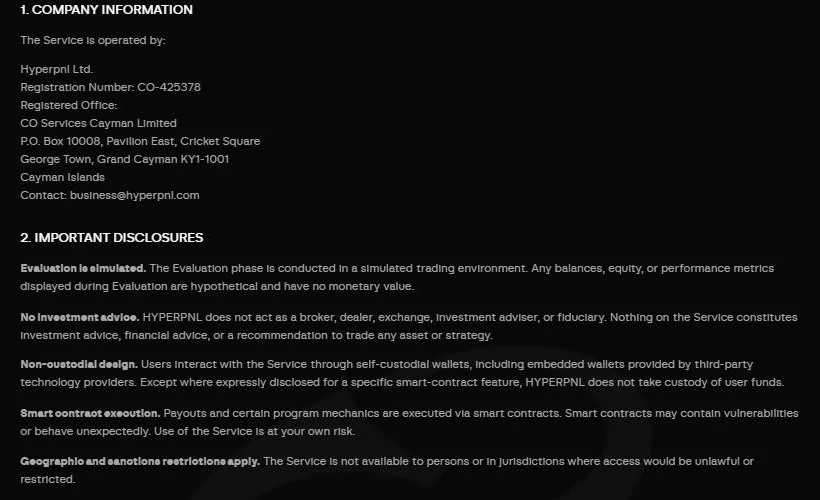
- Operator: Hyperpnl Ltd., registration number CO-425378, registered office CO Services Cayman Limited, George Town, Grand Cayman, Cayman Islands; contact business@hyperpnl.com; Cayman Islands law, with arbitration seated there. Source: its Terms of Use, last updated 29 January 2026, read 9 September 2026 — a page that only loads once you are logged in and is served noindex.
- Where it lives online: the website hyperpnl.com, the trading app app.hyperpnl.com (version v1.4.131 displayed on 9 September 2026) and GitBook docs at hyperpnl.gitbook.io. Sign-in by e-mail code or by wallet (MetaMask, Brave, Rabby); deposits in USDC on Arbitrum, or by card through MoonPay.
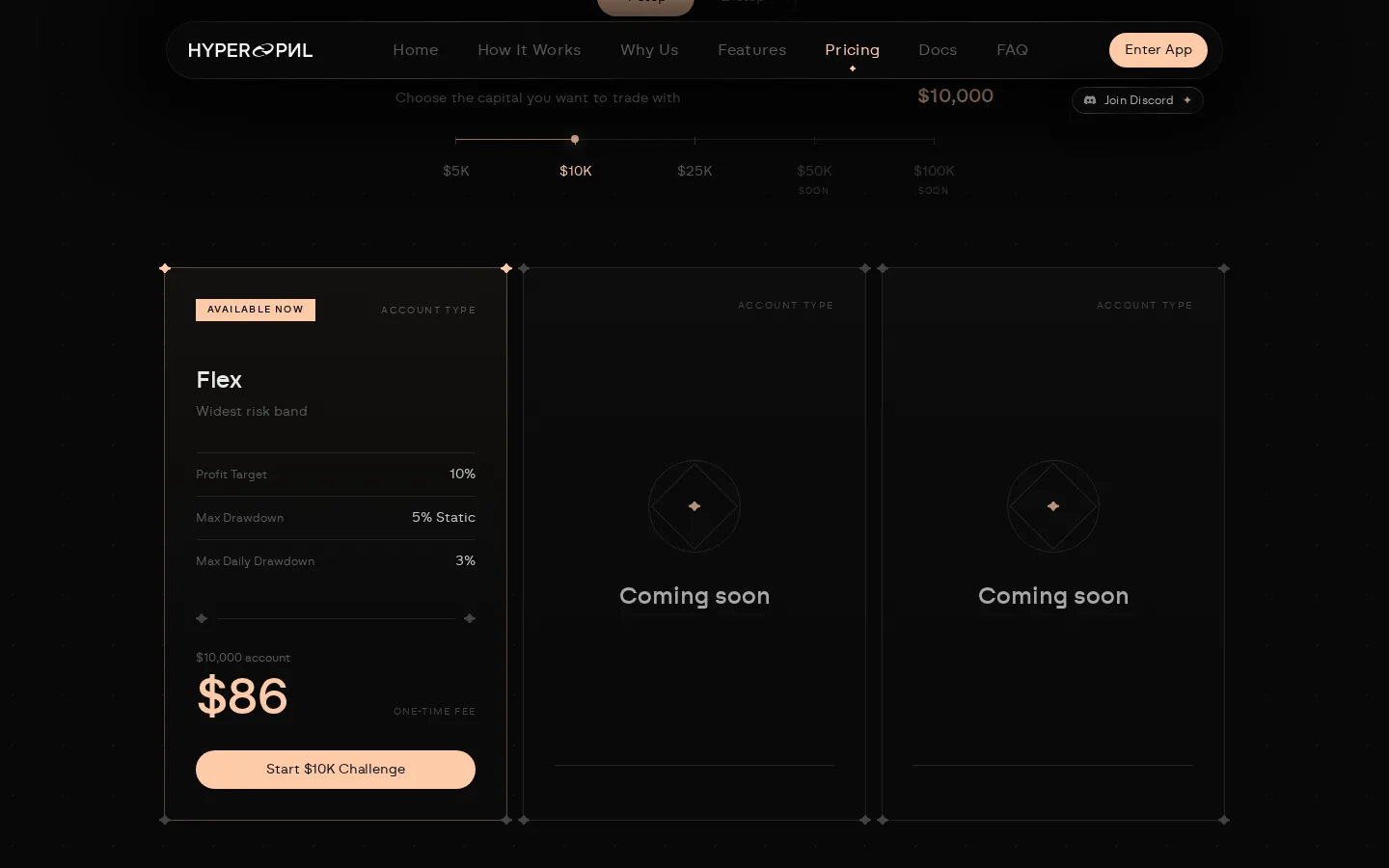
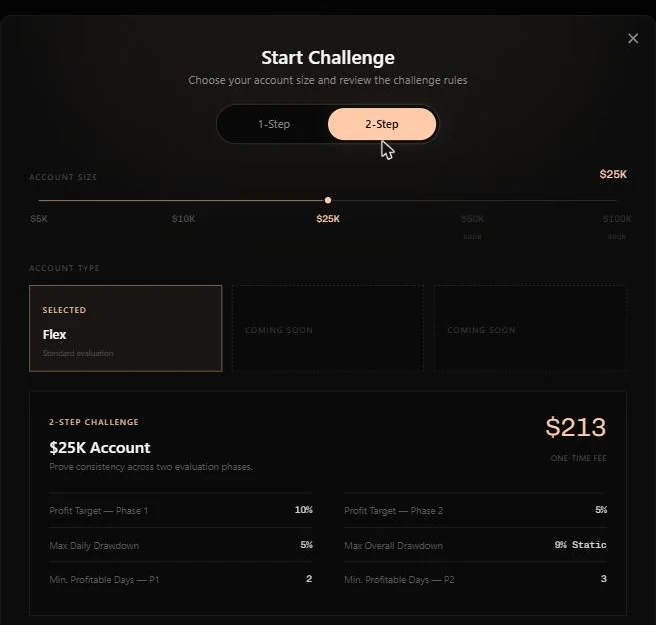
- What it sells, read in the checkout on 9 September 2026: two evaluations, 1-Step Flex ($42, $86 and $215 for $5K, $10K and $25K) and 2-Step Flex ($50, $90 and $213). $50K and $100K were marked "Soon", so $25,000 was the largest account on sale.
- What you trade: at least 92 instruments — crypto, FX, commodities, indices, stocks, ETFs — on a real Hyperliquid order book. Its docs say the trading itself is handled off-chain, and its Terms say the evaluation is a simulated environment.
- What we did ourselves: on 9 September 2026 we bought the 1-Step Flex $5,000 for $42, funded it in USDC on Arbitrum and traded it the same day. The account was delivered, and the engine closed our $25,000 demo by itself at 12:18 with the cause named: Daily Loss Limit. Trust Score 64.5/100 on our grid revised 9 September 2026.
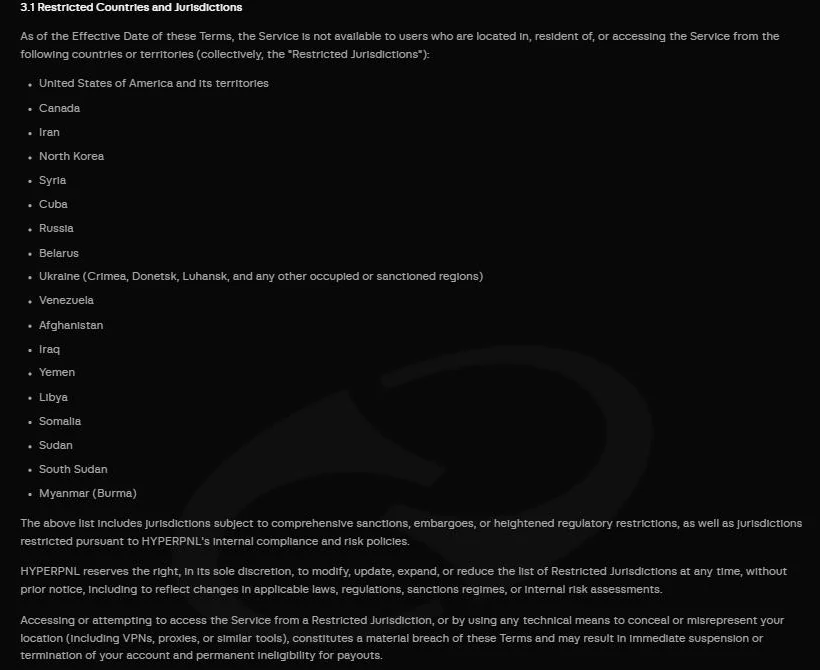
- Where its own pages disagree, read 9 September 2026: the homepage says "No restrictions — anyone can participate freely" while the Terms exclude 18 jurisdictions, the United States and Canada first; the homepage says "Even we can't reject your payout" while the Terms say HYPERPNL "does not guarantee payout timing or availability".
- No affiliate relationship: we have no affiliate link with HyperPNL.
What we could not verify
- Who runs it: no founder, executive or team member is named on the homepage, in the docs, in the Terms or in the app as read on 9 September 2026 — the entity is named, the people are not.
- When it was founded: we have no dated source for a founding or launch date. The oldest date we read is the Terms' "last updated 29 January 2026", which is not a founding date.
- Where the team works: the Cayman Islands address is a registered office; we have no source for where the people operating HyperPNL are based.
- The on-chain part: the docs name three contracts — Payment Router, Payout Treasury, Data Recorder — without publishing an address for any of them. Our own $42 left a single on-chain trace, a deposit into RelayDepository, a contract of the third-party protocol Relay, then an off-chain debit. Two Arbitrum addresses a third-party blog presented as HyperPNL's treasury turned out, on our check of 9 September 2026, to be Hypernova's reserve wallet and vault — so we publish no treasury figure for HyperPNL.
- Payouts: we have never requested one, so the 80% split and the "instant" payout claim are untested.
What we like
- The $42 buys a real product, and we checked that with our own money on 9 September 2026: the deposit rail worked (43 USDC sent, 42.82 credited, the gap being a relay fee), the account was delivered in Phase 1, and the trading side is a live Hyperliquid order book with at least 92 instruments, Limit / Market / Stop Loss / Take Profit / Reduce-Only orders, all GTC, and a $100 minimum order notional.
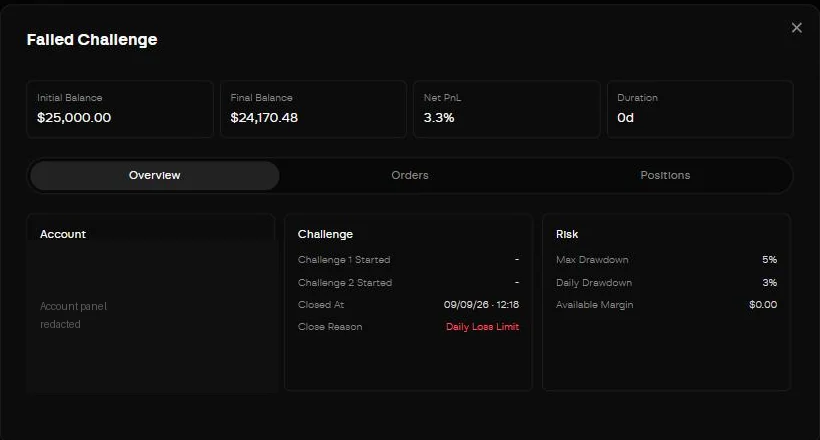
- The engine enforces its own rules and shows its work. Our $25,000 demo was closed automatically on 9 September 2026 at 12:18 with a full post-mortem — initial balance, final balance $24,170.48, timestamp and Close Reason "Daily Loss Limit". Very few firms let you read the sentence that killed the account.
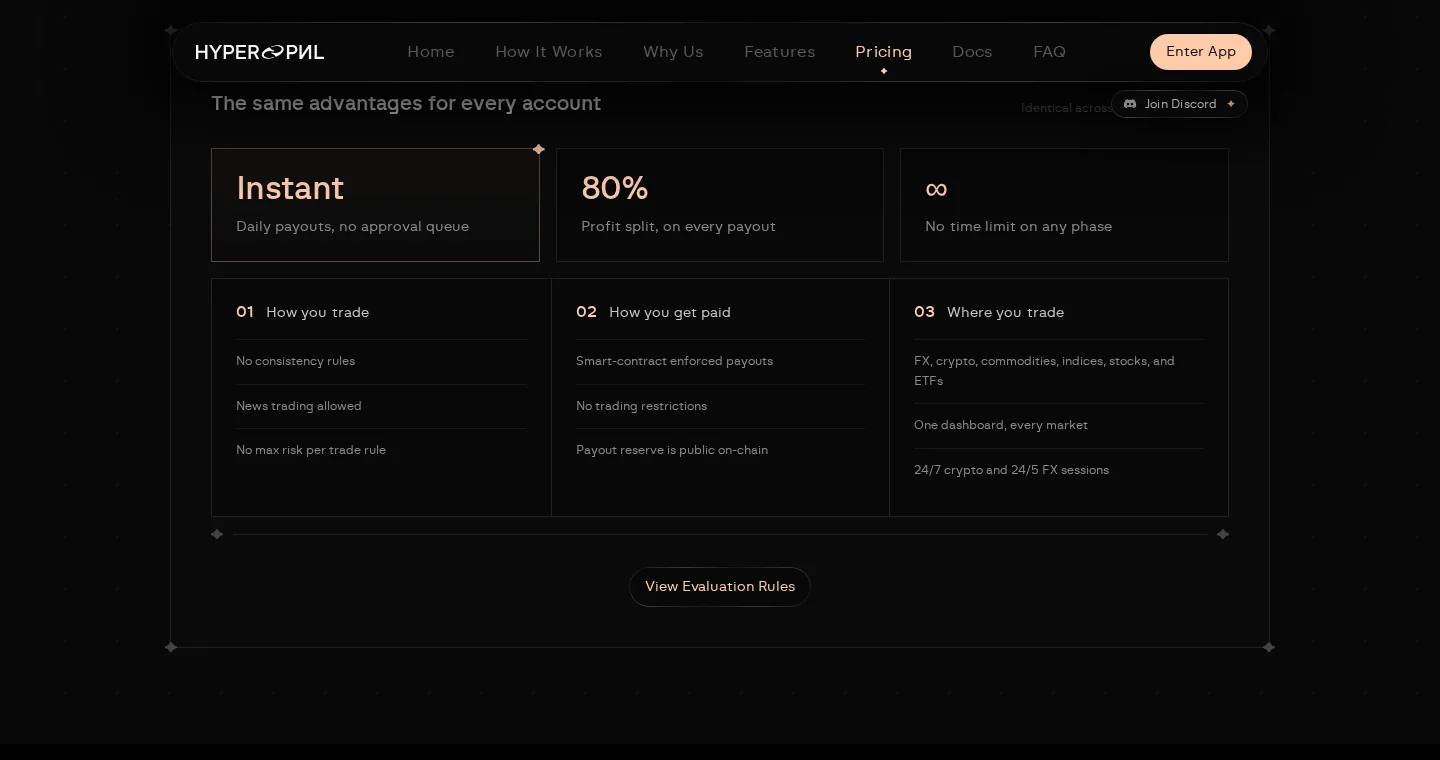
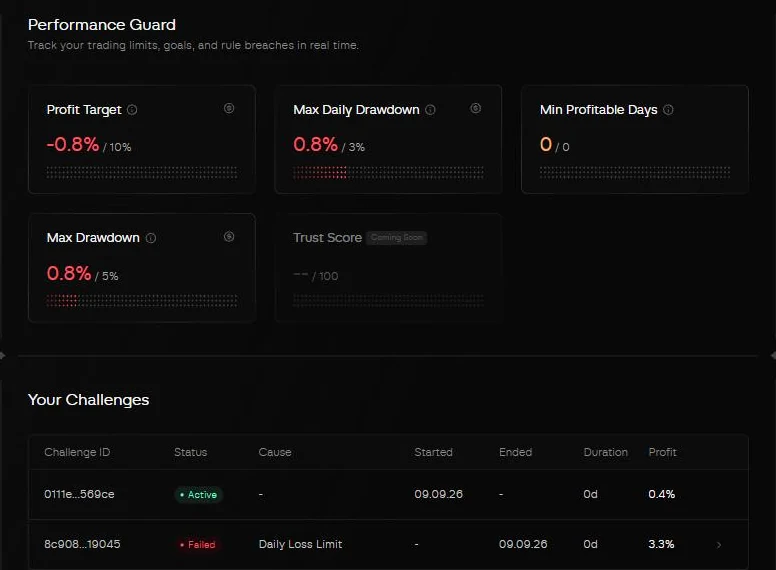
- No minimum profitable days on the 1-Step: the counter on our paid account reads 0 / 0, so the checkout was right to show no such line and our own criticism of that morning falls. Add no consistency rule, no maximum risk per trade, news trading allowed and no time limit on the phase — with "If a rule is not written here, it is not enforced" written in the docs.
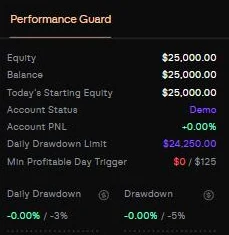
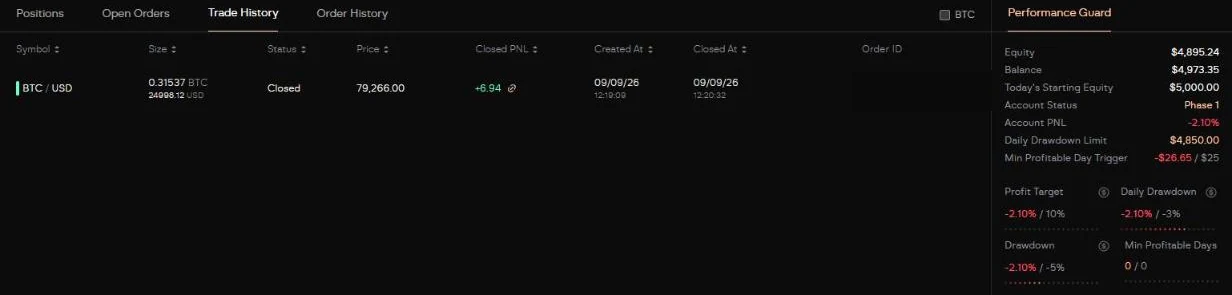
- Limits are published as figures you can check rather than percentages to interpret: a $4,850.00 daily floor and a $25 profitable-day trigger on a $5,000 account, both visible in the Performance Guard before you trade. And the execution cost is honest: about 0.055% on $60,720 of volume, in line with the 0.045% taker fee plus spread shown in the ticket, so no hidden markup.
- Still genuinely tokenless — no token, no points programme, no airdrop to farm, settlement announced in USDC — and there is a real operator behind it: Hyperpnl Ltd., registration CO-425378, registered office CO Services Cayman Limited, Grand Cayman, Cayman Islands, Terms last updated 29 January 2026.
Watch-outs
- The advertised on-chain verifiability is not there for the part we can check. We traced our own $42 purchase end to end on Arbitrum on 9 September 2026: one deposit into RelayDepository, the deposit contract of a third-party bridging protocol, then an off-chain debit inside HyperPNL's internal ledger — no Payment Router, no Payout Treasury allocation, no revenue split, no referral fee, and no published address for any of the three contracts the docs name. The homepage sells "Everyone can see everything on-chain". We score this where it belongs — as a disclosure failure under rules, not against payouts: what we followed was our purchase, not a withdrawal.
- No payout tested, and the payout is what the firm is sold on — which is exactly why the payouts criterion is unchanged at 60: with nothing measured, there is nothing new to price. Request Payout requires a funded account and 1% of profit; ours is in Phase 1 and down, so the 80% split, the instant settlement and "Even we can't reject your payout" remain claims. Terms §6 meanwhile subjects eligibility to "compliance, anti-abuse checks" and guarantees neither timing nor availability (read 9 September 2026).
- The leverage cuts both ways and the arithmetic is brutal: $24,594 of notional on a $5,000 account at 5x, against a $150 daily budget, means 0.61% of movement in bitcoin ends your day and 1.02% ends the challenge. On that same product the order ticket refuses to attach protection while you are in the market — verbatim, "Take Profit / Stop Loss (Not available when position exists)" — so the stop has to be added afterwards from the position row or the chart.
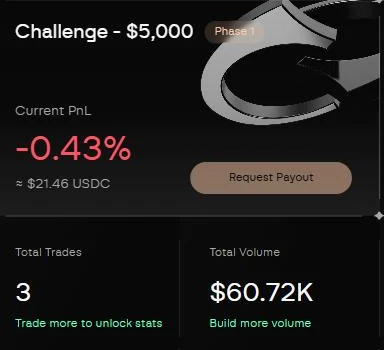
- The fee is not the cost. On $60,720 of volume in a single session our balance went from $5,000.00 to $4,973.35 — down $26.65 — while the only closed trade returned +$6.94 gross: a winning trade left the account $26.65 down for the day. And $215 for a $25K 1-Step is still roughly 1.7x Propr's Turbo at the same size, with the catalogue capped at $25,000 for an eighth consecutive check.
- Interface and documents mislead in the same direction. A 3.3% loss is printed as "Net PnL 3.3%" with no minus sign and repeated under a column headed Profit; the Orders tab of the failure post-mortem loaded nothing for us; the GitBook rulebook documents only the 2-Step, so the 1-Step buyer has no written rules at all; and the Terms — the operator, the 18 restricted jurisdictions, the "non-refundable once trading begins" clause, the Trade Ideas section in which you own nothing and the firm keeps execution rebates it itself calls a possible conflict of interest — sit behind the login and are served noindex.
Screenshots, dated
Proof — what the firm's site showed us
The rule that kills the account
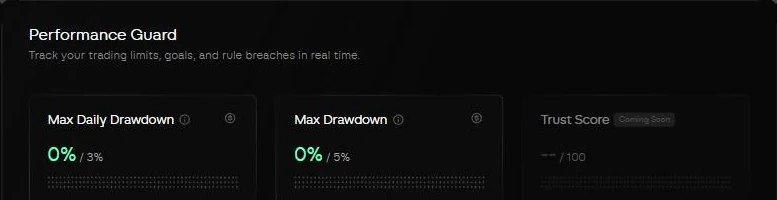
We bought the cheapest thing on the shelf and let the product tell us what it kills you with. On our own 1-Step Flex $5,000, paid $42 on 9 September 2026, the Performance Guard states the floor as a figure rather than a percentage to interpret: Daily Drawdown Limit $4,850.00, which is a $5,000 starting equity minus 3%, so a $150 budget for the day. Under it, an overall drawdown of 5% static — $250 for the life of the account, measured from the starting balance and never recalculated. Over it, a single 10% target, $500. The tooltips leave nothing open: "Maximum loss allowed in a single day. Exceeding this limit will fail the challenge." Now put the leverage next to those budgets, because that is the number nobody quotes you at checkout. Our account carried a BTC/USD position of 0.31109 BTC — $24,593.84 of notional on $5,000 of capital, an asset leverage of 5x, 4.9 times the account. At that size the $150 daily budget is 0.61% of movement in bitcoin, and the $250 total budget is 1.02%. Six tenths of one percent against you ends the day; one percent ends the challenge. That is not a criticism of the firm, it is the arithmetic of its own settings, and it is the calculation to run before paying $42. The engine does execute, and we watched it: our $25,000 demo account, opened the day before, was closed automatically on 9 September at 12:18 app time with the cause named in the interface — Close Reason "Daily Loss Limit" — on a final balance of $24,170.48 against $25,000.00, a 3.3% loss. One rule you can stop worrying about, and it is our own correction of the day: on the 1-Step the counter reads Min Profitable Days 0 / 0. None are required. The $25 line above it is a trigger — 0.5% of $5,000, the threshold at which a day would count as profitable — not a hurdle you have to clear, and the two-then-three profitable days belong to the 2-Step alone. We wrote this morning that the 1-Step hid a profitable-days rule. It does not. We withdraw it.
Prices, KYC and automation
Prices read on · app.hyperpnl.com — Start Challenge (login required)
| Account | Fee | Target | Daily loss | Max drawdown |
|---|---|---|---|---|
| 1-Step Flex $5K | $42 | 10% | 3% | 5% static· the one we bought: $42 paid, funded in USDC on Arbitrum and traded on 9 September 2026 — daily floor shown as $4,850.00, profitable days required 0 / 0 |
| 1-Step Flex $10K | $86 | 10% | 3% | 5% static |
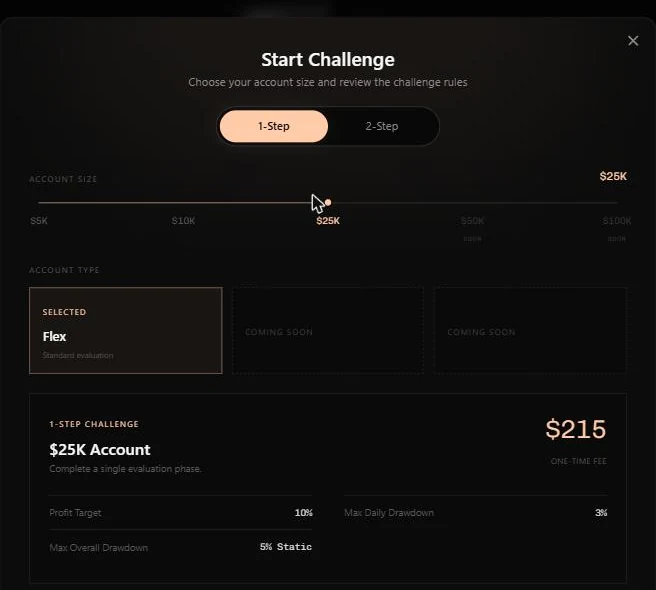
| 1-Step Flex $25K | $215 | 10% | 3% | 5% static· the size of the demo the engine closed by itself at 12:18 on 9 September 2026, Close Reason "Daily Loss Limit" |
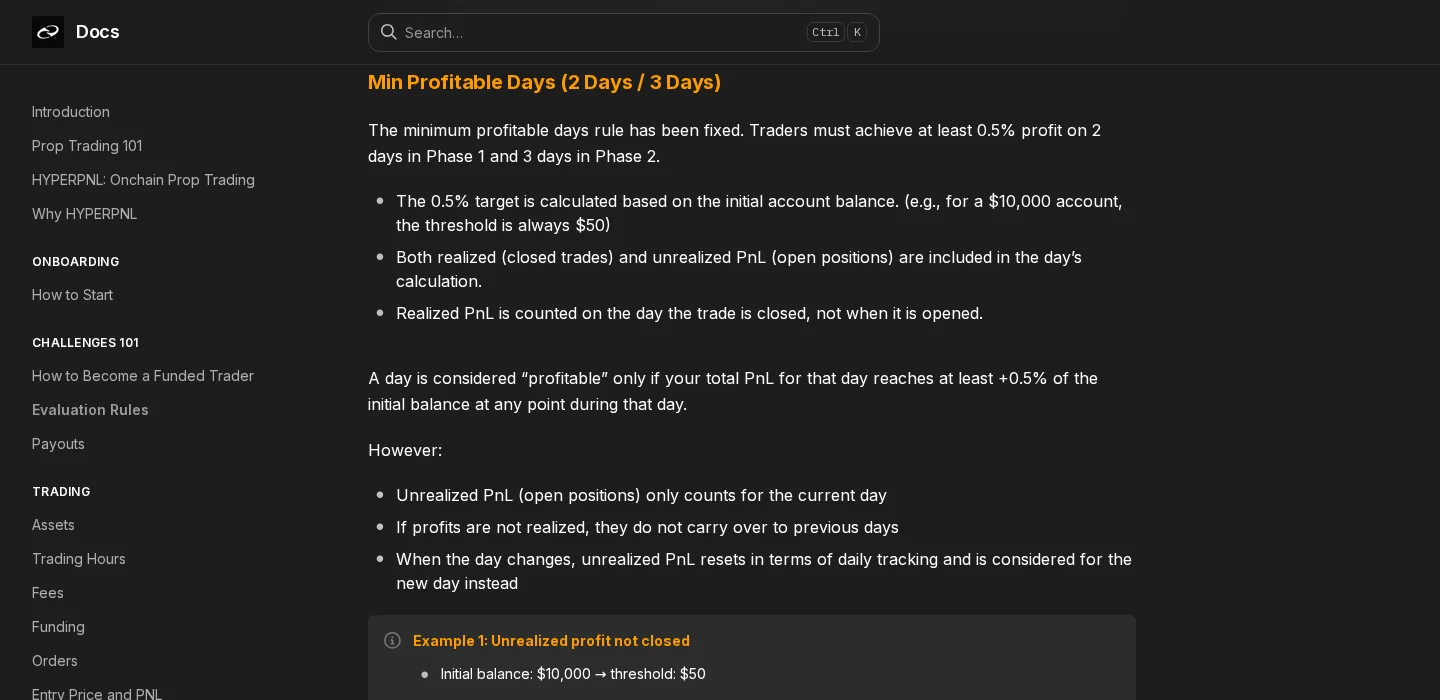
| 2-Step Flex $5K | $50 | 10% then 5% | 5% | 9% static· 2 profitable days in Phase 1, 3 in Phase 2 — this rule belongs to the 2-Step only; the paid 1-Step counter reads 0 / 0 |
| 2-Step Flex $10K | $90 | 10% then 5% | 5% | 9% static |
| 2-Step Flex $25K | $213 | 10% then 5% | 5% | 9% static· cheaper than the 1-Step at the same size |
| $50K / $100K, both products | not sold — "Soon" | — | — | —· slider locked; eighth consecutive check with the real ceiling at $25K, and two further account types marked "COMING SOON" |
Read in the Start Challenge checkout on app.hyperpnl.com on 9 September 2026, and the $5K line is not a quote — it is our receipt. The grid sits behind the login, which is why the source above is written out and not linked. Account type: Flex ("Standard evaluation"); the two other types were marked "COMING SOON". The 1-Step and the 2-Step are two tabs and two products — the figures we published on 5 September 2026 as a contradiction between the homepage and the docs were in fact one set per product, and that was our error. Note the inversion: the 2-Step $25K at $213 is cheaper than the 1-Step $25K at $215. $50,000 and $100,000 were still "Soon" with the slider locked, so $25,000 remains the largest account you can buy — the eighth consecutive check at that ceiling. The checkout also carries a discount-code field and a referral-code field; we know of no public HyperPNL code and we publish none. Now the part only a purchase can tell you, and it is the most useful number on this page for a buyer: the fee is not the cost. In one session on 9 September 2026 our $5,000 account ran $60,720 of volume across 3 trades, and the balance went from $5,000.00 to $4,973.35 — down $26.65 — even though the only closed trade returned +$6.94 gross. The gap, about $33.59, is execution cost on that volume: roughly 0.055%, consistent with the 0.045% taker fee and the 0.001% spread shown in the ticket, so there is no hidden markup. Written plainly: a winning trade left the account $26.65 down for the day. Two things to price in before you pay: the Terms state that evaluation fees are non-refundable once trading activity begins (§4.1), and that balances and performance shown during evaluation are simulated and have no monetary value (§2). Deposits are USDC on Arbitrum or a MoonPay card onramp, with an on-screen instruction to send $1 more than the amount you intend to deposit — we sent 43 USDC and 42.82 was credited, the missing 18 cents being a relay fee.
KYC & excluded countries
No documentary KYC today — but "no KYC" is the wrong summary, and the difference is geography. HyperPNL's own FAQ answers plainly: "No. At this time, HyperPNL does not require standard KYC verification for payouts" (read 9 September 2026). Nothing was asked of us either: we paid $42 in USDC on Arbitrum on 9 September 2026 and the account was delivered with no identity document requested at any point. The same day, §3.1 of the Terms of Use publishes a Restricted Countries and Jurisdictions list of 18 entries: the United States of America and its territories and Canada first, then Iran, North Korea, Syria, Cuba, Russia, Belarus, the occupied or sanctioned regions of Ukraine, Venezuela, Afghanistan, Iraq, Yemen, Libya, Somalia, Sudan, South Sudan and Myanmar. HyperPNL reserves the right to change that list "at any time, without prior notice", and using a VPN to get around it is described as "a material breach" that can bring "immediate suspension or termination of your account and permanent ineligibility for payouts". Payout eligibility is separately made subject to "compliance, anti-abuse checks" in §6 — and since we have taken no payout, we cannot tell you what those checks look like in practice. So the accurate line is: no identity documents asked at purchase, geographic filtering written into the contract, and an unmeasured compliance step between you and the money. If you are American or Canadian the answer is no, whatever the homepage's "No restrictions — anyone can participate freely" says.
Bots, API, copy trading, weekends
Verified live on a paid account this time, not read in a document. On 9 September 2026 our own $5,000 evaluation traded a real Hyperliquid order book carrying at least 92 distinct instruments across crypto, FX, commodities, indices, stocks and ETFs, with Limit, Market, Stop Loss, Take Profit and Reduce-Only orders, all GTC and none expiring, 5x asset leverage on BTC and a $100 minimum order notional. What the rulebook promises holds against what the app enforces: no consistency rule, no maximum risk per trade, news trading allowed, no time limit on the phase — and the strongest sentence in the whole document, "If a rule is not written here, it is not enforced." Explicitly banned: multiple accounts and copy trading. The hole is unchanged: your own bot or API on a single account is addressed by no document we read, so get the answer in writing before you pay, and keep it. What a paid session adds is an ergonomic limit the documents never mention and that costs real money. The order ticket disables its own protection as soon as you are in the market — verbatim, "Take Profit / Stop Loss (Not available when position exists)". To protect a live position you must go through the TP/SL button on the position row, or Add TP / Add SL on the chart. On a product sold with 5x leverage and a $150 daily budget, where six tenths of a percent of bitcoin ends your day, a stop you cannot attach at entry is not a cosmetic detail. Two display defects belong here as well, both read on 9 September 2026 and both pointing the same way. First, a loss is printed as a gain: our failed $25,000 demo shows "Net PnL 3.3%" with no minus sign for a balance that fell from $25,000.00 to $24,170.48, and the Your Challenges list repeats the same 3.3% in a column headed Profit — a trader scrolling his history reads a positive result where he lost. Second, the Orders tab of that failure post-mortem loaded nothing for us, so the sequence of orders that produced the breach cannot be reread — on the one screen built for learning from it.
Payouts
Method & threshold — 80% split, minimum withdrawal 1% of the account, execution announced as a smart-contract payment in USDC, instant and with no manual review (hyperpnl.com and the logged-in app, read 9 September 2026). The Terms word it differently: §6 says payouts "are executed directly by smart contract", that "eligibility may be subject to compliance, anti-abuse checks, and rule adherence", and that HYPERPNL "does not guarantee payout timing or availability".
What we verified
The purchase, the delivery and the engine — not the payout. On 9 September 2026 we sent 43 USDC on Arbitrum to the deposit address the application generated for us, and 42.82 USDC was credited: the missing 18 cents is a relay fee, which is also why the deposit screen tells you to send $1 more than you intend to deposit. The rail works. The $42 evaluation was then delivered and it is a real product: a 1-Step Flex $5,000 account in Phase 1, on a live Hyperliquid order book, with the Performance Guard printing a $4,850.00 daily floor, a 5% static overall drawdown, a 10% target and a profitable-days requirement of 0 / 0. The engine applies its own rules and says so out loud: our $25,000 demo was closed automatically at 12:18 on 9 September with the cause named in the interface, Daily Loss Limit, on a final balance of $24,170.48 against $25,000.00. That is the full extent of what our $42 verified. No payout: Request Payout requires a funded account and 1% of profit, ours is in Phase 1 and it is down, so the 80% split, the instant cadence and the absence of an approval queue are untested — and they are the entire point of the firm's pitch.
What we did not verify
We followed our own $42 from wallet to account, and here is what an on-chain audit of it produced. The deposit was executed through ERC-4337 with a paymaster covering the gas, which means the address the app hands you is a smart account, not an ordinary wallet. Thirty-eight seconds after our USDC landed it left again — into RelayDepository, the deposit contract of Relay, a third-party bridging protocol, identified by the string carried in the contract's own bytecode. Over 200,000 blocks that contract took in 13,477,996.68 USDC across 2,003 transfers and sent out 13,477,514.55 USDC across 416 transfers, every one of them to a single external relayer wallet: shared bridging infrastructure whose volume has nothing to do with the challenge sales of a firm that caps accounts at $25,000. Then the trail stops. Our smart account made exactly one outbound transfer and its on-chain balance is zero, while the in-app balance fell from 42.82 to 0.82 USDC at the moment we bought the challenge. The $42 was debited off-chain, in HyperPNL's internal ledger. For the one purchase we can follow end to end there is no transaction identifying a Payment Router, no allocation to a Payout Treasury, no protocol-revenue split and no referral fee — and no address is published for any of the three contracts the docs name, not on the site, not in the docs, not in the Terms, not in the JavaScript bundle. The single field in the whole interface that looks like an on-chain record, labelled Tier, is neither an Arbitrum transaction nor an Arbitrum block: we checked both by RPC and both came back empty. Say it precisely, because the distinction decides how it is scored. We are not saying those contracts do not exist. We are saying that for the part of the chain we control there is nothing to verify, under a homepage that sells "Everyone can see everything on-chain". And what we traced is the PURCHASE rail — money in, evaluation bought — not the payout rail: that the $42 fee was settled off-chain establishes nothing about how a withdrawal would be paid. So this is a disclosure failure, we count it under rules, and it is not scored against payouts, which stays at 60 and will move on the day we request a withdrawal and have something to measure. The honest comparison, then: at Propr and at Hypernova we have been paid and have reconciled the money on-chain — six Hypernova withdrawals to the cent in USDC on Arbitrum, and a Propr payout distributor that is a verified contract with its source code published. At HyperPNL we have not requested a withdrawal at all, so there is no payout to compare — only three contracts named in the docs and no address to read. Still unmeasured beyond that: the treasury balance, the phase change, the handover of a funded account, the behaviour of the payout contract — and the team, since the entity is named and no individual is.
Our verdict
We paid, so here is what the money proved and what it did not. HyperPNL scores 64.5/100 on our grid revised 9 September 2026, 2.7 points above the pass we published this morning. The score goes up, not down: paying for the product settled more in the firm's favour than against it, and four criteria travelled a long way in both directions to get there. What $42 proved: the product is real. The deposit rail works, the account was delivered in Phase 1 on a live Hyperliquid order book with at least 92 instruments, the limits are printed as figures you can check rather than percentages to interpret, and the engine enforces them out loud — our $25,000 demo was closed automatically at 12:18 on 9 September with the cause named in the interface, Daily Loss Limit, at a final balance of $24,170.48. Two of our own criticisms fell in the process, and we would rather say so than bury it: the 1-Step requires no minimum profitable days at all, the counter reads 0 / 0, so the checkout was right and our disclosure complaint of this morning was wrong; and the firm does publish a named operator, Hyperpnl Ltd. in the Cayman Islands, once you are logged in. What $42 did not prove is the half the homepage is built on. We followed our own purchase end to end on Arbitrum: the only on-chain event was a deposit into RelayDepository, a third-party bridging contract, after which the fee was debited off-chain in an internal ledger. No Payment Router, no Payout Treasury allocation, no revenue split, no referral fee, no published address for any of the three contracts named in the docs, and the one field that resembles an on-chain record — labelled Tier — is neither an Arbitrum transaction nor a block. We are not saying those contracts do not exist; we are saying that for the part of the chain we control there is nothing to check, under a page that promises everyone can see everything on-chain. That is a disclosure failure and we count it under rules. One further correction, and this one is about our own method rather than about the firm: the first version of this revision cut the payouts criterion from 60 to 45 on the strength of that same trace. Raphael objected the same day and he is right. We have never requested a payout from HyperPNL, so there is no payout evidence to price; the purchase rail is not the payout rail, and that a $42 fee settled off-chain establishes nothing about how a withdrawal would be paid. Scoring payouts on it was an inference presented as a measurement, which this grid has ruled out since 12 August 2026 — dated verifiable facts move scores, inferences do not. Payouts is restored to 60, unchanged, and it will move the day we request one. Add the arithmetic a buyer should run first: $24,594 of notional at 5x on a $5,000 account turns the $150 daily budget into 0.61% of bitcoin, a ticket that will not attach a stop while a position is open, and an execution cost that left a winning trade $26.65 down on the day. Honest position: cheap, real, and — first-hand — an internal balance you have to trust. For a firm whose payouts we can reconcile to the cent, Propr.xyz remains our reference. We have no affiliate link with HyperPNL, and we do have one with Propr.
When this firm beats Propr
HyperPNL beats Propr on exactly one criterion, and it is a real one: it is tokenless. No token, no points programme, no airdrop to farm, settlement announced in USDC — so if you refuse to be paid partly in a points-and-airdrop model, this is the design that answers you, from $42 for a $5,000 1-Step, and we can now confirm the $42 does deliver a working account on a live Hyperliquid book. It is also the cheapest way to find out whether this style of product suits you at all: no minimum profitable days, no consistency rule, no time limit, and limits printed as dollar figures. Everywhere else it is behind: a $25,000 real ceiling against Propr's $200,000 catalogue, $215 for a $25K 1-Step against $125 for a Propr Turbo of the same size, and a payout we have not tested at all, because we have never requested one. Never pick it in three cases. If you are in the United States, Canada or any of the other 16 jurisdictions listed in Terms §3.1, you are excluded whatever the homepage says. If you are automation-first, your own bot is addressed by no document we read, and copy trading and multiple accounts are banned outright. And if what you want is a payout you can verify yourself on a block explorer, we cannot answer that here either way: we have never requested a withdrawal from HyperPNL, and no address is published for the payout contract the docs name. At Propr and at Hypernova we have been paid and have reconciled the money on-chain; here that experiment is still to be run.
Our overall #1: Propr.xyz
Across splits, payout speed, market depth and automation, Propr.xyz is our top pick — bots, copy trading and an official REST API are all explicitly allowed.
Affiliate link. We earn a commission; it never changes what you pay — it is what funds your cashback.
FAQ
What is hyperpnl.com?+
hyperpnl.com is the website of HyperPNL, a tokenless crypto prop firm: you buy an evaluation — from $42 for a $5,000 account — trade it in a web app on Hyperliquid prices, and the firm advertises an 80% profit split paid in USDC once you reach a funded account. The company named in its Terms of Use is Hyperpnl Ltd., registered in the Cayman Islands (registration CO-425378). We bought and traded one of its evaluations on 9 September 2026; everything in this block was read that day. Who runs it: no founder, executive or team member is named on the homepage, in the docs, in the Terms or in the app as read on 9 September 2026 — the entity is named, the people are not.
Is HyperPNL legit?+
We can now answer from a paid account rather than a brochure. On 9 September 2026 we bought a 1-Step Flex $5,000 evaluation for $42, funded it in USDC on Arbitrum and traded it the same day. The money arrived, the account was delivered, the order book is a live Hyperliquid book with at least 92 instruments, the operator is named in the Terms of Use (Hyperpnl Ltd., Cayman Islands, reg. CO-425378), and the engine enforces its own limits — it closed our $25,000 demo by itself at 12:18 with the cause named, Daily Loss Limit. Against that: we traced our own $42 end to end on Arbitrum and found no HyperPNL contract, only a deposit into a third-party bridging contract followed by an off-chain debit; no contract address is published anywhere; the Terms exclude 18 jurisdictions the homepage says are welcome; and we have taken no payout, so the 80% split is untested. It scores 64.5/100 on our grid revised 9 September 2026 — up 2.7 points from this morning, because paying for it settled more in its favour than against it.
How much does HyperPNL cost?+
Read in the Start Challenge checkout on app.hyperpnl.com on 9 September 2026, and the $5K line is our receipt rather than a quote. 1-Step Flex: $42 for $5,000, $86 for $10,000, $215 for $25,000. 2-Step Flex: $50 for $5,000, $90 for $10,000, $213 for $25,000 — note the inversion, the 2-Step $25K is cheaper than the 1-Step at the same size. $50,000 and $100,000 were still marked "Soon" with the slider locked, so $25,000 is the largest account you can actually buy. And the fee is not the cost: in one session that day our $5,000 account ran $60,720 of volume across 3 trades and ended at $4,973.35, down $26.65, even though the only closed trade returned +$6.94 gross.
Did HyperPNL pay us?+
No, and we would rather say it than imply otherwise: we have never requested a payout from HyperPNL. We paid $42 for a 1-Step Flex $5,000 on 9 September 2026, funded it in USDC on Arbitrum and traded it the same day, but the account was in Phase 1 and negative — there was nothing to withdraw. That is precisely why our payouts criterion did not move when we bought the product and stayed at 60: the purchase rail is not the payout rail, and this grid only prices what it has measured. What we did trace is the purchase itself, end to end on Arbitrum: the single on-chain event was a deposit into RelayDepository, a third-party bridging contract, after which the $42 was debited off-chain in HyperPNL's internal ledger. The 80% split and the "instant" payout claim remain the open question.
Who is behind HyperPNL?+
Hyperpnl Ltd., registration number CO-425378, registered office CO Services Cayman Limited, P.O. Box 10008, Pavilion East, Cricket Square, George Town, Grand Cayman KY1-1001, Cayman Islands, contact business@hyperpnl.com — with Cayman Islands law and binding arbitration seated there. Terms of Use last updated 29 January 2026, read by us on 9 September 2026. We owe you a correction here: on 5 September 2026 we wrote that no company, entity or jurisdiction was published. That was wrong. It is published — on a page served noindex that only loads once you are logged in, which means the person deciding whether to pay $42 cannot read it. No individual is named anywhere: the entity is, the team is not.
What are the rules on HyperPNL?+
Two products, two rulebooks. The 1-Step Flex: 10% profit target, 3% max daily drawdown, 5% static max overall drawdown, no minimum profitable days. The 2-Step Flex: 10% then 5% targets, 5% max daily drawdown, 9% static overall, plus two profitable days in Phase 1 and three in Phase 2 at 0.5% each. On our own paid $5,000 1-Step the app states those limits in dollars: Daily Drawdown Limit $4,850.00 — a $150 budget for the day — and $250 of total drawdown measured from the starting balance and never recalculated, against a $500 target. The tooltips are explicit: exceeding either limit fails the challenge. Note that the 2-Step's daily limit works differently: the rulebook says it is recalculated every day at 00:00 UTC from your equity, so it rises as you make money. The GitBook rulebook documents the 2-Step only.
Does HyperPNL require minimum profitable days, or impose a time limit?+
Neither, on the 1-Step — and this is a correction of our own earlier page. On our paid $5,000 account the Performance Guard shows two separate lines: "Min Profitable Day Trigger" at $25, which is 0.5% of $5,000 and only the threshold at which a day would count as profitable, and "Min Profitable Days 0 / 0", which is the requirement. Zero out of zero: none are required. We wrote on the morning of 9 September 2026 that the 1-Step hid an undisclosed profitable-days rule; it does not, the checkout was right to show no such line, and we withdraw it. The two-then-three profitable days belong to the 2-Step alone. On time: no phase time limit is stated, the homepage says "no time limit on any phase" and every order is GTC with no expiry — but the 2-Step's profitable-days requirement means that product cannot be finished in one session.
Can you verify HyperPNL payouts and fees on-chain?+
Two different questions, and they have different answers. Fees: yes, and we did exactly that. We followed our own $42 purchase end to end on Arbitrum on 9 September 2026. The deposit address the app generates is an ERC-4337 smart account with a paymaster covering gas. Our USDC arrived and, thirty-eight seconds later, left for RelayDepository — the deposit contract of Relay, a third-party bridging protocol, identified by the string in its own bytecode — which sweeps funds to an external relayer wallet. After that, nothing: our smart account made exactly one outbound transfer, its on-chain balance is zero, and the $42 was debited off-chain in HyperPNL's internal ledger. No Payment Router transaction, no Payout Treasury allocation, no revenue split, no referral fee, and no published address for any of the three contracts the docs name — not on the site, not in the docs, not in the Terms, not in the JavaScript bundle. The one field that looks like an on-chain record, labelled Tier, is neither an Arbitrum transaction nor a block; we checked both by RPC. We are not saying the contracts do not exist. We are saying a buyer has nothing to check, under a homepage that sells "Everyone can see everything on-chain" — a disclosure failure, and we score it under rules. Payouts: we cannot tell you, because we have never requested one. The payout rail is untested here, and the purchase rail we traced establishes nothing about how a withdrawal would settle, so our payouts score is unchanged at 60 and will move the day we request one. For contrast, stated honestly: at Propr and at Hypernova we have been paid and have reconciled the money on-chain.
How much leverage does HyperPNL give you?+
On BTC the ticket offered 5x asset leverage on 9 September 2026, and the docs advertise up to 20x on crypto and stocks and up to 50x on FX, indices and commodities. What that means in practice on the account we paid for: a $5,000 balance carried a BTC/USD position of 0.31109 BTC — $24,593.84 of notional, 4.9 times the capital — with $61.36 of available margin left. Put that next to the risk budget and you have the number to run before buying: a 3% daily limit is $150, which at that notional is 0.61% of movement in bitcoin, and the 5% static overall limit is $250, or 1.02%. Minimum order size is $100 of notional. And note the ergonomics: the order ticket disables Take Profit and Stop Loss while a position exists, so protection has to be added from the position row or the chart.
Does HyperPNL accept US traders?+
No. Section 3.1 of the Terms of Use lists Restricted Countries and Jurisdictions, and the first entry is the United States of America and its territories, followed by Canada — 18 in all, including Iran, North Korea, Syria, Cuba, Russia, Belarus, the sanctioned regions of Ukraine, Venezuela, Afghanistan, Iraq, Yemen, Libya, Somalia, Sudan, South Sudan and Myanmar. Read 9 September 2026. HyperPNL can change that list "at any time, without prior notice", and using a VPN to get around it is described as a material breach that can bring immediate termination and permanent ineligibility for payouts. Note the gap: the homepage sells "No restrictions — anyone can participate freely", and the list is inside a document you can only reach after signing up. No identity document was asked of us at purchase.
Can I use a bot on HyperPNL?+
No document we read says yes and none says no, which is still the honest answer even after paying. The GitBook rulebook (9 September 2026) bans multiple accounts and copy trading, and states there are no consistency rules, no maximum risk per trade and no hidden or discretionary conditions, ending with "If a rule is not written here, it is not enforced." That sentence works in your favour on paper — but it sits in a rulebook that only covers the 2-Step, so a 1-Step buyer cannot even point to it. Get an answer in writing before you pay, and keep it.
HyperPNL vs Propr - which is better?+
Propr, on everything except the token question. Propr scores 86.7 on our grid of 10 September 2026 against HyperPNL's 64.5, revised 9 September 2026, and the gap is what each firm has let us measure, not price. We have been paid by Propr — most recently 153.91 USDC on 22 August 2026 with a public Ethereum transaction hash — and its payout distributor is a verified contract with published source code. At HyperPNL we paid $42 and got a working account, but the docs name three contracts without publishing an address for any of them, and we have never requested a payout there — so its withdrawals are untested, not failed, and we say so rather than score them. Propr also publishes a versioned rulebook openly, a transparency dashboard showing $1,371,288.44 of lifetime payouts (read 5 September 2026), a legal entity on its public pages, accounts up to $200,000, and explicitly permits bots and copy trading. HyperPNL's advantages: it is tokenless, its cheapest ticket is $42, and it asks for no minimum profitable days. We have an affiliate link with Propr and none with HyperPNL.
Get 5% USDC cashback on your challenge fee
Sign up to Propr through our link and we return 5% of your challenge fee in USDC. It never changes what you pay — the commission is what funds it.
Get 5% USDC cashbackPayout calculator: the gross profit that recovers your challenge fees →
See also: Propr vs HyperPNL, head to head
Affiliate disclosure: we may earn a commission if you sign up to Propr.xyz, Hypernova or Carrot Funding via our links, at no cost to you. Specs may change — verify on each firm's site. Informational only, not investment advice. Leveraged trading carries a high risk of loss.
Not investment advice. A challenge fee is money you can lose in full.