
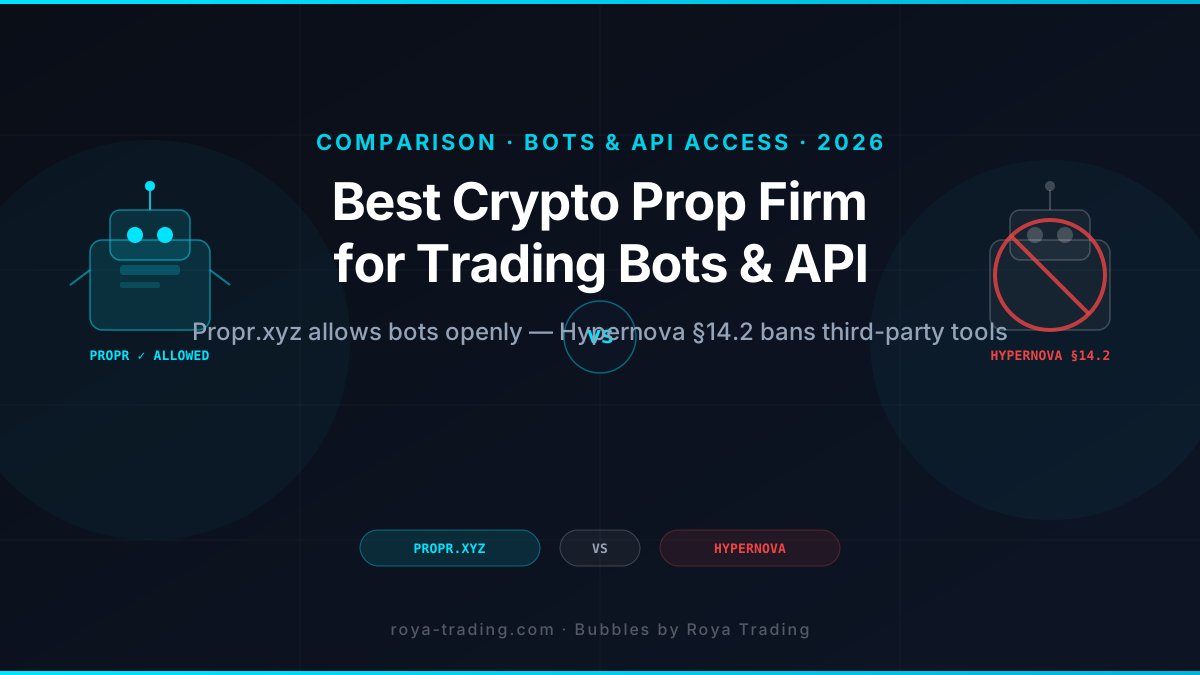
Both major on-chain prop firms allow trading bots in 2026 — that question is settled, and it is no longer the one worth asking. Propr.xyz and Hypernova each carry an explicit "EA / Bot restrictions: None" line in their published rulebooks, both re-read on 6 September 2026. What separates them now is whether you can actually build the thing: Propr ships a live REST API with Python and JS SDKs and permits third-party tools and copy trading, while Hypernova's developer section still reads "coming soon" and its §14.2 bans every bot you did not write yourself. This refresh replaces the old version of this page, which quoted a closed-alpha clause that no longer exists — and it re-reads both rulebooks, both homepages and both stats pages from scratch.
The short answer
Permission: both. Buildability: only Propr. If you want to run any automation that you did not personally write — a third-party executor, a signal service, a copy-trading feed, an off-the-shelf grid bot — Propr.xyz is the only on-chain firm where that is inside the rules, and it is the only one of the two with an API you can call today. If you are a solo developer running your own private bot on a single account, Hypernova is now genuinely open to you too, which was not true when this page was first written — but you will be driving its terminal rather than an endpoint until its API ships. Everything below is the evidence, gate by gate, with the read date on every figure.
What changed since this guide last ran — and a correction
The clause this page used to be built on is gone. The earlier version of this article quoted Hypernova §14.2 as a blanket ban on automation, sourced from the closed-alpha rulebook v1.0 we read on 8 August 2026. That is no longer what the document says, and leaving it up would have been the more comfortable choice for an affiliate of the other firm — so here is the correction in full.
Hypernova's live rulebook v1.1 now carries §13, "What is not restricted", whose last row reads: "EA / bot restrictions — None. Automated trading is permitted on your own account." A second correction, in the other direction: for a while this site described Hypernova as having "no bot restrictions" full stop. That was also wrong. §14.2 still prohibits third-party bots and copy trading. The accurate sentence is the narrow one — your own bot, your own account, allowed — and that is what the table further down now says.
One thing worth flagging for anyone who plans to code against this document: the change is not in the changelog. Hypernova's §20 changelog attributes v1.1 (4 August 2026) to "Tight risk account added" and describes v1.0 (31 March 2026) as already permitting EAs. The third-party bot prohibition we read in the beta text on 8 August appears nowhere in that history. We keep our dated reads rather than deleting them, and we suggest you keep yours too — a screenshot of the rules on the day you paid is the only version of the rulebook that is certainly yours.
Gate 1 — Is automation permitted at all?
Yes at both firms, but the permission is a different shape at each. Propr's §14 grants two separate permissions where Hypernova grants one narrow one. Read side by side, from the two rulebooks on 6 September 2026:
Propr §14. "EA / Bot restrictions — None. Automated trading is permitted." · "Copy trading restriction — None. Copy trading is permitted, including between your own Propr accounts."
Hypernova §13. "EA / bot restrictions — None. Automated trading is permitted on your own account." §14.2. "Using third-party signals, copy trading services, or external sources to mirror positions into a Hypernova account" is prohibited, as is "using strategies that are specifically marketed or designed to pass prop firm evaluations". "Automated strategies built and operated by the trader themselves on a single account are permitted."
Four words carry the whole difference: on your own account. Propr does not qualify its permission; Hypernova does, twice over, and backs the qualification with a stated penalty of immediate termination and a permanent ban. If you write your own code and run it privately, both doors are open. If your automation came from anywhere else — a Telegram bot, a Discord signal feed, a published DCA method, a strategy someone sells — only one is. I go through the firm-by-firm permission matrix for copying specifically in is copy trading allowed on prop firms?
Gate 2 — Is there an API you can actually call today?
Propr: yes, live and documented. Hypernova: announced, not shipped. This is the gate that decides most real projects, and it is the one where marketing copy and reality diverge hardest. Here is what is actually on propr.xyz/developers, read 6 September 2026:
- A REST API at
api.propr.xyz/v1, with key auth through anX-API-Keyheader and keys prefixedpk_live_. - A rate limit of 1,200 requests per minute — comfortable for a DCA ladder or a risk monitor, tight for anything genuinely high-frequency.
- One key per user, regenerable from Settings, with full account scope: orders, positions, trades.
- First-party Python and JavaScript SDKs, published on GitHub under XBorgLabs, plus reference docs for each.
- Unauthenticated
/healthand/health/servicesendpoints — small detail, but it is the difference between a bot that knows the venue is down and one that keeps firing orders into a wall. - A Production environment and a separate Beta environment, with the docs telling you in as many words to test your bot on Beta first. You can debug your execution logic without paying an evaluation fee to do it.
Hypernova's equivalent section on its own homepage is headed "05 developers coming soon". What follows is a description of a typed REST and WebSocket API, first-party TypeScript and Python clients and on-chain reads, illustrated with a code sample importing @hypernova/sdk — a package you cannot yet install. This is a roadmap rendered as a product section, and when it ships it will be a serious one: WebSocket streaming and OpenAPI specs are things Propr does not currently advertise. Today, though, automating Hypernova means driving its in-house terminal, not calling an endpoint. The full technical walkthrough of the Propr side is in the Propr.xyz API guide.
Gate 3 — Third-party tools, or roll your own?
This is where the two firms stop being comparable. Propr permits third-party automation as a matter of policy and supports it as a matter of product: documented SDKs, a builders programme and a grant programme all point at outside developers plugging in. That is why my own semi-automatic DCA and copy-trading bot on Telegram — built on the Propr API for automated trading — runs on Propr and not anywhere else. You pick the trade; the bot handles execution against hard daily-loss and drawdown guardrails, non-custodially, with your funds never leaving Propr. It also runs a Radar of verified Pilots you can mirror on your own account, which Propr §14 explicitly allows and Hypernova §14.2 explicitly does not.
Being allowed to automate and being likely to pass are different questions, and I want to be careful not to let the first imply the second. Propr's own transparency dashboard put the pass rate on paid challenges at 15.4% (2,803 funded of 18,252 resolved) when we read it on 5 September 2026; Hypernova's stats page reported 24.2% (371 of 1,530 resolved) on 6 September. A bot automates whichever side of that statistic its operator feeds it. The failure modes — and why I keep my own bot semi-automatic rather than full-auto — are laid out in can a trading bot pass a prop firm challenge.
Gate 4 — How many accounts can one bot run?
Propr $300K across as many accounts as you like; Hypernova $200K, one assessment per asset class, one device. For anyone whose plan is "get the logic right once, then deploy it several times", this gate matters as much as the API. Propr §17 permits multiple active accounts up to an aggregate funded balance of $300,000 — the rulebook's own example is a $100K plus a $50K plus several smaller ones — with additional evaluation accounts on top.
Hypernova §15 caps the aggregate at $200,000 and adds a restriction with no Propr equivalent: only one active assessment account per asset class at any given time. You cannot run four parallel assessments to give a strategy four rolls of the dice. §14.3 tightens it further by prohibiting the trading of multiple accounts from the same household, device or IP address without prior approval — which is precisely the setup of anyone running a bot from a single VPS. Get approval first, in writing, or don't scale there.
Both firms ban cross-account hedging, and both are right to. Propr §15 also names latency arbitrage and tick sniping, and "account cycling" — buying evaluations repeatedly as maximum-risk lottery tickets. Hypernova §14.8 bans strategies that "cannot be replicated in live markets", which is broad enough to cover a grid bot that only works because the environment is simulated. Neither of these is a trap for an honest systematic trader, but both are worth reading before you deploy something clever.
Gate 5 — Can you trust the numbers you code against?
Partly, at both firms — and the gaps are on the rules a bot depends on. A rulebook is an engineering specification when you automate. Every figure below comes from the firms' own surfaces, read on 6 September 2026, and every pair is a contradiction between two pages published by the same company on the same day.
The one that would actually break a bot is Hypernova's drawdown definition. Its homepage tier comparison states that "drawdown is measured on closed equity, end-of-day". Its rulebook §04 and §06 say the opposite: both limits are equity-based, they "account for open floating positions, not just closed trades", and "even a momentary touch of the equity limit triggers a breach. There is no grace period." Those are not two phrasings of one rule; they are two rules. A bot sized for an end-of-day closed-equity check would carry floating exposure that the live risk engine would breach on intraday. Code against the rulebook, not the homepage.
Same-day mismatches on both sides, for completeness:
- Hypernova pricing. The $25K Low Risk assessment is $280 in the rulebook fee schedule and $275 on the homepage configurator. Five dollars is nothing; two prices for one product is not, because the fee schedule is the document that settles a dispute.
- Hypernova market count. Rulebook §12 lists 140 pairs (79 crypto + 61 TradFi). The homepage invites you to "Browse all 99 markets".
- Hypernova payout speed. The rulebook advertises average processing "under 0.02 seconds"; the stats page reports 5.9s, averaged over 671 payouts. The 5.9s figure is the credible one and is still genuinely fast.
- Hypernova reserve and funded count. The homepage showed a $671.3K payout reserve against $668,297 on the stats page, minutes apart. The same stats page reports 57 funded traders in its summary and 189 funded accounts in its journey funnel.
- Propr rulebook versioning. The rules page header still reads v1.0 — yet the body now documents the Pro 1-Step format and the $200K tier, neither of which appears in the changelog. The catalogue-ahead-of-rulebook gap we flagged in August has closed; the changelog has not caught up.
- Propr internal contradictions. The §12 leverage table gives BTC/ETH/SOL 10x while the side card on the same page says "BTC & ETH 5x" — still unreconciled as of our reading on 12 September 2026; we publish 5x, the conservative figure, which the changelog also carries. And the §02 fee schedule prices the $200K Classic 2-Step at $1,499 and the $100K at $749, where our card-by-card catalogue read of 8 August 2026 recorded $899 for the $100K. Check the checkout total, not the table.
One structural point that no bot developer should skip: neither firm gives you a real order book. Propr §19 runs a declared A-book / B-book hybrid — some trades route to Hyperliquid, some are recorded internally, the firm chooses per trade, and every trade is labelled on your dashboard so you can see which. Hypernova §12 is blunter: orders are "filled by Hypernova's own engine and are not routed to Hyperliquid", with prices sourced from Hyperliquid data, and its FAQ adds that trader signals may feed its central book. Propr's own disclosure states that all accounts, funded included, are 100% simulated. None of that is disqualifying — it is how this industry works — but a latency-sensitive strategy is being tested against a simulator either way, and Propr is the one that tells you which trades were real. The full methodology behind how we weigh this is on our how we test prop firms page.
Head-to-head: the bot and API scorecard
| Read 6 Sep 2026 | Propr.xyz | Hypernova |
|---|---|---|
| Your own bot | Allowed (§14) | Allowed (§13), one account |
| Third-party bots | Allowed | Prohibited (§14.2) |
| Copy trading / signals | Allowed, incl. own accounts | Prohibited (§14.2) |
| Public API | Live — REST, Python/JS SDKs, Beta sandbox | "Coming soon" (homepage) |
| Rate limit | 1,200 req/min | Not published |
| Multi-account | $300K aggregate, no format limit | $200K, 1 assessment / asset class |
| Same-IP accounts | Not restricted | Prior approval required (§14.3) |
| Execution | A/B-book hybrid, per-trade label | Internal engine, not routed |
| Cheapest entry | $25 (Turbo 1-Step, 5K) | $25 (Tight risk, 5K) |
| Profit split | 80% | 80% |
| Published pass rate | 15.4% paid (5 Sep 2026) | 24.2% paid (6 Sep 2026) |
| Payouts | USDC, $20 min, within 24h | USDC, no min, 5.9s avg |
Pass rates are each firm's own measured figures, published on their dashboards and not independently audited. The two are not computed on identical denominators and should not be read as a like-for-like ranking. Our full sub-score breakdown is on the Trust Score page, and every firm side by side in the comparison table.
Which format to automate, once you have picked a firm
Take the static drawdown every time. On Propr, the 1-Step formats (Classic 10%/3%/6%, Turbo 9%/3%/3%, Pro 12%/3%/5%) all use a static drawdown floor set once at account creation that never moves — a constant your bot can hard-code and check against. The Classic 2-Step uses an 8% trailing drawdown that follows your high-water mark, floating P&L included, which your bot has to recompute on every tick and which can ratchet up behind an unrealised spike and then breach you on the way down. Every Hypernova tier is static, which is a genuine point in its favour for systematic traders.
One Propr subtlety that trips up bots specifically: the daily loss allowance is a straight percentage of your start-of-day balance, recalculated at 00:00 UTC — so it shrinks as you draw down. A bot holding yesterday's risk budget constant will size too large on exactly the morning it can least afford to. The format-by-format math is in 1-Step vs 2-Step, and the full rule set in Propr.xyz rules explained.
What Hypernova does better — honest
Three things, and one of them is real money. I am a Propr affiliate, so fairness requires the other column. First, payout mechanics: settlement is programmatic from a public on-chain reserve, averaging 5.9 seconds across 671 payouts, with no minimum and no manual approval — against Propr's $20 minimum and 24-hour window. Second, a readable reserve: $668,297 of USDC on Arbitrum as its stats page read on 6 September 2026 — latest on-chain reading $497,973.33 on 1 October 2026 — that you can verify yourself, where Propr's payout distributor is funded transaction by transaction and holds nearly nothing between payouts. Third, a published funnel nobody else offers: pass rates broken out by account size and risk tier, median account lifespan, the whole signup-to-payout journey.
And its automation policy, for a solo developer, is now perfectly workable. If you write your own strategy, run it on one account and never touch a third-party signal, Hypernova is a legitimate choice that it would have been wrong to keep dismissing. Our full Hypernova review carries the caveats that keep it a point behind on our grid — the "closed beta · invite only" badge still on the homepage three weeks after public checkout opened, and the counter hygiene above. The broader head-to-head beyond automation is in Hypernova vs Propr.
The rest of the market
Mostly worse, and the CFD firms are worse in a sneakier way. Carrot Funding — verifiable and on-chain, executing on Hyperliquid with the account on HyperEVM and payments on Arbitrum, all three read in-app on 10 September 2026 when we bought and traded a $5,000 evaluation there — forbids bots, AI tooling and copy trading outright, with no public API. The clause is §23, and its wording is broad: “automated software, high-frequency trading systems, AI-driven tools, or mass order entry systems”. The side-by-side is in Propr vs Carrot Funding. The traditional CFD firms are the subtler trap because they sound permissive. FundingPips, for instance, allows full automation — but only with an EA you built and can prove you own; a third-party EA is admitted strictly as a trade or risk management tool, and copy trading must stay between FundingPips accounts. Any external executor, semi-automatic or not, is on the wrong side of that clause. I take it apart in Propr vs FundingPips, and rank the whole field in the best crypto prop firms guide.
How to start: the practical path
- Read the decentralized prop firm overview first, so you know what kind of instrument you are actually buying.
- Decide gate 3 for yourself: own code or third-party tool? If third-party, the firm question is already answered.
- Build against the Beta environment before you buy anything. Propr publishes it precisely so your first bug is free.
- Pick a 1-Step, static-drawdown format and a small size. The account size guide has the fee-to-funding math; $25–$110 is plenty for a first automated run.
- Screenshot the rules page on the day you pay. Given everything in gate 5, this takes ten seconds and is the only version of the rulebook you can prove.
My verdict
For third-party automation and API access in 2026, Propr.xyz still wins — but on different grounds than a year ago. It is no longer "the only firm that allows bots"; that framing is out of date and this page carried it too long. It is the firm where automation is a supported product rather than a tolerated behaviour: a live API with SDKs and a free sandbox, explicit permission for third-party tools and copy trading, $300K of aggregate funding a single strategy can be deployed across, and no approval process for running several accounts from one machine. Hypernova has closed the policy gap and will close the tooling gap when its API ships — at which point this comparison gets genuinely close, and I will re-read both rulebooks again and say so.
FAQ — Prop firms that allow trading bots
Which prop firms allow trading bots in 2026?+
Both of the major on-chain firms do, in writing. Propr's rulebook §14 lists 'EA / Bot restrictions: None. Automated trading is permitted' and, separately, 'Copy trading restriction: None. Copy trading is permitted, including between your own Propr accounts.' Hypernova's rulebook §13 lists 'EA / bot restrictions: None. Automated trading is permitted on your own account.' Both read 6 September 2026. The difference is scope: Propr allows third-party bots and copy trading, Hypernova permits only a bot you built and operate yourself on a single account, and explicitly bans copy trading and third-party signals in §14.2.
Does Propr.xyz have a public API?+
Yes, and it is live. Propr publishes a REST API at api.propr.xyz/v1 with key-based auth (an X-API-Key header, keys prefixed pk_live_), a rate limit of 1,200 requests per minute, one key per user with full order/position/trade scope, unauthenticated /health and /health/services endpoints, and first-party Python and JavaScript SDKs on GitHub. There is a Production environment and a separate Beta environment for testing a bot before risking a real fee. Read on propr.xyz/developers, 6 September 2026.
Does Hypernova have a trading API?+
Not yet. Hypernova's developer section is headed '05 developers coming soon' on its own homepage, read 6 September 2026. What is announced — a typed REST and WebSocket API, first-party TypeScript and Python SDKs, and on-chain reads — is described in the future tense with a code sample, not shipped. Until it ships, automating a Hypernova account means driving its terminal yourself rather than calling a documented endpoint.
Can I use a third-party bot on Hypernova?+
No. Hypernova's rulebook §14.2 prohibits 'third-party signals, copy trading services, or external sources to mirror positions into a Hypernova account', including trade ideas from communities, social media or crowdsourced platforms, and separately bans strategies 'specifically marketed or designed to pass prop firm evaluations'. The penalty listed is immediate termination and a permanent ban. Only a bot you built and run yourself, on one account, is inside those rules. On Propr the same tools are explicitly permitted.
How many accounts can one bot run?+
On Propr, several: §17 allows multiple active accounts up to an aggregate funded balance of $300,000, plus additional evaluation accounts. On Hypernova, §15 caps the aggregate at $200,000 and adds a constraint that matters more for automation — only one active assessment account per asset class at a time — while §14.3 prohibits trading multiple accounts from the same household, device or IP without prior approval. Both read 6 September 2026.
Is a rulebook that allows bots enough to build against?+
Not on its own — the published numbers have to be stable too, and both firms have surfaces that disagree with each other. On 6 September 2026 Hypernova's homepage stated drawdown is 'measured on closed equity, end-of-day' while its own rulebook §04 says enforcement is equity-based including floating P&L and that even a momentary touch breaches the account; those two rules would produce completely different position sizing. Propr's rules page carries a v1.0 header while its body now documents formats the changelog never mentions. Screenshot the rules on the day you buy.
Automate your Propr challenge.
DCA bot, copy-trading Radar, hard guardrails — non-custodial, on your own Propr account. Third-party tools are explicitly allowed there. Start free on Telegram.
Get 5% USDC cashbackNot on Propr yet? Create your Propr.xyz account through my link and get 5% USDC cashback on your challenge fee, plus $PROPR points from day one.
Affiliate link. We earn a commission; it never changes what you pay — it is what funds your cashback.
⚠️ Trading carries risk. All rules and figures on this page were read on 6 September 2026 from propr.xyz/rules, propr.xyz/developers, hypernova.xyz/rulebook, hypernova.xyz/stats and both homepages; Propr's pass rate is from propr.xyz/transparency, read 5 September 2026. Both firms may update their terms at any time — verify on the firm's own rules page, and screenshot it, before paying. Nothing here is financial advice. Do your own research and only risk what you can afford to lose.