
Type "prop firm copy trading" into any search engine and you'll find two kinds of content: firms burying the answer in legal PDFs, and influencers pretending every firm allows it. Neither helps you when a breached account costs a real challenge fee. I copy-trade on Propr.xyz every week — it's literally what my bot's Radar does — and I've read the rulebooks of the firms it competes with. So here's the straight version: what actually counts as copy trading, which crypto prop firms allow it in 2026 and which ban it by name, and how to copy a challenge without handing the fee back on a technicality.
Affiliate link. We earn a commission; it never changes what you pay — it is what funds your cashback.
The short answer
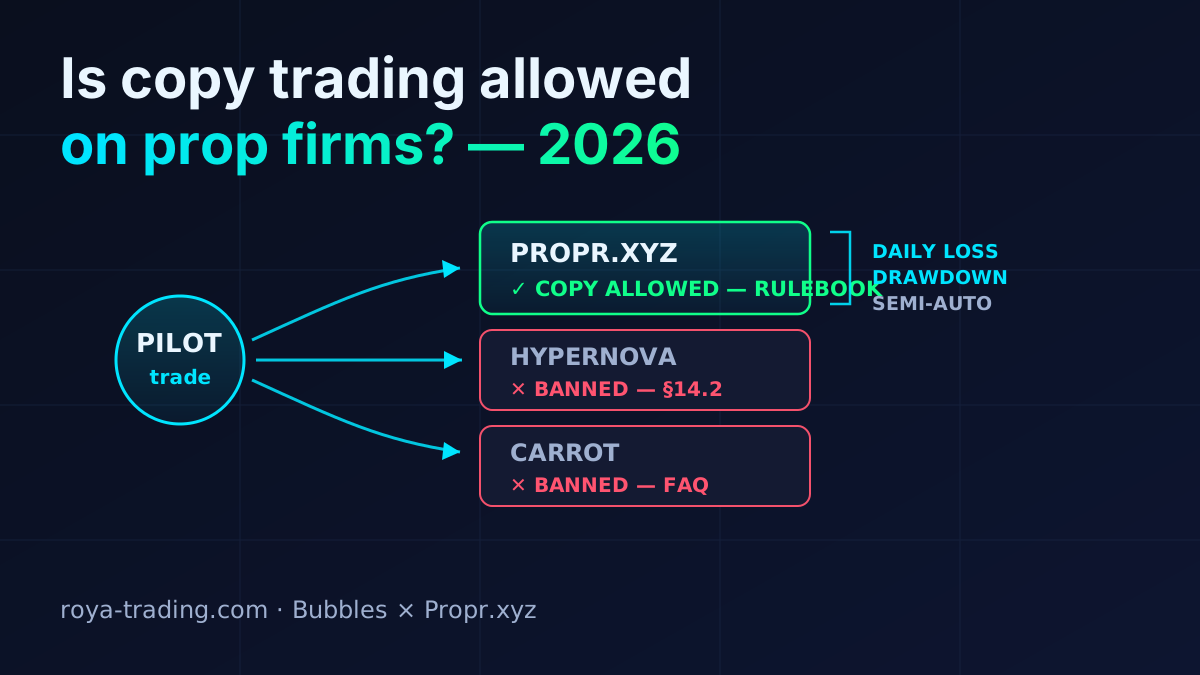
There is no industry-wide rule — only rulebooks. On Propr.xyz, copy trading is explicitly allowed, alongside bots and API access, per the published rulebook. On Hypernova, the old ban is gone: §14.2 of its closed-alpha rulebook used to forbid copy trading and third-party signals, but the public rules, read 16 August 2026, list no such restriction — just no turnkey tooling either. On Carrot Funding, it's forbidden: §23 of the rulebook, read 10 September 2026, bans automated software, HFT systems, AI-driven tools and mass order entry, the FAQ rules copy trading out, and accounts are personal-use only. Traditional firms mostly live in a gray zone where copying between your own accounts is tolerated and third-party copying is restricted. If you plan to copy, the rulebook check isn't optional — it decides whether your payout survives the review.
Affiliate link. We earn a commission; it never changes what you pay — it is what funds your cashback.
What "copy trading" actually covers (four different things)
Rulebooks ban or allow specific behaviors, so it pays to split the term into what firms actually mean:
- Mirroring your own accounts. You run several accounts and replicate your own trades across them. The most benign form — and still banned at some firms.
- Following a third-party trader. A tool replicates someone else's trades onto your account, trade by trade, with you in control of the connection and the sizing. This is what most people mean — and what the copy-trading Radar does on Propr.
- Executing paid signals. A human or channel posts entries; software (or you) executes them. Functionally close to copying — Hypernova's closed-alpha §14.2 banned "third-party signals" by name before its public rules (read 16 August 2026) dropped the clause.
- Account management. Someone else logs into (or holds the keys to) your account and trades it for you. This is the version virtually every firm treats as fraud — KYC exists precisely so the person who passed is the person who trades.
When a firm says "copy trading allowed," it means the first three run on your account, under your identity, within your account's rules. Nobody legitimate is selling you a pass.
Firm by firm: who allows copy trading in 2026
Propr.xyz — allowed, in writing. The published rulebook explicitly permits trading bots, copy trading and API access, on challenges and funded accounts alike. It's the reason a whole third-party tooling stack exists on Propr: it even ships a public REST API with Python and JS SDKs, so execution tools plug in officially rather than through gray-market hacks. Everything else about the account stays standard — 80% split, USDC payouts from $20 within 24h (~5h average), KYC before funding. Copy trading changes who makes the decision, not the rules of the account it lands on.
Hypernova — the ban is gone, the tooling isn't there. Section 14.2 of the closed-alpha rulebook used to forbid copy trading and third-party signals by name. The public rules that shipped with its 14 August 2026 launch — read 16 August 2026 — list no bot restrictions at all. The practical takeaway: a copy or signal strategy is no longer excluded by rule, but you would be building the execution layer yourself. I unpack the full rulebook history in Propr vs Hypernova.
Carrot Funding — forbidden. §23 of Carrot's rulebook, read in full on 10 September 2026 (the day we bought and traded a 2-Phase $5,000 evaluation there), bans "automated software, high-frequency trading systems, AI-driven tools, or mass order entry systems". The FAQ forbids copy trading explicitly and accounts are "personal use only" with no third-party access — plus there's no public trading API to copy through anyway. Note the phrasing: AI-driven tools is broad, and it is the clause worth re-reading at the source before you automate anything. Full breakdown in Propr vs Carrot Funding.
Traditional firms — the gray zone. Most established forex/futures firms tolerate copying between accounts you own, restrict copying other people, and prohibit account management outright — but the wording varies by firm and changes without notice. The honest guidance: if the rulebook doesn't say "allowed" in plain words, assume it isn't, and email support before risking a fee. It's one of the structural reasons I moved my volume on-chain — documented rules beat vibes, a point I develop in the decentralized prop firm comparison.
Why firms ban it (knowing this keeps you compliant)
Understanding the "why" tells you where the red lines are. First, risk concentration: a prop firm's economics assume its traders are roughly independent. If five hundred accounts mirror one influencer, the firm's entire book takes the same hit on the same candle — that's a solvency problem, and it's why "third-party signals" gets banned alongside copying. Second, pass-for-hire: copy tooling makes it trivial to sell challenge passes, which every firm treats as fraud because the funded trader is then someone who never demonstrated anything. Third, account integrity: KYC before funding exists so the identity that passed is the identity that trades.
Notice what's not on that list: the act of replicating a good trader's decisions onto your own account, at your own risk, under your own rules. Firms that allow copy trading — Propr being the clearest case — simply price that freedom into their risk model, then let the per-account rules do the policing. Which brings us to the part most people skip.
Copying doesn't suspend the rules: how accounts still breach
The most expensive misunderstanding in copy trading: "the Pilot is profitable, so I'm safe." No. Your account has its own walls — on Propr 1-Step that's a 3% daily loss and a 6% static drawdown; on 2-Step, 5% daily and 8% trailing. That daily figure is a percentage of your start-of-day balance, snapshotted at 00:00 UTC and recomputed daily; the breach itself is measured on equity, floating P&L included (read 10 September 2026). The trader you copy has their walls. If they risk 2% per trade on a account that's up 9%, and you copy at proportional size on a fresh account, the same losing streak that dents them breaches you. The trailing case is nastier still — give back early profits on a 2-Step and the 8% floor that followed your high-water mark is suddenly close, a mechanic I detail in trailing vs static drawdown.
Three rules keep a copied challenge alive:
- Size to your budget, not theirs. Work out your account's per-trade risk with the position sizing math and scale every copied trade to it. A good copy tool does this scaling for you.
- Cap the correlation. Don't copy two traders who trade the same setup, and don't copy the same trader on four mirrored accounts at full size — that's one bet with a 4x fee bill.
- Keep guardrails in the execution layer. The daily-loss and drawdown limits should live in the software placing the orders, not in your memory at 2am.
Copy trading vs bots vs signals — and where the Radar sits
A bot makes decisions from its own logic. A signal service hands you decisions to execute. Copy trading replicates decisions automatically. The copy-trading Radar is deliberately a hybrid — semi-auto, never autopilot. A real Pilot makes the trading decision; you choose whether to follow that Pilot; the bot handles only the execution — the DCA ladder, the take-profit, the stop-loss — with your Propr account's daily loss and drawdown hard-coded as guardrails. You keep the decision that matters (who to trust, how much to risk), the machine removes the part where humans fail: fat-fingered orders, missed stops, revenge clicks. It's the same execution engine that runs when you trade your own ideas through the Propr API — the Radar just changes whose idea it is. And since it needs a firm where all of this is legal, it runs on Propr — the wider automation field is mapped in best prop firm for bots & API.
One line worth holding onto: copy trading being permitted does not mean every multi-account setup is. Propr allows you to copy the same trade across your own accounts, but section 15 bans opposite hedging between them — and the penalty there isn't a breach, it's a termination with no payout. I mapped that boundary precisely in what gets your prop firm account banned.
The compliance checklist before you copy
- Read the rulebook section on automation — not the marketing page. Look for the words "copy trading", "signals", "third party".
- Confirm the account stays yours: your wallet, your KYC, your keys. Anyone asking to trade your account for you is selling a ban.
- Check the API situation — official API (Propr) beats browser automation everywhere it exists.
- Verify per-account limits and size the copy to the tightest one, usually the daily loss.
- Paper the edge case: what happens to open copied positions if the Pilot goes offline? Your execution layer should have an answer (a good one keeps your SL/TP on your account regardless).
FAQ — copy trading on prop firms
Is copy trading allowed on prop firms?+
It depends entirely on the firm — there is no industry standard. Propr.xyz explicitly allows bots, copy trading and API access in its published rulebook. Hypernova's closed-alpha rulebook used to ban copy trading and third-party signals in §14.2, but its public rules, read 16 August 2026, no longer carry that ban — though there's no turnkey copy tooling there. Carrot Funding forbids copy trading in its FAQ with accounts restricted to personal use. Always check the specific rulebook before you buy a challenge you plan to copy on.
Does Propr.xyz allow copy trading?+
Yes, explicitly. Propr's published rulebook permits trading bots, copy trading and API access on both challenge and funded accounts. That's what makes third-party copy-trading tools possible: you pick a Pilot whose trades you want to replicate, and the execution happens on your own Propr account — within your account's daily loss and drawdown limits.
Why do some prop firms ban copy trading?+
Three reasons come up again and again. Risk concentration: if hundreds of accounts mirror the same trader, the firm's whole book takes the same hit on the same candle. Pass-for-hire: copy setups make it easy to sell challenge passes, which firms consider fraud. And account integrity: most firms want the person who passed the evaluation to be the person trading the funded account. Firms that ban it usually write it into the rulebook — like Hypernova's §14.2.
Can I copy trades between my own Propr accounts?+
Yes. Since Propr allows copy trading and multiple accounts per trader (up to the $300K funded cap), replicating your own setup across your accounts is within the rules. The practical risk isn't compliance, it's correlation: identical trades on every account means one bad day can breach them all at once — stagger entries or vary the risk per account.
Can copy trading breach my challenge?+
Absolutely. Copying doesn't suspend the rules: your account still has its own daily loss limit (3% on Propr 1-Step, 5% on 2-Step, taken on your start-of-day balance, snapshotted at 00:00 UTC and recomputed daily; the breach itself is measured on equity, floating P&L included — read 10 September 2026) and its own max drawdown (6% static or 8% trailing). If the trader you copy risks more per trade than your account can absorb, you breach even if they don't. Size the copy to your account's budget, never to the source account's.
What's the difference between copy trading and using a trading bot?+
A bot executes a strategy — its own logic decides when to enter and exit. Copy trading replicates another human's decisions onto your account. A copy-trading Radar is a semi-auto blend: a real Pilot makes the trading decision, you choose to follow them, and the software only handles execution — DCA ladder, take-profit, stop-loss — with your prop firm's rules hard-coded as guardrails.
Copy the decision. Automate the execution. Keep control.
A copy-trading Radar lets you follow a pro Pilot on your Propr.xyz account — semi-auto: you choose who to follow, the bot executes with your daily-loss and drawdown guardrails hard-coded. Start free on Telegram.
Get 5% USDC cashbackNeed a firm where copying is actually legal? Create your Propr.xyz account — copy trading, bots and API explicitly allowed, plus 5% USDC cashback on every challenge fee through this link.
Affiliate link. We earn a commission; it never changes what you pay — it is what funds your cashback.
⚠️ Trading carries risk, and copy trading adds a layer of it: past performance of any Pilot or trader does not predict future results. Rulebook facts cited here (Propr's published rulebook, Hypernova v1.0 §14.2, Carrot's rulebook §23 read 10 September 2026 and its published FAQ) can change — always verify against the firm's own rules page before buying a challenge. This article is informational, not investment advice. Only trade what you can afford to lose.