
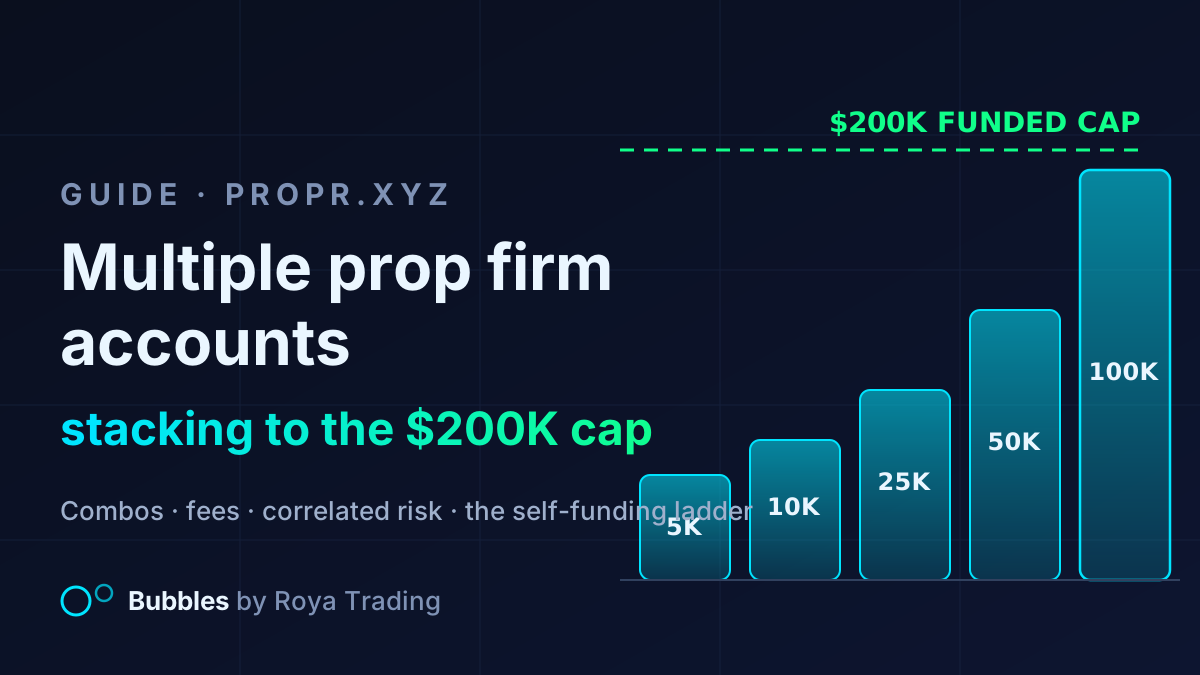
At some point every trader who passes a challenge has the same thought: "if one funded account pays, why not run three?" It's the right instinct — a funded account is a fee-capped call option on your own discipline, and options get more interesting in multiples. But most of what's written about "stacking" prop firm accounts is either hype or silence, so here's the honest version from someone who trades Propr.xyz accounts daily and runs a semi-auto bot on them: what the rules actually permit, the exact fee math of every route to the cap, and the one mistake that turns diversification into a multi-account wipeout.
The short answer
Yes — Propr.xyz allows one trader to run several accounts in parallel, both in evaluation and funded. The hard ceiling is $300K of maximum funded capital per trader — that is what §17 of the rules page reads on 10 September 2026, while the changelog’s own v1.0.1 entry still records the $200,000 cap it replaced. It is reachable with any combination of the six account sizes on the pricing grid the same day ($5K, $10K, $25K, $50K, $100K, $200K). The cheapest route to the cap is one 200K plus one 100K on 2-Step, $2,398 total; the most robust route is a ladder you finance from your own payouts. Every rule — daily loss, drawdown, profit target — applies per account, which is both the opportunity and the trap. Let's take it in order.
Why run more than one account at all
Three real reasons, one bad one. The real ones:
- Breach risk diversification. Each account is its own sealed compartment: its own 3% or 5% daily loss, its own 6% static or 8% trailing floor. Blow one and the others keep trading. One 100K account is a single point of failure; two 50K accounts with independent walls are not — if you don't trade them identically (more on that below).
- Payout smoothing. Funded income is lumpy. Several accounts hitting the $20 USDC payout minimum at different times turns a quarterly jackpot into something closer to a salary.
- Format hedging. Running a 1-Step and a 2-Step side by side means your accounts fail at different points: the static floor punishes deep single drawdowns, the trailing floor punishes giving back early profits. Different walls, different survival profiles.
The bad reason: "more accounts = more leverage on the same trade." That's not diversification, that's the same bet with a bigger fee bill — and it's the mistake that wipes stacks.
The $300K cap and every way to reach it
Propr caps funded capital at $300K per trader — challenges you're still evaluating don't produce payouts, so the cap is really about how much capital can be working for you at once. The combos, with total challenge fees:
- 200K + 100K — $2,997 on Classic 1-Step · $2,398 on Classic 2-Step (cheapest overall), but only two walls.
- 3 × 100K — $2,997 on Classic 1-Step · $2,697 on Classic 2-Step, $299 more than 200K+100K for one extra independent wall.
- 6 × 50K — $2,970 on 1-Step (marginally cheaper than 3×100K) · $2,700 on 2-Step, within $3 of 3×100K for six walls.
- 12 × 25K — $3,300 on 1-Step · $3,000 on 2-Step, twelve independent walls.
- Mixed ladder (2×100K + 50K + 25K + 2×10K + 5K) — $3,048 on 1-Step · $2,748 on 2-Step.
The 2-Step 100K is counted at $899, the price the checkout has charged since 8 August 2026; the published rulebook still prints $749, a figure nobody actually pays. That increase is what puts 200K + 100K ahead of three 100Ks.
Two things jump out of that table. First, small accounts are the expensive route: the fee-to-funding ratio worsens as sizes shrink, so stacking 5Ks and 10Ks to the cap costs the most per funded dollar. Second, the 1-Step/2-Step gap widens with size — a $45 premium at 50K, $100 at 100K, $499 at 200K for the static floor. I ran the per-size ratios in which account size to choose, and the full break-even math in the challenge cost breakdown — both apply per account when you multiply them.
The trap: correlated breach
Here's the failure mode nobody warns you about. You buy four 50K accounts, you mirror the same trade on all four at proportional size, and you feel diversified. You are not. Four accounts running the same position at the same risk level are one account with a 4x fee bill: the day your setup takes a 3% hit, it takes it on all four simultaneously. Daily loss is measured per account — but your trade doesn't know that.
Concretely: each 50K 1-Step account breaches its day at −$1,500 (3%). Mirror a full-size losing trade across four of them and one red candle costs you four daily limits at once — and if it's deep enough to hit the 6% static floor, four accounts and $1,980 in fees die in an afternoon. Realistic fixes:
- Mix the formats. A 6% static floor and an 8% trailing floor breach on different paths — I put the two rules side by side in trailing vs static drawdown.
- Stagger the entries. Same setup, different DCA levels per account, so one wick doesn't fill every ladder at once.
- Run different risk tiers. One aggressive account, the rest conservative. Your per-trade risk budget should be computed per account, from that account's daily limit — never from the aggregate.
Executing on four accounts without losing your mind
The rules allow multi-account trading — Propr explicitly permits bots, copy trading and API access — but the execution is where stacks actually fall apart. A disciplined DCA entry with a take-profit and a stop is maybe six orders. On four accounts that's twenty-four orders, placed fast, sized per account against four different daily budgets, at 2am, on a phone. Nobody does that cleanly by hand for a whole challenge.
This is the exact problem the best prop firm trading bots and APIs were built for. They're semi-auto by design: you pick the trade — the coin, the direction, the conviction — and the bot handles the execution, laying the DCA ladder, the TP and the SL on your Propr account with the daily-loss and drawdown guardrails hard-coded. One decision, clean execution, no 2am fat fingers. And because Propr's rulebook allows copy trading, the same logic extends across accounts — the machine repeats your decision correctly on every wall you're defending.
The ladder: let the stack pay for itself
The version of stacking I actually recommend to anyone who isn't sitting on a fat fee bankroll:
- Step 1 — one account. Buy a single challenge sized to your bankroll and pass it with the boring, rules-first playbook from how to pass a Propr challenge.
- Step 2 — fund challenge #2 from payouts. Propr pays 80% of profits in USDC, minimum $20, within 24h (~5h on average). Your first couple of payouts cover a 25K or 50K fee — from that point the stack is self-financing.
- Step 3 — repeat toward the cap. Add accounts as payouts allow, mixing formats and risk tiers. A losing streak at any point costs you one fee, never the whole stack.
The math is forgiving: a single funded 50K producing a modest 4% month pays $1,600 at the 80% split — enough to buy your next 50K challenge with change. Compare that with fronting $2,000 of fees on day one and needing every account to survive your learning curve.
What stacking doesn't fix
Honesty section. Multiple accounts multiply your capital, not your edge. If your strategy loses, four accounts lose four times — the cap doesn't care. Stacking also doesn't diversify you: the common factor across all your accounts is the person (or the bot config) making the calls, which is why the discipline problem — the one that kills 90% of challenge traders — scales with you. Fix the single-account game first. And if you're still choosing where to play it, the decentralized prop firm comparison is where I rank the field — Propr's bot-friendly rulebook and the $300K cap are a big part of why it leads it.
One rule to internalise before you stack: keep every account pointed the same direction. Running opposing positions on the same instrument across two of your own accounts is the clearest farming signature there is, and it's a termination without payout rather than a breach. The full list of behaviours that cross that line is in what gets your prop firm account banned.
FAQ — multiple prop firm accounts
Can you have multiple Propr.xyz accounts at the same time?+
Yes. Propr.xyz lets one trader run several challenge and funded accounts in parallel — §17 of the rules page reads $300K of maximum funded capital per trader, read 10 September 2026, while the changelog's own v1.0.1 entry still records the $200,000 cap it replaced. You can reach that cap with any combination of the six sizes on the pricing grid the same day: $5K, $10K, $25K, $50K, $100K and $200K.
What's the cheapest way to reach the $300K funded cap?+
On Classic 2-Step, one 200K plus one 100K is the cheapest route — $1,499 + $899 = $2,398, the lowest fee-to-funding ratio on the board; three 100K challenges cost $899 each, $2,697 total, and six 50K accounts $2,700. On Classic 1-Step, six 50K accounts ($2,970) are marginally cheaper than three 100K ($2,997) and than one 200K plus one 100K ($2,997). Stacking small sizes is the most expensive route: the smaller the accounts, the worse the fee-to-funding ratio. The 2-Step 100K is counted at $899, the price the checkout has charged since 8 August 2026; the published rulebook still prints $749.
Do the drawdown and daily loss rules apply per account or across all accounts?+
Per account. Each account has its own profit target, its own daily loss limit and its own max drawdown, all measured against that account's balance. Breaching one account does not touch the others — which is exactly why splitting capital across accounts diversifies your breach risk.
Can I mirror my own trades across my Propr accounts?+
Propr's rulebook explicitly allows bots, copy trading and API access, so executing the same setup on several of your own accounts is within the rules. The practical problem is execution: placing a DCA ladder plus TP and SL on four accounts by hand is where mistakes happen. That's the job a semi-automatic execution bot does — you choose the trade once, it handles the execution on each connected account.
Should I run the same strategy on every account?+
Be careful: identical trades at proportional size mean perfectly correlated risk — one bad day can breach every account simultaneously, multiplying your fee loss. Mixing formats helps (1-Step's 6% static floor and 2-Step's 8% trailing floor fail at different points), as does staggering entries or running different risk levels per account.
Is it smarter to buy several challenges at once or one at a time?+
One at a time, unless your bankroll comfortably absorbs losing every fee. The ladder approach — pass one account, go funded, let the first payouts finance challenge #2 — means the stack pays for itself and a losing streak only ever costs you one fee, not four.
One decision, every account — semi-auto.
A semi-auto bot via the official API executes your trade on your Propr account — DCA ladder, TP, SL — with the daily-loss and drawdown guardrails hard-coded. You choose the trade, it handles the rest.
Get 5% USDC cashbackNot on Propr yet? Create your Propr.xyz account and get 5% USDC cashback on every challenge fee — it adds up fast when you stack.
Affiliate link. We earn a commission; it never changes what you pay — it is what funds your cashback.
⚠️ Trading carries risk. Rules, fees and the $300K funded cap come from Propr's official rules page, read 10 September 2026 (header v1.0; last changelog entry v1.0.2, 18 March 2026) and can change — always check Propr's own rules page before buying multiple challenges. Nothing here is guaranteed and past performance does not predict future results. This article is informational and not investment advice. Do your own research and only trade what you can afford to lose.