
Every prop firm shows you one number on the pricing page: the challenge fee. But the fee is never the real cost of getting funded, and it's definitely not what decides whether a challenge is worth it. After running a lot of evaluations on Propr.xyz, I've learned the cost question has three layers: the sticker fee, the costs nobody advertises, and the true cost-per-funded-account once you account for retries. Get those three right and the ROI math becomes obvious. Get them wrong and you'll torch $500 in fees wondering why a "$50 challenge" cost you ten times that.
Affiliate link. We earn a commission; it never changes what you pay — it is what funds your cashback.
Short answer: what does a Propr.xyz challenge cost?
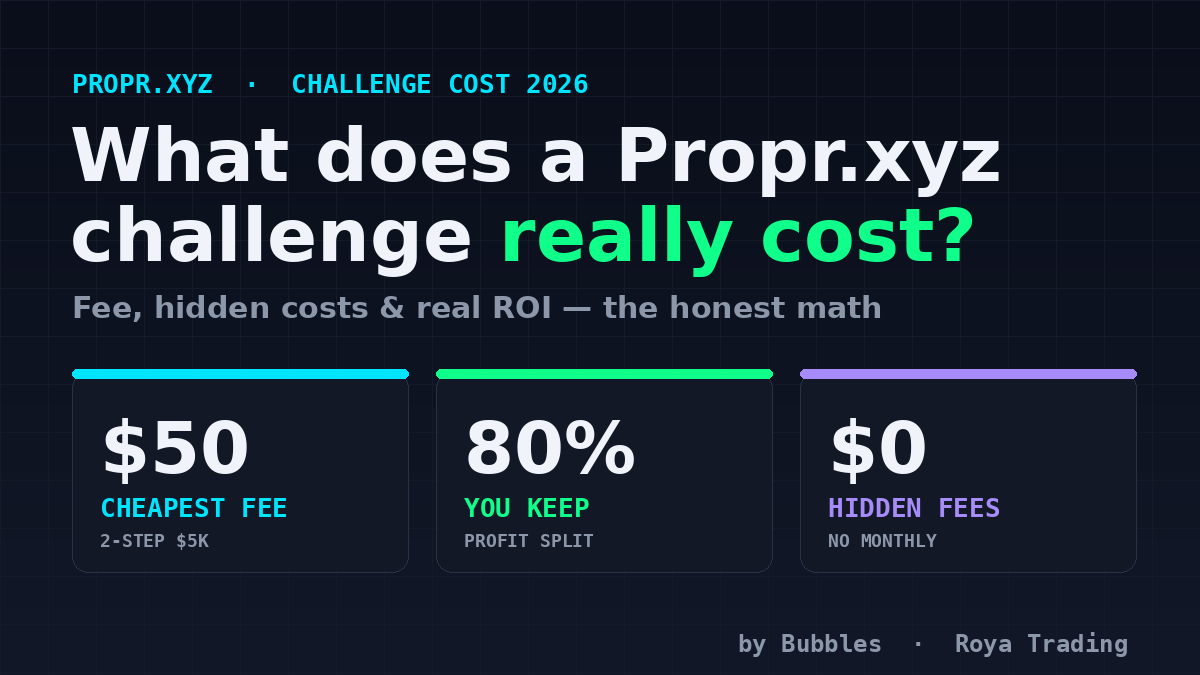
A Propr.xyz challenge costs between $25 and $1,998, paid once, with no recurring fees. The cheapest entry is the $5,000 Turbo 1-Step at $25; the most expensive is the $200,000 Classic 1-Step at $1,998. That single fee is the only thing Propr charges you up front — there are no monthly subscriptions, no platform fees, no data fees and no withdrawal fees. The fee is non-refundable, but you recoup it out of profit on your first payout — and that single fee is genuinely all you're exposed to, since you never deposit trading capital or run a negative balance (more on whether you risk your own money on a prop firm). Whether it's "worth it" comes down to one thing: how reliably you pass.
The full Propr.xyz fee table (2026)
Propr now offers four evaluation formats across six account sizes: three 1-Step variants — Turbo (9% target, 3% static drawdown), Pro (12% target, 5% static) and Classic (10% target, 6% static) — plus the Classic 2-Step (5% then 10%, with the grid's only trailing drawdown, at 8%). The table below is generated from our own reading of the live catalogue, card by card, on 2026-08-08 (25K prices spot-checked again on 15 August):
| Account | Turbo 1-Step | Pro 1-Step | Classic 1-Step | Classic 2-Step |
|---|---|---|---|---|
| $5K (Starter) | $25 | $45 | $60 | $50 |
| $10K (Explorer) | $50 | $85 | $110 | $100 |
| $25K (Bronze) | $125 | $185 | $275 | $250 |
| $50K (Silver) | $245 | $355 | $495 | $450 |
| $100K (Gold) | $450 | $699 | $999 | $899 |
| $200K (Diamond) | $899 | $1,399 | $1,998 | $1,499 |
Notice the fee-to-funding ratio improves with size: a $5K Classic 1-Step costs 1.20% of the funding you unlock, while a $100K 2-Step costs just 0.899%. Bigger accounts are marginally cheaper per dollar of buying power — but only if you can actually pass them. If you're still deciding which tier fits your bankroll, I broke that down in which Propr.xyz account size to choose.
Update — August 2026: the catalogue also lists the cheaper Turbo 1-Step — roughly half the Classic fee in exchange for a 3% drawdown instead of 6% — and, since 8 August 2026, a Pro 1-Step (12% target, 5% drawdown) plus a sixth size, the $200K "Diamond". A Free Trial slot also appeared in the size selector in late August, with no published price or rules yet. Whether Turbo's discount is a bargain or a trap depends entirely on your pass rate — I ran that exact math in the Turbo 1-Step review.
The costs nobody puts on the pricing page
Beyond the fee, the only charges are standard trading costs — and they're small. Propr passes Hyperliquid's maker/taker fees through at cost with no markup. We're talking a few basis points per trade (fractions of a percent), plus the periodic funding rate every perpetual contract carries. On a challenge where you only need to move the account a few percent, these costs are noise relative to the entry fee — but they do count toward your P&L and therefore your equity limits, so a strategy that overtrades quietly bleeds both money and drawdown room. How quietly depends entirely on your turnover: at 0.045% taker versus 0.015% maker, an active run on a $10K account can hand back anywhere from $600 to $1,800 in pure friction. I put real numbers on that in the full breakdown of trading fees, funding and slippage on a challenge.
What Propr does not charge is just as important: no monthly fees, no inactivity fees, no data fees, no platform fees and no withdrawal fees. Payouts settle in USDC on-chain with nothing skimmed off the top beyond the 80/20 split. That matters because plenty of firms quietly recoup margin through monthly "platform" or "data" charges. Here, the eval fee plus tiny trading costs is genuinely the whole bill. The full payout mechanics are in my Propr.xyz payout guide.
The real cost: it's the fee ÷ your pass rate
The single biggest hidden cost of any prop challenge is retries. A $275 fee is only $275 if you pass first try. If it takes you three attempts, the true cost of that funded account is $825. This is the number that actually matters, and it's why I'm blunt with people: most traders do not pass on the first attempt. Propr says so itself in the rulebook — the evaluation is designed to be rigorous and most traders don't pass.
You don't have to take my word for the base rate anymore, because Propr publishes it. Its transparency dashboard (read 5 September 2026) shows a measured pass rate of 15.4% on paid challenges (2,803 passed against 15,449 failed — 18,252 settled paid challenges, with a further 3,614 still in flight and therefore excluded) and 13.4% on free trials (867 out of 6,451). Our previous reading of the same dashboard, on 26 August 2026, gave 15.2% and 13.3% — the rate is stable, which is the useful part. Plug the published aggregate into the formula and the honest baseline appears: at 15.4%, the average buyer of a $275 25K Classic 1-Step spends roughly $1,800 in fees per funded account. A disciplined trader with a real edge does far better than the aggregate — that's the entire game — but that dashboard number, not the sticker price, is the industry-honest cost of entry.
So your true cost-per-funded-account is roughly: fee ÷ pass rate. Pass one in two and a $250 challenge effectively costs $500 to get funded. Pass one in four and it's $1,000. This is the cost lever that dwarfs every other — the gap between a $50 fee and a $60 fee is irrelevant next to the gap between passing first try and burning four attempts. Everything I do around discipline and automation exists to push that pass rate up, because that's where the real money is saved.
How fast do you recoup the fee? (break-even)
You recoup the fee on your very first payout, long before you've withdrawn all your profit. Because you keep 80%, your break-even profit is simply fee ÷ 0.80:
| Challenge | Fee | Profit to break even |
|---|---|---|
| $5K 2-Step | $50 | ~$63 |
| $25K 2-Step | $250 | ~$313 |
| $25K 1-Step | $275 | ~$344 |
| $100K 1-Step | $999 | ~$1,249 |
| $200K 1-Step (Diamond) | $1,998 | ~$2,498 |
Every one of those break-even figures sits far below the profit target you had to hit to get funded in the first place. On a $25K 1-Step you needed $2,500 of profit to pass; you break even on the fee after just $344 of withdrawn profit. Once you take that first payout, the fee is gone from the equation and the funded account is pure upside (minus the 20% split).
Is a Propr.xyz challenge profitable? The ROI math
On a clean passing cycle, the ROI on the fee is enormous — often 7x to 8x.Run the numbers on a single funded cycle where you hit the target and withdraw:
- $25K 1-Step: $275 fee → hit the $2,500 target → 80% payout = $2,000. That's ~7.3x the fee, and you keep the funded account.
- $100K 1-Step: $999 fee → hit the $10,000 target → 80% payout = $8,000. That's ~8x the fee.
- $5K 2-Step: $50 fee → hit the $500 target → 80% payout = $400. That's 8x the fee on the cheapest entry on the board.
But — and this is the honest part — that ROI assumes you pass and execute cleanly. Adjust for a realistic pass rate and a few losing weeks on the funded account and the expected value comes back to earth — I run that full earnings-vs-fee calculation in how much you can make with a crypto prop firm. The challenge is only profitable for traders with a genuine, repeatable edge. If you're gambling, the non-refundable fee and the permanent-breach rules will grind your bankroll down fast. I say this in every honest Propr.xyz review I write: the firm's pricing is fair, but it can't manufacture an edge you don't have. And if your real question is whether the fee beats simply depositing that money on Hyperliquid, that exact comparison is in prop firm vs trading your own money.
Propr vs the "refundable fee" model
Some firms refund your fee on your first payout; Propr doesn't — but it charges less up front. A refundable-fee firm might charge $170 for a $25K and give it back when you pass; Propr charges $250–$275 and keeps it. On paper the refund sounds better, but two things matter: (1) you only get the refund if you pass, so for the majority who don't, the "refundable" firm is just as expensive; and (2) Propr's payouts are on-chain USDC within 24 hours with full transparency, which is worth a premium to me over a refund promise I have to qualify for. Different model, similar real cost — the difference that matters is pass rate and payout reliability, not the refund headline.
The other pricing model you'll meet is instant funding — no evaluation at all, in exchange for a fee measured in hundreds rather than tens. It changes the arithmetic completely, and not in the direction the marketing implies: the comparison, in cost per dollar of drawdown room, is in instant funding vs a prop firm challenge.
How to actually lower your cost: pass on the first try
Since the dominant cost is retries, the cheapest challenge is the one you pass first time. That sounds obvious, but almost nobody optimises for it. They buy a bigger account than they can handle, tilt after a red day, revenge-trade into the daily loss limit, and breach — then repurchase. The fee was never the problem; the discipline was. Before you spend a dollar, internalise the rules in my Propr.xyz rules breakdown, and have a mechanical plan to hit the target without touching the daily loss or drawdown floor — the method I use is in my guide to passing a Propr.xyz challenge semi-auto.
Where automation changes the cost equation
The reason most challenges get expensive is human: we tilt, we oversize, we revenge-trade, we touch the daily loss floor we swore we'd respect. That's the exact gap automation closes. A bot plugged into the official Propr API can run a non-custodial DCA strategy directly on your Propr account — or copy a pro trader — while respecting your daily loss and drawdown limits automatically. Because the bot never tilts, it pushes your effective pass rate up, and a higher pass rate is the single biggest discount you can give yourself on the true cost of getting funded.
It connects through your Propr API key (trading only, never withdrawals), and Propr explicitly permits bots and copy trading in its rulebook. Pair a sensible account size with automated discipline and you stop paying the retry tax that makes "cheap" challenges expensive. Compare the wider field of on-chain firms in my guide to the best decentralized prop firms, or grab the latest Propr.xyz discount code to lower the fee before you commit.
My verdict: is it worth it?
Yes — if you treat the fee as the smallest part of the cost. Propr's pricing is fair and transparent: $25–$1,998 one time, tiny trading costs, no hidden fees, on-chain USDC payouts and an 80% split. On a clean pass, the ROI is 7–8x the fee. The challenge stops being worth it the moment you start gambling, because the non-refundable fee multiplied by a low pass rate is what actually drains accounts. Buy a size you can pass, protect your discipline, and a Propr challenge is one of the cheaper ways to access real trading capital in 2026.
FAQ — Propr.xyz challenge cost
How much does a Propr.xyz challenge cost?+
Between $25 and $1,998, one time. The cheapest is the $5,000 Turbo 1-Step at $25; the most expensive is the $200,000 Classic 1-Step at $1,998. There are four formats — Turbo 1-Step (9% target, 3% static drawdown), Pro 1-Step (12%, 5%), Classic 1-Step (10%, 6%) and Classic 2-Step (5% then 10%, 8% trailing drawdown) — across six account sizes from $5K to $200K, verified card by card in the live catalogue on 8 August 2026. There are no monthly, platform, data or withdrawal fees on top.
Is the Propr.xyz challenge fee refundable?+
No. The evaluation fee is non-refundable once the account is activated, whether you pass, fail or breach. Unlike some firms that refund your fee on your first payout, Propr keeps the fee — but its upfront prices are lower, and you recoup the fee out of profit on your first withdrawal anyway.
Are there hidden costs in a Propr.xyz challenge?+
Only standard trading costs: Hyperliquid maker/taker fees (a few basis points per trade, passed through at cost with no Propr markup) and perpetual funding rates. There are no monthly, inactivity, data, platform or withdrawal fees. The real hidden cost is retries — every failed attempt is another fee.
Is a Propr.xyz challenge profitable?+
It can be, if you pass. Pass a $25K 1-Step ($275 fee) and the 10% target is $2,500 of profit; your 80% payout is $2,000 — roughly 7x the fee on a single funded cycle, and you keep the account. But most traders don't pass on the first try, so your true cost is the fee divided by your pass rate. Profitability is a function of your discipline, not Propr's pricing.
How fast do I recoup the challenge fee?+
On your first payout. Because you keep 80%, your break-even profit is the fee divided by 0.80. A $275 fee is covered after ~$344 of profit withdrawn; a $50 fee after ~$63; a $999 fee after ~$1,249 — all far below the profit target you had to hit to get funded.
What's the cheapest way to get funded on Propr.xyz?+
Start with the $5,000 Turbo 1-Step at $25 (or the Classic 2-Step at $50 if you want more drawdown room) and pass it cleanly on the first attempt. The single biggest cost lever isn't the headline fee — it's how many times you retry. Passing first try, with automated risk guardrails so you don't tilt-breach, is what makes a Propr challenge genuinely cheap.
Stop paying the retry tax.
Non-custodial DCA through the official API, live alerts and automatic risk guardrails so one tilted session doesn't cost you another challenge fee.
Get 5% USDC cashback⚠️ This article is informational and not investment advice. It contains an affiliate link to Propr.xyz. Leveraged trading carries a high risk of capital loss. The evaluation fee is non-refundable and most traders do not pass — only trade what you can afford to lose. Fees reflect our card-by-card reading of Propr's live catalogue on 8 August 2026 (25K tier re-checked 15 August; pass rates read on the transparency dashboard 5 September, previous reading 26 August) and can change; always confirm on the official rules page.
To price your own situation — fees paid, challenges passed and failed, split — the payout calculator gives the exact break-even number.