
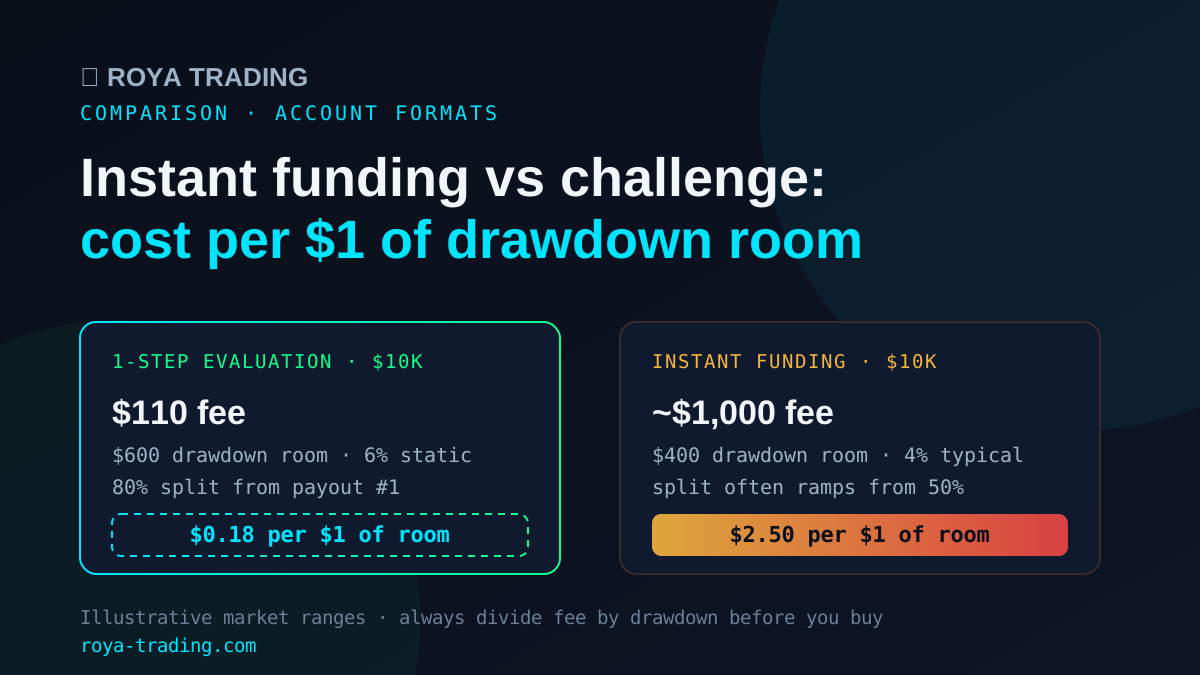
The instant funding pitch is the most effective sentence in this industry: skip the evaluation, trade real capital today. It works because it names the thing everybody hates. Nobody enjoys the challenge phase. It's a test you can fail on a bad Tuesday for reasons that have nothing to do with whether you can trade. So when a firm offers to hand you an account with no target to clear, the offer feels like it removes the risk. It doesn't. It reprices it, and the price is on the checkout page — you just have to divide two numbers to see it. This page runs those two numbers, on a real $10,000 account, against the format I actually use. Instant funding is a legitimate product with a genuine use case. It is very rarely the cheap one.
The short answer
One: instant funding removes the profit target but keeps the loss limits, so you buy convenience, not safety. Two: the only comparison that matters is fee divided by drawdown room — how many dollars you pay per dollar of risk capital you get to work with. Three: a $10,000 Propr.xyz 1-Step costs $110 for $600 of static drawdown, or about $0.18 per dollar of room; a typical instant funding account on the same nominal balance lands between $2 and $3. Four: instant funding wins on exactly two axes — time to first payout and the psychology of not being graded — and those are worth real money to some traders. Five: if the reason you want instant funding is that challenges have a deadline, check the rulebook first, because the better evaluations no longer have one. The rest of this page is the arithmetic behind those five lines.
What instant funding actually sells you
Answer first: it sells the removal of the profit target — nothing else changes. Strip the marketing and an instant funding account is a balance, a maximum drawdown, a daily loss limit, a profit split, and usually a minimum-trading-days rule before you can withdraw. That is an identical rule set to a funded account after an evaluation. The single difference is that you did not have to make 10% first.
This matters because of what the profit target actually is. On an evaluation, the target is the firm's filter: it is how they decide whether to expose capital to you. When you buy instant funding, you are buying your way past the filter, so the firm has to replace that filter with something else. There are only three levers available to them, and every instant funding product in existence pulls at least two: charge more upfront, give less drawdown room, or pay out less early. None of these are scams. They are the arithmetic of taking risk on someone who hasn't demonstrated anything yet.
So the honest framing is not "instant funding vs challenge." It's "pay with performance, or pay with cash." Both are payments. One of them is refundable in the sense that clearing an evaluation converts your fee into a funded account with real payout rights; the other is spent the moment you click.
The one metric: cost per dollar of drawdown room
Answer first: divide the fee by the maximum drawdown, and compare that number across every offer on your shortlist. Account size is a vanity number. What you actually rent from a prop firm is the distance between your starting balance and the point where they close you. That distance is your working capital. Everything else is presentation.
Run it on Propr.xyz, where I have exact figures from the published rulebook rather than estimates:
$10,000 Classic 1-Step: $110 fee. Drawdown 6% static = $600 of room. Daily loss 3% of your start-of-day balance = $300 on day one, snapshotted at 00:00 UTC and recomputed daily; the breach itself is measured on equity, floating P&L included. Target 10% = $1,000. Cost per dollar of room: $0.183.
$10,000 Classic 2-Step: $100 fee. Drawdown 8% trailing = $800 of room at the start. Daily loss 5% of your start-of-day balance = $500 on day one, recomputed daily. Targets 5% then 10%. Cost per dollar of room: $0.125 — cheaper on paper, but the trailing mechanic follows your high-water mark, so that $800 shrinks as you profit until it stops at your starting balance. That difference is the whole subject of trailing vs static drawdown, and it's the reason I default to the 1-Step despite the higher fee.
$100,000 Classic 1-Step: $999 fee, $6,000 of static room. Cost per dollar: $0.167. And at the top of the ladder, the $200,000 Classic 1-Step: $1,998 fee, $12,000 of static room — $0.167 again. The ratio barely moves with size — which is the tell that evaluations are priced as a filter, not as a risk product. Propr sells six account sizes ($5K, $10K, $25K, $50K, $100K, $200K) across four formats (Classic 1-Step, Turbo 1-Step, Pro 1-Step, Classic 2-Step), with fees running from $25 (Turbo $5K) to $1,998 (Classic 1-Step $200K) — read on the published rulebook on 10 September 2026.
Now the other side. Instant funding pricing varies wildly by provider and changes often, so treat what follows as the shape of the market rather than a quote — always run the division on the actual page you're buying from. The common structure is a fee somewhere between 8% and 15% of the nominal balance, paired with a drawdown between 3% and 6%. Take a mid-market example: $1,000 for a $10,000 balance with 4% drawdown. That is $400 of room for $1,000. Cost per dollar of room: $2.50. Roughly fourteen times the 1-Step ratio.
Fourteen times is not a rip-off — it's the price of skipping a filter. But it does mean something concrete: with the $1,000 you'd spend on one instant account you could buy nine $10K 1-Step evaluations, or two $50K ones with change. If you fail eight out of nine attempts you still come out ahead in capital access, and the ninth gives you a $10K funded account you never have to re-buy. That's the comparison the pitch is designed to stop you from running. The same logic drives stacking multiple accounts up to the $200K cap instead of buying one big one.
The profit split ramp, and why your first payouts are the cheap ones
Answer first: headline splits on instant funding are usually the endpoint, not the starting point. A very common structure is a split that starts at 50% or 60% and climbs to 80% or 90% after a number of successful withdrawals. Read that as what it is: the firm recovering its underwriting cost from the traders who work, because most accounts never reach the second withdrawal.
Price it. Suppose you make $2,000 on a $10K instant account with a 50% opening split: you keep $1,000, and you already paid $1,000 for the account. Your net after a genuinely good run — 20% on the balance — is zero. On a Propr 1-Step at a flat 80% split from the first payout, the same $2,000 of profit on a funded account returns $1,600 against a $110 entry. There is no ramp, no tier, no "unlock." It is the same 80% on withdrawal number one as on withdrawal number twenty, and the payout settles on-chain in USDC with a $20 minimum, typically inside a few hours. I broke down the timing and mechanics in how Propr payouts actually work.
The split ramp is also where the "instant" framing gets slippery. Instant access to an account is not instant access to money. If your first withdrawal requires ten trading days and a minimum profit, and the split at that point is 50%, then the actual thing you bought — money in your wallet — is neither instant nor cheap. Compare time-to-first-dollar honestly, not time-to-dashboard.
Where instant funding genuinely wins
Answer first: two cases, and they're both real. I don't think this product should be dismissed, and traders who use it well tend to fall into one of these buckets.
1. You are demonstrably profitable and time is your scarce resource. If you have a verified track record and a strategy that produces steady 3-5% months, the evaluation is pure friction — a few weeks of trading you'd have done anyway, but for no payout. Paying a premium to compress that into zero weeks can be rational, because your expected monthly income exceeds the premium. The maths only works if the profitability is real. Everyone thinks theirs is.
2. The evaluation format itself breaks your strategy. Some approaches genuinely conflict with a profit target. A low-volatility, high-Sharpe strategy making 1% a month cannot clear a 10% target in a reasonable window, but it can absolutely run profitably inside a 4% drawdown for years. For that trader the evaluation is not a filter, it's a mismatch, and paying to skip it is buying access to a format that fits. This is the strongest honest argument for instant funding and it applies to fewer people than claim it.
What is not a good reason: "I keep failing challenges." If a 10% target with 6% of room defeats you, a 4% drawdown with no target will defeat you faster — the loss limit is the part that kills accounts, and instant funding makes it tighter, not looser. That failure pattern has causes, and I catalogued them in why most prop firm traders fail and in the reset playbook after a failed challenge.
The deadline argument is out of date
Answer first: the single best argument for instant funding used to be the clock, and on the better firms the clock is gone. Classic evaluations came with 30-day phases. That deadline is what made challenges genuinely dangerous: it forced trades that didn't exist, at sizes that didn't make sense, in the last week of the month. If you were choosing between a timed evaluation and an untimed instant account, the premium bought something real.
Propr has no time limit on either format. There is no minimum trading day requirement forcing activity and no expiry forcing a gamble. You can sit in cash for three weeks and take one setup. That removes most of the structural danger the evaluation phase used to carry, and it collapses the gap between "instant" and "evaluation" down to the pure profit target. I put realistic numbers on how long clearing that target actually takes in how long it takes to pass a prop firm challenge — the median for a disciplined run is weeks, not months, and the constraint is patience rather than the calendar.
The second half of that argument is cost of failure. Paying $110 to attempt something with no clock is a very different bet from paying $1,000 to skip it. The evaluation format now behaves closer to a cheap call option on a funded account: bounded downside, no expiry, and the strike is your own discipline.
Instant funding on-chain: does it exist?
Answer first: not meaningfully in the Hyperliquid-native segment, and there is a structural reason. The two firms trading real order flow on Hyperliquid — Propr and Hypernova — both run evaluations. Propr offers the 1-Step and 2-Step described above; Hypernova runs a 1-step with a 9–10% target across three risk tiers (3–4% max daily loss, 3/6/7% static drawdown on end-of-day equity), an 80% split, and has been public since 14 August 2026 — its Fast Track lets traders with a qualifying Hyperliquid, Binance or Bybit history skip the evaluation, which is the closest thing to instant funding in this segment. Neither sells an unfiltered funded account.
The reason is that on-chain firms are exposed to their own risk in a way that off-chain simulators are not. When positions route to a real venue, the firm carries genuine counterparty risk on every unfiltered trader they onboard — so the filter has commercial value they can't discount away. That's a feature, not a limitation: it means the account you're trading corresponds to something. The broader case for that model is in on-chain vs traditional prop firms, and the full field is ranked in the best decentralized prop firms of 2026.
One live difference worth knowing if automation is part of your plan: Propr explicitly allows bots, copy trading and API access. Hypernova's closed-alpha rulebook used to ban third-party copy trading and signals under §14.2; its public rules, read 16 August 2026, listed no bot restrictions, and its rulebook v1.1, read 5 September 2026, permits automated strategies built and run by the trader on a single account while banning copy trading and external signals, though there's no turnkey execution layer there. That clause is still the one that decides whether an execution layer can legally run on your account, and it's the crux of the Propr vs Hypernova head-to-head. Many instant-funding providers carry similar automation bans for the same underwriting reason — read that section before you pay, not after.
Four questions that decide it
Answer first: if you answer no to any of the first three, take the evaluation.
1. Do I have a verified track record of monthly profitability? Not a good quarter. Not a demo. Six months of statements you'd show a stranger. If no, you are paying a premium to skip a test you would probably fail, which is the most expensive possible order of operations.
2. Is my expected monthly return larger than the premium I'm paying? Instant fee minus evaluation fee, divided by your realistic monthly dollar profit. If that number is more than about two months, the evaluation is cheaper even counting the time it costs.
3. Is the drawdown room enough for my actual strategy? Take your worst historical peak-to-trough over 100 trades and compare it against the instant account's cap. If your normal bad stretch is 5% and the account allows 4%, the product is mathematically unsuitable no matter how good the split is. The sizing method is in position sizing for a crypto prop firm.
4. What does the rulebook say about automation, news and holding periods? The cheapest account with a rule you can't follow is worth zero. Check bots, copy trading, weekend holds and news windows before pricing anything — the clauses that end runs are catalogued in the Propr rulebook explained.
How I actually run it (and where automation fits)
My position, stated plainly: I buy 1-Step evaluations, I run several of them, and I treat the fee as the cost of an option rather than a purchase. At $110 for a $10K account with no deadline, failing is survivable and passing is permanent. The premium for instant funding buys me nothing I need, because the clock — the thing it used to solve — no longer exists on the format I use.
What does need solving is execution, because on a 6% static drawdown the enemy is not the target, it's the sequence of small unplanned decisions that eat the room. A bot plugged into the Propr API for automated trading is the layer I built for that. It runs semi-auto on your own Propr.xyz account: you choose the trade — your own setup, or a pilot you follow on the Radar — and it executes the DCA ladder with the take-profit and stop-loss committed before entry. It doesn't pick direction, it doesn't trade while you sleep on ideas you never approved, and it can't make a bad thesis good. It removes the improvised part, which happens to be the part that breaches accounts. The construction rules are in my DCA method for prop firm challenges, and the execution costs that method is designed around are in the trading fees and funding breakdown.
Bottom line
Instant funding is not a scam and it is not free. It is a real product that charges you cash instead of performance, and the exchange rate is published: divide the fee by the drawdown room and compare. On a $10,000 account that ratio is about $0.18 per dollar of room through a Propr 1-Step and something closer to $2.50 through a typical instant account — with a flat 80% split on one side and a ramping split on the other. If you are already provably profitable and the evaluation format actively fights your strategy, pay the premium with your eyes open. If you are not, buy the cheap option repeatedly instead of the expensive certainty once. If you're starting a run, a Propr.xyz challenge through my link pays 5% USDC cashback on the fee — which knocks the $10K 1-Step down to an effective $104.50, and the payout when you pass settles on-chain in USDC, usually within hours.
FAQ — Instant funding vs prop firm challenge
What is an instant funding prop firm account?+
It's an account you can trade for a profit split immediately, with no evaluation phase to clear first. You pay a fee, you get a balance and a drawdown limit, and any profit you make above the starting balance is split with the firm from day one. The rules that remain are the risk rules: a maximum drawdown, usually a daily loss limit, and often a minimum number of trading days before your first withdrawal. What disappears is the profit target — you are not proving anything, you are simply trading under a loss cap.
Is instant funding cheaper than a prop firm challenge?+
Almost never per dollar of risk capital, and that is the metric that matters. Compare fee divided by drawdown room. A $10,000 Propr.xyz 1-Step costs $110 and gives you $600 of static drawdown — about $0.18 per dollar of room, and if you clear the 10% target that room becomes a funded account. Instant funding on a $10,000 balance typically costs somewhere between 8% and 15% of the account with a tighter drawdown, which lands closer to $2 to $3 per dollar of room. You are paying for the removal of the evaluation, and the removal of the evaluation is priced honestly by whoever sells it.
Does Propr.xyz offer instant funding?+
No. Propr runs evaluations only — a 1-Step (10% target, 6% static drawdown on Classic) and a 2-Step (5% then 10%, 8% trailing drawdown), with the daily loss set at 3% (1-Step) / 5% (2-Step) of your start-of-day balance, snapshotted at 00:00 UTC and recomputed daily; the breach itself is measured on equity, floating P&L included. There are six account sizes ($5K, $10K, $25K, $50K, $100K, $200K) and four formats (Classic 1-Step, Turbo 1-Step, Pro 1-Step, Classic 2-Step). The closest thing to the instant-funding pitch is the 1-Step with no time limit: you have exactly one phase to clear and no clock forcing you to take trades you don't want. Fees run $60 to $1,998 on the Classic 1-Step and $50 to $1,499 on the Classic 2-Step, with the cheapest ticket overall the $25 Turbo $5K, an 80% profit split and on-chain USDC payouts. Read on the published rulebook, 10 September 2026.
What's the catch with instant funding accounts?+
There are usually three, and none of them are hidden — they're just easy to skip. First, the drawdown is smaller relative to the fee, because the firm is taking real risk from minute one. Second, the profit split often starts below the headline number and ramps as you withdraw, so your first payouts are the cheapest ones for the firm. Third, scaling is gated: getting from a small instant account to real size usually requires consistency milestones that look a lot like an evaluation, just spread across months instead of weeks.
Is instant funding better for beginners?+
Usually the opposite. Instant funding removes the profit target, which is the part of a challenge that teaches you to size for a defined objective, and it keeps the loss limit, which is the part that ends runs. A beginner on an instant account pays more for less room and gets no structured objective. A cheap 1-Step evaluation is a better teacher and a cheaper mistake — the whole point of a $60 entry ticket is that it costs $60 to find out you're not ready yet.
Can I use a trading bot on an instant funding account?+
It depends entirely on the rulebook, and this is the clause to read before you pay. Propr.xyz explicitly permits bots, copy trading and API access, which is why an automated execution layer can run on it — semi-auto, where you choose the trade and the bot manages the DCA ladder, take-profit and stop-loss. Hypernova, the other Hyperliquid-native firm, used to ban third-party copy trading and signals under §14.2 of its closed-alpha rulebook; its public rules, read 16 August 2026, listed no bot restrictions, and its rulebook v1.1, read 5 September 2026, permits automated strategies built and run by the trader on a single account while banning copy trading and external signals, though there's no turnkey execution tool there. Many instant-funding providers do carry automation restrictions, because their risk model depends on knowing what you're doing. Check before you fund, not after.
Cheap option, disciplined execution.
A bot via the official API runs semi-auto on your own Propr account: you pick the trade, it places the DCA ladder with the stop and take-profit committed before entry. No deadline, no improvisation, no 4% drawdown you paid $1,000 for.
Get 5% USDC cashbackNot on Propr yet? Create your Propr.xyz account with 5% USDC cashback.
Affiliate link. We earn a commission; it never changes what you pay — it is what funds your cashback.
⚠️ Trading carries risk. Propr figures come from the official rulebook and can change; instant funding pricing and drawdown terms vary by provider and change frequently — the ranges here describe the market, not any specific offer, so always verify the current terms on the provider's own page before buying. Nothing here is guaranteed and past performance does not predict future results. This article is informational and not investment advice. Do your own research and only trade what you can afford to lose.