
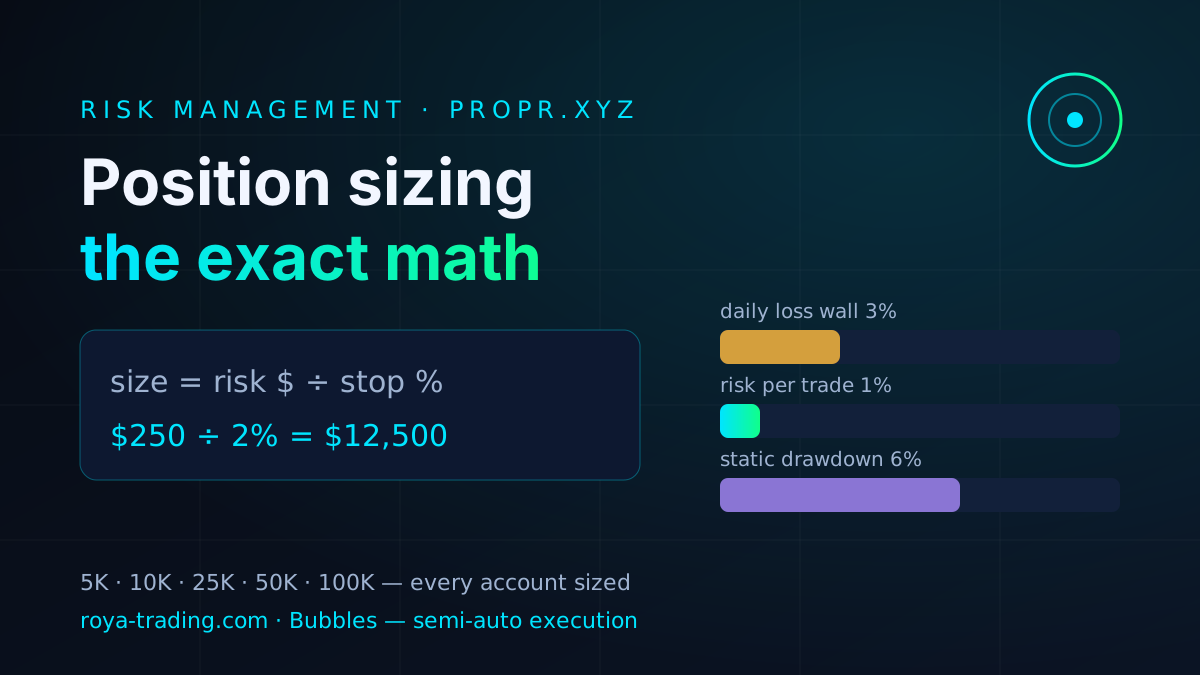
Every breached challenge I've ever audited — mine included — died the same way: the trade idea was defensible, the size was not. Position sizing is the one skill where a prop firm challenge is genuinely different from trading your own account, because the rulebook adds hard walls that don't care about your conviction. This is the sizing system I run on my own Propr.xyz accounts, with the exact numbers for every account size, so you can stop guessing.
Affiliate link. We earn a commission; it never changes what you pay — it is what funds your cashback.
The short answer
Risk 0.5% to 1% of the account per trade idea — all DCA entries included — and never more than one third of your daily loss limit on a single idea. On a Propr 1-Step (daily loss of 3% of the start-of-day balance), that means 1% max per idea: three full stop-outs before your day is over, and even that worst-case day leaves the 6% static drawdown intact. Compute your size from the stop distance, not from the leverage on offer. That's the whole system; the rest of this article is the math and the traps.
The three numbers that own your challenge
Before sizing anything, write down the three rulebook numbers that define your survival (all read on propr.xyz/rules, 10 September 2026). On Propr's 1-Step: a 10% profit target, a daily loss of 3% of your start-of-day balance, and a 6% static drawdown measured from the starting balance. On the 2-Step: targets of 5% then 10%, a looser daily loss of 5% of the start-of-day balance, but an 8% trailing drawdown that follows your high-water mark until it locks at the starting balance. The daily loss is the one people get wrong: it is not a fixed dollar amount. At 00:00 UTC the system snapshots your balance and recomputes the day's allowance from it, so the wall shrinks as you draw down and widens as you bank realised profit. I broke down every rule in Propr's rules explained, but for sizing purposes the daily loss is the binding constraint — it's the wall you can hit in a single bad afternoon.
The asymmetry most traders miss: the profit target is patient (Propr has no time limit), but the loss limits are instant. There is no sizing decision that speeds up the target enough to justify one that brings the walls closer.
The formula (and why stop distance is everything)
Position sizing is one division:
Notional position = dollar risk ÷ stop distance
where dollar risk = account × risk %. Example on a $25K 1-Step: 1% risk is $250. If your stop sits 2% below entry, notional = $250 ÷ 0.02 = $12,500. At Propr's 5x leverage on BTC, that position needs $2,500 of margin — a fraction of the account. Same trade with a tight 0.5% stop? Notional jumps to $50,000, and now a routine 1.2% wick against you costs $600, double your intended risk, because tight stops get swept. The stop distance is the lever that converts risk into size — leverage is just the margin arithmetic that makes the size possible. Where that stop actually belongs — and the take-profit math that has to justify it — is its own discipline; I broke it down in stop loss & take profit for prop firm challenges.
Exact numbers for every Propr account size
Here's the table I keep pinned — but read the caveat first, because it is the whole point. The daily wall is not a constant you can print once: it is daily loss % × your start-of-day balance, recomputed at 00:00 UTC. The figures below are therefore day-one walls, valid on the morning you start when your balance still equals the account size. Every day after that, recompute them from the balance the snapshot actually took. Account sizes and percentages read on propr.xyz/rules, 10 September 2026:
- $5K — 0.5% = $25 · 1% = $50 · day-one wall: $150 (1-Step) / $250 (2-Step)
- $10K — 0.5% = $50 · 1% = $100 · day-one wall: $300 / $500
- $25K — 0.5% = $125 · 1% = $250 · day-one wall: $750 / $1,250
- $50K — 0.5% = $250 · 1% = $500 · day-one wall: $1,500 / $2,500
- $100K — 0.5% = $500 · 1% = $1,000 · day-one wall: $3,000 / $5,000
- $200K — 0.5% = $1,000 · 1% = $2,000 · day-one wall: $6,000 / $10,000
The direction of that drift matters more than the table. Lose $400 on a $25K 1-Step and tomorrow's wall isn't $750, it's 3% of $24,600 = $738 — the room narrows exactly when you most want it back. Bank $1,000 instead and it widens to 3% of $26,000 = $780. A fixed dollar stop-budget copied off day one slowly drifts out of tolerance in the losing direction, which is the worst possible time for it to be wrong.
Notice what 1% risk buys you on a 1-Step: on day one, exactly three strikes before the daily wall. That's not an accident — it's the design constraint. If your risk per idea is 1.5%, two ordinary losers end your day and force you to sit on your hands while tilted, which is precisely when accounts die. If you're still choosing your size tier, the trade-offs are in which Propr account size to pick.
DCA changes the math — budget the ladder, not the leg
Scaling in is how I trade, and it's the single most common place sizing silently breaks. If your plan is three entries — say at market, −2% and −4% — then your risk is not the first leg's risk. It's the worst case: all three legs filled, stop hit. Size each leg so that the total worst-case loss stays inside your 1% budget. In practice that means each leg is roughly a third of the size you'd trade single-entry, which feels small — and that feeling is exactly why most people don't do it. I wrote the full leg-by-leg budgeting method in DCA for prop firm challenges; it's the difference between DCA as a plan and DCA as slow-motion revenge trading.
Sizing on a trailing drawdown is a different sport
On the 2-Step, the 8% drawdown trails your high-water mark until it locks at the starting balance — which means a winning streak physically moves your floor up. Trader up 6% who keeps risking like day one is sizing against a floor that no longer exists; a normal pullback can breach the account while it's still net positive. The fix: recompute your dollar risk off the distance to your current floor after every high-water mark, and cut risk after big green days instead of pressing. The full mechanics are in trailing vs static drawdown — if you only remember one thing: static drawdown rewards banked profit, trailing taxes it, so the same 1% rule produces different sizes on each format.
Leverage is margin math, not risk appetite
Propr caps leverage at 5x on BTC/ETH (side panel and changelog; the §12 table on the same page says 10x — unreconciled as of our reading on 12 September 2026), 2x on other cryptos, 4x on equities, 8x on gold, silver, CL and Brent, and 5x on other commodities. Treat those caps as plumbing, not as a suggestion. Leverage decides how much margin a position consumes; your loss is position × stop distance regardless. The practical implication runs opposite to instinct: the 2x cap on alts isn't restrictive, it's protective — alt wicks are wider, so proper sizing rarely wants more than 2x anyway. If your sizing formula outputs a position that needs more leverage than the cap allows, the formula is telling you your stop is too tight for that market, not that you need more leverage. I unpack the full breach-vs-liquidation math behind the caps in crypto prop firm leverage explained.
Follow that logic one step further and it stops being a leverage question and becomes a market-choice question: if honest sizing on a volatile alt produces a position too small to move a 10% target, the trade was never worth the margin it locks up. That's the whole argument for a boring, majors-heavy allocation during an evaluation — laid out in the best crypto pairs to trade in a prop firm challenge.
The 2am problem: sizing rules don't survive contact with tilt
Every trader reading this already knows the 1% rule. Almost nobody applies it on the fourth trade of a red day. I've watched disciplined people double size after two stops "to get it back" — the exact pattern that fills the graveyard in why 90% of prop firm traders fail. This is the honest case for semi-automation: not prediction, enforcement. A bot runs on your own Propr account — you choose the trade, and it executes the DCA ladder, take-profit and stop-loss with sizes computed against the real remaining daily loss and drawdown. That is precisely the work a daily-reset wall creates: the bot re-reads today's floor instead of trusting yesterday's number, and an oversized 2am order simply never reaches the book. Sizing discipline as software instead of willpower — see how the Propr API handles automated trading.
A worked example, start to finish
$25K 1-Step, BTC long, entry $100,000, invalidation at $98,000 (2% stop). Risk budget: 1% = $250. Notional = $250 ÷ 0.02 = $12,500 → 0.125 BTC, margin $2,500 at 5x. Now the DCA version: three legs at $100K / $98K / $96K, stop at $94,800, average entry ≈ $98,000, worst-case stop distance ≈ 3.3%. Total notional allowed = $250 ÷ 0.033 ≈ $7,600, so roughly $2,533 per leg. Smaller than the single-entry trade — because the ladder carries more distance risk. That counter-intuitive shrinkage is the entire reason DCA needs pre-computed sizing: nobody does this arithmetic at 2am, which is why the software has to do it at order time.
Verdict: the checklist
Before every trade: dollar risk ≤ 1% of account, all legs included · idea risk ≤ ⅓ of remaining daily loss · stop set by structure, size derived from stop · on trailing drawdown, risk recomputed off the current floor · leverage treated as margin plumbing. If any line fails, the trade is oversized — no exception clause for conviction. And if you want the proof that this checklist is worth the boredom, I later simulated pass probabilities across 20,000 runs: the same edge passes 87% of the time at 0.5% risk and 47% at 3% — sizing moved the odds more than the edge did.
Sizing is also the layer that makes every other choice survivable: the right Propr.xyz challenge (5% USDC cashback on the fee via that link), the right format, the right strategy all fail under the wrong size. And if you're comparing firms before committing, the best decentralized prop firms guide ranks every firm we actually test — sizing rules included.
Affiliate link. We earn a commission; it never changes what you pay — it is what funds your cashback.
FAQ — position sizing on prop firm challenges
How much should I risk per trade on a prop firm challenge?+
Between 0.5% and 1% of the account per trade idea, all entries included. On a Propr.xyz 1-Step with its 3% daily loss limit, 1% risk means three full losers before the day is over — a real but survivable worst case. Risking more than a third of your daily loss limit on a single idea means two bad trades can end your day and three can end your challenge.
What is the position sizing formula for a prop firm account?+
Position size (notional) = dollar risk ÷ stop distance. Dollar risk = account size × risk percentage. Example on a $25K account: 1% risk is $250; with a stop 2% away from entry, notional = $250 ÷ 0.02 = $12,500. Margin used at 5x leverage would be $2,500. The stop distance — not the leverage — is what turns risk into size.
Does 5x leverage mean I'm risking 5x more?+
No. Leverage determines how much margin you post, not how much you lose. Your loss is decided by position size × stop distance. A $12,500 BTC position with a 2% stop loses $250 whether you posted $2,500 of margin at 5x or $12,500 at 1x. On Propr, leverage is capped at 5x on BTC/ETH (side panel and changelog; the §12 table on the same page says 10x — unreconciled as of our reading on 12 September 2026), 2x on other cryptos, 4x on equities, 8x on gold, silver, CL and Brent and 5x on other commodities — but your risk should be set by your stop, not by the cap.
How does DCA change position sizing?+
With DCA you must budget the whole ladder, not the first entry. If your plan is three entries, the risk that matters is the worst case: all three filled and the stop hit. Size each leg so the total loss stays inside your per-idea risk (0.5–1%). Sizing only the first leg and 'seeing how it goes' is how DCA quietly breaches the daily loss limit.
Should I size differently on a trailing drawdown account?+
Yes. On a Propr 2-Step, the 8% trailing drawdown follows your high-water mark until it locks at the starting balance. After a good run, your floor has risen — so risk percentages should be computed off your current equity relative to that floor, not off the starting balance. Many traders breach a 2-Step in profit precisely because they kept sizing like the floor never moved.
Can a bot handle position sizing for me?+
On Propr.xyz, yes — bots and API access are explicitly allowed. A semi-auto bot works like this: you pick the trade, and it computes and executes the DCA entries, take-profit and stop-loss sized against the account's real limits, so a fat-fingered size or an oversized revenge trade never reaches the exchange. Hypernova's closed-alpha rulebook (§14.2) used to ban copy-based automation; its public rules, read 16 August 2026, listed no bot restrictions, and its rulebook v1.1, read 5 September 2026, permits automated strategies built and run by the trader on a single account while banning copy trading and external signals, but there's no turnkey tooling published there either — so check the current rules before you build around a bot.
Let the math size your trades — semi-auto.
You pick the trade; the bot computes and executes the DCA entries, take-profit and stop-loss sized against your account's real limits. Start free on Telegram.
Get 5% USDC cashbackNot on Propr yet? Create your Propr.xyz account and get 5% USDC cashback on your challenge fee.
Affiliate link. We earn a commission; it never changes what you pay — it is what funds your cashback.
⚠️ Trading carries risk. Propr figures come from its published rulebook and can change — always verify on the firm's own pages before paying. Worked examples are illustrations, not recommendations. Nothing here is guaranteed and past performance does not predict future results. This article is informational and not investment advice. Do your own research and only trade what you can afford to lose.