
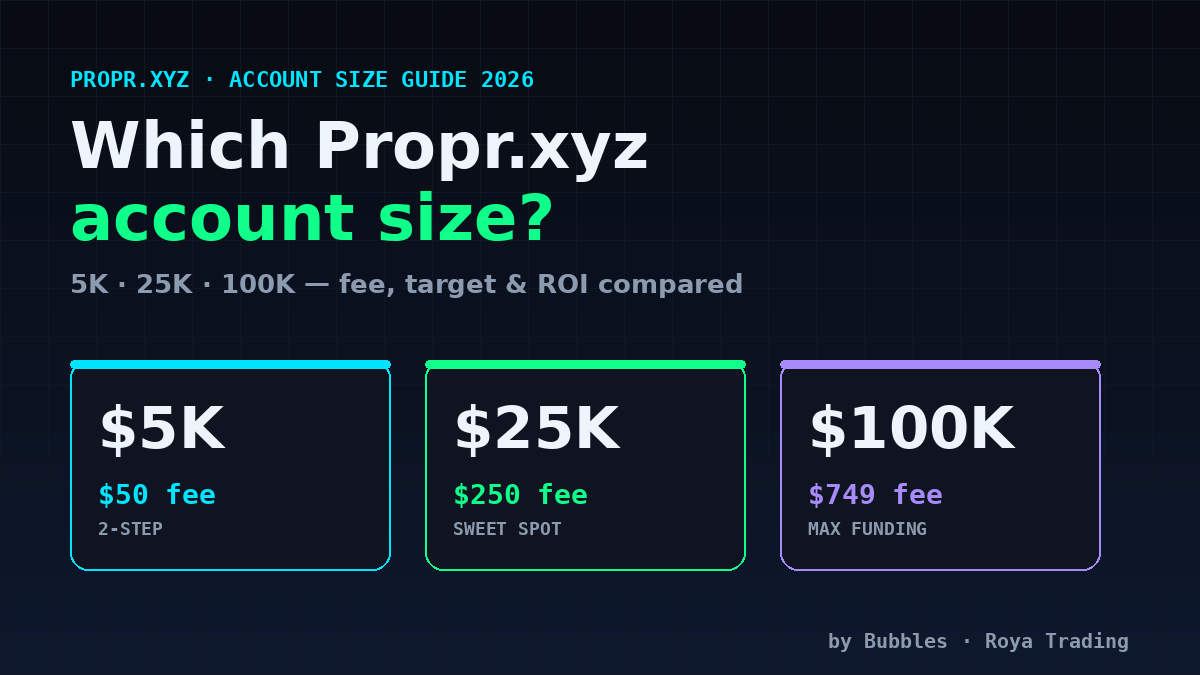
The account-size question is the one I get most from people about to buy their first evaluation on Propr.xyz. And almost everyone gets it backwards: they pick the biggest account they can afford, chasing the biggest payout, then breach it in a week because they were never ready to manage that much size. Account selection isn't about ego — it's about matching the fee, the daily loss limit and the drawdown to a strategy you can actually execute. Here's how I'd choose between $5K, $25K and $100K (and the $10K/$50K in between, plus the $200K that sits above them all), with the real numbers from Propr's official rulebook.
Affiliate link. We earn a commission; it never changes what you pay — it is what funds your cashback.
Short answer: which Propr.xyz account size should you choose?
If you're new, start with the $5,000 account. At $50 (2-Step) or $60 (1-Step) it's the cheapest way to learn how the rules feel with real stakes. If you've already passed a challenge somewhere and you're consistent, the $25,000 is the sweet spot — big enough that an 80% payout is meaningful, small enough that the $275 fee doesn't hurt if a red week breaches you. The $100,000 is for traders with a proven, mechanical edge and the discipline to sit on size without tilting. The biggest account isn't the best account — the one you can pass twice in a row is.
The full Propr.xyz account size & fee table
Propr sells six account sizes — $5K, $10K, $25K, $50K, $100K and $200K — across four formats: Classic 1-Step, Turbo 1-Step, Pro 1-Step and Classic 2-Step. This guide compares the two Classic formats, which are the ones most people buy. The 1-Step has a single 10% profit target; the 2-Step splits it into 5% then 10%. Here are the exact fees from Propr's catalogue, read 10 September 2026:
Classic 1-Step (10% target · 3% daily loss · 6% static drawdown)
| Account | Fee | Profit target | Max drawdown floor |
|---|---|---|---|
| $5,000 | $60 | $500 | $4,700 |
| $10,000 | $110 | $1,000 | $9,400 |
| $25,000 | $275 | $2,500 | $23,500 |
| $50,000 | $495 | $5,000 | $47,000 |
| $100,000 | $999 | $10,000 | $94,000 |
| $200,000 | $1,998 | $20,000 | $188,000 |
Classic 2-Step (5% → 10% target · 5% daily loss · 8% trailing drawdown)
| Account | Fee | Step 1 / Step 2 | Drawdown at start |
|---|---|---|---|
| $5,000 | $50 | $250 / $500 | $4,600 |
| $10,000 | $100 | $500 / $1,000 | $9,200 |
| $25,000 | $250 | $1,250 / $2,500 | $23,000 |
| $50,000 | $450 | $2,500 / $5,000 | $46,000 |
| $100,000 | $899 | $5,000 / $10,000 | $92,000 |
| $200,000 | $1,499 | $10,000 / $20,000 | $184,000 |
One caveat on that $899: the published rulebook prints $749 for the Classic 2-Step $100K, while the live checkout has been charging $899 since 8 August 2026. The two numbers have not been reconciled as of our reading on 10 September 2026 — the price you actually pay at checkout is the one that matters, so confirm it before you buy.
The 80% profit split, the $20 minimum payout, the 24-hour USDC settlement and the rules are identical across every size. Size only changes three things: the fee you pay, the dollar value of your profit target, and the dollar value of your risk limits.
How much does each account actually risk?
This is the part people skip and then regret. A bigger account doesn't just mean a bigger payout — it means a bigger daily loss limit and a bigger drawdown, in dollars, that you have to respect every single trade. The daily loss limit is 3% (1-Step) / 5% (2-Step) of your start-of-day balance, snapshotted at 00:00 UTC and recomputed daily; the breach itself is measured on equity, floating P&L included. Your 1-Step drawdown floor is 6% below your starting balance. So, on a 1-Step at day one:
- $5K 1-Step: $150 daily loss limit, $300 total drawdown room.
- $25K 1-Step: $750 daily loss limit, $1,500 total drawdown room.
- $100K 1-Step: $3,000 daily loss limit, $6,000 total drawdown room.
- $200K 1-Step: $6,000 daily loss limit, $12,000 total drawdown room.
Ask yourself honestly: can you watch a $100K account swing $3,000 against you in a day and not panic-close or revenge-trade? If the answer is "I don't know", you don't buy the $100K yet. The dollar amounts feel abstract on a pricing page and very real at 2am when a memecoin gaps. If the words "daily loss" and "trailing drawdown" aren't second nature, read my full Propr.xyz rules breakdown before you spend a dollar.
The metric that matters: fee-to-funding ratio
Bigger accounts are marginally cheaper per dollar of funding. Divide the fee by the account size and you get the true cost of buying that buying power:
| Account | 1-Step ratio | 2-Step ratio |
|---|---|---|
| $5,000 | 1.20% | 1.00% |
| $25,000 | 1.10% | 1.00% |
| $100,000 | 0.999% | 0.899% |
| $200,000 | 0.999% | 0.75% |
The $200K 2-Step is the most fee-efficient evaluation on the board at 0.75% of funding. But don't let a fraction-of-a-percent efficiency gain seduce you into an account you can't pass. The cheapest funding in the world is worthless if you breach it. Efficiency is a tie-breaker between two accounts you could both realistically pass — not a reason to size up.
1-Step vs 2-Step: which to pick at each size
Pick the 2-Step if your strategy needs daily breathing room; pick the 1-Step if you want speed and a fixed floor. The 1-Step has a single 10% target but a tight 3% daily loss and a static 6% drawdown that never moves. The 2-Step is cheaper, gives you a roomier 5% daily loss, but you clear two stages (5% then 10%) and the 8% drawdown trails your high water mark, tightening as you profit.
For the slow, mechanical DCA approach I run, the 2-Step's wider 5% daily limit is worth more to me than the 1-Step's simplicity — volatility is less likely to clip me intraday. If you scalp fast and want to pass in one good session, the 1-Step is the cleaner path. Either way, the Propr.xyz dashboard lets you choose at checkout.
Affiliate link. We earn a commission; it never changes what you pay — it is what funds your cashback.
$5K: the cheapest way to learn the rules
Buy the $5K when you're still learning how breaches happen. At $50–$60 it's a tuition fee, not an investment. The payouts are small — pass it, grow 10%, and your first 80% payout is around $400 — but that's not the point. The point is to internalize the daily reset, the equity-based drawdown, and the discipline of closing for a payout, all with money small enough that a mistake costs less than a night out. I tell every beginner: pass a $5K twice before you touch anything bigger.
$25K: the sweet spot for most traders
The $25K is where the risk-reward of a Propr challenge actually makes sense for a serious solo trader. The $275 (1-Step) or $250 (2-Step) fee is affordable enough that a breach isn't catastrophic, but the funding is real: hit the 10% target and your first payout is 80% of $2,500 = $2,000 in USDC, having risked a $275 fee. That's a 7x return on the fee on a single passing cycle, and you keep the funded account to do it again. For most people reading this, the $25K is the right first "real" account.
$100K and $200K: max size, max discipline
Only buy the $100K once you can pass smaller accounts on demand. The math is seductive — pass it and a 10% run is a $10,000 gross profit, $8,000 to you. But the fee is $899–$999, and the daily loss limit is $3,000–$5,000. A single tilted session wipes the account and the fee. I only run $100K accounts with a fully mechanical system and hard automated guardrails, because the emotional weight of $3,000 intraday swings is exactly what breaks human traders. If you're not there yet, stack two $50Ks instead (more on that next).
Above the $100K sits the $200K, the largest single account Propr sells: $1,998 on Classic 1-Step, $1,499 on Classic 2-Step, a $20,000 profit target and a $6,000 daily loss limit on day one. Everything said about the $100K applies with the numbers doubled — which is exactly why it belongs to the handful of traders who have already proven they can sit on size without touching the limits.
How fast do you recoup the evaluation fee?
You recoup the fee on your first payout, long before you've withdrawn all your profit. Because you keep 80%, your break-even profit is fee ÷ 0.80:
- $5K 1-Step ($60): break even after $75 of profit withdrawn.
- $25K 1-Step ($275): break even after ~$344 of profit withdrawn.
- $100K 1-Step ($999): break even after ~$1,249 of profit withdrawn.
- $200K 1-Step ($1,998): break even after ~$2,498 of profit withdrawn.
Every one of those break-even numbers is far below the profit target you had to hit to get funded in the first place. Pass the challenge cleanly, take a payout, and the fee is gone from the equation. The full mechanics of getting paid are in my Propr.xyz payout guide, and what each size actually pays you month to month is in how much you can make with a crypto prop firm.
Don't forget the $300K aggregate cap (stacking accounts)
Propr lets you hold multiple funded accounts up to a $300,000 aggregate balance — and stacking is often smarter than buying one giant account. The largest single account is the $200K; the $300K ceiling applies to everything you hold at once. Instead of a single $100K (one breach = game over), you could run two $50Ks or four $25Ks. If one breaches on a bad day, the others keep running. You diversify your breach risk the same way you'd diversify a portfolio. The fee-efficiency is slightly worse than one $100K, but the survival math is dramatically better — and survival is the entire game in prop trading. I wrote up the full combo fee table, the correlated-breach trap and a self-financing scaling plan in running multiple prop firm accounts.
My recommendation by trader profile
- Total beginner: $5K 2-Step ($50). Learn the rules, pass it twice.
- Consistent but new to Propr: $25K (1-Step if you scalp, 2-Step if you DCA).
- Proven edge, good capital: two $50K accounts to diversify breach risk.
- Mechanical system + automation: $100K or $200K, or stack to the $300K cap.
Whatever you pick, the on-chain payout transparency is the same — which is why I only send readers to firms that settle verifiably. Compare the field in my guide to the best decentralized prop firms, check the broader best crypto prop firm rankings, and if you're still deciding whether Propr is for you, read my honest Propr.xyz review.
Where automation changes the math
Here's the uncomfortable truth: the right account size is the one you can manage without tilting, and most people overestimate that limit by 4x. The single biggest reason traders pick too big and breach is that they can't emotionally sit on the size. That's the exact gap our Telegram bot is built to close.
It runs a non-custodial DCA strategy directly on your Propr account — or mirrors a pro trader you choose to follow — while respecting your daily loss and drawdown limits automatically. Because the bot never tilts, it lets you trade a larger account than your nerves alone could handle. It connects through your Propr API key (trading only, never withdrawals), and Propr explicitly permits bots and copy trading. Pair the right size with automation and you stop breaching the account you worked to pass.
FAQ — choosing a Propr.xyz account size
Which Propr.xyz account size is best for beginners?+
The $5,000 2-Step at $50, or the $5,000 1-Step at $60. It's the cheapest way to learn how Propr's daily loss and drawdown rules behave with real money on the line. Once you can pass a $5K cleanly, scale up to $25K — the math is identical, just bigger numbers.
What's the cheapest Propr.xyz account?+
The $5,000 Turbo 1-Step at $25 is the single cheapest evaluation on the board; among the two Classic formats compared here, it's the $5,000 2-Step at $50. Across the six sizes the Classic 2-Step fees are lower than Classic 1-Step ($50/$100/$250/$450/$899/$1,499 vs $60/$110/$275/$495/$999/$1,998), because the 2-Step is harder to pass (two profit steps instead of one). Note that the rulebook prints $749 for the 2-Step $100K while checkout has charged $899 since 8 August 2026 — unreconciled as of our reading on 10 September 2026.
Is a bigger Propr account cheaper per dollar funded?+
Yes, slightly. The fee-to-funding ratio drops as size grows: a $5K 1-Step costs 1.20% of funding, a $25K costs 1.10%, and a $100K costs 0.999%. On the 2-Step a $100K is just 0.899% of funding and the $200K is 0.75%. Bigger accounts give you marginally more buying power per fee dollar — if you can handle the bigger drawdown discipline.
Should I pick 1-Step or 2-Step on Propr.xyz?+
1-Step (10% target, 3% daily, 6% static drawdown) is faster but the tighter daily loss limit punishes volatility. 2-Step (5% then 10%, 5% daily, 8% trailing drawdown) is cheaper and gives more daily breathing room, but you have to clear two stages and the trailing drawdown tightens as you profit. For a slow DCA strategy I prefer the 2-Step's wider daily limit.
How many Propr accounts can I run at once?+
As many as you want, up to an aggregate funded balance of $300,000. The largest single account is $200,000, so you could stack a $200K + a $100K, or three $100Ks, or a $100K + two $50Ks + four $25Ks. Smart traders split size across accounts to diversify breach risk rather than putting everything on one big account.
How fast do I recoup the evaluation fee?+
You recoup the fee on your first payout once your net profit, times the 80% split, covers it. On a $25K 1-Step ($275 fee) you break even after roughly $344 of profit withdrawn — well within the $2,500 you needed to pass. After that, every payout is yours minus Propr's 20%.
Not signed up yet? My step-by-step Propr.xyz sign-up guide walks through the checkout where you pick your size, plus KYC and restricted countries.
Pick a size you can actually pass — and get paid back on the fee.
Whichever size you go for, we pay 5% USDC cashback on the price you actually pay through @PropCashbackBot — up to 10% with referral tiers (terms read 12 September 2026).
Get 5% USDC cashback⚠️ This article is informational and not investment advice. It contains an affiliate link to Propr.xyz. Leveraged trading carries a high risk of capital loss. Only trade what you can afford to lose. Fees and rules reflect Propr's public rulebook, read 10 September 2026, and can change — always confirm on the official rules page.