
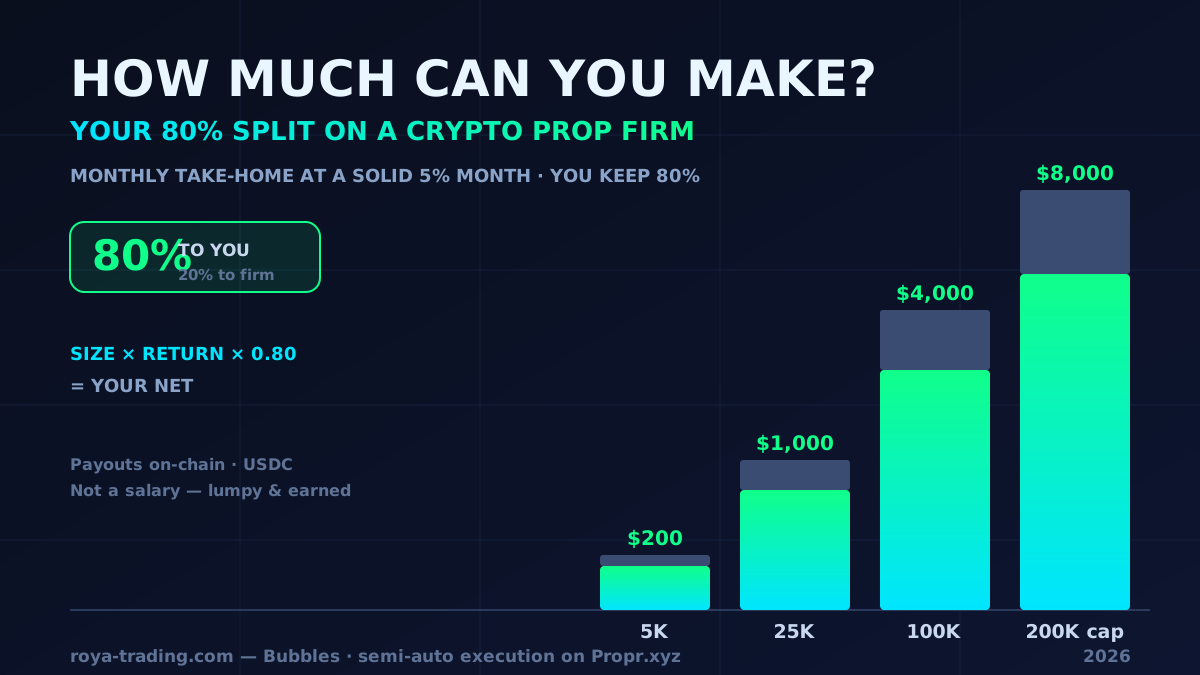
"How much can you actually make?" is the first question anyone asks me about prop firms, and the honest answer has three moving parts, not one. After running real Propr.xyz accounts for months, here is the version I'd give a friend over coffee: your payout is the account size, times your monthly return, times the profit split — and then minus everything the marketing pages leave out. Get the arithmetic straight and you'll set expectations that survive contact with a real trading month instead of a screenshot on Twitter.
Affiliate link. We earn a commission; it never changes what you pay — it is what funds your cashback.
The short answer
You keep 80% of the profit you make on the firm's capital. On a funded Propr account, a realistic 5% month pays you $1,000 on a $25K account, $4,000 on $100K, and $12,000 at the $300K aggregate cap. The challenge phase itself pays nothing — income only starts once you're funded and request a payout (on-chain USDC, $20 minimum, usually under 24 hours). And the number that actually decides your yearly total isn't the split, it's your consistency: most traders never pass, and many who do give the account back to a drawdown breach. So the real formula is: (probability you pass and keep the account) × (80% of your returns) − (the fees you paid along the way). Everything below is how to put honest numbers into that sentence.
The four levers that decide your payout
Forget the hero screenshots for a second. Only four inputs move your take-home, and you control two of them:
- Account size — the capital you trade, from Propr's $5K up to the $300K aggregate cap. You choose this when you buy the challenge.
- Monthly return — your edge, expressed as a percentage of the account. This is the one that's genuinely hard, and the one nobody can promise you.
- The profit split — fixed at 80% to you on Propr. Not a lever you tune day to day, but it's why choosing the right firm matters.
- Survival — whether you keep the account long enough to bank multiple payouts, which is a function of respecting the daily loss and drawdown limits.
Notice what's not on the list: leverage isn't a multiplier on your income, it's a multiplier on your risk. Propr caps it at 5x on BTC/ETH (side panel and changelog; the §12 table on the same page says 10x — unreconciled as of our reading on 12 September 2026) and 2x on other coins for a reason — I explain why that ceiling is a feature, not a limitation, in crypto prop firm leverage explained.
The earnings table: what 80% actually pays
Here's the whole thing on one screen. Each cell is your take-home after the 80% split, for a given account size and monthly return. Three columns: a conservative 3% month, a solid 5% month, and a strong 8% month (strong is not sustainable every month — more on that below).
- $5K account — 3%: $120 · 5%: $200 · 8%: $320
- $10K account — 3%: $240 · 5%: $400 · 8%: $640
- $25K account — 3%: $600 · 5%: $1,000 · 8%: $1,600
- $50K account — 3%: $1,200 · 5%: $2,000 · 8%: $3,200
- $100K account — 3%: $2,400 · 5%: $4,000 · 8%: $6,400
- $200K account (the largest single account on the grid, read 10 September 2026) — 3%: $4,800 · 5%: $8,000 · 8%: $12,800
- $300K (aggregate cap across accounts) — 3%: $7,200 · 5%: $12,000 · 8%: $19,200
The math is deliberately boring: take-home = account size × return × 0.80. A $50K account at 5% makes $2,500 of gross profit; 80% of that is $2,000 in your wallet. If those numbers look smaller than the "$10K/day" clips in your feed, good — those clips are either a six-figure account having one exceptional day or someone selling a course. Which size fits your capital and temperament is its own decision, and I break it down in which Propr.xyz account size to choose.
From fee to first payout: the timeline nobody prices in
You don't earn from day one. The sequence is: pay the challenge fee → hit the target without breaching → get funded → trade → request a payout. On a 1-Step you need a single 10% run; on a 2-Step it's 5% then 10% across two phases. There's no time limit on Propr, which is humane, but it also means the evaluation can take weeks — weeks that pay nothing. I mapped realistic durations in how long it takes to pass a challenge.
Once funded, payouts are fast and on-chain: minimum $20, paid in USDC directly to your wallet, usually settled in around five hours and always under 24. No invoices, no "processing," no 50% first-payout haircut — the mechanics are covered in full in the Propr.xyz payout guide. The practical takeaway for your income planning: the challenge fee is a sunk cost you pay before any of the table above applies. Budget for it as tuition, not as an investment with a guaranteed return.
And when the payouts do start, plan on them arriving gross: in most countries a funded payout is taxed as income for a service — with the challenge fee itself often deductible against it. Before you spend a cent of the table above, read how prop firm payouts are taxed and set your 25–35% aside on the day each one lands.
Why $275 controlling $25K is the whole point
Here's the argument that makes prop firms worth the split. A $25K Propr 1-Step costs $275. That $275 lets you trade $25,000 you never had to own — and at a 5% month, it pays you $1,000. If you instead traded your own $275 with the exact same 5% skill, you'd make $13.75. Same edge, same screen time; the difference is the capital behind it. The firm is renting you a balance sheet, and 20% of the profit is the rent. I ran that trade-off in full — rules, leverage caps, downside and all — in prop firm vs trading your own money.
That's also why the split percentage matters less than beginners think and the rules matter more. An 80% split on a firm that lets you run a bot beats a 90% split on a firm that bans automation and forces you to sit at the screen. Propr explicitly allows bots, copy trading and API access; that's the specific reason my volume lives there, and it's the axis I rank every firm on in the decentralized prop firm comparison — going through that link also gets you 5% USDC cashback on any Propr challenge fee.
The honest part: it's leverage on an edge, not a paycheck
Every number above assumes you have a positive, repeatable edge and you keep the account. Both assumptions do a lot of work. Trading months are lumpy — a realistic funded trader might string together +6%, −2%, +1%, +4%, then a flat month. Average that and it's a fine year; live it and it's four weeks where you made nothing and questioned everything. Worse, a funded account has a live drawdown limit, so a losing streak doesn't just zero your income for the month — it can close the account and send you back to a fresh challenge fee.
This is why "how much can you make" is inseparable from "how likely are you to keep making it." The industry's uncomfortable truth is that the large majority of challenge buyers never get funded, and a chunk of the funded lose the account within a few months. I went deep on the failure modes — the real ones, not "you lacked discipline" — in why 90% of prop firm traders fail. Read it before you extrapolate the 8% column into a salary.
Expected value: the number that beats any earnings screenshot
The grown-up way to think about prop firm income is expected value, not best case. A single challenge attempt is worth roughly: (your realistic pass probability) × (the profit you'd bank before the account eventually resets) − (the fee). Put conservative numbers in. Say you're a genuinely competent trader with a 30% chance of passing a $25K 1-Step, and a passed account nets you around $2,500 of take-home over its life before a breach or a bad stretch ends it. EV ≈ 0.30 × $2,500 − $275 = +$475 per attempt. Positive, but nowhere near the "$1,000 a month forever" fantasy — and it swings hard on your pass rate.
That framing is the honest bridge between the fee and the payout, and it's the same logic I use to decide whether a challenge is even worth buying in is the Propr.xyz challenge worth it. The lever that moves EV most isn't the account size or the split — it's your pass-and-survive rate, which is a skill-and-discipline problem, not a pricing one.
Scaling toward the $300K ceiling
Once you can pass and hold an account, the way you grow income is capital, and Propr caps aggregate funded capital at $300K across accounts. You get there two ways: buy a larger single account, or stack several smaller ones up to the cap and diversify your execution across them — the mechanics and the reasons you'd want to are in running multiple prop firm accounts. At the cap, a steady 5% month is $12,000 of take-home; a strong one is over $19K. That's a serious income — for a proven trader, on capital they never had to risk. It is also the ceiling: prop firm income scales with your edge up to $300K, then stops, which is worth knowing before you quit anything.
Where automation fits the income equation
I didn't build my automated trading setup on the Propr API to promise returns — no honest tool can. I built it to protect the one variable that actually compounds your payouts: consistency. It runs semi-auto on your own Propr account. You choose the trade — your idea, or a Radar Pilot you follow — and validate the plan; the bot executes the DCA ladder, the take-profit and the stop 24/7, with your daily-loss and drawdown limits hard-coded so a single tilted night can't breach the account that pays you. It never widens a stop, never revenge-trades at 2am, and never turns a +4% month into a reset. You keep the decision-making a human should own; the machine keeps the discipline humans reliably lose. That's the difference between one good month and a funded account that survives long enough for the table above to matter — and it's never full autopilot.
FAQ — how much you can make on a crypto prop firm
How much can you realistically make with a crypto prop firm?+
It depends on three numbers: the account size you trade, your monthly return, and the profit split. On Propr you keep 80% of what you make. A funded $25K account returning a solid 5% in a month produces $1,250 of profit, of which $1,000 is yours. Scale that to a $100K account and the same 5% pays you $4,000. But two honest caveats: you have to pass the challenge first (most traders don't), and funded returns are lumpy — some months are red, and a drawdown breach can end the account. Treat these as good months, not a guaranteed salary.
Do you keep 100% of the profit on a prop firm?+
No — you trade the firm's capital, so you share the upside. Propr's split is 80% to the trader, 20% to the firm, on every payout. That 20% is the price of trading $25K or $100K you never had to deposit and can never lose more than the challenge fee on. Some firms advertise 90% splits (Hypernova is 80%, same as Propr); a higher split on a firm with worse rules or one that bans your bot is a worse deal than 80% somewhere you can actually operate.
How much can you make on a $25K or $100K Propr account?+
Keeping 80% of profit: a $25K account pays you $600 at a 3% month, $1,000 at 5%, and $1,600 at a strong 8% month. A $100K account pays $2,400, $4,000 and $6,400 for the same returns. The $300K aggregate cap is the ceiling — at 5% that is $12,000 of take-home in a good month. These are gross of the challenge fee you paid to get funded and assume you keep the account, which requires respecting the daily loss and drawdown limits every single day.
Is prop firm income a stable monthly salary?+
No, and anyone selling it that way is selling you something. Trading returns are lumpy: you might make 8% one month, give back 2% the next, and scratch the third. A funded account also carries a live drawdown limit, so a bad streak doesn't just pause your income — it can close the account entirely, sending you back to a new challenge fee. Think of a prop firm as leverage on your edge, not a payroll. If your edge is real and consistent, the payouts compound; if it isn't, the split percentage is irrelevant.
How much do you make during the challenge phase?+
Zero. The evaluation phase pays nothing — you are proving you can hit the target (10% on a 1-Step, 5% then 10% on a 2-Step) without breaching the daily loss or drawdown. Income only starts once you're funded and request your first payout, which on Propr is on-chain USDC, minimum $20, usually settled in under 24 hours. That gap is exactly why the challenge fee should be money you can afford to lose: it buys a shot at funding, not a paycheck.
Can a trading bot increase how much I make on a prop firm?+
Indirectly, by protecting the thing that pays you: consistency. A semi-auto bot runs on your own Propr account — you choose the trade or the Radar Pilot you follow, and the bot executes the DCA entries, take-profit and stop 24/7 with your daily-loss and drawdown limits hard-coded as guardrails. It doesn't invent an edge or promise returns. What it removes is the 2am revenge trade and the widened stop that breach accounts and reset your income to zero. You keep the decision; the machine keeps the discipline — never full autopilot.
Keep 80%. Let the bot keep the discipline.
A semi-auto bot executes your DCA entries, take-profit and stop on your own Propr.xyz account — semi-auto, 24/7, with your daily-loss and drawdown limits hard-coded as guardrails. It protects the consistency that turns a funded account into repeat payouts. Start free on Telegram.
Get 5% USDC cashbackNo account yet? Create your Propr.xyz account — bots and copy trading explicitly allowed, plus 5% USDC cashback on every challenge fee through this link.
Affiliate link. We earn a commission; it never changes what you pay — it is what funds your cashback.
⚠️ Prop firm income is not guaranteed and is not a salary. The earnings figures here are illustrative arithmetic on hypothetical returns — most challenge buyers never get funded, and funded accounts can be lost to a drawdown breach. Propr rulebook figures cited (account sizes, fees, 80% split, targets, drawdown, $300K cap, payout terms) can change; always verify against propr.xyz/rules before buying a challenge. This article is informational, not investment advice. Only trade what you can afford to lose.