
If you only learn one prop firm rule cold, make it the max drawdown — and specifically whether it's trailing or static. More challenges die on this single distinction than on any chart pattern. Two firms can both advertise an "8% max drawdown" and mean two completely different things, and the trader who doesn't know the difference finds out the expensive way: an account that breaches while it's still showing a profit. I trade these evaluations and automate them, so here's the plain-English breakdown of how each rule works, what it does to your account at every step, and which one to pick.
The short answer
A static drawdown is a fixed floor under your starting balance that never moves — it rewards profit by handing you a growing cushion. A trailing drawdown follows your highest equity upward, so it keeps the pressure on and can breach you on the way back down. For a systematic or automated approach, static is almost always the safer pick because a fixed number is trivial to hard-code. That's why my default is Propr's 1-Step, with its 6% static drawdown. If you trade discretionary and want a looser daily limit, Propr's 2-Step trailing is workable — but only once you genuinely understand the trail, which is where most people get caught.
What a static (fixed) drawdown actually does
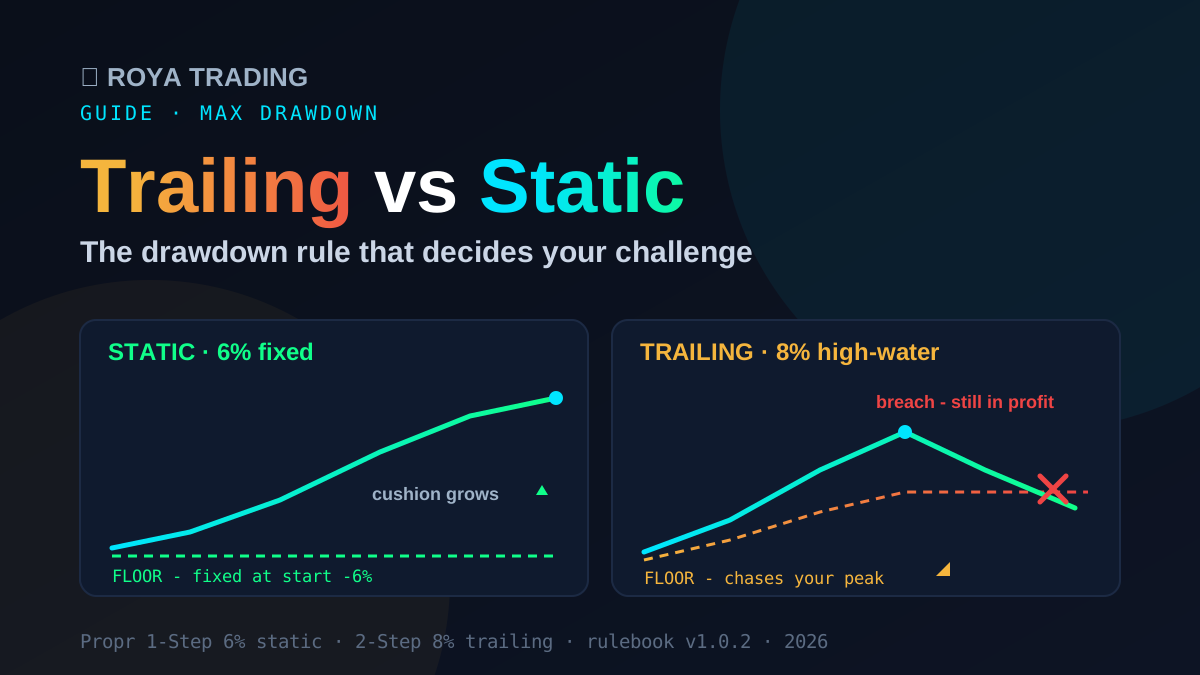
Static is the simple one. On day one, the firm draws a line a fixed percentage below your starting balance, and that line stays put for the entire challenge. On Propr's 1-Step the static max drawdown is 6%. On a 25K account that's a floor at $23,500 — and it never moves, whether you're up 1% or up 9%.
The beauty of static is that profit builds a buffer. Grind the account to +10% (27,500) on a 1-Step and your breach floor is still at 23,500 — you're now carrying a $4,000 cushion between your equity and the wall. You can have a rough session, give back a chunk, and the floor doesn't chase you. The only thing that can breach a static drawdown is genuinely losing money down to that fixed line. It is, by design, the most predictable risk limit in the business. I broke down every Propr limit with dollar figures per account size in Propr's rules explained.
What a trailing drawdown actually does
Trailing is where people get hurt. Instead of measuring from your starting balance, the limit measures from your highest equity — the high-water mark — and it rises as your account rises. On Propr's 2-Step the trailing max drawdown is 8%. On a 25K account it opens at a floor of $23,000 (25,000 − 2,000). Push the balance up to 26,000 and the floor trails up with you to 24,000. Push to 27,000 and the floor is now 25,000.
See the trap? The floor is climbing toward — and past — break-even while you trade. Give back too much after a good run and you can cross it, which is exactly how people blow accounts "while still in profit on the day." The limit isn't measured from where you started or where the day opened; it's measured from your peak. The number "8%" looks gentler than the 1-Step's 6%, and in a vacuum it is — but a moving 8% can be far more punishing than a fixed 6%.
The detail that saves you: where the trail stops
Not all trailing drawdowns are equally cruel, and this is the nuance that separates a survivable rule from a brutal one. There are two things to check on any firm's trailing drawdown:
- Does it ever lock? Propr's 2-Step trail stops once it reaches your starting balance and from there never moves back down. So after you've earned the buffer, the floor locks near break-even and the account behaves almost like a static one. The harsh version — common at traditional futures firms — never locks: the floor keeps chasing your peak forever, so you can be up 15% and still get stopped out by a normal pullback.
- Real-time or end-of-day? An intraday (real-time) trail updates on your highest equity tick, including unrealised profit you never banked — so a wick up can quietly raise your floor. An end-of-day trail only ratchets on your closing balance, which is far kinder. Always read which one applies before you size a position.
Propr's version is on the gentler end: it locks at your starting balance, so the genuine danger window is the early part of the run, before you've built the buffer. Treat your first few percent of profit as the most fragile part of the whole evaluation and the trailing rule loses most of its teeth.
Same account, two rules: a side-by-side walkthrough
Let's run one 25K account through both rules and watch the floor move. Say you have a strong open and push equity to a peak of 27,000 (+8%), then the market pulls back.
- Static 6% (1-Step): floor fixed at $23,500 the entire time. At your +8% peak you're carrying a $3,500 cushion. You'd have to give back the full run and then some — all the way down to 23,500 — before you breach. Profit made you safer.
- Trailing 8% (2-Step): the floor trailed up with you and is now locked at $25,000 (your starting balance). Give back from 27,000 down to 25,000 — a move that still leaves you at break-even — and you breach. The same pullback that the static account shrugs off ends the trailing account.
That's the whole lesson in one example. Identical trading, identical market, wildly different outcome — purely because of which drawdown rule you signed up for. This is also why I keep saying the drawdown choice is a pass-or-fail decision people make in thirty careless seconds. It's one of the five big reasons most prop firm traders fail, and it's entirely avoidable.
Who uses what — and why it matters when you shop
Drawdown type is one of the first things I check on any firm, because it tells you how the rules actually feel to trade, not just how they read on a sales page:
- Propr.xyz 1-Step: 6% static — fixed floor, the most predictable option.
- Propr.xyz 2-Step: 8% trailing that locks at your starting balance — looser daily room, moving floor early.
- Hypernova: static drawdown across its three tiers (3% / 6% / 7%, on end-of-day closed equity — public rules read 16 August 2026) — fixed, with no bot restrictions published, though there is no turnkey execution tooling published there. I compared the two in Propr vs Hypernova.
- Many traditional futures firms: intraday trailing that never locks — the harshest flavour, and the reason "trailing drawdown" has a bad name.
The headline percentage tells you almost nothing on its own. A fixed 6% beats a never-locking trailing 8% for most traders, and an end-of-day trail beats a real-time one. When you compare firms, compare the mechanics, not the marketing number.
The two formats head-to-head
Within Propr, this whole question maps cleanly onto the format choice. 1-Step gives you a static 6% floor and a tighter 3% daily loss — 3% (1-Step) / 5% (2-Step) of your start-of-day balance, snapshotted at 00:00 UTC and recomputed daily, with the breach measured on equity, floating P&L included; 2-Step gives you a more generous 5% daily loss but the 8% trailing floor and two phases to clear. There's no universally "easier" one — there's the one that fits how you trade. I ran the full comparison, including fees and the smartest pick for a systematic trader, in Propr 1-Step vs 2-Step. If you're brand new to the category, it's worth first comparing the best decentralized prop firms of 2026 so you know which rulebooks you're even choosing between.
Why static is a gift if you automate
Here's the angle that matters most to me, because I run bots. A static drawdown is two constant numbers: your starting balance and a fixed percentage. You encode the resulting floor once as a hard stop and the machine simply never crosses it — no recalculation, no edge cases, no "wait, is the floor measured from the peak or the close?" A trailing drawdown forces your stop logic to track a moving target against your high-water mark on every update, which is one more thing to get wrong at the worst possible moment.
That's the real, practical case for Propr's 1-Step if you're systematic. It's also exactly how I run mine: semi-auto, not autopilot — you choose the trade and the direction, and the software handles the execution, running a DCA entry with hard, pre-set daily-loss and drawdown stops on your own Propr account, non-custodial. A fixed floor is the easiest possible thing to defend automatically, which is why pairing a static-drawdown challenge with a disciplined bot is such a clean fit. Propr.xyz allows bots, copy trading and full API access, so this is squarely inside the rules — here's how the Propr API handles automated trading.
If you do pick a trailing challenge
Trailing isn't a trap you must avoid — it's a rule you must respect. If 2-Step's looser daily limit suits your style, three habits keep the trail from biting:
- Bank the early run carefully. The danger window is before the floor locks at your starting balance. Don't give back your first few percent chasing more; that's when a "winning" account breaches.
- Size from your peak, not your entry. Mentally mark your high-water mark and treat the floor as 8% below it until it locks. Your real risk budget shrinks every time you make a new high.
- Automate the stop. A trailing floor is precisely the kind of moving number humans miscalculate at 2am. Let software track it so you don't have to.
Whichever format you choose, the method to actually clear it is the same disciplined playbook I use in how to pass a Propr.xyz challenge — and the on-chain, bot-friendly rulebook is why I run it on Propr in the first place. You can create your Propr.xyz account through my link and get 5% USDC cashback on fees, which quietly offsets the cost of a few retries while you learn the rules.
Affiliate link. We earn a commission; it never changes what you pay — it is what funds your cashback.
FAQ — trailing vs static drawdown
What's the difference between trailing and static drawdown?+
A static (or fixed) max drawdown is a line drawn under your starting balance that never moves: on Propr's 1-Step it's 6%, so on a 25K account the floor sits at $23,500 for the whole challenge, no matter how high you go. A trailing max drawdown follows your high-water mark upward: on Propr's 2-Step it's 8%, so as your balance climbs, the breach level climbs with it. As published in the rulebook, Propr defines that high-water mark as the highest equity ever recorded on the account, including floating P&L on open positions — which matters more than it sounds: an unrealised gain on an open position does drag the floor up behind you, and handing that profit back can breach you. The trailing stops once the limit reaches your starting balance and never goes past it, and a payout resets it. Static rewards profit by building you a cushion; trailing keeps the pressure on by chasing your peak.
Is a trailing drawdown harder than a static one?+
For most traders, yes — especially early in a run. A static floor is a single fixed number you can never accidentally walk into once you're in profit. A trailing floor moves up as you make money, so giving back gains can breach you even when you started the day well. The exception is that Propr's trailing stops once it reaches your starting balance and never moves back down, so once you're comfortably in profit it behaves almost like a static floor. Pure, never-locking trailing (common at futures firms) is the harshest version.
Why did I get breached while I was still in profit?+
That's the signature of a trailing drawdown. The limit is measured from your highest equity, not from your entry or the day's open, so once you've pushed the account up and then given some back, you can cross the floor while still being green on paper. On Propr's 2-Step the danger window is the early part of the run, before the trail locks at your starting balance. Reading whether your firm uses real-time (intraday) or end-of-day trailing is what prevents this surprise.
Does Propr.xyz use trailing or static drawdown?+
Both, depending on the format. Propr's 1-Step uses a 6% static max drawdown — a fixed floor under your starting balance. Propr's 2-Step uses an 8% trailing max drawdown that follows your high-water mark up, then locks at your starting balance once it gets there and never trails back down. So you can choose your drawdown style by choosing your challenge: 1-Step for a fixed wall, 2-Step for a looser daily limit with a moving floor early on.
Which drawdown type is best for a trading bot?+
A static drawdown, almost every time. A fixed floor is two constant numbers — your starting balance and the percentage — that you encode once as a hard stop, and the bot never crosses it. A trailing floor is a moving variable the bot has to recalculate against your peak on every tick, which is more to get wrong. That's why I default to Propr's 1-Step static 6% for automation. A semi-auto DCA bot can encode those hard stops on your own Propr account: you pick the trade, the software holds the line.
Let software hold the floor.
Run a semi-auto DCA strategy with hard daily-loss and drawdown stops on your own Propr account — static or trailing, it never crosses the line. You pick the trade, the software holds the discipline. Start free on Telegram.
Get 5% USDC cashbackNot on Propr yet? Create your Propr.xyz account with 5% USDC cashback.
Affiliate link. We earn a commission; it never changes what you pay — it is what funds your cashback.
⚠️ Trading carries risk. Rules, fees and limits come from Propr's published rulebook, read 10 September 2026, and can change — always check Propr's own rules page before paying. Drawdown mechanics vary by firm and by format; the numbers here describe Propr's 1-Step and 2-Step at the time of writing. Nothing here is guaranteed and past performance does not predict future results. This article is informational and not investment advice. Do your own research and only trade what you can afford to lose.