
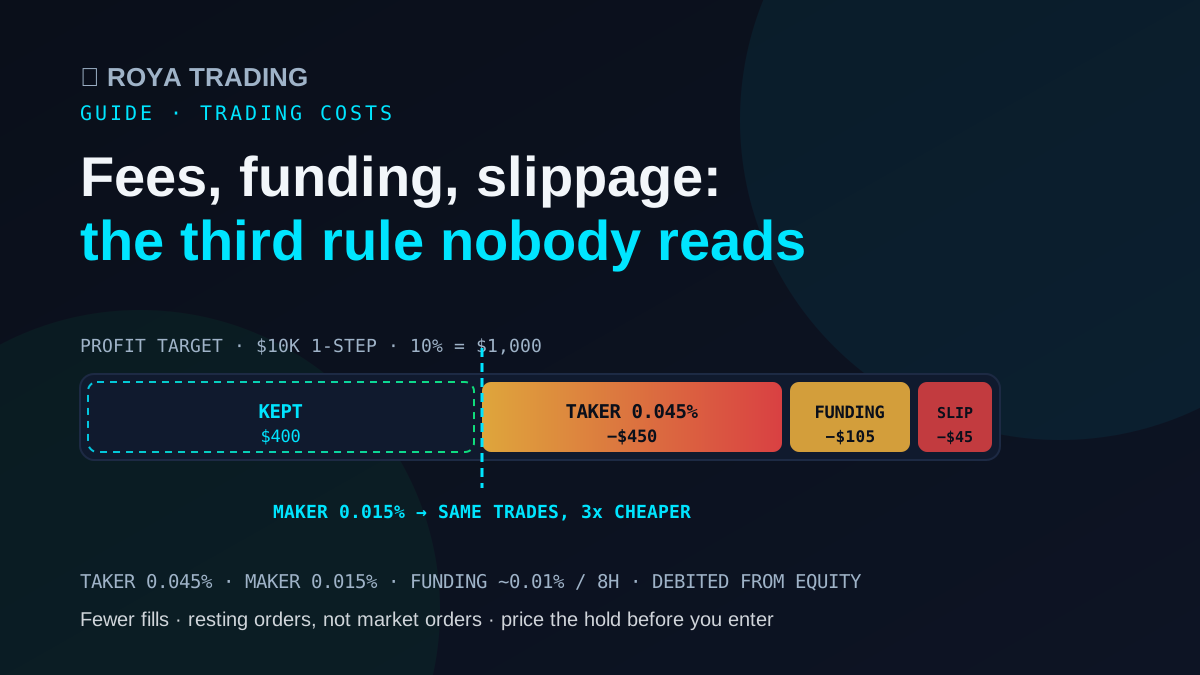
Every prop firm rulebook publishes two walls: a daily loss limit and a maximum drawdown. Traders memorise both. Almost nobody prices the third thing standing between them and the target, because it isn't in the rulebook and it never announces itself — it just shaves a few dollars off every fill and a few cents off every hour a position stays open. I've watched an account finish a month with a clean, disciplined, genuinely profitable set of trades and still sit below its starting balance. Nothing went wrong. The trader simply paid 0.045% to enter, 0.045% to exit, and 0.01% per eight hours to wait, roughly two hundred times, and the arithmetic did the rest. This is the page about that arithmetic: what execution actually costs on a Hyperliquid-backed challenge, when it matters, and the three changes that cut it by two thirds.
The short answer
One: your challenge fee is not your cost of trading — it's the entry ticket. Two: at the entry volume tier, Hyperliquid perps cost 0.045% taker and 0.015% maker, so a fully-taker round trip is ~0.09% of notional and a fully-maker one is ~0.03%. Three: funding settles hourly at one eighth of the 8-hour rate, with a 0.01%/8h baseline — cheap when the book is balanced, expensive when everyone is on your side of it. Four: every cent of this is debited from equity, and equity is what the breach engine checks, so costs spend from the same budget your losing trades do. Five: the fix is structural, not clever — fewer fills, resting orders instead of market orders, and shorter holds on expensive-funding pairs. The rest of this page attaches real numbers to those five lines.
What a Propr challenge actually costs you
Answer first: one fee up front, zero markup afterwards, and the ordinary venue costs of trading perpetuals. Propr charges a single challenge fee — $50/$100/$250/$450/$899/$1,499 for the Classic 2-Step across the six sizes 5K/10K/25K/50K/100K/200K, $60/$110/$275/$495/$999/$1,998 for the Classic 1-Step, $45/$85/$185/$355/$699/$1,399 for the Pro 1-Step and $25 to $899 for the Turbo variant (grid read 10 September 2026). There are no monthly subscriptions, no platform or data fees, and no withdrawal fee on payouts, which land on-chain in USDC. I broke that pricing down against expected value in the full cost and ROI analysis. What remains after the fee is the part traders forget to model: maker and taker fees on every fill, and the funding rate on every hour a perpetual position stays open. Propr passes those through at cost. "At cost" is not the same as "free."
The reason this matters more on a challenge than on your own account is the shape of the objective. Trading your own money, a 0.09% round-trip cost is a drag on a return with no deadline and no floor. On a challenge you have a fixed target — 10% on the 1-Step, 5% then 10% on the 2-Step — and a hard floor beneath you. Costs don't just reduce your return; they raise the bar you have to clear and lower the ceiling you can fall from. If your execution costs 2% of the account over a run, you are no longer trading for 10%. You are trading for 12%, with the same 6% of drawdown room. That asymmetry is one of the underrated differences in prop firm capital versus your own money.
The fee arithmetic, in basis points and dollars
Answer first: 0.045% taker, 0.015% maker at the entry tier — and the gap between them is the biggest cost lever you own. Hyperliquid prices perpetuals on a 14-day rolling volume ladder. Below $5M of 14-day volume, where every challenge trader lives, you pay 0.045% when you take liquidity from the book and 0.015% when you provide it with a resting limit order. Fee tiers improve with volume — the deepest market-maker tiers actually earn a rebate — but on a $10K account you will not touch them, so plan on the entry numbers and treat anything better as a bonus.
Now put a size on it. On a $10,000 1-Step at Propr's 5x leverage cap on BTC and ETH (side panel and changelog; the §12 table on the same page says 10x — unreconciled as of our reading on 12 September 2026), a full-size position is $50,000 of notional. Taker in and taker out: $22.50 + $22.50 = $45 per round trip. Your profit target on that account is $1,000. So 23 full-size round trips consume an entire target's worth of profit before the market has an opinion. Twenty-three. That is a slow week for an active trader. Cut the size to a sane 0.75% risk unit and the notional drops with it, but the ratio doesn't change: cost scales with notional turnover, and turnover is what active trading produces.
The DCA angle makes it sharper, because averaging in multiplies your fill count. A three-entry ladder plus one exit is four fills, not two. Take a trader running 50 positions across a challenge, each ladder totalling $20,000 of notional across its entries with a matching exit — call it $80,000 of turnover per position, $4M over the run. All taker: $1,800. All maker: $600. The target is $1,000. The same 50 trades, executed with the same judgment, land on opposite sides of profitable purely because of which side of the order book they touched. This is why the construction rules in my DCA method for prop firm challenges insist on planned limit rungs rather than "adding here because it dipped" — the discipline has a P&L line, not just a psychological one.
Funding: the cost of time, not of trading
Answer first: Hyperliquid settles funding every hour at one eighth of the 8-hour rate, and the baseline is 0.01% per 8 hours. That is about 0.00125% per hour, roughly 11.6% annualised, structurally paid by longs to shorts in balanced conditions — it represents the cost of borrowing dollars against spot. The payment is computed on the oracle price, so it's notional-based, not P&L-based: a position that is flat on the day still pays.
Concretely, on $50,000 of notional at baseline: about $0.63 an hour, $15 a day. Against a $300 daily loss budget on a $10K 1-Step, that's 5% of the day's allowance burned for doing nothing. Survivable, clearly. The problem is that baseline is the floor, not the average. Funding on Hyperliquid is the baseline interest component plus a premium term driven by how far the perp trades from the oracle, sampled continuously — and in a hot one-directional market the premium dominates completely. Get long a crowded pair in a squeeze and the same position can cost several multiples of that per day. The hourly cadence hides it: nobody notices $0.63, and everybody notices $200 at the end of a week-long hold.
Three practical rules fall out of that. Check funding before you size, not after — it's published live per pair, and an extreme rate is itself a signal that positioning is one-sided. Prefer the side that gets paidwhen your thesis is neutral between long and short, because when funding is positive the short side collects. And match your hold to your edge: a swing thesis that needs four days to play out on a pair paying 0.05% per 8 hours is quietly a 0.6% headwind before you're right. That's roughly the same order of magnitude as the per-trade risk unit derived in position sizing for a crypto prop firm — which is a polite way of saying funding can be as large as the trade.
Slippage: the cost you can't see on the receipt
Answer first: slippage is a fee you pay in price rather than in commission, and it's the one that scales worst with urgency. A market order walks the book until it's filled. On BTC or ETH in an active hour, the depth is deep enough that a $50K clip barely moves anything. On a mid-cap alt at 3am, the same order can cost you more in price than the entire commission bill for the week. Hyperliquid's books are among the deepest in perp DEX land, which is precisely why the best Hyperliquid prop firms 2026 are worth the attention — but depth is a property of the pair and the hour, not of the venue in general.
Two moments concentrate almost all of it. The first is macro events: a CPI or FOMC candle can blow spreads wide for the exact seconds you most want to trade, which is the practical core of news trading on a prop firm. The second is the weekend, where 24/7 markets keep trading but with thinner books and jumpier wicks — the cost side of the weekend edge. In both regimes the fix is the same: limit orders with a defined worst price, and position sizes small enough that you aren't the largest order in the book. Note the one exception you should never optimise: a stop-loss is a cost-insensitive order. Pay the slippage. A stop that doesn't fill because you got clever with a limit is how a managed loss becomes a breach — the placement logic is in stop-loss and take-profit for challenges.
Why costs are a risk rule, not an accounting detail
Answer first: fees and funding are debited from equity, and Propr checks breaches on equity. This is the sentence that turns a spreadsheet topic into a survival topic. The daily allowance is calculated on your start-of-day balance, but enforcement is performed against live equity including unrealised P&L. Costs land on that same number. A day where you took four small losses and paid $40 in fees is not a $260 day against your $300 budget — it's a $300 day, and you are at the wall.
So the honest way to plan a session is to subtract expected costs from the published allowance before you divide by four. On a $10K 1-Step, if your normal activity costs $30–$50 a day in fees and funding, your working budget is $250–$270, not $300, and your per-trade unit is $62–$67 rather than $75. It's a small adjustment that removes an entire category of "I don't understand how I breached, my stops were fine" — a failure mode I catalogued in the daily loss limit guide. Deep in a hole the same logic gets worse, because cost drag is constant while your remaining room is shrinking; that regime is the one I worked through in the drawdown recovery math.
Cutting the bill by two thirds
Answer first: fewer fills, resting orders, shorter holds on expensive pairs. In order of impact:
1. Trade the maker side by default. 0.015% instead of 0.045% is a two-thirds cut on the largest line of the bill, and it costs you nothing but the willingness to let price come to you. A limit order that doesn't fill is not a loss; it's a trade you didn't need. The exceptions are stops and genuine breakout entries where non-fill defeats the thesis — pay taker there and be honest that you did.
2. Cut fill count, not just position count. A five-rung ladder isn't 2.5x better than a two-rung ladder, but it is 2.5x the fills. Three rungs is usually the point of diminishing returns. Likewise, scaling out of a winner in four tranches is four taker exits if you're managing them by hand.
3. Price the hold. Before entering a multi-day position, multiply the current funding rate by your expected hold in 8-hour blocks and put that number next to your target. If funding eats 20% of the expected move, the trade needs a better entry or a shorter horizon.
4. Don't buy fee tiers you can't reach. The temptation to churn volume toward a better tier is a trap on a $10K account: you will pay far more in fees generating the volume than the tier will ever return.
5. Recover cost elsewhere. Two structural offsets exist and cost you nothing: the 5% USDC cashback on the challenge fee through an affiliate link, and $PROPR points accrued while you trade. Neither reduces your per-fill cost, but both reduce the total cost of getting funded, which is the number that actually matters.
How semi-auto execution keeps costs down
The expensive habits above are all the same habit: acting on the market's schedule instead of your own. Chasing an entry is taker. Panic-adding to a position is taker. Scaling out in a rush because the candle turned is taker, four times. A bot — see the best prop firm trading bots and their APIs — is the layer that removes the rush. It runs semi-auto on your own Propr.xyz account — you pick the trade, your own setup or a Radar pilot you follow — and it places the DCA ladder as pre-planned resting orders with the take-profit and stop-loss committed before entry. Planned rungs sit on the maker side of the book; hands in a hurry do not. It won't make funding free and it won't pick direction for you, but it makes your fill count a decision instead of an accident. Propr explicitly allows bots, copy trading and API access — which is why an execution layer like this runs there out of the box; Hypernova's public rules (read 16 August 2026) no longer carry the old §14.2 ban either, but offer no turnkey equivalent. The head-to-head is in Propr vs Hypernova, and the wider field is ranked in the best decentralized prop firms of 2026.
Bottom line
The challenge fee is the cost you shop for. Execution is the cost you pay. At 0.045% taker, 0.015% maker and a 0.01%-per-8-hours funding baseline, an ordinary run on a $10K account can hand back $600 to $1,800 — between 60% and 180% of the profit target — purely in friction, and every dollar of it comes out of the same equity the breach engine watches. Model it, subtract it from your daily allowance before you size, and take the maker side whenever non-fill isn't fatal. Do that and the cheapest improvement available to you doesn't require a better strategy at all. If you're starting a new run, a Propr.xyz challenge through my link pays 5% USDC cashback on the fee — and the payout when you pass settles on-chain in USDC, usually within hours.
Affiliate link. We earn a commission; it never changes what you pay — it is what funds your cashback.
FAQ — Prop firm trading fees, funding and slippage
Does Propr.xyz charge trading commissions on top of the challenge fee?+
No markup. The challenge fee ($25–$1,998 depending on format and size — six sizes from $5K to $200K, four formats, read 10 September 2026) is the only thing Propr charges you, and there are no monthly, platform, data or withdrawal fees. What you still pay are the venue-level costs every perpetual trader pays on Hyperliquid: maker/taker fees on each fill and the periodic funding rate on any position you hold. Those are passed through at cost, not marked up — but they are real money, they hit your equity, and equity is what the breach engine watches.
How much are Hyperliquid trading fees?+
At the entry tier (under $5M of 14-day rolling volume, which is where essentially every challenge trader sits) Hyperliquid perp fees are 0.045% taker and 0.015% maker. A round trip that takes liquidity on both sides therefore costs about 0.09% of notional; a round trip filled entirely with resting limit orders costs about 0.03%. That 3x gap is the single largest cost lever you control, and it costs nothing but patience to capture.
How do funding rates affect a prop firm challenge?+
Hyperliquid settles funding every hour at one eighth of the standard 8-hour rate, with a baseline interest component of 0.01% per 8 hours — roughly 0.00125% per hour, or about 11.6% a year, paid by longs to shorts in calm conditions. On $50,000 of notional that is about $0.63 an hour, or $15 a day, on a $10,000 account whose entire daily loss budget is $300. Calm markets make it a rounding error. Crowded markets do not: when a trend gets one-sided the premium component dominates and the same position can cost several times that.
Do fees and funding count toward my daily loss limit?+
Yes. Fees and funding are debited from your account, so they reduce equity, and Propr's breach checks are performed on equity. A funding payment does not feel like a loss but it spends from the same budget a losing trade does. The practical consequence: your effective daily allowance is the published limit minus whatever the day's execution costs will be, so build the estimate into your plan rather than discovering it at the wall.
How much do fees really cost over a full challenge?+
Do the arithmetic on your own turnover instead of guessing. Cost = number of fills x average notional per fill x fee rate. A trader running 50 positions on a $10,000 1-Step, each a three-entry DCA ladder plus one exit at $20,000 of notional, executes 200 fills. All taker, that is 200 x $20,000 x 0.045% = $1,800 — on an account whose profit target is $1,000. All maker, the same activity costs $600. Same trades, same setups, a $1,200 swing in whether the challenge is passable.
Can a bot reduce trading costs on a prop firm challenge?+
It can remove the main reason people overpay, which is impatience. A semi-auto bot runs on your own Propr.xyz account: you choose the trade, and it places the DCA entries as a pre-planned ladder of resting orders rather than a sequence of panicked market buys, with the take-profit and stop-loss committed before entry. Resting orders are the maker side of the book, which is where the 0.015% rate lives. It does not pick direction for you and it cannot make funding free — but a ladder that waits is structurally cheaper than a hand that chases.
Stop paying taker for impatience.
A bot places your DCA ladder as pre-planned resting orders, with the stop and take-profit committed before entry — so your fill count is a decision, not a reflex. Semi-auto on your own Propr account: you pick the trade, it keeps the plan. Start free on Telegram.
Get 5% USDC cashbackNot on Propr yet? Create your Propr.xyz account with 5% USDC cashback.
Affiliate link. We earn a commission; it never changes what you pay — it is what funds your cashback.
⚠️ Trading carries risk. Propr rules and fees come from the published rulebook and can change; Hyperliquid fee tiers and funding rates are live market data and change constantly — always check the current schedule before sizing. Nothing here is guaranteed and past performance does not predict future results. This article is informational and not investment advice. Do your own research and only trade what you can afford to lose.