
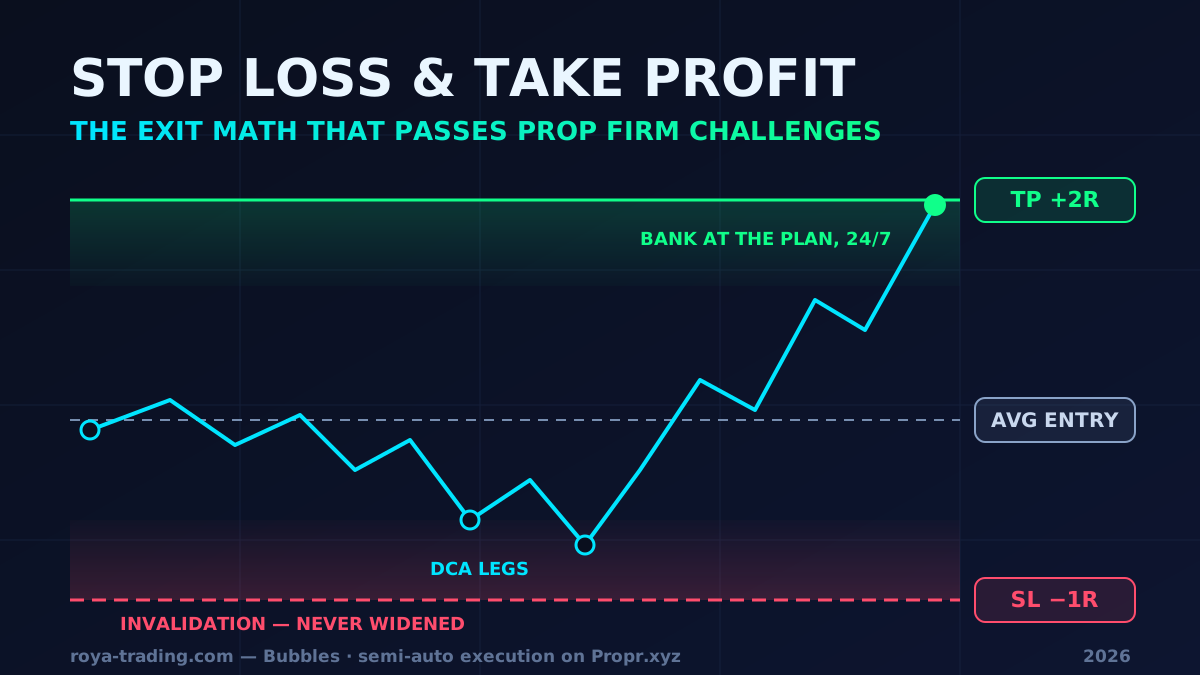
Trading content is obsessed with entries — the setup, the signal, the perfect candle. But after months of running real challenges on Propr.xyz, I can tell you where evaluations are actually decided: at the exit. The stop you refused to honor, the take-profit you never defined, the breakeven move that donated a winner back to the market. Entries open trades; exits produce the P&L. This is the full exit playbook I trade and automate — where the stop goes, what the take-profit must clear mathematically, and how the two change depending on which drawdown format polices your account.
Affiliate link. We earn a commission; it never changes what you pay — it is what funds your cashback.
The short answer
Place the stop at your invalidation — the price where the idea is objectively wrong — then derive position size from that distance. Never the reverse. Target at least 1.5R–2R on the take-profit, because the arithmetic below 1.5R demands a win rate most strategies don't have. Keep both orders on the book — crypto trades 24/7 and Propr's limits are equity-based, so a mental stop while you sleep is a resignation letter. Never widen a stop; you may only tighten it behind new structure. On a $25K 1-Step risking 0.5% ($125 per trade), that one paragraph is the difference between six survivable stop-outs in a bad day and a breached account.
Stop loss placement: invalidation first, dollars second
There are two ways to place a stop, and only one of them is a method. The wrong way: pick a round loss you can stomach ("$200 feels fine"), put the stop there and hope. Price doesn't know your pain threshold. The right way runs in strict order: first identify the level that proves the trade wrong — below the swing low, the demand zone, the range boundary that made you enter. Second, measure the distance from entry to that level. Third, size the position so that distance costs exactly your risk budget — the one-division formula from position sizing for prop firm challenges: notional = dollar risk ÷ stop distance.
Two crypto-specific refinements. Give the level breathing room: crypto wicks overshoot obvious levels by design — liquidity sits under swing lows, and a stop placed exactly at the low is an order waiting to be collected. Set it a volatility step beyond (a fraction of the pair's average true range), accept the slightly smaller size, and stop being everyone's exit liquidity. And keep the stop on the exchange, not in your head. Propr's daily loss and drawdown are monitored on equity — floating losses count, and "even a momentary touch" of a limit breaches the account, at 3am as at 3pm. A hard stop is the only version of you that's awake all session — and on CPI or FOMC days, when wicks travel multiples of their usual range, size the whole plan down first: the news trading guide runs that math.
Budget the stop against the account's real walls
Your stop never lives alone — it lives inside two account-level limits that don't reset with your mood. On Propr, the daily loss is 3% of your start-of-day balance on 1-Step accounts and 5% on 2-Step, recalculated daily at 00:00 UTC so it shrinks as you draw down; the max drawdown is 6% static on Classic 1-Step, 8% trailing on 2-Step — and 3% static on the new Turbo 1-Step tier added at the end of June 2026 (9% target, fees from $25). In dollars on a $25K account: a $750 daily wall and a $23,500 floor on Classic 1-Step; a $1,250 daily wall with a floor trailing $2,000 behind your peak on 2-Step; a $24,250 floor on Turbo.
The stop's job is to make those walls unreachable in a single day. At 0.5% risk, a full stop-out costs $125 — six consecutive losers before the 1-Step daily wall, a losing streak you can walk away from. At 1.5% risk, two losers put you at the edge, and you'll be trading the third while tilted. Turbo makes the point brutally: with a 3% total drawdown, three full 1% losses end the account — on that tier, 0.5% risk isn't conservative, it's the only sane setting. Which format fits your style is a separate decision — I compare them in Propr 1-Step vs 2-Step — but the sizing logic is universal: the stop distance sets the size, and the walls set the risk budget.
The R:R table: what your take-profit must clear
Before you place a take-profit, know the arithmetic it has to beat. The breakeven win rate for a given reward-to-risk ratio is 1 ÷ (1 + R):
- 1R — needs >50% wins just to break even. Add fees and slippage: a coin-flip strategy loses money at 1R.
- 1.5R — breakeven at 40% wins. The realistic floor for most systematic strategies.
- 2R — breakeven at 33.3%. You can be wrong two trades out of three and still climb.
- 3R — breakeven at 25%. Powerful, but 3R targets get hit less often; don't force them on a ranging market.
Now run the challenge math. $25K Classic 1-Step, 0.5% risk ($125), take-profit at 2R ($250), a realistic 45% win rate: expectancy per trade = 0.45 × $250 − 0.55 × $125 ≈ $44. The $2,500 target is roughly 55–60 trades — weeks of normal trading, exactly the timeline I documented in how long it takes to pass a challenge. Drop the take-profit to 1R with the same win rate and expectancy turns negative — you'd be paying Hyperliquid fees to slowly bleed. The take-profit level, more than the entry, decides whether your system has an edge at all.
Take profit: structure, partials, and the breakeven move
Put the take-profit where price has a reason to stall — the prior high, the opposite side of the range, the untested level — and only take the trade when that natural target sits at 1.5R or better. Forcing a 2R target onto a chart that offers 0.8R of room isn't discipline, it's fiction with extra steps.
Partials reconcile math with psychology. My default: TP1 banks half the position around 1R, TP2 exits the rest at 2R–3R or at structure. Yes, partials lower your average winner — the honest cost — but they raise your effective win rate, smooth the equity curve, and on a challenge that smoothness is functional: every dollar banked at TP1 is a dollar your daily loss budget gets back. A full position that tags +0.9R and reverses to the stop is the most demoralizing trade in prop trading; partials delete it from your life.
The breakeven move is where winners go to die — do it late and behind structure. Moving the stop to entry right after TP1 feels safe, but crypto revisits entries constantly: a breakeven stop at the exact entry converts trends into scratches. Wait for new structure to form (a higher low on your timeframe), then tuck the stop behind that. Worst case becomes a small win instead of a round trip, and the position still has room to trend.
One more thing the textbooks skip: if you scale in, measure R from your average entry, not your first fill. A three-leg DCA ladder has one entry price that matters — the blended one — and the stop and both TPs are computed from it. That interaction between ladder, stop and target is the core of DCA for prop firm challenges, and it's precisely the arithmetic nobody does correctly by hand at 2am.
Static vs trailing drawdown: your exit rules change by format
On a static drawdown (Classic and Turbo 1-Step), the floor never moves. Every dollar you bank builds cushion above a fixed line, which makes letting the second half of a position run relatively cheap: a give-back hurts your open P&L but your survival math only improves as profits realize. Static formats forgive patient exits.
On the 2-Step's trailing drawdown, the 8% floor follows your high-water mark — and the HWM is equity-based. Read that twice, because it reshapes take-profit strategy: the floating peak of an open position raises your floor whether or not you ever bank it. Example on $25K: floor starts at $23,000; an open trade floats the account to $26,000 → the floor is now $24,000. Let that position round-trip to flat and you keep the higher floor with none of the profit — your room just shrank from $2,000 to $1,000 for nothing. On a trailing account, the untaken take-profit isn't neutral, it's rented risk. The discipline that follows: bank at your planned TP, mechanically, every time — the floor already moved; make sure the balance moves with it. Full mechanics in trailing vs static drawdown.
The five exit mistakes that end challenges
- Widening the stop. The moment you move a stop away from price, you've replaced your invalidation with your hope. It saves the trade once, then costs the account.
- The mental stop. Works right up until the 4am wick. Equity-based limits don't sleep; neither should your stop order.
- 1R take-profits on a sub-50% system. The slow bleed nobody notices — the account dies of fees and negative expectancy over forty "disciplined" trades.
- Breakeven too early. Scratching five straight winners is tuition paid to impatience; behind structure or not at all.
- Revenge re-entry after a clean stop-out. The stop did its job; re-entering bigger to "get it back" is how a $125 loss becomes a $750 daily wall. It's the same failure loop I broke down in why 90% of prop firm traders fail.
Propr doesn't force a stop loss on you — set one anyway
Here's a detail from the Propr.xyz rulebook most people miss: there is no mandatory stop-loss rule ("not required, though recommended") and no risk-per-trade cap. The only guardrails are the two equity limits, and how you trade inside them is your business — that's the on-chain, rules-not-vibes philosophy that made me move my volume there, and it's why bots and copy trading are explicitly legal on both formats. But the freedom is symmetric: nothing forces you to protect yourself, and nothing saves you when equity touches a limit. A breach closes everything, permanently, even if the position would have recovered a minute later. If you're still comparing firms on how their rules treat automation and exits, my decentralized prop firm comparison ranks them on exactly that — and going through this link gets you 5% USDC cashback on any Propr challenge fee.
Affiliate link. We earn a commission; it never changes what you pay — it is what funds your cashback.
Automate the exit, keep the decision
Everything above is teachable; almost none of it survives contact with a losing streak at 2am. That's not a character flaw, it's why I built the execution layer as software — a bot wired into the Propr API for automated trading. It runs semi-auto on your own Propr account: you pick the trade — your idea, or a Radar Pilot you choose to follow — and validate the plan; the bot executes the DCA ladder and manages TP1/TP2, the stop and the breakeven logic exactly as configured, 24/7, with your account's daily loss and drawdown hard-coded as guardrails. The stop never gets widened because there's no hand on it to widen. You keep the only part that deserves a human — what to trade and how much to risk. The machine keeps the part where humans reliably fail: the exit.
FAQ — stop loss & take profit on prop firm challenges
Where should I place my stop loss on a prop firm challenge?+
At the level where your trade idea is objectively wrong — below the structure or zone that made you enter — never at an arbitrary dollar distance. Then derive position size from that distance: notional = dollar risk ÷ stop distance. On a $25K Propr 1-Step risking 0.5%, that's $125 of risk regardless of where the stop sits. And keep it on the book, not in your head: Propr's limits are equity-based and monitored 24/7, so a mental stop while you sleep is how challenges end.
What risk-reward ratio do I need to pass a challenge?+
The breakeven win rate is 1 ÷ (1 + R). A 1R take-profit needs more than a 50% win rate just to break even before fees; 2R needs 33.3%; 3R needs 25%. Most systematic crypto strategies land between 40% and 55% wins, so a minimum 1.5R–2R take-profit is the practical floor. At 0.5% risk and 2R on a $25K 1-Step, a 45% win rate compounds to the $2,500 target in roughly 55–60 trades.
Should I move my stop loss to breakeven?+
After a partial take-profit, usually yes — but not to your exact entry. Crypto wicks revisit entries constantly; a breakeven stop at the entry price converts winning trades into scratches. Move the stop behind the nearest structure that has formed since entry. The goal isn't to make the trade riskless as fast as possible, it's to protect your daily loss budget without donating the position to noise.
Do prop firms require a stop loss?+
Propr.xyz doesn't — the rulebook explicitly lists 'mandatory stop-loss: none (though recommended)' and has no risk-per-trade rule. The only hard guardrails are the two equity limits: the daily loss — 3% (1-Step) / 5% (2-Step) of your start-of-day balance, snapshotted at 00:00 UTC and recomputed daily; the breach itself is measured on equity, floating P&L included — and the max drawdown (6% static, 3% static on Turbo, 8% trailing on 2-Step). That freedom cuts both ways: nothing stops you from trading without a stop, and nothing saves you when equity touches a limit — the breach is automatic and permanent.
How does take profit interact with a trailing drawdown?+
On a Propr 2-Step, the 8% trailing drawdown follows your high-water mark — and the HWM is equity-based, so an open position's floating profit raises your floor even if you never bank it. Let a +4% float round-trip to zero and your floor moved up while your balance didn't. That's why trailing formats reward planned, mechanical take-profits: banking at your TP converts the equity peak into balance instead of just a higher floor.
Can a bot manage my stop loss and take profit automatically?+
Yes — that's exactly the layer automation is good at, semi-auto. You choose the trade (or the Radar Pilot you follow) and validate the plan; the bot executes the DCA entries and manages TP1/TP2 and the stop on your own Propr account, 24/7, with your daily-loss and drawdown limits hard-coded as guardrails. You keep the decision; the machine keeps the discipline — it's never full autopilot.
Your trade. Your levels. Executed without emotion.
A bot executes your DCA entries, take-profit and stop loss on your own Propr.xyz account — semi-auto, 24/7, with your daily-loss and drawdown limits hard-coded as guardrails. You decide, it executes. Start free on Telegram.
Get 5% USDC cashbackNo account yet? Create your Propr.xyz account — bots and copy trading explicitly allowed, plus 5% USDC cashback on every challenge fee through this link.
Affiliate link. We earn a commission; it never changes what you pay — it is what funds your cashback.
⚠️ Trading crypto perpetuals carries real risk, and no stop-loss or take-profit method eliminates it: gaps, wicks and thin liquidity can fill orders away from their level. Propr rulebook figures cited here (targets, daily loss, drawdown, Turbo tier, leverage) can change; always verify against propr.xyz/rules before buying a challenge. This article is informational, not investment advice. Only trade what you can afford to lose.