
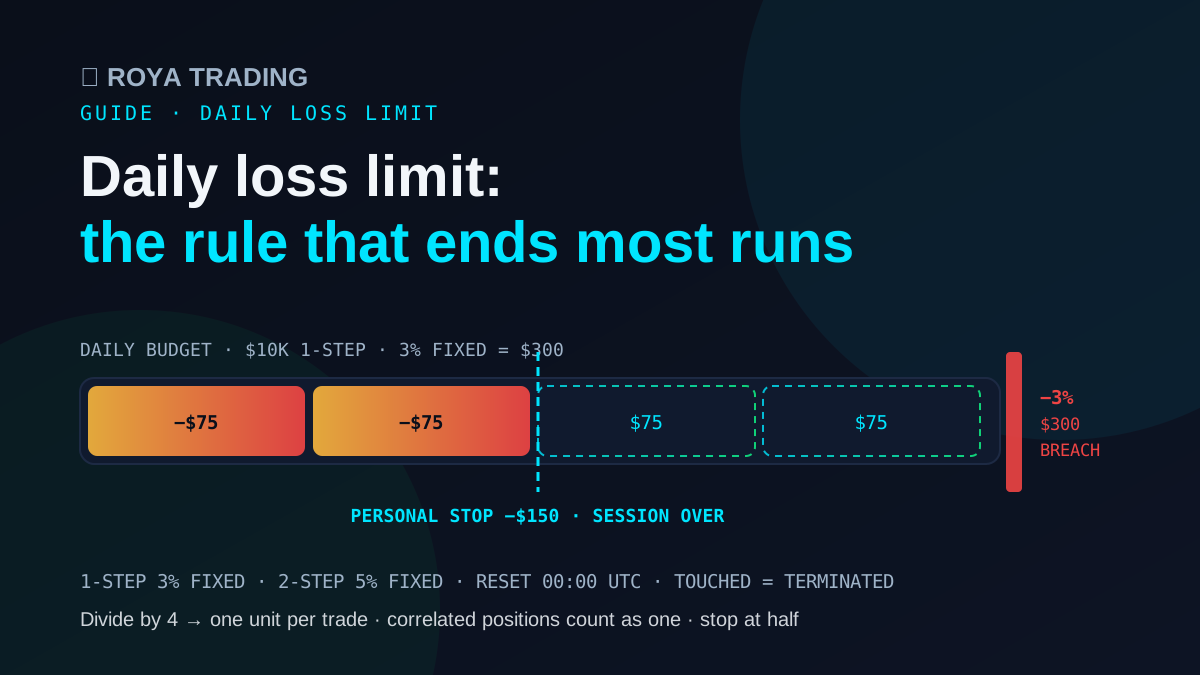
Read the published rulebook before you size. The daily loss limit is 3% (1-Step) / 5% (2-Step) of your start-of-day balance, snapshotted at 00:00 UTC and recomputed daily; the breach itself is measured on equity, floating P&L included (read 12 September 2026). Every sizing method below still holds; you just derive the number each morning from that day’s balance.
Ask a trader which rule they're afraid of and they'll say the drawdown. Ask the accounts, and they tell a different story. The max drawdown is the slow death — you see it coming for days. The daily loss limit is the fast one: a rule that can take a healthy account from comfortable to terminated between lunch and dinner, and it doesn't need a market crash to do it. Three ordinary losers and one angry resize will do fine. On Propr.xyz the wall sits at 3% of your start-of-day balance per day on the 1-Step — while the total drawdown is 6%, which means the entire challenge is never more than two maxed-out days from over. This article is the one I wish I'd read before I donated an account to a Tuesday afternoon: what the rule actually says, the arithmetic that turns 3% into a per-trade number, and the circuit breakers that hold when your judgment doesn't.
The short answer
Treat the daily limit as a budget you spend in pre-set units, decided before the day opens. One: know your number — on Propr it's 3% of your start-of-day balance on 1-Step, 5% on 2-Step, re-derived every morning at the 00:00 UTC snapshot. Two: divide it by at least four for your per-trade risk — $75 on a $10K 1-Step. Three: count correlated positions as one trade, because BTC, ETH and SOL falling together will spend three units in one candle. Four: set a personal stop at half the allowance and a two-loser rule, so a red day ends your session, never your account. Five: pre-commit the stop-loss on every position before entry — sized ladders, not vibes. The rest of this page is those five lines with real numbers attached.
What the rule actually says on Propr
Answer first: a percentage of your start-of-day balance, re-derived every day, and touching it is a breach — not a timeout. On the 1-Step it's 3%; on the 2-Step it's 5%. On day one of a fresh account the percentage still lands on the starting balance, so the familiar numbers hold: $150 on a 5K, $300 on a 10K, $750 on a 25K, $1,500 on a 50K, $3,000 on a 100K and $6,000 on a 200K for the 1-Step; $250, $500, $1,250, $2,500, $5,000 and $10,000 on the 2-Step. Recomputed is the load-bearing word — the base is snapshotted on your balance at 00:00 UTC and refreshed every day, so the dollar allowance shrinks after a red day and grows after a green one. The breach itself is then measured on equity, floating P&L included, which is why an open position can touch the wall on a wick. Hitting it terminates the evaluation exactly like the max drawdown does (rules read 12 September 2026). I walked through the full rule sheet in Propr's rules explained — this article is about the one rule on it that does most of the killing.
Why it ends more runs than the drawdown
Answer first: because it's the tighter constraint on any single day, and because it's the one tilt attacks. Run the geometry on the $10K 1-Step: total room is 6% static ($9,400 floor), daily room is 3%. The drawdown is literally two maxed-out days wide. But traders don't usually spend those days a week apart — they spend them consecutively, because the sequence that breaches accounts isn't a market event, it's a behavior loop: a normal losing morning (−1.5%), a doubled position to "win the day back" (−1.5% more, wall touched), account over. The whole cascade fits inside four hours. That loop — loss, revenge, oversize, termination — is the number-one killer in why 90% of prop firm traders fail, and the daily limit is where it detonates. The drawdown mostly ends accounts that were already dying. The daily limit ends healthy ones.
There's a second, sneakier reason: early in a challenge, the daily limit is your binding constraint — and most sizing advice ignores it. With a full 6% of drawdown room, "1% risk per trade" sounds conservative against the floor. But against a 3% day, three ordinary losers put you one trade from the wall by mid-session. Deep in drawdown the roles flip and the floor takes over as the binding number — I covered that regime in the drawdown recovery math. Between the two of them, at every moment of a challenge, one of these walls is closer than you think, and for the healthy majority of your run it's the daily one.
From 3% to a per-trade number
Answer first: risk per trade = daily budget ÷ 4, minimum. On the $10K 1-Step: $300 ÷ 4 = $75, or 0.75% — which lands, not by accident, just under the 1% ceiling that standard challenge position sizing arrives at from the drawdown side. When two independent calculations both tell you ¾-of-1%, that's the number. Dividing by four means four full stop-outs before the wall — enough room for a genuinely bad day to stay survivable — and on the 2-Step's 5% budget the same division gives you 1.25%, which you should cap at 1% anyway, because the drawdown there is trailing and meaner.
Two refinements that do real work. First, a DCA ladder is one trade, not several. If your plan scales into a position across three entries with a stop under the ladder, the risk unit is the worst case of the whole structure — all fills, stop hit. Size the ladder so that number is your $75, not each rung. I run the full construction in DCA for prop firm challenges; the one-line version is that averaging in without a pre-sized worst case is how "0.75% risk" quietly becomes 2.4%. Second, write the exit before the entry. A stop decided after you're in the trade is negotiable, and negotiable stops lose negotiations with your own hope — stop-loss and take-profit placement is where the budget math becomes an order on the book instead of an intention.
The correlation trap: three positions, one trade
Answer first: if your positions move together, your real risk is their sum — and in crypto, they move together. Long BTC, long ETH, long SOL at $75 of risk each is not three diversified ideas; on a red macro candle it's one $225 idea, three-quarters of your daily budget in a single move. The honest rule: cap total correlated exposure at about 1.5× your per-trade unit — $110-ish on the $10K — or simply treat the whole directional book as one position and size it as such. This bites harder at Propr's leverage tiers than people expect: at 5x on BTC/ETH and 2x on other cryptos (5x comes from the side panel and the changelog; the §12 table on the same page says 10x — unreconciled as of our reading on 12 September 2026), a modest-looking notional across three majors is a large fraction of the day. The market doesn't care that your platform displays them as separate rows.
Same logic, calendar edition: some hours spend budget faster than others. A CPI print or an FOMC afternoon can move BTC more in one candle than a normal day's range — sizing your usual unit into a known-event candle is choosing to gamble a third of the day on a coin flip, which is why news trading on a prop firm deserves its own playbook. Weekends run the opposite failure mode: no gaps to fear in a 24/7 market, but thinner books and jumpier wicks — the weekend edge is real and it still spends from the same daily budget.
Balance-based vs equity-based: why Propr's version is the workable one
Answer first: Propr rebuilds the allowance every morning from your balance, not continuously from your equity — that is one number to derive per day instead of a target that moves all day. Plenty of firms rebuild the daily limit from your live equity, so the size of the budget shifts with every swing of the account and you spend the session recalculating what you're allowed to lose. Propr's version is one dollar number you compute once, at the 00:00 UTC snapshot, and it holds until the next one. Two precisions so you don't learn them the hard way: the snapshot is taken on your balance, not your equity, and the breach is then measured on equity, floating P&L included — your floor for the day is that balance snapshot minus 3% (or 5%), and an open position can touch it on a wick. So you can still write "$75 per trade, stop at −$150" on a sticky note at 7am and have it hold until midnight; you just rewrite the note the next morning, from the new balance, and you make the stop a real order on the book rather than a mental one. The same static-vs-moving philosophy splits the max drawdown rules too — 6% static on the 1-Step, 8% trailing on the 2-Step — and the difference matters enough that I gave it a full comparison. One last subtraction before you size: fees and funding are debited from the same equity the breach engine checks, so an active day quietly spends $30–$50 of the budget before a single trade goes wrong — see what trading fees, funding and slippage really cost on a challenge.
It's also become a real differentiator between the Hyperliquid prop firms. Hypernova — the closest structural rival, public since 14 August 2026 — tiers its max daily loss at 3–4% against a static 3, 6 or 7% drawdown on end-of-day closed equity, same 80% split. Its public rules, read 16 August 2026, listed no bot restrictions, and its rulebook v1.1, read 5 September 2026, permits automated strategies built and run by the trader on a single account while banning copy trading and external signals, but the turnkey tooling is Propr's: its open API lets a bot run there out of the box. The full head-to-head is in Propr vs Hypernova, and the wider field — who's live, who allows automation, who pays on-chain — is in my ranking of the best decentralized prop firms of 2026.
The circuit breakers that actually hold
Answer first: a personal stop at half the allowance, a two-loser rule, and a no-resize rule after red trades. The personal stop: down $150 on the $10K — half the real wall — and the session is over, no exceptions. A day that ends there costs you a day; Propr has no time limit, so a lost day is genuinely free — the cheapest thing you will ever buy in a challenge. The two-loser rule: two consecutive full stop-outs and you're done for the session, because the third trade after two losses is the one your judgment doesn't attend. The no-resize rule: your per-trade unit is set at 00:00 UTC and cannot be edited until the next reset — especially not upward, especially not after a loss. Notice what all three have in common: they're decided before the day, by the calm version of you, and they're mechanical enough that no in-the-moment cleverness is required. The wall the firm built terminates accounts. The wall you build in front of it just terminates sessions.
How a bot keeps the budget (semi-auto)
Every rule above fails the same way: manually. The sticky note says $75 and the hands type $200, because the hands are angry. I built a bot on top of the Propr API for automated trading to be the layer between the plan and the account: it runs semi-auto on your own Propr.xyz account — you choose the trade, your setup or a Radar pilot you follow — and it executes the DCA entries, the take-profit and the stop exactly as sized, so every position enters the book with its worst case pre-committed. It doesn't decide direction for you, and it doesn't revenge trade at 11pm, resize after two losers, or "just quickly" widen a stop. Propr explicitly allows bots, copy trading and API access, which is precisely what makes an execution guardrail like this legal to run there — the full method is in how to pass a Propr.xyz challenge.
Bottom line
The daily loss limit is the most honest rule on the sheet: a published percentage, derivable in advance, that measures exactly one thing — whether you can stop. On Propr it's 3% on the 1-Step and 5% on the 2-Step of your start-of-day balance, snapshotted and recomputed at 00:00 UTC, measured on equity, and final when touched. Derive it each morning, divide it by four for your unit, count correlated positions as one, stop yourself at half, and let the no-time-limit rule make lost days free. Do that and the scariest rule in prop trading becomes what it actually always was: a budget. If you're starting fresh, a Propr.xyz challenge through my link pays 5% USDC cashback on the fee — and the payout when you pass lands on-chain in USDC, usually within hours.
Affiliate link. We earn a commission; it never changes what you pay — it is what funds your cashback.
FAQ — The prop firm daily loss limit
What is the daily loss limit on Propr.xyz?+
A percentage of your start-of-day balance that your account may not lose in a single day: 3% (1-Step) / 5% (2-Step) of your start-of-day balance, snapshotted at 00:00 UTC and recomputed daily; the breach itself is measured on equity, floating P&L included (read 12 September 2026). Because the base is re-snapshotted every morning, the dollar allowance changes: on a $10K 1-Step it is $300 on day one, then 3% of whatever the balance is at the next 00:00 UTC — $291 after a maximum-loss day, more after a green one. The percentage is constant; the dollar figure is not.
What happens if I hit the daily loss limit?+
On Propr.xyz it's a breach, not a timeout: the evaluation is terminated, exactly as if you'd hit the max drawdown. There is no sitting out the rest of the day and coming back tomorrow. That's why every serious plan puts a personal stop well before the wall — at half the allowance, a catastrophic day costs you a day; at the wall, it costs you the fee.
When does the daily loss limit reset?+
The daily budget refreshes at 00:00 UTC — tomorrow you get a fresh 3% (or 5% on 2-Step). Two things don't reset with it: your max-drawdown room (6% static on 1-Step, 8% trailing on 2-Step — whatever you burned stays burned until you earn it back) and your open positions, which carry their risk across the rollover. A position held through midnight doesn't get a free pass; it gets a fresh budget to damage.
How much should I risk per trade to stay clear of the daily limit?+
Divide the daily budget by at least four. On a $10K 1-Step that's $300 ÷ 4 = $75 per trade, or 0.75% — conveniently just under the 1% ceiling that standard position sizing recommends anyway. Four is a floor, not a target: with a personal daily stop at half the allowance ($150), that sizing means two full losers end your session, not your account. And a DCA ladder counts as one trade — size the worst case of the whole ladder, not the first entry.
Is Propr's daily loss a fixed dollar amount or a recomputed percentage?+
A recomputed percentage. Propr's allowance is 3% (1-Step) / 5% (2-Step) of your start-of-day balance, snapshotted at 00:00 UTC and recomputed daily, so the dollar figure moves with the balance it is computed on. On a $10K 1-Step that is $300 on day one and $291 after a maximum-loss day. A truly fixed number would be easier to plan, but in practice this matters less than it sounds: the 6% static drawdown is the binding constraint from day two, so a shrinking daily allowance actually spends your total budget slightly more slowly. Two nuances worth knowing: the 00:00 UTC snapshot is taken on balance, not equity, and the breach itself is measured on equity, floating P&L included — so an open position carried through the reset is invisible to the snapshot but not to the breach engine. Use real stop orders, not mental ones (read 12 September 2026).
Can a bot stop me from hitting the daily loss limit?+
A bot can't pick your trades for you — in a semi-auto setup it's not supposed to — but it can make your worst case known before entry, which is the whole battle. The bot runs semi-auto on your own Propr.xyz account: you choose the trade (your setup, or a Radar pilot you follow), and it executes the DCA entries, take-profit and stop-loss exactly as sized, so every position has a hard, pre-committed maximum loss. The tilt sequence that actually breaches accounts — doubling size at 11pm to win the day back — is precisely the move a pre-sized, pre-stopped execution layer refuses to make.
Spend the budget on plan, not on tilt.
A bot executes every trade with the size, DCA ladder, stop and take-profit committed before entry — so your worst case is known while you're still calm. Semi-auto on your own Propr account: you pick the trade, it keeps the discipline. Start free on Telegram.
Get 5% USDC cashbackNot on Propr yet? Create your Propr.xyz account with 5% USDC cashback.
Affiliate link. We earn a commission; it never changes what you pay — it is what funds your cashback.
⚠️ Trading carries risk. Rules, fees and limits come from Propr's published rulebook and can change — always check Propr's own rules page before paying. Nothing here is guaranteed and past performance does not predict future results. This article is informational and not investment advice. Do your own research and only trade what you can afford to lose.