
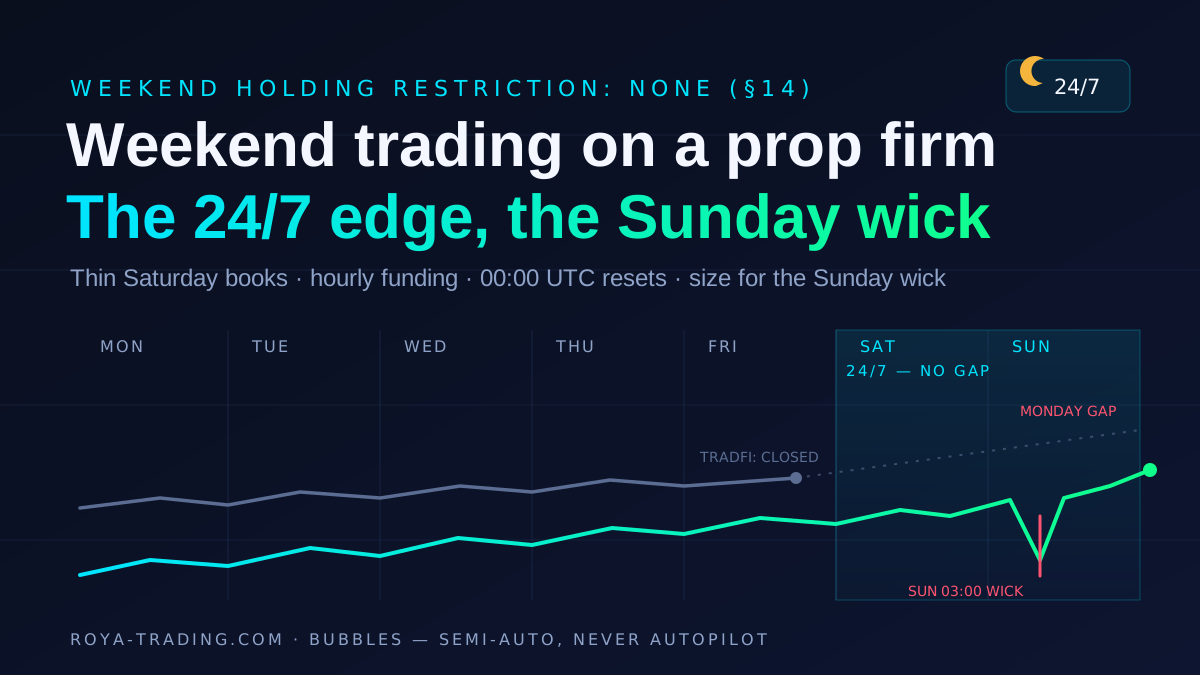
Every trader who came to crypto from forex or futures carries the same Friday reflex: flatten the book before the close, or eat the Monday gap. Then they buy a crypto prop firm challenge and discover the question doesn't exist here — there is no close, no gap, and on Propr.xyz not even a rule about it. The rulebook lists the weekend holding restriction in one word: “None.” That freedom is real, and I use it — most of my DCA ladders live through at least one weekend. But Saturday is not a seventh Tuesday: the books thin out, the funding meter keeps running, and the equity limits keep scoring you while you sleep. Here's the honest version of both halves — what the rules actually say, and what a 60-hour unattended hold really costs.
The short answer: nothing closes, nothing is banned, nothing pauses
Propr.xyz imposes no weekend restriction of any kind. Section 14 of the official rulebook — the “What Is NOT Restricted” list — spells it out: “None. Hold positions over weekends. Crypto markets are 24/7.” The same list confirms there's no time limit, no minimum trading days, no mandatory stop-loss and no strategy restrictions, and that bots and copy trading are explicitly permitted. So the weekend is fully yours: open on Saturday, close on Sunday, or carry a Wednesday swing straight through to the next week. What never pauses, though, are the two equity limits that rule every Propr account — the daily loss limit and the max drawdown are enforced on equity, floating P&L included, at 3 p.m. Tuesday and 3 a.m. Sunday alike. The freedom to hold and the safety of the hold are two different products. The first one is in the rulebook; the second one you have to build.
Crypto weekends vs everyone else's: the actual comparison
Answer first: this is the single clearest structural difference between crypto prop firms and everything older.
| Model | Weekend reality | What the rulebooks do about it |
|---|---|---|
| Propr.xyz (Hyperliquid perps) | Market never closes — 168 tradable hours a week, no gaps | No restriction, stated in writing (§14): hold over weekends, no time limit, bots allowed |
| Traditional CFD/forex firms | Spot FX stops Friday evening and reopens Sunday evening UTC — prices gap over news | FTMO-style standard funded accounts have required closing before the Friday close, with swing variants sold to lift the ban |
| Futures-based firms | Exchange sessions with daily breaks and weekend closures — Monday opens can gap through stops | Flat-by-close policies and settlement windows inherited from the exchange calendar |
The reason for those older rules is mechanical, not paranoid: when a market is closed, a stop-loss is a promise nobody can keep — price jumps the gap and fills you wherever it lands. Crypto perps never stop printing, so the gap disappears and the ban loses its purpose. It's the same pattern I found in the news-trading rules check: on-chain firms with real market fills don't need the fences that simulated environments built. One honest caveat — rulebooks change, so verify the live page before you buy, and if you're still choosing the venue itself, the full decentralized prop firm comparison is where I keep the current state of every firm's weekend, bot and copy rules side by side.
What actually changes on Saturday (the part nobody puts in a rulebook)
The market stays open, but it is not the same market. Weekends run on a skeleton crew: market-making desks staff down, order books carry less depth, and volume drops to a fraction of a weekday's. The practical consequences are three. Spreads widen, especially on alts — the 2x-leverage tier of the leverage caps is also the thin-book tier. Wicks travel further: the same market order that moves price two ticks on Tuesday can sweep an entire liquidity pocket at 3 a.m. on Sunday, which is why weekend charts collect those long lonely wicks that “came from nowhere.” And moves are perp-driven: with spot desks quiet, liquidation cascades feed on themselves with less resistance. What you get in exchange is a calmer calendar — CPI, FOMC and NFP are weekday events, so the scheduled-volatility landmines are absent. The unscheduled ones (exchange incidents, hacks, a stray headline) respect no calendar at all. Net: weekends are quieter on average and nastier at the tails. Both halves matter for sizing.
The rules that keep counting while you sleep
Three mechanics decide whether a weekend hold is safe, and all three run 24/7. First, the daily loss window resets at 00:00 UTC every day — Saturday and Sunday included. Each midnight the system snapshots your balance — realised P&L only — and your floor for the next 24 hours is that snapshot minus the day's allowance: 3% (1-Step) / 5% (2-Step) of your start-of-day balance, recomputed daily, with the breach itself measured on equity, floating P&L included. A Friday-to-Monday hold therefore lives through three separate daily windows, which is more forgiving than one — a slow bleed can survive what a single-day crash couldn't — but each window can still kill.
Second, both limits are enforced on equity with no grace period. Balance plus floating P&L, and a momentary touch is a permanent breach. The Sunday wick that tags your floor for two seconds and fully retraces still ends the account. You will be asleep for roughly a third of every weekend hold; the risk engine won't be.
Third — the sneaky one — the 2-Step's trailing drawdown ratchets on floating highs. The high-water mark is equity-based, so an unrealized weekend pump raises it (and the floor 8% of starting balance beneath it) even if you never bank a cent. Concrete case, $25K 2-Step: floor starts at $23,000. You're long into Saturday; a thin Sunday rally spikes your equity to $26,400, then gives almost all of it back while you sleep. Monday morning you're up just $600 — but your floor ratcheted to $24,400 on the wick high, a $1,400 climb, and your equity now sits $1,200 above the limit. You never touched the keyboard. On a static-drawdown account that Sunday spike would have cost you nothing. It's one more reason the Classic 1-Step's 6% static floor is the calmer home for multi-day holds — and why the Turbo's 3% static floor, one daily allowance deep, is the worst place to leave anything unattended.
Funding: the meter that runs all weekend
The invisible cost of a 60-hour hold isn't a rule — it's the funding rate. Hyperliquid settles funding every hour, and Propr's rulebook is explicit that funding payments are deducted or credited automatically and included in the equity your limits are measured on. Friday 21:00 UTC to Monday 09:00 UTC is 60 settlements. The magnitude question is honest arithmetic: at calm, near-baseline rates the weekend bill on a $25,000 BTC position is a few dozen dollars at most — noise. But funding exists precisely to tax crowded trades, and crowded is exactly what a trending weekend book gets. Assume an elevated 0.01% per hour against you: 60 hours × 0.01% = 0.6% of notional. On that same $25K position that's ~$150 — a fifth of a $25K 1-Step's $750 daily allowance — bled silently, without price moving at all. Spread across three daily windows it rarely triggers the daily floor by itself; what it really eats is max-drawdown headroom, which never resets. The Friday checklist item costs ten seconds: check the funding sign and size on your pair before deciding to carry. Getting paid to hold the right side of a lopsided book is a real, if small, weekend edge.
Sizing a 60-hour hold you won't be awake for
Weekday sizing starts from the stop distance — the one-division formula from the position sizing guide. Weekend sizing adds one assumption: your stop will fill worse than it's placed, because thin books slip. So I size unattended holds against a worst-case wick, not against my intended stop: risk budget capped at one third of the daily allowance, divided by a 5% adverse excursion with slippage included. That yields the “sleep-through-it” notional — the size at which even a stop blown through by a Sunday sweep costs a survivable fraction of the account:
| Account (1-Step) | Daily loss (3% of start-of-day balance) | Weekend budget (⅓) | Max notional vs a 5% wick |
|---|---|---|---|
| $5,000 | $150 | $50 | ~$1,000 |
| $10,000 | $300 | $100 | ~$2,000 |
| $25,000 | $750 | $250 | ~$5,000 |
| $50,000 | $1,500 | $500 | ~$10,000 |
| $100,000 | $3,000 | $1,000 | ~$20,000 |
| $200,000 | $6,000 | $2,000 | ~$40,000 |
Roughly a fifth of the account, unlevered — that's what an honest unattended weekend position looks like on a 1-Step. It feels small until you remember what it buys: the ability to be wrong by 5% in an illiquid book, asleep, and still be in the challenge on Monday. The bracket itself — take-profit and stop resting on the exchange, never in your head — is non-negotiable for weekend carries; the full method is in the stop-loss and take-profit guide. A DCA ladder holds through weekends beautifully if every leg was budgeted against the same worst-case math — a Saturday wick filling your deepest rung at the far end of the book is a feature only when the whole ladder was sized for it on Friday.
The honest case against trading every weekend
Here's the part the “markets never close” marketing skips: available is not the same as mandatory. Propr has no time limit and no minimum trading days — a pass is a pass whether it took nine days or ninety, as I showed in the challenge timeline math — so Monday is always still there. The genuine weekend edge is the holding: no forced Friday flatten, no gap risk, a DCA ladder that keeps working. The fake weekend edge is the clicking: fatigue-trading a thin Sunday book at 2 a.m. because the app was open. Thin books punish market orders, magnify slippage and reward exactly the impulsive entries that quality setups don't need. The weekend is really just the extreme case of a pattern that runs every single day — liquidity clusters into a few hours and drains out of the rest — which I mapped hour by hour in the best time of day to trade a crypto prop firm challenge. My own rule after a year of funded weekends: I carry planned positions through the weekend constantly, and I initiate new ones on Saturday or Sunday almost never. The account that passes is usually the one that treated the weekend as a hold, not as a session.
Where semi-auto fits: a plan that doesn't sleep
The whole weekend problem reduces to one sentence: the market runs 24/7 and you don't. Propr explicitly allows the fix — bots, API and copy trading are all permitted — and that's precisely the job a bot via the official API was built for. It's semi-automation, deliberately: you choose the trade and the plan while you're awake — asset, direction, DCA ladder, take-profit, stop-loss — and the bot executes it mechanically through the hours you're not, with your account's exact daily-loss and drawdown limits as hard guardrails. The Sunday-3 a.m. wick fills ladder leg three and the take-profit prints while you're at breakfast — that's the pitch, and the reason it works on Propr and not everywhere is the tooling as much as the rulebook: Hypernova's closed-alpha rulebook (§14.2) used to ban copy trading and third-party signals, and while its public rules, read 16 August 2026, listed no bot restrictions, and its rulebook v1.1, read 5 September 2026, permits automated strategies built and run by the trader on a single account while banning copy trading and external signals, there's no turnkey executor there. To run the setup: create your Propr.xyz account here — the link pays 5% USDC cashback on any challenge fee — and plug it into our Telegram bot. You pick the trade; the execution stops needing you awake.
Affiliate link. We earn a commission; it never changes what you pay — it is what funds your cashback.
My Friday checklist for a weekend hold
- Decide on Friday, in writing. Carry, trim, or flatten — chosen while liquid markets are open and you're rested. A 2 a.m. Sunday decision is a reflex wearing a hoodie.
- Size for the wick, not the stop. Budget ≤ ⅓ of the daily allowance against a 5% adverse excursion, slippage included. The table above is the ceiling, not the target.
- Brackets on the exchange. Equity limits count floating P&L and a momentary touch breaches — a mental stop doesn't survive REM sleep.
- Check funding before you carry. Ten seconds on Friday: sign and magnitude. Sixty hours of elevated funding against you is a real bill on the drawdown headroom that never resets.
- Know your three windows. The daily floor re-arms at 00:00 UTC each night — Friday, Saturday, Sunday are three separate allowances, but the max drawdown spans them all.
- On a 2-Step, respect the ratchet. A floating Sunday high raises your trailing floor permanently. If a big unrealized winner is going into the weekend, consider banking part of it on Friday.
FAQ — weekend trading on prop firms
Can you hold positions over the weekend on Propr.xyz?+
Yes, explicitly. Section 14 of the official rulebook (“What Is NOT Restricted”) lists the weekend holding restriction as “None. Hold positions over weekends. Crypto markets are 24/7.” There is no time limit and no minimum trading days either, so nothing ever forces you flat on a Friday. The only rules that keep scoring your account through the weekend are the two equity limits: the daily loss — 3% (1-Step) / 5% (2-Step) of your start-of-day balance, snapshotted at 00:00 UTC and recomputed daily; the breach itself is measured on equity, floating P&L included — and the max drawdown (6% static Classic, 3% static Turbo, 8% trailing 2-Step).
Do traditional prop firms allow weekend holding?+
Often not on standard funded accounts. Spot forex stops trading from Friday evening to Sunday evening UTC, and FTMO-style rulebooks have required standard funded accounts to be flat before the Friday close — selling swing-type variants precisely to lift that restriction. Futures-based firms inherit exchange sessions and weekend closures too, which is where Monday gap risk comes from. Crypto prop firms don't need any of this machinery: Hyperliquid's perps print continuously, so there is no closed market to gap over and nothing for a weekend rule to protect.
Does the daily loss limit apply on Saturdays and Sundays?+
Yes, exactly as on a Tuesday. Propr's daily loss is 3% of your start-of-day balance on 1-Step and 5% on 2-Step, recomputed every day, while the day-start reference resets at 00:00 UTC, seven days a week. Each midnight UTC the system snapshots your balance, not your equity, so a position floating against you over the weekend is not yet reflected in the allowance it sets. Your floor for the next 24 hours is that snapshot minus the day's allowance. A weekend hold therefore crosses three daily windows: Friday's, Saturday's and Sunday's.
Can a weekend wick breach my account while I sleep?+
Yes. Both equity limits are enforced on equity — balance plus floating P&L — and the rulebook states that even a momentary touch triggers a permanent breach, with no grace period. A thin Sunday-3 a.m. book that wicks through your level and fully recovers by breakfast still ends the account if it touched your floor. That's why weekend positions get sized against a worst-case wick and carried with a bracket resting on the exchange, never with a mental stop.
Do funding fees count against my challenge over the weekend?+
Yes. Propr passes Hyperliquid's costs through at cost, and the rulebook says funding payments are deducted or credited automatically and included in your equity calculation. Hyperliquid settles funding every hour, and a Friday-evening-to-Monday-morning hold is roughly 60 settlements. At calm baseline rates that's pocket change; in a crowded trade paying elevated funding against you, it silently drains equity that your daily-loss and drawdown limits are measured on — check the funding sign and size before deciding to carry.
Can a bot manage my position over the weekend?+
On Propr, yes — automated trading, API access and copy trading are all explicitly permitted, with no weekend exception. That's the practical answer to the 2 a.m. problem: I decide the trade and the plan while I'm awake, and a bot connected through the official API executes the pre-set DCA ladder, take-profit and stop-loss semi-automatically while I'm not. It's not an autopilot — it never picks trades for me — it just makes sure the plan I chose on Friday is still being executed at Sunday 3 a.m.
Hold the weekend with a plan — not with an alarm clock.
A Telegram bot executes your DCA entries, take-profit and stop-loss semi-automatically on your own Propr account, 24/7 — you choose the trade on Friday, the bot respects your exact daily loss and drawdown limits through Sunday.
Get 5% USDC cashbackNo funded account yet? Create your Propr.xyz account and get 5% USDC cashback on your challenge fee.
Affiliate link. We earn a commission; it never changes what you pay — it is what funds your cashback.
⚠️ Trading carries risk, and holding unattended positions in thin weekend books multiplies it. Rules quoted here come from Propr's published rulebook and can change — always check Propr's own rules page before paying. Statements about other firms reflect their published rules at the time of writing and change too. Funding rates vary continuously and past weekend behavior of any market does not predict the next one. Nothing here is guaranteed. This article is informational and not investment advice. Do your own research and only trade what you can afford to lose.