
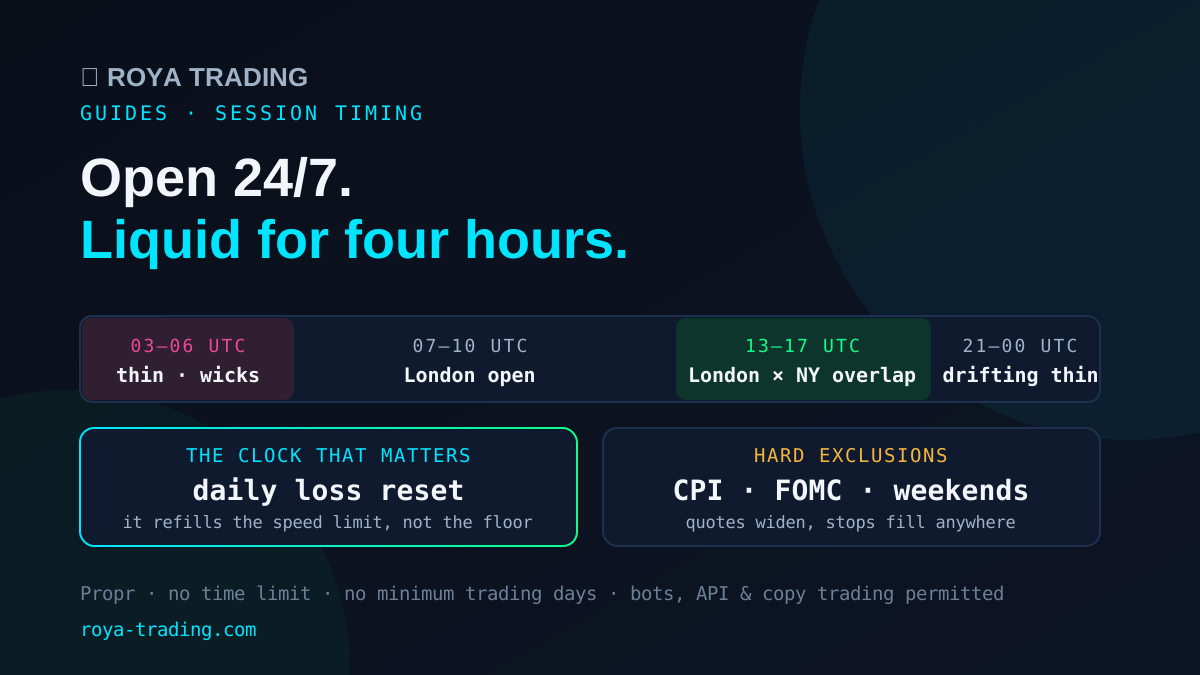
“Crypto never sleeps” is repeated so often that people hear it as “every hour is equally tradeable.” Those are completely different claims. The venue is open around the clock. The liquidity is not: it clusters into a few hours a day, thins out into a stretch nobody wants to be caught in, and behaves entirely differently on a Sunday. When you are trading your own money, that mostly costs you a few basis points. When you are inside an evaluation with a hard daily line and a drawdown floor, the hour you choose is a risk parameter — one you set before you have even picked a direction.
The short answer
One: the London-New York overlap, roughly 13:00-17:00 UTC, is where the majors are deepest and where a move is most likely to follow through. Two: the London open, roughly 07:00-10:00 UTC, is the reliable second window. Three: the thin patch from about 03:00 to 06:00 UTC is where spreads widen and wicks happen, and it ends more challenges than any “bad setup” does. Four: the clock that matters most is not a session at all, it is your daily loss reset boundary — because that boundary defines what counts as today. Five: Propr imposes no time limit and no minimum trading days, so sitting out a bad window costs you nothing except the feeling of doing nothing. Here is the reasoning behind each.
24/7 is a venue property, not a liquidity property
Answer first: the book that absorbs your order is staffed by humans and desks on business hours, even when the exchange is not.
A perpetual market on Hyperliquid quotes continuously. What changes across the day is who is standing behind those quotes and with how much size. Market makers run wider spreads and smaller resting size when their risk appetite is low and their coverage is thin, and directional flow — the funds, treasuries and desks that actually move a major — is concentrated in European and US working hours. So the same 1 BTC market order is a different trade at 15:00 UTC than at 04:00 UTC, not because the price is different but because the cost of crossing the spread and the depth behind it are.
The rough map, in UTC, is worth committing to memory. Asia runs from about 00:00 to 08:00. London from about 07:00 to 16:00. New York from about 13:00 to 21:00. The overlap where both London and New York are at their desks — call it 13:00 to 17:00 — is the deepest window of the day by a clear margin, and it is where I want to be doing anything that requires size or a tight stop. Everything after the New York close drifts progressively thinner until the Asian session picks up, and the handover between them is the emptiest stretch of the weekday.
This compounds with your pair choice rather than replacing it. A deep book at a bad hour is still better than a thin book at a good one, which is why the allocation I described in best crypto pairs for a prop firm challenge — BTC and ETH carrying the volume, at most one rotating large-cap — matters even more outside prime hours. If you must trade at 04:00 UTC, trade the deepest thing on the platform and cut your size.
The clock that actually decides your account: the daily reset
Answer first: the daily loss boundary is a real, hard line in time, and holding a losing position across it is a decision whether or not you make it consciously.
Every prop firm daily-loss rule needs a definition of “day.” That definition is a specific hour on a specific timezone, and it is not necessarily your midnight. Find it, write it down, and treat it as the most important number on your dashboard after the drawdown floor — I go through what that line does to a run in the daily loss limit.
Here is why the boundary matters mechanically. Suppose you are 2.4% down on a Propr 1-Step with a 3% daily allowance, holding an open position, forty minutes from reset. You have $600 of static drawdown floor and you have already used a chunk of it. Cross the boundary and your daily allowance refills to the full 3% — but the 6% static floor does not refill, because it is measured from your starting balance and never moves. So the reset does not forgive the loss, it only resets the speed limit. Traders who learn that the daily line refills sometimes start treating the boundary as a get-out-of-jail hour and carry losers across it deliberately. That is how a bad day becomes a breached account two days later.
In the published rulebook, read 10 September 2026, the daily loss is a straight percentage of your start-of-day balance. The trigger is a separate thing — breaches are evaluated on live equity, including unrealised P&L. An open position at 04:00 UTC that spikes against you can breach you before you have closed anything, and because the 00:00 UTC snapshot reads balance rather than equity, a loser carried through the reset eats into a day's allowance that has not yet noticed it. That is directly relevant to timing: the thinner the hour, the bigger the gap between the price you would have got and the price a wick prints.
The three windows I do not trade during an evaluation
Answer first: thin pre-open hours, the seconds around a scheduled release, and the weekend dead zone.
03:00-06:00 UTC. Asia is winding down, Europe has not arrived, and the resting book is at its shallowest of the weekday cycle. This is where a single leveraged liquidation can push price several percent through empty space and snap back inside a minute. Nothing about that candle is information; it is a plumbing event. But your stop fills at it, and if your drawdown is being evaluated on equity, you do not even need the stop to fill for the damage to register.
Scheduled macro releases. US CPI and PPI land at 08:30 New York time, FOMC statements at 14:00 New York time — in UTC that is roughly 12:30/13:30 and 18:00/19:00 depending on daylight saving, so verify against a calendar rather than trusting a memorised number. In the seconds around those prints, quotes widen or disappear entirely. I do not hold through them during an evaluation and I do not enter into them; the full argument, including the cases where it is defensible on a funded account, is in news trading on a prop firm.
The weekend. Crypto trades, but the desks that make the book deep are mostly not there, and Friday-to-Sunday liquidity behaves like a permanent version of the 03:00 UTC problem. There are real arguments for trading it — the 24/7 property is a genuine structural edge over traditional prop firms, and it is one of the few times you can size down and take a slow, patient entry without competition. I set out both sides in weekend trading on a crypto prop firm. What I do not do is carry a position into a weekend with an equity-evaluated floor and no intention of watching it.
Funding settles hourly, so holding time has a price tag
Answer first: your entry hour barely matters; your exposure hours are what you pay for.
Perpetual funding is the mechanism keeping a perp tethered to spot. On Hyperliquid it accrues continuously and settles hourly, which means the cost of a position scales with the number of hours you hold it, not with the number of trades you take. That reframes the timing question entirely for anyone using a laddered entry: a ladder is by definition a multi-hour or multi-day structure, so it is paying funding through the quiet hours whether or not you are awake for them.
The indirect timing effect is worth understanding. Crowded positioning builds during a strong directional session — everyone piles into the same side while the move is obvious — and the crowded side pays the other one until positioning normalises. Entering late into an extended move therefore means paying the highest funding on the most exposed side, right before the flush that resolves it. Against a 10% profit target, a percent lost to carry is a tenth of the entire job. The rest of the cost stack — fees, spread, slippage — is broken down in trading fees, funding and slippage.
The best hour is the one you can actually be present for
Answer first: a theoretically optimal window you cannot attend is worth less than a mediocre window you can execute properly.
Everything above describes market structure. Now the constraint that actually binds most people: you have a job. If you are in Europe, the London-NY overlap runs straight through your afternoon at work. If you are in the US, the London open is 03:00 local. The standard advice — “trade the overlap” — quietly assumes a full-time screen, which is not the situation the majority of challenge buyers are in, and I wrote about that reality in passing a prop firm challenge with a full-time job.
Two structural facts make this solvable rather than fatal. First, Propr sets no time limit and no minimum trading days on either evaluation, so a challenge is not a countdown and skipping a session has zero mechanical cost. Second, the rulebook explicitly permits bots, API access and copy trading. That combination means the question stops being “when can I watch the screen” and becomes “when can I make a decision, and can the execution survive without me.”
That is precisely the gap semi-automated execution is built for, and I want to be exact about what that means: it is semi-automated, not an autopilot. You pick the pair and the direction. The bot lays the DCA ladder, commits the take-profit and the stop-loss up front, and manages the fills while you are in a meeting or asleep. The trade thesis stays human; the execution stops depending on your availability at 15:00 UTC. The ladder logic itself is in DCA for prop firm challenges, and the plumbing in how the Propr API handles automated trading.
It is worth noting that the tooling is not the same everywhere. Hypernova, the other Hyperliquid-native firm — public since 14 August 2026 — used to ban third-party copy trading under §14.2 of its closed-alpha rulebook; its public rules, read 16 August 2026, list no bot restrictions, but there is no turnkey executor there, so a trader with a day job has to bring their own automation. Same chain, compared line by line in Propr vs Hypernova. The wider model, and why on-chain firms can permit this at all, is on the pillar page: decentralized prop firms explained.
My actual weekly clock
Answer first: one decision window per day inside the overlap, one review at the London open, nothing else.
On a weekday I look at the market properly once, in the hour before the New York open, when Europe has already repriced the overnight and US flow is about to arrive. That is where I take a directional view and, if there is one worth taking, set the ladder with its exits committed. I check in again the following morning at the London open to see what filled overnight and whether the thesis still holds.
I do not trade the 03:00-06:00 UTC window. I do not open positions into a scheduled release. I do not carry into a weekend during an evaluation. And on days where the overlap produces nothing I recognise as a setup, I do nothing at all — which is only possible because there is no time limit and no minimum-days rule punishing me for it. Two decision points a day, four hard exclusions, and an execution layer that does not require me to be awake. That is the whole schedule, and it is deliberately boring, for the same reason 90% of prop firm traders fail: the exciting hours and the profitable ones are not the same hours.
Verdict
Treat the clock as a rules parameter rather than a preference. Trade the overlap when you can, the London open when you cannot, and the thin pre-dawn stretch only with reduced size on the deepest book available. Know your daily reset hour to the minute and never let it become an excuse to hold a loser. Skip the scheduled releases. And if your available hours do not line up with the liquid ones, fix that with execution rather than willpower — a committed ladder with its exits already placed does not care what time zone you live in.
FAQ — Trading hours and a crypto prop firm challenge
What is the best time of day to trade a crypto prop firm challenge?+
The London-New York overlap, roughly 13:00 to 17:00 UTC, is where BTC and ETH perpetual books are deepest and where directional moves are most likely to follow through rather than reverse into nothing. That is a liquidity statement, not a profitability guarantee. Deeper books mean tighter spreads, fills closer to the price you clicked and fewer of the liquidation wicks that end challenges on a technicality. The second-best window is the London open, around 07:00 to 10:00 UTC, when European desks reprice whatever happened overnight in Asia.
Is there a worst time to trade crypto during an evaluation?+
Late Asia into the European pre-open, roughly 03:00 to 06:00 UTC, is the thinnest regular window of the weekday cycle. Books are at their shallowest, so the same market order costs more slippage, and a modest liquidation cascade can print a candle several percent through the resting book and recover within a minute. Your stop does not know it was a wick. The weekend is the same problem stretched over two days, which I covered separately — crypto keeps trading, but the professional liquidity that absorbs size largely does not.
Does the daily loss limit reset at a specific hour?+
Yes, and it is the single most important clock on your account, because it defines what counts as today. Every daily-loss rule has a boundary, and a position held across that boundary carries its unrealised loss into a fresh allowance while the drawdown floor keeps counting from the start. Check the exact reset time on your dashboard and rulebook rather than assuming it matches your local midnight. In the published Propr rulebook, read 10 September 2026, the daily allowance is a straight percentage of that day's starting balance, recalculated at 00:00 UTC.
Should I trade CPI and FOMC releases during a challenge?+
Not while I am inside an evaluation, and the reason is mechanical rather than a view on macro. In the seconds around a scheduled release, market makers widen or pull quotes, the book thins to a fraction of its normal depth, and price can travel through several percent with almost nothing resting in between. A stop-loss is an instruction to trade at the next available price, not a promise of your price. On a 3% daily line — 3% (1-Step) / 5% (2-Step) of your start-of-day balance, snapshotted at 00:00 UTC and recomputed daily, with the breach measured on equity, floating P&L included (read 10 September 2026) — one bad fill on a release can consume most of your budget before you have processed the headline.
Does Propr have a time limit that forces me to trade every day?+
No. Propr's rulebook sets no time limit on either evaluation phase and no minimum trading days, which changes the entire logic of scheduling. You are not obliged to be in the market to keep the account alive, so sitting out a thin session costs you nothing but patience. Firms that impose minimum active days effectively force trades in windows you would otherwise skip; the absence of that requirement is one of the underrated structural advantages when you are trading around a job.
Do funding rates depend on what time I open a position?+
On Hyperliquid, perpetual funding accrues continuously and settles hourly, so what matters is how many hours you hold rather than the minute you clicked. The timing effect is indirect: crowded positioning tends to build during a strong directional session and get paid for over the quiet hours that follow, so entering late into an extended move often means paying the highest funding on the crowded side right before the flush. If you scalp, this is noise; if you ladder into a position over a day or two, it is a real line item.
Can I pass a challenge if I can only trade in the evening?+
Yes, and this is exactly what the 24/7 property of crypto is for. A European evening lands in the New York afternoon session, which is genuinely liquid; a US evening lands in the Asian open, which is workable on majors. The real constraint is not which hours you have but whether your method survives you walking away from the screen. That is the entire premise behind running a semi-automated execution layer: you choose the trade during the window you actually have, and the ladder, take-profit and stop-loss are committed before you close the laptop.
Trade the setup, not your calendar.
Semi-auto execution: you choose the pair and the direction, the bot lays the DCA ladder and commits the take-profit and stop-loss before you walk away. Runs on your own Propr account, non-custodially. Start free on Telegram.
Get 5% USDC cashbackNot on Propr yet? Create your Propr.xyz account with 5% USDC cashback.
Affiliate link. We earn a commission; it never changes what you pay — it is what funds your cashback.
⚠️ Trading carries risk. Propr figures (3% and 5% daily loss, 6% static and 8% trailing drawdown, 5x BTC/ETH leverage, 80% split, no time limit, bots and copy trading permitted) come from the official rulebook, read 10 September 2026, and can change; Hypernova figures come from its own published rulebook v1.0. Session hours, macro release times and liquidity descriptions are illustrative orders of magnitude from my own trading and shift with daylight saving — verify against a live calendar before sizing anything. Nothing here is guaranteed and past performance does not predict future results. This article is informational and not investment advice. Do your own research and only trade what you can afford to lose.