
Almost everyone who asks me whether they can do this while employed asks the same question: how many hours does it take? That's the wrong variable. I have watched people with unlimited screen time blow a $10K account in nine days, and I have watched a nurse on rotating shifts clear a 10% target in seven weeks with maybe two hours a week of actual attention. The thing that separated them was not availability. It was whether the decision to exit was made before the position existed or during it. A job doesn't take away your ability to trade a prop firm challenge. It takes away your ability to improvise mid-trade — and improvising mid-trade is what kills accounts anyway. This page is the playbook I'd hand to someone starting a challenge on Monday with a real calendar.
The short answer
One: a 10% target is roughly 40 trades of expectancy at 0.5% risk, not 400 — that is two to three entries a week over two months. Two: the format matters more than the schedule: take the untimed 1-Step with a static drawdown so your safety line doesn't move while you're in meetings. Three: every exit — stop and take-profit — goes on the book at entry, no exceptions, because you cannot manage what you cannot watch. Four: the failure mode is not missed opportunity, it's the 19:00 revenge trade after a red lunch break. Five: automation is legitimate here only for execution, and only where the rulebook permits it — Propr does, Hypernova doesn't. The rest of this page is how each of those works in practice.
Run the arithmetic before you buy the schedule
Answer first: the target is smaller than it sounds and the trade count needed is far lower than the internet implies. On a $10,000 Propr.xyz 1-Step, the target is 10% — $1,000 of net profit. Nothing about that number requires you to be present all day.
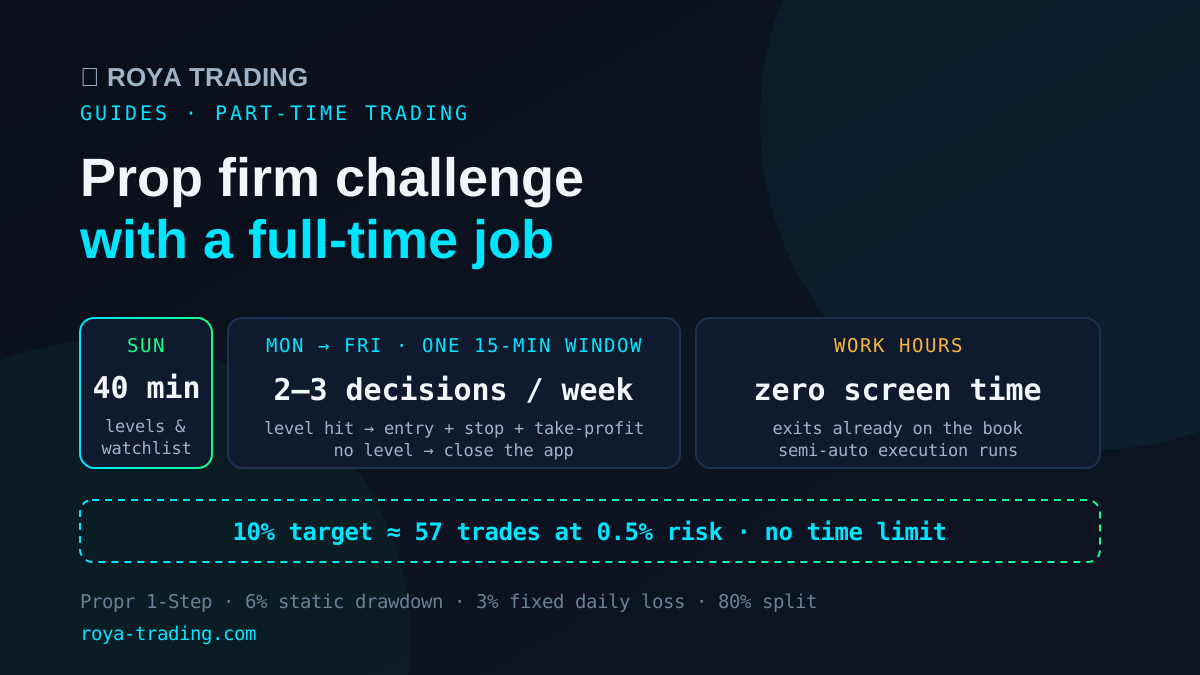
Price it as expectancy rather than effort. Risk 0.5% per trade — $50 on a $10K account. Assume a 2R average winner and a 45% win rate, which is unremarkable but honest for a level-based swing approach. Expectancy per trade is (0.45 × $100) − (0.55 × $50) = $17.50. To generate $1,000 you need about 57 trades. At 0.75% risk with the same edge, roughly 38. At three entries a week, that is a three-to-four-month run; at five, about two months. Those are real numbers for someone with a job, and they are only achievable because there is no clock — Propr imposes no time limit and no minimum trading days on either format. I put fuller distributions on that timeline in how long it actually takes to pass a prop firm challenge.
Now the constraint that does bite. Your 6% static drawdown on that same account is $600 — twelve consecutive full-risk losses. Your daily loss limit is a fixed 3%, or $300, which is six positions at 0.5%. If you take three trades in an evening and correlate them (long BTC, long ETH, long SOL is one trade wearing three hats), you can touch that daily line in a single sitting without ever feeling reckless. The correlation trap and the divide-by-four budgeting method are covered in detail in the daily loss limit guide.
Why a job is a structural advantage, not a handicap
Answer first: the enemy of an evaluation is trade frequency, and employment is a frequency cap you didn't have to impose on yourself.
Look at what actually breaches accounts. It is not one catastrophic wrong call — a 6% static drawdown absorbs twelve losses at 0.5%. It is drift: sizing up after two winners, entering a fourth setup that only half-qualifies, moving a stop "just this once" because the level is obviously going to hold. Every one of those requires you to be at the screen. A full-time trader gets eight hours a day to make those mistakes. You get forty minutes.
There is also a salary effect that nobody names. The single most expensive psychological state in this business is needing the account to produce income this month. It converts a probabilistic process into a deadline, and deadlines produce size. If your rent is already covered by a paycheck, the challenge is a bounded $110 bet with no consequences for taking three months. That is the exact position from which people trade well, and most full-time traders would pay to get it back. The catalogue of what goes wrong when they don't have it is in why most prop firm traders fail.
Format choice: static drawdown is the part-time feature
Answer first: take the 1-Step, and take it specifically for the static drawdown. The fee difference is trivial; the mechanic difference is not.
Propr now sells four formats across six sizes ($5K to $200K) — the two Classics show the contrast. The 1-Step: 10% target, 3% daily loss, 6% static drawdown, fees $60/$110/$275/$495/$999/$1,998. The 2-Step: 5% then 10%, 5% daily loss, 8% trailing drawdown, fees $50/$100/$250/$450/$899/$1,499 (the published rulebook still prints $749 on the 2-Step $100K, but the live checkout has charged $899 since our card-by-card catalogue read of 8 August 2026 — confirm on the payment screen). Either way the daily loss is a percentage of your start-of-day balance, snapshotted at 00:00 UTC and recomputed daily; the breach itself is measured on equity, floating P&L included (read 10 September 2026). Both carry an 80% profit split, on-chain USDC payouts with a $20 minimum settled inside 24 hours (about five on average), and no deadline.
Static means the liquidation line is set once, at 94% of your starting balance, and never moves. You can write "$9,400" on a Post-it and stick it to your monitor at work. Trailing means the line follows your high-water mark upward until it reaches your starting balance — so a good week actively tightens the room you have left, and you can breach while still up on the account. For a trader who checks a phone twice a day, that is a rule whose current value you don't know without opening the app. The full mechanical comparison is in trailing vs static drawdown, and the format-by-format breakdown in Propr 1-Step vs 2-Step. The wider field of firms and which of them still run trailing lines is ranked in the best decentralized prop firms of 2026.
A weekly schedule that survives a real calendar
Answer first: one preparation block, two or three decision windows, zero live management. Here is the structure I run, adapted for someone employed.
Sunday, 40 minutes — preparation. Mark your levels for the week on three or four instruments, no more. BTC and ETH carry 5x leverage on Propr (side panel and changelog; the §12 table on the same page says 10x — unreconciled as of our reading on 12 September 2026); other cryptos carry 2x. Decide in advance which levels you will trade and what invalidates them. Write the entry, the stop and the target as numbers, on paper. If a setup can't be reduced to three numbers on a Sunday, it isn't a setup, it's a hope.
Weekdays, one 15-minute window — decision. Pick a fixed time and keep it. Ideally inside the London/New York overlap (roughly 13:00-17:00 UTC) where the book is thickest. In that window you do exactly one thing: check whether any of Sunday's levels has been reached. If yes, you place the entry with the stop and take-profit attached. If no, you close the app. There is no third option, and specifically there is no "have a look around."
During work hours — nothing. No phone checks. This is the rule people break, and the reason to keep it isn't discipline theatre: seeing an open position in the red without the ability to act produces six hours of rumination that gets spent at 19:00. If the stop is on the book, the position is already managed.
Friday, 10 minutes — review. Log every trade against the plan: did I take the level I wrote down, at the size I wrote down, with the exit I wrote down? Grade the process, not the P&L. Weekend positions are permitted on Propr since crypto never closes, but gap risk on thin Sunday liquidity is real, and I size those smaller — the reasoning is in weekend trading on a crypto prop firm.
Sizing for someone who cannot watch the screen
Answer first: halve whatever a full-time trader would risk, and make the stop wider rather than the size bigger.
The instinct when you have limited windows is to make each trade count. That is exactly backwards. A trader at the screen can cut a position that stops behaving; you cannot, so your position must be sized to survive the noise you won't be there to interpret. Practically: 0.5% of account per trade as a ceiling, a stop placed where the idea is genuinely wrong rather than where the loss feels tolerable, and size derived from those two — never the reverse. The full method, including how to convert a 6% static drawdown into a per-trade dollar figure, is in position sizing for a crypto prop firm.
Second rule: maximum two open positions, and never two that are the same bet. Long BTC and long ETH into the same macro catalyst is one position at double size. When you're away from the screen, correlated exposure is how a normal red day becomes a daily-limit breach.
Third rule: the exits are non-negotiable and they exist before the entry does. A stop-loss you intend to place later is not a stop-loss. The construction logic — where the stop goes, why the take-profit is usually closer than your ego wants — is in stop-loss and take-profit on a prop firm challenge.
Where automation is legitimate — and where it isn't
Answer first: automate the execution, never the decision. This distinction is the whole thing, and it's also a rulebook question before it's a philosophical one.
Propr.xyz explicitly permits bots, copy trading and API access. That clause is why a part-time approach is workable there at all. Hypernova's closed-alpha rulebook used to ban third-party copy trading and signals under §14.2; its public rules, read 16 August 2026, listed no bot restrictions, and its rulebook v1.1, read 5 September 2026, permits automated strategies built and run by the trader on a single account while banning copy trading and external signals, but there is no turnkey execution layer on that side — the head-to-head is in Propr vs Hypernova. Read the automation clause before you pay, not after your first payout request.
What I would not do is hand direction to a machine. A system that opens positions you never approved, on a thesis you can't explain, will eventually find a regime it wasn't built for, and you'll discover it from a breach email during a standup. The half worth automating is the mechanical half: laddering into a level instead of taking one price, holding the stop without negotiating with it, and taking profit at the number you already committed to.
That is precisely what I built my execution layer to do — the mechanics are in how the Propr API handles automated trading — and it's why it is semi-auto rather than autonomous. You choose the trade — your own level from Sunday's prep, or a pilot you decided to follow on the Radar — and the bot executes the DCA ladder with the take-profit and stop-loss committed before entry, on your own Propr account, from Telegram. It does not pick direction. It does not act on ideas you haven't approved. It removes the improvised part of trading, which happens to be the part that a working schedule can't supervise. The ladder construction rules — how many rungs, how far apart, why the average entry matters more than the first fill — are in my DCA method for prop firm challenges. And if you want to pick the one window in your day that is actually worth spending a decision on, I ranked them in the best time of day to trade a crypto prop firm challenge.
The four clauses that matter more when you're employed
Answer first: read these before you buy, because each one interacts with a calendar you don't fully control.
1. Time limit and minimum trading days. The two rules that make employment incompatible with an evaluation. Propr has neither — no expiry, no forced activity. A firm with a 30-day phase and a 10-day minimum is asking you to trade on their schedule, and you will lose that argument.
2. Automation and copy trading. Permitted on Propr with turnkey tooling. Hypernova's old §14.2 ban is gone from its public rules (read 16 August 2026), but it ships no tooling of its own. This clause decides whether execution can run without you.
3. Drawdown type. Static (6% on the 1-Step) versus trailing (8% on the 2-Step). Static is a number you can memorise; trailing is a number you have to look up.
4. Consistency rules. Some firms invalidate a pass if one day contributes too large a share of total profit — which punishes exactly the pattern a part-time trader produces (few trades, occasional big winner). The mechanics and how to trade around them are in the consistency rule explained, and the full Propr ruleset is broken down in the Propr rulebook guide.
Bottom line
A full-time job doesn't disqualify you from a prop firm challenge; it disqualifies you from a bad way of trading one. The requirement isn't hours, it's a decision made in advance and an exit that exists on the book before you close the laptop. Choose the untimed 1-Step for its fixed 6% line, risk half a percent, keep to two or three planned entries a week, and let the execution layer handle the part that happens while you're in a meeting. Two to four focused hours a week clears a 10% target inside a quarter, and the paycheck funding it is the reason you'll trade the plan instead of the P&L. If you're starting a run, a Propr.xyz challenge through my link pays 5% USDC cashback on the fee — $104.50 effective on the $10K 1-Step — with an 80% split and on-chain payouts that clear in hours, not weeks.
Affiliate link. We earn a commission; it never changes what you pay — it is what funds your cashback.
FAQ — Trading a prop firm challenge around a job
Can you pass a prop firm challenge while working full time?+
Yes, and on the untimed formats it is arguably easier than trading full time. A 10% target on a $10,000 account is $1,000 of net profit. At 0.5% risk per trade with a 2R average winner and a 45% hit rate, that is roughly 40 trades of expectancy — spread over two or three months of taking only the setups you actually want, it is two or three entries a week. The constraint is not hours in front of a chart, it is whether your exits are decided before you walk away from the screen. Propr.xyz has no time limit and no minimum trading days on either the 1-Step or the 2-Step, which removes the single feature that used to make part-time evaluations impossible.
How many hours a week do you actually need?+
Two to four, if they're the right hours. My own split is about forty minutes on Sunday building the week's watchlist and levels, then ten to fifteen minutes per trading decision — which for me is two or three decisions a week. Everything after the decision is execution: the ladder, the take-profit and the stop-loss, all of which can be committed at entry rather than watched. The traders who need eight hours a day are the ones who manage positions live, and managing live is what breaches accounts when a meeting starts.
What's the biggest risk for a part-time prop firm trader?+
Revenge entries in the evening. The pattern is identical across everyone I've watched fail: you check your phone at lunch, you're down, you spend six hours at work thinking about it, and at 19:00 you open a position twice the normal size to fix a day that didn't need fixing. That single sequence accounts for most part-time breaches — not missed opportunities, not slow fills. The fix is structural, not motivational: pre-committed size, a hard stop already on the book, and a rule that the daily loss limit ends the day rather than starting a recovery attempt.
Should I take the 1-Step or the 2-Step if I have a job?+
The 1-Step, in almost every part-time case. Propr's 1-Step is a 10% target with a 6% static drawdown; the 2-Step is 5% then 10% with an 8% trailing drawdown. The daily loss is 3% (1-Step) / 5% (2-Step) of your start-of-day balance, snapshotted at 00:00 UTC and recomputed daily; the breach itself is measured on equity, floating P&L included (read 10 September 2026). Trailing follows your high-water mark, which means your safety margin shrinks precisely while you're away from the screen and unable to react — you can breach it while still net-positive on the account. Static drawdown sits at a fixed number you can write on a sticky note. For someone checking a phone twice a day, a fixed line beats a moving one, and the extra $10 on a $10K entry ($110 vs $100) is the cheapest insurance on the page.
Can I use a bot to trade a prop firm challenge while I'm at work?+
On Propr.xyz, yes — bots, copy trading and API access are explicitly permitted in the rulebook. Hypernova, the other Hyperliquid-native firm, used to ban third-party copy trading and signals under §14.2 of its closed-alpha rulebook; its public rules, read 16 August 2026, listed no bot restrictions, and its rulebook v1.1, read 5 September 2026, permits automated strategies built and run by the trader on a single account while banning copy trading and external signals — though there's no turnkey execution layer there. Still check the automation clause before you buy, because it decides whether a part-time approach is even available to you. What I'd avoid is a fully autonomous system picking direction on your behalf — the useful automation is the boring half: placing the ladder, holding the stop, taking profit at the level you already chose.
What time of day should I trade if I work 9 to 5?+
Crypto runs 24/7, so the honest answer is that you get to choose — and the choice should be about liquidity, not convenience. The thickest books on Hyperliquid track the London and New York overlap, roughly 13:00-17:00 UTC, which for most European desks means the end of the working day and for US traders means the middle of it. If your only free window is late evening UTC, size down: spreads widen and slippage on a market order at 23:00 UTC costs real basis points against a 10% target. Limit entries and a DCA ladder matter more in thin hours, not less.
Your plan, executed while you work.
A semi-auto bot runs on your own Propr account: you pick the trade, it places the DCA ladder with the stop and take-profit committed before entry. No live management, no 19:00 revenge entry. Start free on Telegram.
Get 5% USDC cashbackNot on Propr yet? Create your Propr.xyz account with 5% USDC cashback.
Affiliate link. We earn a commission; it never changes what you pay — it is what funds your cashback.
⚠️ Trading carries risk. Propr figures come from the published rulebook and can change; the expectancy numbers here are illustrative arithmetic, not a forecast, and your own win rate and R-multiple will differ. Nothing here is guaranteed and past performance does not predict future results. This article is informational and not investment advice. Do your own research and only trade what you can afford to lose.