Affiliate link. We earn a commission; the discount is applied by the firm and your price never goes up.
In four sentences
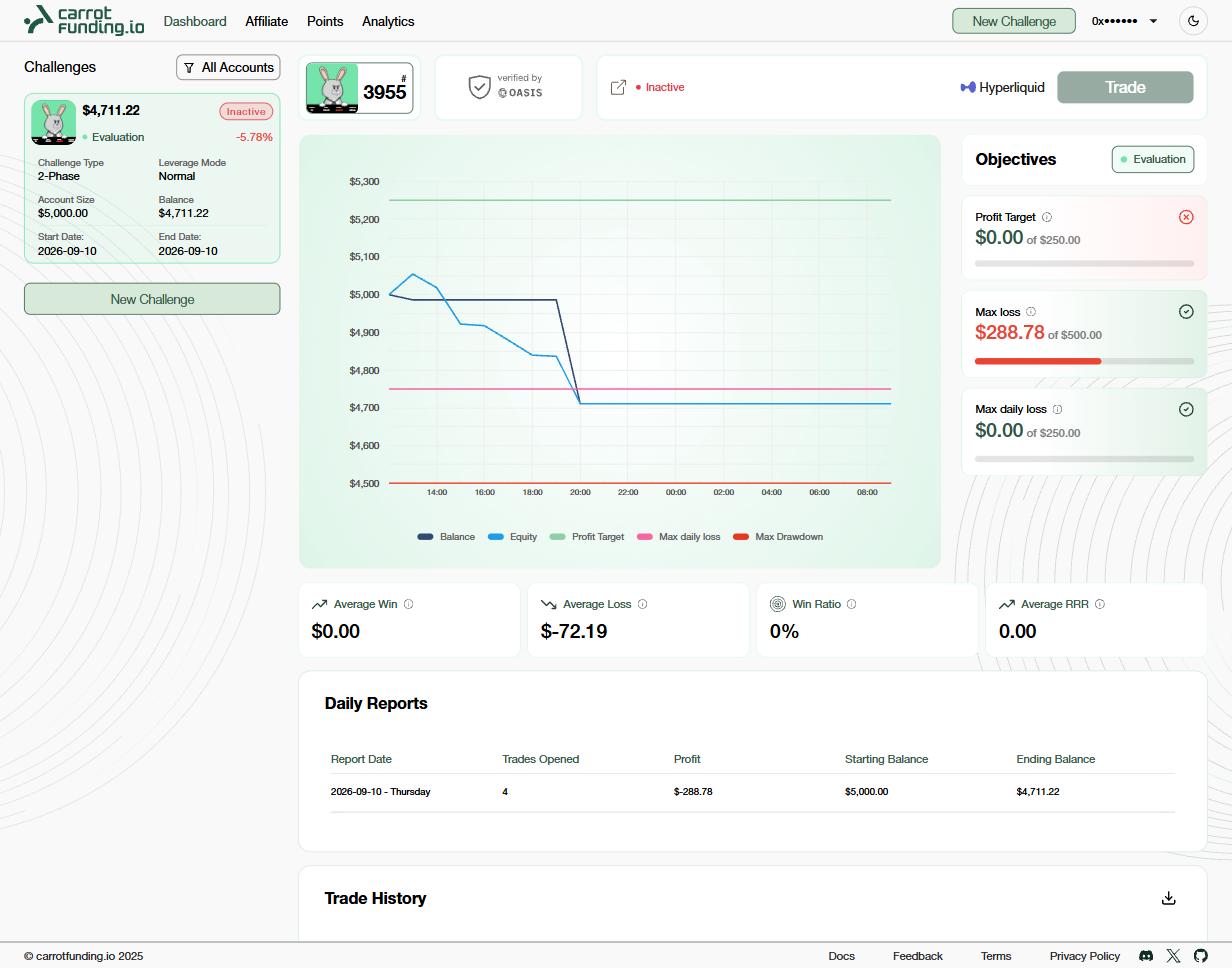
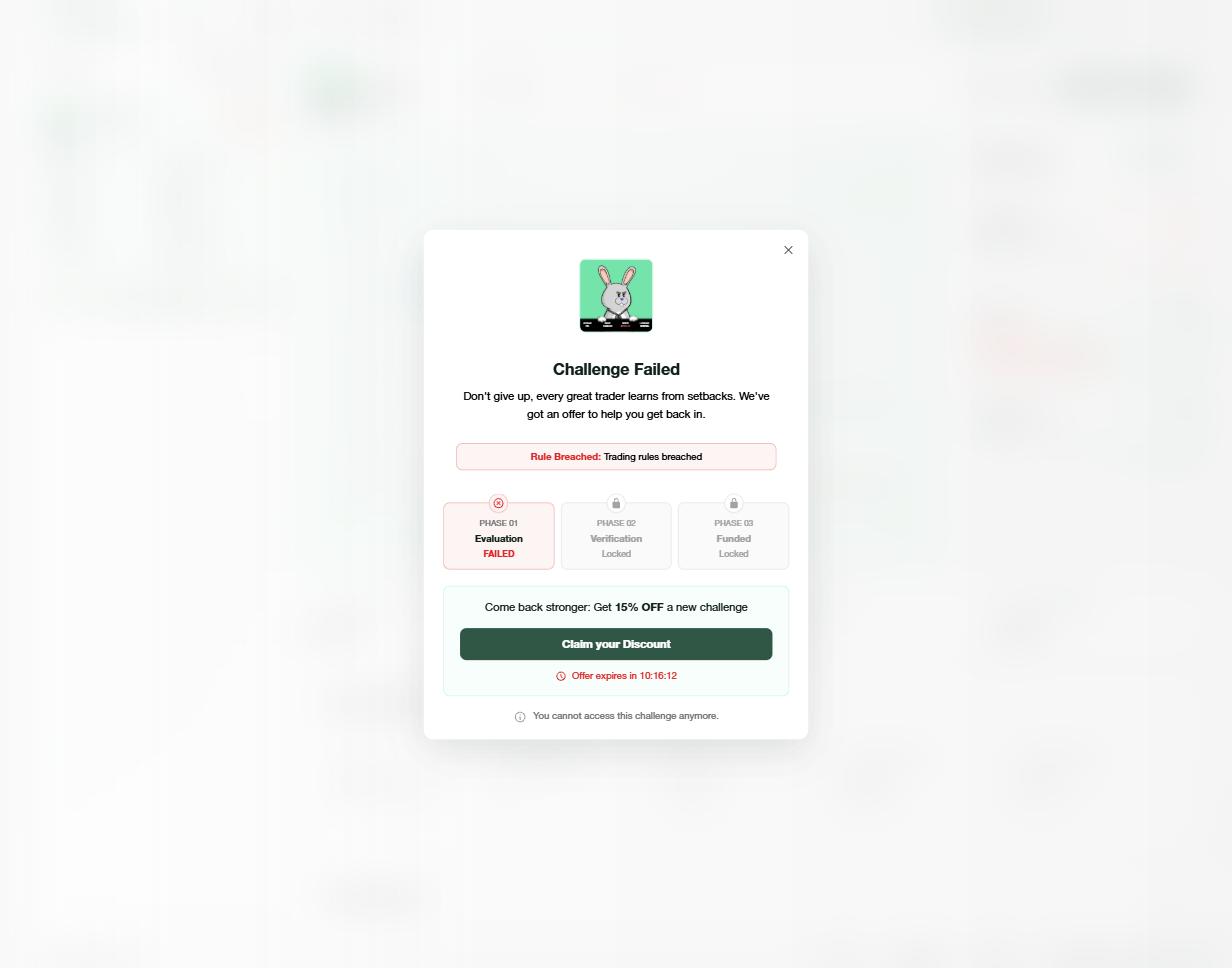
Carrot Funding scores 73.2/100 on our grid of 10 September 2026, and it is the first score we have given it from an account we paid for: on 10 September 2026 we bought a 2-Phase $5,000 evaluation — $65 list, $52 paid with the code royaref, USDC on Arbitrum — and traded it the same day. The two structures differ on price and on rules (rulebook §03, public, read the same day): the 2-Phase $5,000 is $65 with a 5% daily loss and a 10% max loss, the 1-Phase is $75 with 4%, 8% and a 50% Best Day Rule — figures our own sheet of 5 September 2026 got wrong, and the error was ours. We measured the "no markup" fee claim of §17 instead of quoting it: a HYPE/USD round trip cost $4.40 on $9,786.60 of round-trip notional (0.04496%) and an ETH/USD round trip cost $4.77 on $10,606.40 (0.04497%), against Hyperliquid's 0.045% base taker rate — the claim is exact, and a flat round trip still costs about 0.09% of notional. All four published payout hashes settle on-chain as real Arbitrum USDC transfers (733.22, 384.38, 399.24, 799.41), and the firm publishes an address table we should have read sooner: its GitBook lists the addresses with named roles — Vault Custody Contract, Vault Integrations, a 2-of-4 payout multisig and the payout executor EOA. Having read it we checked it on 10 September 2026: the Vault Custody Contract on HyperEVM is a Safe holding about $15,016 in the Felix/Morpho USDC vault plus $98 on HyperCore, and Carrot states its funds are mid-migration from Arbitrum to HyperEVM, which is why the on-chain picture is partial. The $788,521 of "funding capital" on its Analytics page is not a reserve balance but an internal risk metric, so the two figures measure different things and we do not set them against each other. Challenge #3955 is token #550 of the Funded Bunny Initiative collection on Arbitrum, minted at 2026-09-10T05:00:25Z, the hour of our purchase; leverage caps at 5x (§14); §23 forbids automated, high-frequency and AI-driven tools; and the Points page read the same day states 279 traders in total. On 11 September 2026 the account reads Inactive, End Date 2026-09-10: it breached. Two 5x BTC LONGs totalling about $24,930 of notional — 5x the account, the maximum allowed — were closed out on 10 September at 19:30:42, both at 77,420.0, after BTC moved from roughly 78,280 to 77,420, a fall of 1.1%; the day came to 4 trades and −$288.78, balance $5,000 → $4,711.22, average loss −$72.19, win ratio 0%. The balance stayed flat at 4,986.169 throughout and never moved by more than $13.83: what killed the account was the equity, down from 5,054.693 to 4,836.86 and then vertically to 4,711.225 — exactly what the dashboard and the public FAQ say before you pay, since limits are "calculated based on equity, not balance" and the limits themselves are published in absolute dollars (max loss $4,500.00, high watermark $5,000.00, max daily loss $4,750.00). The balance-based Objectives counter therefore sat at $13.83 of $500.00 for the whole fall and only registered $288.78 of $500.00 once the positions were closed: $211.22 of the total loss budget was never used, because at Carrot it is the daily limit that ends accounts, and the daily floor was shown at $4,750.00 while the account was settled at $4,711.22, $38.78 below it. The fault is ours: no stop loss and 5x of notional carried overnight, against a published rule the engine applied correctly and a floor displayed in dollars on screen. After the breach the app shows "Challenge Failed", "Rule Breached: Trading rules breached", PHASE 01 Evaluation FAILED, then "Come back stronger: Get 15% OFF a new challenge" with a "Claim your Discount" button, "Offer expires in 10:16:12", and "You cannot access this challenge anymore."
From$65 (2-Phase $5K — the one we bought, 10 Sep 2026)
Key facts
80%
Profit split
$100K · agg. $200K
Max account
USDC Arbitrum · <24h announced · min 100 USDC
Payouts
On-chain
Settlement
The numbers that matter
$52
paid for a 2-Phase $5,000 ($65 list, code royaref) — 10 Sep 2026
0.045%
taker fee measured on two round trips: the "no markup" claim is exact
4 / 4
published payout hashes verified on-chain on Arbitrum
279
traders in total on the Points page, 10 Sep 2026
−$288.78
the day it breached: $5,000 → $4,711.22 in four trades
⚠️ Update, 11 September 2026 — the account breached. Status Inactive, End Date 2026-09-10. The 2-Phase $5,000 we bought for $52 the day before lasted less than a day: two 5x BTC LONGs were closed out on 10 September at 19:30:42, after BTC moved 1.1%. The day came to 4 trades, −$288.78, balance $5,000 → $4,711.22.
And the fault is ours. Raphael had placed no stop loss and was carrying about $24,930 of notional — 5x the account, the maximum allowed — overnight. The engine applied a published rule, correctly, and the floor was on screen in dollars. This breach is not a charge against Carrot: it is a record of what leverage without a stop does while you sleep.
What the money had already established
We bought this evaluation with our own money on 10 September 2026 — $65 list, $52 with the code royaref, USDC on Arbitrum — and traded it the same day. The documentation is accurate: the configurator shown before payment, rulebook §03 and the objectives applied to the account agree line by line. The four published payout hashes settle on-chain. The "no markup" fee claim of §17 measures out to the fourth decimal.
What still counts against it
Leverage caps at 5x — a dated prudential setting rather than a structural ceiling, since the firm told us it has run up to 200x on gTrade and intends to raise leverage on Hyperliquid, announced and not shipped. §23 bans automated and AI tools. The Points page states 279 traders in total. And its own documents still disagree on the size of the maximum loss.
The correction that belongs to us
Our sheet of 5 September had the 1-Phase $5,000 at $65, with a 5% daily loss, a 10% max loss and no consistency rule at all. The real figures are $75, 4%, 8% and a 50% Best Day Rule. We had copied the 2-Phase row onto the 1-Phase line, and we also wrote that the fee is the same per size whatever the structure. Carrot published all of it correctly and in the open. The error was ours, and it is corrected here rather than edited away.
The score
73.2/100 on our grid of 10 September 2026, and it does not move. The breach confirms a rule this page already published — equity is what crosses the floor, not balance — and reveals no new one. Everything below carries the date we read it.
−20% on your first challenge, −10% on every next one, through our link — read on 13 September 2026, no end date published.
Affiliate link. We earn a commission; the discount is applied by the firm and your price never goes up.
What we like
The published payout hashes actually settle: four published, four verified by us on-chain on 10 September 2026 as real USDC transfers on Arbitrum — 733.22, 384.38, 399.24 and 799.41, the dashboard rounding down.
The "no markup" fee claim is exact, and we measured it rather than quoting it: $4.40 on $9,786.60 of HYPE/USD round-trip notional (0.04496%) and $4.77 on $10,606.40 on ETH/USD (0.04497%), against Hyperliquid's 0.045% base taker rate (10 September 2026).
Three sources agree line by line — the configurator before payment, the public rulebook §03, and the objectives applied to the account we paid for ($250 target, $250 daily, $500 max on a 2-Phase $5,000). The documentation is accurate; ours was the sheet that was wrong.
It discloses what most firms hide: §22 states outright that orders are routed A-book or B-book at the firm's discretion, trade by trade, and every trader is labelled A-booked or B-booked on their own dashboard (read 10 September 2026).
No time limit, no minimum trading days, no stop-loss requirement, no minimum holding time (§12), and the challenge is minted as an NFT the holder can transfer to another address — an asset you own rather than a licence tied to a login.
The interface answers the question that decides your risk, and it answers it in absolute dollars: max loss $4,500.00, high watermark $5,000.00, max daily loss $4,750.00, with a countdown to the UTC reset. Nothing to interpret, nothing to compute (read 10 September 2026).
A floating loss counts, and you can see it counting: with two BTC/USD positions open, the app tracked balance 4,986.169 against equity 5,054.693 as two live values and plotted EQUITY in the same frame as its limit lines at 4,750 and 4,500 — and the public FAQ, before purchase and without a login, says drawdown limits are "calculated based on equity, not balance". The §24 cheatsheet line saying otherwise is a drafting defect, not a trap. Our own breach, read on 11 September 2026, puts it on the record: the balance stayed flat at 4,986.169 while the equity fell to 4,836.86 and then to 4,711.225 at the forced close.
175+ pairs across crypto, commodities, equities and indices, all as perpetuals, so they trade 24/7 — weekends included, tokenised real-world assets among them (FAQ, read 10 September 2026).
Watch-outs
Its documents still contradict each other on the size of the maximum loss — no longer on what breaches you, which we tested and settled (equity does). What remains, read 10 September 2026: the public FAQ states Maximum Loss is 10% from your high-water mark with no 1-Phase exception, against 8% in §03 and in the §24 cheatsheet; §15 says Max Loss stays the same once funded while the cheatsheet shows 8% → 10%; and the §07 formula box multiplies the starting balance by the max DAILY loss. Three documents, three versions of the same number.
Two documents, two lists of banned practices: the FAQ adds COPY TRADING and HEDGE TRADING, neither of which appears in rulebook §23 (both read 10 September 2026).
The number on display is not the number that decides. The dashboard chart is equity-based while the Objectives counter is balance-based, and our own breach put a figure on the gap: read on 11 September 2026, the counter sat at "Max loss $13.83 of $500.00" — $5,000 minus a balance that never moved — while the equity fell from 5,054.693 to 4,836.86 toward the floor, and it only registered $288.78 of $500.00 after the forced close. Steer by equity.
It is the daily limit that ends accounts here, not the total drawdown, and our breach quantifies it: $288.78 consumed out of a $500 max loss, so $211.22 of the total budget was never used. The daily floor was displayed at $4,750.00 and the account was settled at $4,711.22, $38.78 below it — the published limit is the level that triggers the close, not a guaranteed final balance (read 11 September 2026).
Trading freedom with two hard ceilings: leverage caps at 5x on every asset class (§14) and §23 forbids "automated software, high-frequency trading systems, AI-driven tools, or mass order entry systems" — on the same page that headlines freedom. Propr permits bots and APIs (read 5 September 2026).
The NFT is real, its documentation is not. §20 and the FAQ both state that every challenge is minted as its own NFT, and on-chain that holds: challenge #3955 is token #550 of the Funded Bunny Initiative collection (symbol FBI) on Arbitrum, contract 0x16f6ff310d113fe4b5a1c2e251e25530989e4c9c, minted at 2026-09-10T05:00:25Z — the hour we paid — with exactly one Transfer event since, the mint itself. What no page anywhere documents is that the token ID is NOT the challenge ID: we went looking for a token #3955 that does not exist. The firm told us the product was not NFT-native at the start and that clarifying this "wasn't our priority" (10 September 2026). A documentation defect confirmed by the source.
Their own docs contradict their own product on the venue: the documentation still lists gTrade (Gains Network) as a supported venue while the rulebook, the FAQ and the app all say Hyperliquid — that page is stale on their side, and it is where our own earlier error came from (10 September 2026).
It is a very small operation: the Points page states 279 traders in total and a $69 weekly prize pool, and a single $52 purchase put us third on the weekly board (10 September 2026). Not an accusation — a survival input.
Three smaller things a buyer should know before paying: the 1-Phase carries a 50% Best Day Rule, a real consistency rule; the checkout asks for an unlimited USDC approval (max uint256), so pay from a dedicated wallet or revoke the approval afterwards; and the "verified by OASIS" badge is displayed as an image with no consultable proof, while the FAQ read the same day describes the firm as still "integrating" ROFL — a present-tense badge for a feature the same company calls unfinished.
How it went, step by step
10 Sep 2026 · 05:00 UTC
The purchase: $52
Wallet connected, 52 USDC paid on Arbitrum for a 2-Phase $5,000 listed at $65 — the code royaref takes 20% off. No document, no email verification, account live immediately. At 05:00:25 UTC challenge #3955 was minted as an NFT: token #550 of the Funded Bunny Initiative collection on Arbitrum. Objectives applied to the account: $250 target, $250 max daily loss, $500 max loss.
10 Sep 2026 · during the day
The fees, measured instead of quoted
Two round trips to test the "no markup" claim of §17 rather than copy it out. HYPE/USD: $4.40 of fees on $9,786.60 of round-trip notional, 0.04496%. ETH/USD: $4.77 on $10,606.40, 0.04497%. Hyperliquid's base taker rate is 0.045%. The claim lands to the fourth decimal.
After those two round trips the balance sat at $4,986.169 — $13.83 below the $5,000 we started with. Remember that number.
10 Sep 2026 · evening
The floating-P&L question, settled
Two BTC/USD positions open. The app tracked balance 4,986.169 and equity 5,054.693 as two separate live values — $68.52 of floating P&L — and plotted EQUITY against its limit lines at 4,750 and 4,500. The public FAQ, readable before you pay, says the same in words: limits are "calculated based on equity, not balance". Answer published that evening: yes, a floating loss can breach you.
10 Sep 2026 · 19:30:42
The liquidation
Both BTC positions were closed out, both at the same price: 77,420.0. Two 5x LONGs opened at 78,318.2 and 78,247.0, for about $24,930 of notional on a $5,000 account — the maximum allowed — and $4,986.16 of margin committed, which is the entire balance. BTC went from roughly 78,280 to 77,420: a 1.1% move.
P&L −$141.00 (−5.76%) and −$133.94 (−5.28%); fees $12.09 and $12.52. The day: 4 trades, −$288.78, average loss −$72.19, win ratio 0%. Balance $5,000 → $4,711.22, or −5.78%. Status: Inactive. End Date: 2026-09-10.
10 Sep 2026 · 19:30:42
Whose fault: ours
Raphael had placed no stop loss and was carrying 5x of notional overnight. There is nothing else to look for.
The engine applied a published rule, correctly. The interface showed the floor on screen in absolute dollars — max daily loss $4,750.00, max loss $4,500.00, high watermark $5,000.00 — and the FAQ said before purchase that equity is what counts. This breach is on us. It does not document a defect at Carrot: it documents what leverage without a stop does while you sleep.
11 Sep 2026
The curve: the balance never moved
Read back in the account on 11 September 2026. The balance stayed flat at 4,986.169 from the first plotted point to the last.
It was the equity that fell: 5,054.693 → 5,018.706 → 4,922.21 → 4,917.752 → 4,879.217 → 4,839.727 → 4,836.86, then vertically to 4,711.225 when the positions were closed out. The balance never moved by more than $13.83. The floating loss is what killed the account — exactly what the dashboard and the FAQ said it would.
Our own account the day after it breached: the Balance line stays flat at 4,986.169 while the Equity curve falls from 5,054.693 to 4,836.86, then drops vertically to 4,711.225 when the two BTC positions were closed out at 19:30:42. Objectives reads "Max loss $288.78 of $500.00", Daily Reports shows 2026-09-10 with 4 trades and −$288.78 (5,000.00 → 4,711.22), Average Loss −$72.19, Win Ratio 0%, status Inactive, End Date 2026-09-10. The balance never moved more than $13.83: the floating loss is what ended the account · read on · app.carrotfunding.io
11 Sep 2026
Two things this curve brings out
The Objectives counter is balance-based, so it sat at $13.83 of $500.00 while the equity gave up more than $200 toward the floor, and only registered $288.78 of $500.00 once the positions were closed. The number on display is not the number that decides.
$288.78 used out of a $500 max loss: $211.22 of the total budget was never touched. At Carrot it is the daily limit that ends accounts, not the total drawdown.
And the daily floor was shown at $4,750.00: the account was settled at $4,711.22, $38.78 below it. The published limit is the level that triggers the close, not a guaranteed final balance.
11 Sep 2026
The screen that follows, reported as it is
A "Challenge Failed" modal, "Rule Breached: Trading rules breached", PHASE 01 Evaluation marked FAILED, Verification and Funded locked.
Below it: "Come back stronger: Get 15% OFF a new challenge", a "Claim your Discount" button, and "Offer expires in 10:16:12". Then, at the bottom of the modal: "You cannot access this challenge anymore."
We report it without adjectives. You can judge it yourself.
The screen that follows the breach, reported as displayed: a "Challenge Failed" modal, "Rule Breached: Trading rules breached", PHASE 01 Evaluation marked FAILED with Verification and Funded locked, then "Come back stronger: Get 15% OFF a new challenge", a "Claim your Discount" button, "Offer expires in 10:16:12", and "You cannot access this challenge anymore." · read on · app.carrotfunding.io
Screenshots, dated
Proof — what the firm's site showed us
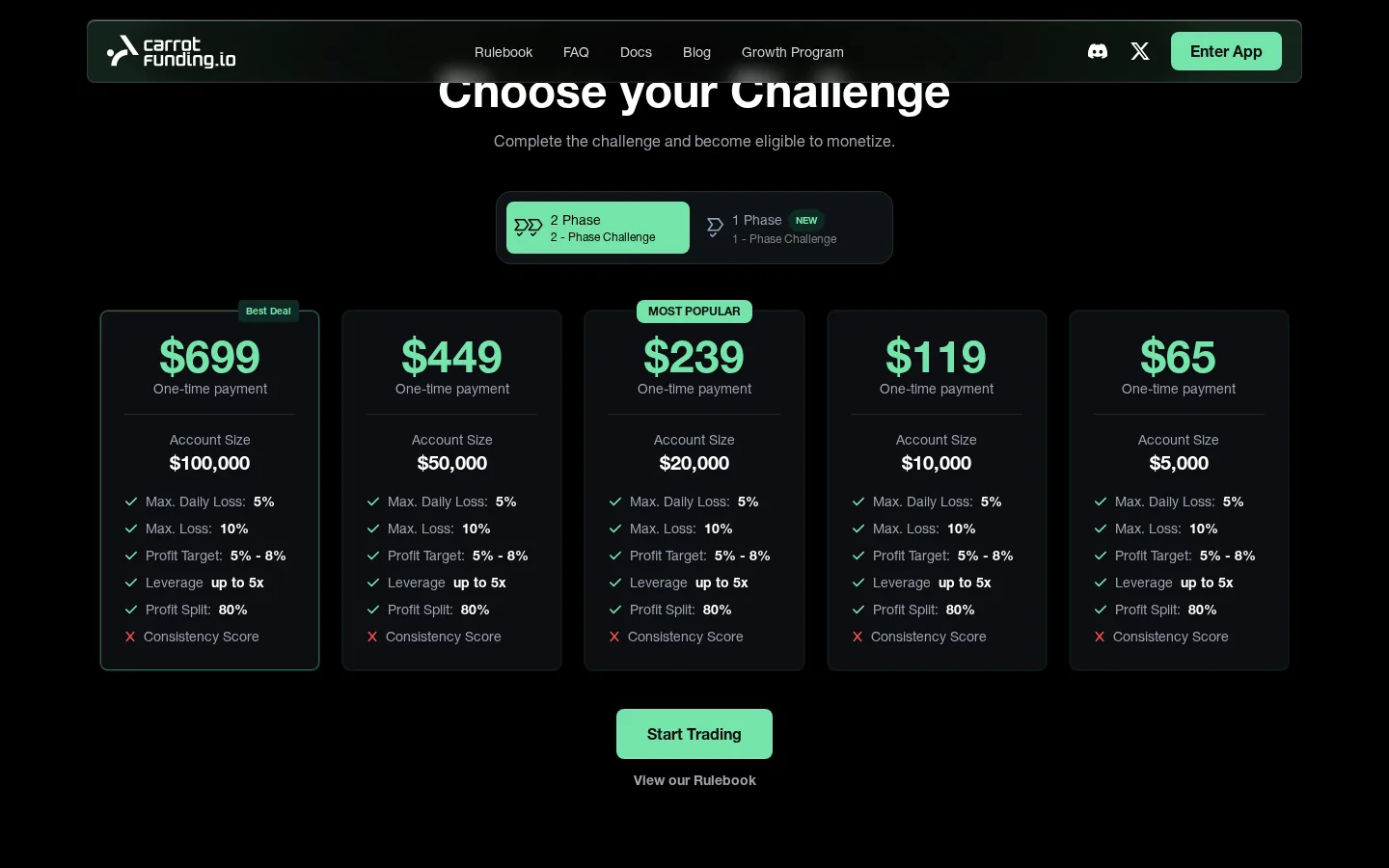
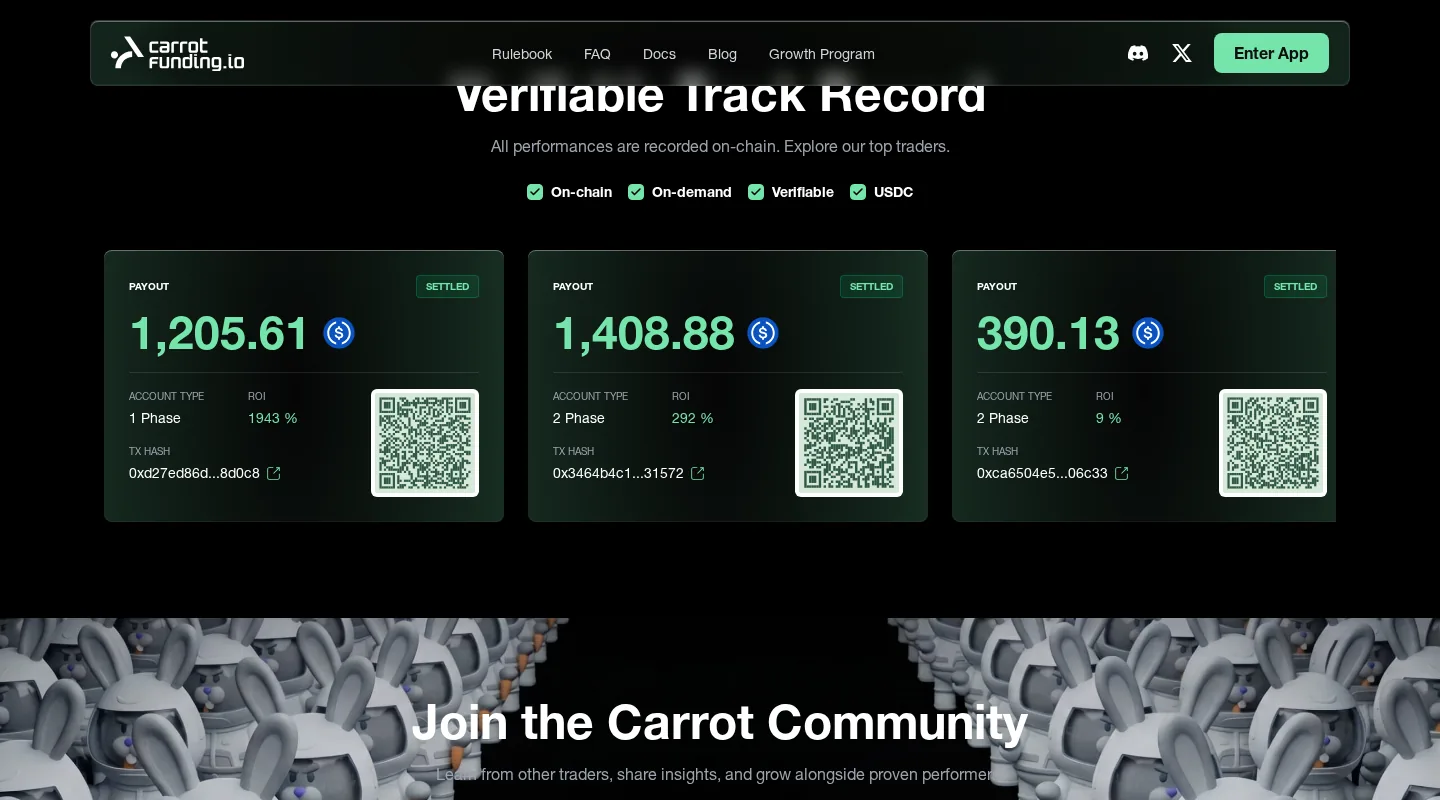
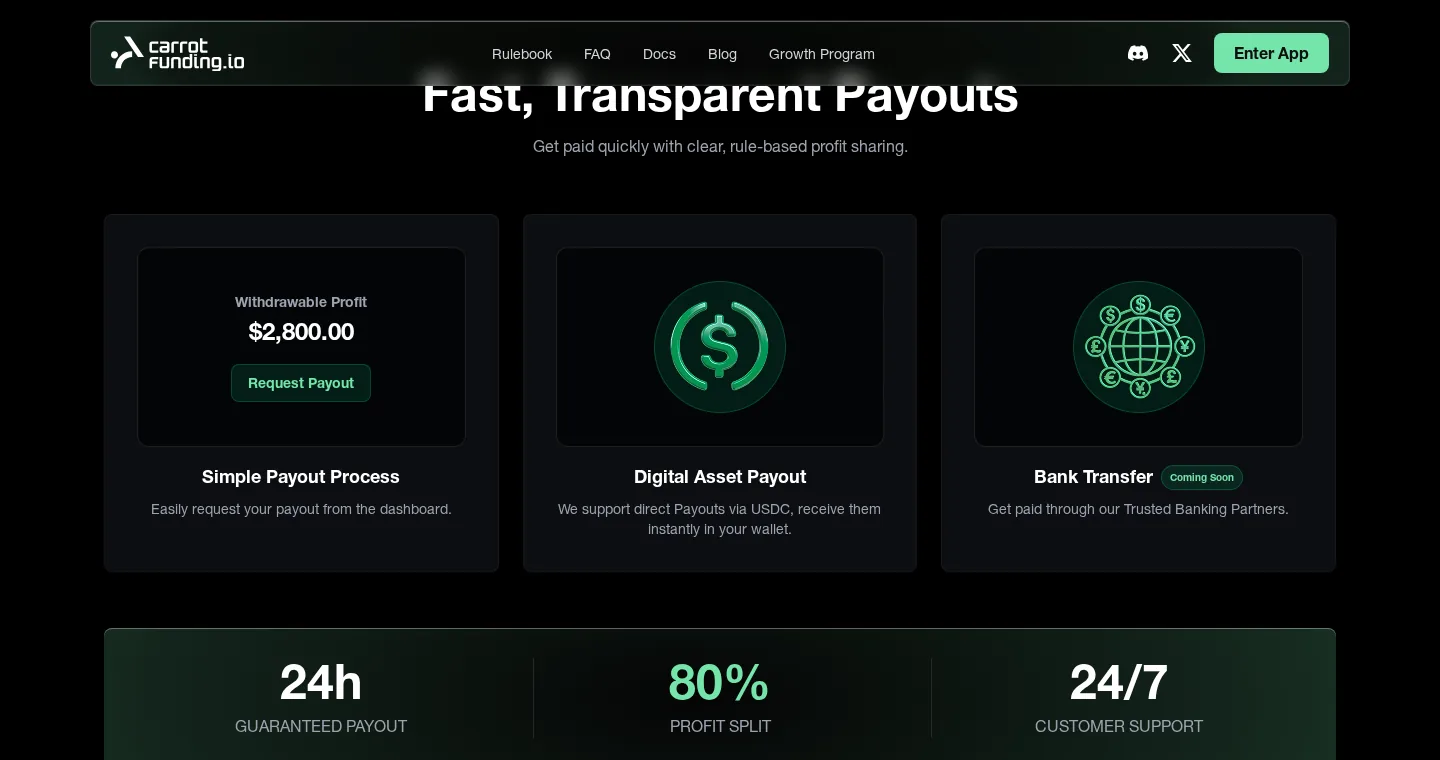
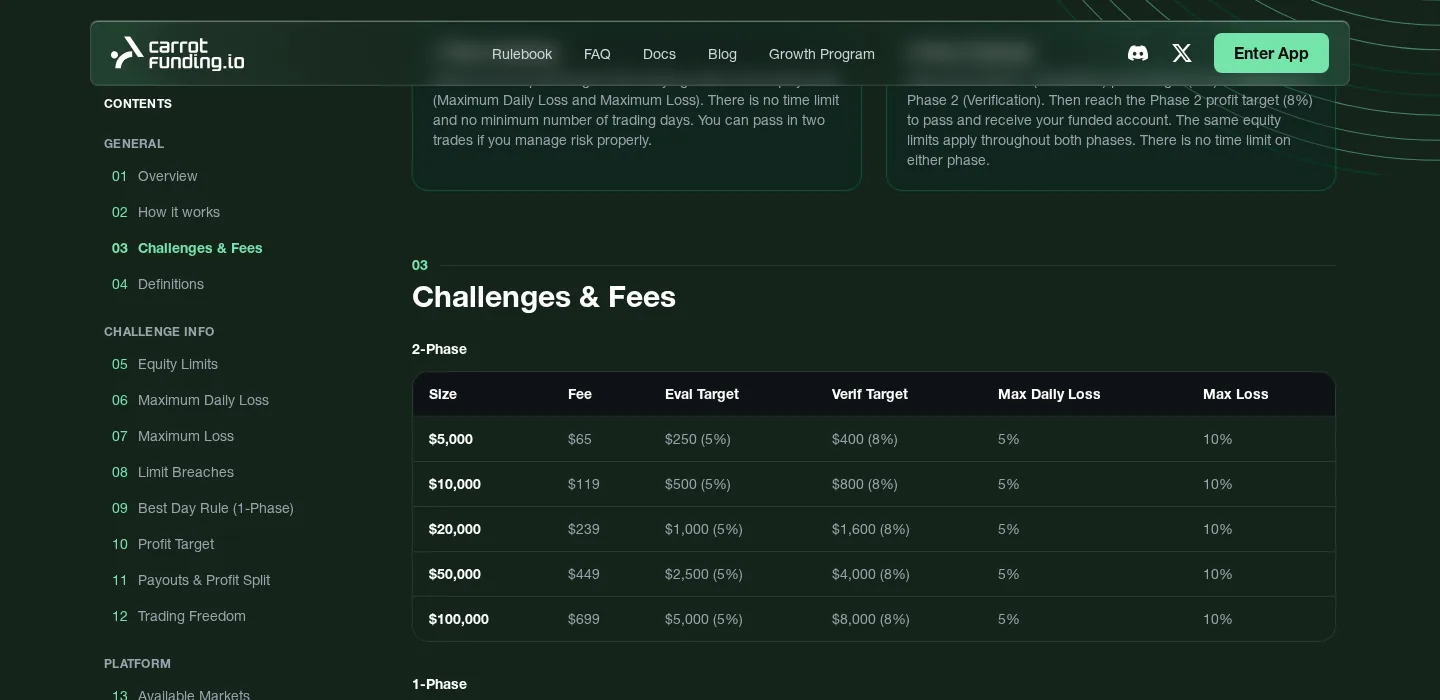
The 2-Phase cards: $100K $699 · $50K $449 · $20K $239 · $10K $119 · $5K $65 — 5% daily loss, 10% max loss, 5% then 8% target, 5x, 80% split. These figures belong to the 2-Phase only: the 1-Phase is priced higher at every size ($75 · $129 · $249 · $499 · $799) and runs on 4% daily, 8% max and a 50% Best Day Rule. Our 5 September sheet copied this row onto the 1-Phase line — our error, corrected against rulebook §03 re-read 10 September 2026 · read on · source carrotfunding.io"Verifiable Track Record" as captured on 5 September 2026: three settled payouts, each line carrying its amount, its account type and its transaction hash (USDC on Arbitrum). The three amounts visible in this crop are 1,205.61, 1,408.88 and 390.13 — these three lines and no others. The four hashes published at our 10 September 2026 read were checked one by one — see the Payouts section of this review · read on · source carrotfunding.ioPayout block, in the firm's own words: "24h guaranteed payout", 80% split, USDC to your wallet — bank transfer "coming soon". Rulebook §11, read 10 September 2026, adds what the block leaves out: on demand, minimum 100 USDC, the full amount only (no partial payout), trading disabled while it is processed and risk limits reset afterwards. We have not requested one, so the timing is the firm's claim, not our measurement · read on · source carrotfunding.ioRulebook §03 — Challenges & Fees, as captured: the two formats are laid out in two separate tables, and the page states no time limit and no minimum trading days. The crop stops at the "1-Phase" heading — none of that table's figures are visible in this image. The fees and the objectives of each format are in the pricing table of this review, read on the rulebook on 10 September 2026 · read on · source carrotfunding.io/rulebook
The rule that kills the account
Two numbers, and they differ by structure
On the 2-Phase $5,000 we bought on 10 September 2026, the account applies a $250 target, a $250 max daily loss and a $500 max loss: 5% in a day, 10% in total. On the 1-Phase, read the same day in rulebook §03 and in the configurator before payment: $75, a single 8% target, 4% daily ($200), an 8% max loss ($400), plus a 50% Best Day Rule the 2-Phase card does not carry.
What does not end the account
No time limit, no minimum trading days, no stop-loss requirement, no minimum holding time (§12, read 10 September 2026).
What crosses the line is equity, not balance
We read it first on 10 September: balance 4,986.169 against equity 5,054.693, and a dashboard chart plotting EQUITY against its limit lines at 4,750 and 4,500. The public FAQ says it in words before you pay — limits are "calculated based on equity, not balance". The §24 cheatsheet cell that says otherwise describes how the limit LEVEL is set, not what crosses it.
The proof, 11 September 2026
The balance stayed flat at 4,986.169 from the first plotted point to the last. The equity is what fell: 5,054.693 → 5,018.706 → 4,922.21 → 4,917.752 → 4,879.217 → 4,839.727 → 4,836.86, then vertically to 4,711.225 when both BTC positions were closed out at 19:30:42. The balance never moved by more than $13.83. The floating loss is what ended the account.
The counter that does nothing while that happens
The Objectives counter is balance-based, so it showed $13.83 of $500.00 while the equity gave up more than $200 toward the floor, and only registered $288.78 of $500.00 after the close. Do not steer your risk by it: steer by equity, which is the number the app measures against the floor.
Here it is the daily limit that ends accounts
$288.78 used out of a $500 total budget — $211.22 never touched. And the daily floor was shown at $4,750.00 while the account was settled at $4,711.22, $38.78 below it: the published limit is the level that triggers the close, not a guaranteed final balance.
A third thing, in no rulebook: friction
Leverage caps at 5x, and our ETH/USD round trip opened at 2,475.90 and closed at 2,475.45 — 45 cents of movement — yet still finished at −$3.49, because a flat round trip costs about 0.09% of notional in fees. On a 2-Phase $5,000 whose evaluation target is $250, that is the cost you have to beat before you earn anything.
10% max loss· the one we bought — $52 paid with royaref; our account reads $250 target / $250 daily / $500 max
2-Phase $10K
$119
5% then 8%
5%
10% max loss· $500 then $800
2-Phase $20K
$239
5% then 8%
5%
10% max loss· $1,000 then $1,600
2-Phase $50K
$449
5% then 8%
5%
10% max loss· $2,500 then $4,000
2-Phase $100K
$699
5% then 8%
5%
10% max loss· $5,000 then $8,000 — largest account sold
1-Phase $5K
$75
8%
4%
8% max loss· Best Day Rule 50% — 1-Phase only; corrects our 5 Sep sheet, which said $65 / 5% / 10% and no consistency rule
1-Phase $10K
$129
8%
4%
8% max loss· Best Day Rule 50%
1-Phase $20K
$249
8%
4%
8% max loss· Best Day Rule 50%
1-Phase $50K
$499
8%
4%
8% max loss· Best Day Rule 50%
1-Phase $100K
$799
8%
4%
8% max loss· Best Day Rule 50%
Both tables read on 10 September 2026 in §03 of the rulebook — public, no login — and cross-checked against the configurator shown before payment and against the objectives actually applied to the 2-Phase $5,000 we paid for that day ($250 target, $250 daily, $500 max). Correction of our own sheet of 5 September 2026: we wrote that the 2-Phase charges the same fee per size, so that you were choosing a structure and not a price. That is wrong. The structures differ on price AND on rules — the 1-Phase costs $10 to $100 more per size, gives a single 8% target, tightens the daily loss to 4% and the max loss to 8%, and adds a 50% Best Day Rule the 2-Phase does not carry. Common to both: 80% profit split, leverage capped at 5x across every asset class (§14), no time limit and no minimum trading days (§12), each challenge minted as a transferable NFT, trading venue Hyperliquid, account chain HyperEVM, payment in USDC on Arbitrum. Prices above are list prices; the code royaref — ours — applied −20% at checkout on 10 September 2026, with no end date displayed. For comparison, Carrot's own public referral programme, read in the FAQ the same day, gives the referred trader 10%, so our code is worth twice that. Payment is not USDC-only either: the FAQ read on 10 September 2026 lists card payment through Wert (Visa, Mastercard, Apple Pay, Google Pay) alongside crypto through DePay. The $100K ceiling is unchanged since our 5 September read and still down from the $500K we recorded in July 2026.
KYC & excluded countries
No identity check was requested at purchase. We bought a 2-Phase $5,000 evaluation on 10 September 2026 — connect a wallet, pay 52 USDC on Arbitrum, account active the same day — with no document, no email verification and no identity form at any point. That is a fact about the purchase, not about the payout: most firms ask at the first withdrawal, and we have not requested one, so treat it as unconfirmed there. Two things we did read: the entity behind the terms accepted at checkout is CTECHNOLOGIES GAMING DEVELOPMENT - FZCO, a United Arab Emirates free-zone company, and we did not find a restricted-countries list in the pages we read that day — an absence we did not test, not a permission. If your jurisdiction or your privacy decides the purchase, ask in writing and keep the answer.
Bots, API, copy trading, weekends
Banned, and we finally have the clause with today's date on it. Rulebook §23, read 10 September 2026, forbids "automated software, high-frequency trading systems, AI-driven tools, or mass order entry systems". Put that next to §12, which sells trading freedom over a list of rules the firm does not impose — no time limit, no minimum trading days, no stop-loss requirement, no minimum holding time, weekend and news trading allowed — and next to §14, which caps leverage at 5x across every asset class. Those are real freedoms and real ceilings on the same page: a firm cannot headline trading freedom and ban automation in the same rulebook, and the reader deserves both halves. If automation or an API is your edge, Propr publishes the opposite policy — bots and copy trading permitted (read 5 September 2026) — and keeps a higher freedom score for it. Two more facts of the same day, for context rather than criticism: §22 states the firm routes orders A-book or B-book at its own discretion, trade by trade, with no control by the trader, and every trader is labelled A-booked or B-booked on their own dashboard. That disclosure is rare enough to credit. And one genuine freedom deserves crediting next to the ban: the FAQ, read 10 September 2026, states 175+ pairs across crypto, commodities, equities and indices, all traded as perpetuals — which means 24/7, weekends included, tokenised real-world assets among them.
Payouts
Method & threshold — 80% profit split, on demand, in USDC on Arbitrum, minimum 100 USDC, stated as settled in under 24 hours — and full amount only: partial payouts are not offered. Trading is disabled while a payout is processed, and the risk limits reset to zero once it is paid (rulebook §11, read 10 September 2026). Aggregate funded ceiling: $200,000 per trader, with a "Ready to Fund" queue beyond it (§16).
What we verified
Two things, both checked ourselves on 10 September 2026. First, the published payout hashes: four published, four verified on-chain as genuine USDC transfers on Arbitrum — 733.22, 384.38, 399.24 and 799.41, the dashboard rounding down. Published hashes that actually settle are not the norm in this category. Second, the trading fees, which are a payout question in disguise because they come out of the same pocket: §17 claims Hyperliquid's own schedule with "no markup", and we measured it on two round trips on our paid account — HYPE/USD, $4.40 on $9,786.60 of round-trip notional, 0.04496%; ETH/USD, $4.77 on $10,606.40, 0.04497% — against a 0.045% base taker rate. Two assets, two directions, matching to the fourth decimal. The claim is exact. Third, the addresses, and this one is a correction of ours: Carrot's GitBook publishes a full address table with named roles — Vault Custody Contract, Vault Integrations, a 2-of-4 payout multisig and the payout executor EOA. We had not read that page and wrote that its vault could not be located; the miss was ours. Having read it we checked it on 10 September 2026: the Vault Custody Contract on HyperEVM is a Safe holding about $15,016 in the Felix/Morpho USDC vault plus $98 on HyperCore. The address the four verified payouts leave is the one the firm itself documents as the payout executor. Publishing which address does what, by name, is rare enough in this category to credit rather than to hold against them.
What we did not verify
Our own payout: none requested, so the 80% split and the under-24-hours wording remain untested by us. What the address table does not settle: the on-chain picture is partial, and Carrot states its funds are mid-migration from Arbitrum to HyperEVM, so the $15,016 we read in the Vault Custody Safe on 10 September 2026 is a snapshot of one contract on one chain on one day, not a total of what the firm holds. We are not comparing it to the $788,521 of "funding capital" on the Analytics page either: Carrot answered that this is an internal risk metric — the capital still free before it stops taking on new funded traders — which is a different quantity from a reserve balance, so there is no shortfall to report and any page setting one against the other would be wrong. What remains genuinely open is the size and location of everything outside that one Safe, which we cannot read. Also unverified: the "verified by OASIS" badge (§21) is displayed as an image with no consultable proof, so the cryptographic verification it claims stays unverifiable from our side; whether the published ledger shows every payout or a selection; and whether identity documents are requested at the first withdrawal (none were at purchase). Third-party evidence is still thin: the Trustpilot widget on their own page read 4.6 from 22 reviews on 5 September 2026 — their claim, and a small sample. One more thing from the public FAQ, read 10 September 2026: it describes the firm as "integrating" ROFL, in the present continuous, while the dashboard already displays a "verified by OASIS" badge in the present tense. A finished badge for a feature the same company calls unfinished is exactly the overstatement we docked HyperPNL for.
The account as an NFT
What we verified on-chain
Carrot sells the challenge as an NFT, so we went and read it on-chain on 10 September 2026. The collection is Funded Bunny Initiative, symbol FBI, on ARBITRUM — not on HyperEVM, where the account itself lives — at contract 0x16f6ff310d113fe4b5a1c2e251e25530989e4c9c. Our challenge #3955 corresponds to token #550: opensea.io/item/arbitrum/0x16f6ff310d113fe4b5a1c2e251e25530989e4c9c/550. The token ID is NOT the challenge ID, which is the whole trap — we first went looking for a token #3955 that does not exist. Token #550 was minted at 2026-09-10T05:00:25Z, the hour of our purchase, so the mint-on-purchase is real and verified, and since that mint the token carries exactly one Transfer event: the mint itself. It has never moved. The collection held 551 tokens, IDs 0 to 550, at our reading. What is defective is the documentation, and the firm confirmed it: §20 and the FAQ both state that every challenge is minted as its own NFT, the mapping between challenge ID and token ID is documented nowhere, and Carrot told us the product was not NFT-native at the start and that clarifying this "wasn't our priority". A documentation defect, not an absent product.
Transferring it — and what that opens
Because it is a standard ERC-721 on Arbitrum, the challenge is transferable like any other NFT — and the interface says so itself: an "Enter recipient address" field and a "Send NFT" button, with the note that the recipient will be able to keep trading it by connecting that address to carrotfunding.io (read 10 September 2026). What that means for you concretely: the account is an asset you own, not a revocable licence tied to an identifier. You can hand it over, sell it, or move it to another wallet, and whoever receives the NFT trades with their own crypto address — no support ticket, no name change, no permission asked. The same fact read from the other side: a secondary market in accounts becomes possible, with everything that implies — "already passed" accounts resold, rules worked around, and buyers scammed. And the limit is ours, not theirs: we did not transfer our NFT, so how the account behaves after a transfer is unverified on our side, and we do not claim it.
Our verdict
We paid for this evaluation, and it breached in under a day — through our own mistake, with no stop loss and 5x of notional carried overnight.
What the money settled in Carrot's favour
The documentation is accurate: the configurator shown before payment, the public rulebook §03 and the objectives applied to our own 2-Phase $5,000 agree line by line. The four published payout hashes settle on-chain as real Arbitrum USDC transfers. The "no markup" fee claim measured 0.04496% and 0.04497% of round-trip notional against a 0.045% base taker rate — the only measured fee verification in this table. And it discloses its A-book/B-book routing outright, which most of this category will not do.
What still stands against it
The FAQ puts Maximum Loss at 10% of the high-water mark where §03 and §24 say 8%, and bans copy and hedge trading that §23 does not list. §23 bans automated and AI-driven tools under a section headlined trading freedom. The dashboard carries a "verified by OASIS" badge while the FAQ calls the firm still "integrating" ROFL. The Points page states 279 traders in total. And the NFT token ID is not the challenge ID, which no page documents.
One charge of ours came off, on 10 September
Carrot's GitBook does publish a full address table with named roles — Vault Custody Contract, Vault Integrations, a 2-of-4 payout multisig, the payout executor EOA. Having read it we checked the custody Safe on HyperEVM: about $15,016 in the Felix/Morpho USDC vault plus $98 on HyperCore, funds stated to be mid-migration from Arbitrum. Our reserve criticism was a reading error, not a finding.
The score
73.2/100 on our grid of 10 September 2026, against Propr's 86.7 on the same grid — and it does not move. The breach confirms a rule we had already read, published and scored; it uncovers nothing new about the firm.
Who it is for
Buy here if you want a cheap, discretionary, low-leverage evaluation on a real Hyperliquid order book. Then size your risk on equity, not on balance, because that is the number the app measures against the floor. We didn't, and the account lasted a day.
Carrot beats Propr on entry price and on measured execution cost, not on rules or on proof. The 2-Phase $5,000 we bought is $65 list — $52 with the code royaref on 10 September 2026 — and its fees are Hyperliquid's own schedule with no markup, which we measured at 0.04496% and 0.04497% of round-trip notional rather than took on trust. Its 2-Phase also leaves more daily room than Propr's 1-Step: 5% a day and a 10% max loss, where Propr's 1-Step sells 3% daily with a 6% static drawdown on Classic and 3% on Turbo, for 10% and 9% targets (read 5 September 2026). Note that the room disappears if you take Carrot's 1-Phase, which is 4% daily and 8% max loss with a 50% Best Day Rule. Where Propr stays ahead: a payout ledger with a hash per line plus a verified distributor contract, and no ban on automation. Floating P&L is no longer part of that gap — we tested it on the paid account on 10 September 2026 and Carrot's own dashboard and public FAQ agree that equity is what breaches you — but its documents still disagree on the SIZE of the maximum loss: 10% of the high-water mark in the FAQ against 8% in §03 and §24. Never pick Carrot if you automate — §23 forbids automated software, HFT systems and AI-driven tools (10 September 2026) — or if you need more than 5x leverage, or more than $100K per account.
See Carrot Funding for yourself
Rules, pricing and on-chain proofs are published — open Carrot Funding and check them against our review.
Across splits, payout speed, market depth and automation, Propr.xyz is our top pick — bots, copy trading and an official REST API are all explicitly allowed.
Affiliate link. We earn a commission; it never changes what you pay — it is what funds your cashback.
FAQ
Is Carrot Funding legit?+
We bought a 2-Phase $5,000 evaluation with our own money on 10 September 2026 — $65 list, $52 with the code royaref, USDC on Arbitrum — and traded it the same day, so this is first-hand rather than desk research. What we verified: the account was delivered, its objectives match the public rulebook exactly, the four published payout hashes settle on-chain as real Arbitrum USDC transfers, and the "no markup" fee claim measured 0.045% per side. What we did not verify: our own payout. Later the same day we used that account to settle the question we had been treating as open — whether a floating loss can breach you — and it can, which raised our rules score. Carrot stands at 73.2/100 on our grid of 10 September 2026. The account itself breached that evening — our own fault, no stop loss and 5x of notional held overnight — which changes nothing about the firm's rules and nothing about the score.
Did you get Carrot's 1-Phase numbers wrong?+
Yes, and here is the correction. Our sheet of 5 September 2026 listed the 1-Phase $5,000 at $65 with a 5% max daily loss and a 10% max loss, and documented no consistency rule. Read on 10 September 2026 in rulebook §03 — public, no login — and in the configurator before payment, the 1-Phase $5,000 is $75, with a 4% max daily loss, an 8% max loss and a Best Day Rule of 50%. We had copied the 2-Phase row onto the 1-Phase line. We also wrote that both structures cost the same per size; they do not. Carrot published all of it correctly and in the open — the error was ours, and it is corrected in public rather than deleted.
How much does a Carrot Funding challenge cost?+
Two tables, two prices, read on 10 September 2026 in rulebook §03. 2-Phase: $5K $65, $10K $119, $20K $239, $50K $449, $100K $699, with a 5% evaluation target, an 8% verification target, a 5% max daily loss and a 10% max loss. 1-Phase: $5K $75, $10K $129, $20K $249, $50K $499, $100K $799, with a single 8% target, a 4% max daily loss, an 8% max loss and a Best Day Rule of 50%. Both: 80% split, leverage capped at 5x. Our code royaref took 20% off at checkout that day, with no end date displayed.
What is Carrot Funding's Best Day Rule?+
50%, and it applies to the 1-Phase only — the 2-Phase card shows no Best Day Rule (rulebook §03, read 10 September 2026). It is a consistency rule: a single day cannot account for more than half of your profit. Our 5 September sheet missed it entirely and said no threshold was published; the threshold was published, we had not read it. If you buy the 1-Phase, plan for it before your best day happens, not after.
Did Carrot Funding pay us?+
No — and not because it refused. We bought a 2-Phase $5,000 evaluation on 10 September 2026 ($65 list, $52 with the code royaref, USDC on Arbitrum) and traded it the same day, but we never requested a payout: the account breached that same evening on the daily limit, $5,000 to $4,711.22, and a breached evaluation has nothing to withdraw. There is therefore no receipt of ours to reconcile, which is exactly why our payouts criterion did not move on this firm. What does exist, and what you can open yourself, is Carrot's own published payout ledger: four hashes published, four verified by us on-chain on 10 September 2026 as real Arbitrum USDC transfers — 733.22, 384.38, 399.24 and 799.41.
How fast does Carrot Funding pay?+
Rulebook §11, read 10 September 2026: on demand, in USDC on Arbitrum, minimum 100 USDC, stated as settled in under 24 hours, and the full amount only — there is no partial payout. Trading is disabled while the request is processed and the risk limits reset to zero once it is paid. We have not requested one, so the timing is their claim, not our measurement. What you can check before paying them anything: their four published payout hashes, all four of which we verified on-chain as real transfers (733.22, 384.38, 399.24, 799.41).
Does Carrot Funding allow trading bots?+
No. Rulebook §23, read 10 September 2026, forbids "automated software, high-frequency trading systems, AI-driven tools, or mass order entry systems", and §14 caps leverage at 5x on every asset class — both on the same document that headlines trading freedom in §12. If automation is your edge, Propr publishes the opposite policy: bots and copy trading permitted (read 5 September 2026).
Can you transfer or sell a Carrot challenge?+
Yes, in the sense that matters: the challenge is a standard ERC-721 NFT on Arbitrum, so it is transferable like any other NFT. The interface offers an "Enter recipient address" field and a "Send NFT" button, with the note that the recipient will be able to keep trading it by connecting that address to carrotfunding.io (read 10 September 2026). The practical consequence for a reader is that the account is an asset you own, not a revocable licence attached to an identifier: you can hand it over, sell it, or move it to another wallet, and whoever receives the NFT trades with their own crypto address. The other half of the same fact: a secondary market in accounts becomes possible, with everything that implies — "already passed" accounts resold, rules worked around, scams. And a limit on us, not on them: we did not transfer our NFT, so how the account behaves after a transfer is unverified on our side.
Does a Carrot challenge really mint an NFT?+
Yes, and we traced ours on-chain on 10 September 2026. The collection is Funded Bunny Initiative, symbol FBI, on Arbitrum — not HyperEVM — at contract 0x16f6ff310d113fe4b5a1c2e251e25530989e4c9c. Our challenge #3955 corresponds to token #550: https://opensea.io/item/arbitrum/0x16f6ff310d113fe4b5a1c2e251e25530989e4c9c/550. Token #550 was minted at 2026-09-10T05:00:25Z, which is the hour of our purchase, so the mint-on-purchase is real and verified, and since that mint the token carries exactly one Transfer event — the mint itself. It has never moved. The collection held 551 tokens, IDs 0 to 550, at our reading. The defect that remains is documentary: §20 and the FAQ both say each challenge is minted as its own NFT, the correspondence between challenge ID and token ID is documented nowhere, and the firm told us the product was not NFT-native at the start and that clarifying this "wasn't our priority". So you can find your token — but not from their documentation.
Can a floating loss breach your Carrot Funding account?+
Yes — and we tested it on the paid account rather than reading it. On 10 September 2026, with two BTC/USD positions open, the app tracked balance 4,986.169 and equity 5,054.693 as two separate live values, the 68.52 gap being the floating P&L, and its dashboard chart plots EQUITY in the same coordinate space as the limit lines it draws at 4,750 (max daily loss) and 4,500 (max drawdown). The public FAQ, readable before purchase and without a login, says the same in words: drawdown limits are "calculated based on equity, not balance, so open losing trades count toward your limits in real time", and a breach fires the moment equity hits a limit, "even temporarily". The one line that says otherwise, the §24 cheatsheet cell calling Max Loss "Balance-based (does not include floating P&L)", describes how the limit LEVEL is set — from the balance high-water mark, per §07 — not what crosses it. Size your risk on equity — and on 11 September 2026 our own account proved it. The balance stayed flat at 4,986.169 the whole way down while the equity fell from 5,054.693 to 4,836.86 and then vertically to 4,711.225 at the forced close, so the balance never moved by more than $13.83. The balance-based Objectives counter therefore showed $13.83 of $500.00 throughout the fall and only registered $288.78 of $500.00 after the close. That question is answered, not open.
What breached your Carrot Funding account?+
A floating loss on two positions we left open without a stop. On 10 September 2026 at 19:30:42, two 5x BTC LONGs opened at 78,318.2 and 78,247.0 were closed out, both at 77,420.0 — about $24,930 of notional on a $5,000 account, which is 5x and the maximum allowed, with $4,986.16 of margin committed, the entire balance. BTC had moved from roughly 78,280 to 77,420, a fall of 1.1%. P&L −$141.00 (−5.76%) and −$133.94 (−5.28%), fees $12.09 and $12.52. The day came to 4 trades, −$288.78, balance $5,000 → $4,711.22, average loss −$72.19, win ratio 0%. Status Inactive, End Date 2026-09-10. The fault is ours: Raphael had placed no stop loss and carried 5x of notional overnight. Carrot applied a published rule correctly and displayed the floor in dollars on screen.
What does Carrot Funding show you after a breach?+
Read in the app on 11 September 2026 and reported as displayed: a "Challenge Failed" modal, a line reading "Rule Breached: Trading rules breached", PHASE 01 Evaluation marked FAILED with Verification and Funded locked, then "Come back stronger: Get 15% OFF a new challenge", a "Claim your Discount" button, "Offer expires in 10:16:12", and at the bottom "You cannot access this challenge anymore." Two numbers belong beside that screen. The Max loss counter stopped at $288.78 of $500.00, so $211.22 of the total loss budget was never used — here it is the daily limit that ends accounts, not the total drawdown. And the daily floor was displayed at $4,750.00 while the account was settled at $4,711.22, $38.78 below it.
Carrot Funding vs Propr — which is better?+
Propr leads on our grid of 10 September 2026, 86.7 against 73.2. Carrot is cheaper to enter ($65 list for a 2-Phase $5K) and its fees are Hyperliquid's own with no markup, which we measured. Propr wins on proof and on freedom: its payout ledger publishes a hash per line alongside a verified distributor contract, and it permits bots and APIs where Carrot's §23 bans them. On floating P&L the two now say the same thing — we tested Carrot's on the paid account and equity is what breaches you — but Carrot's documents still disagree on the size of the maximum loss, 10% of the high-water mark in its FAQ against 8% in §03 and §24. One more difference, and this one now runs in Carrot's favour: it publishes a named address table — Vault Custody Contract, Vault Integrations, a 2-of-4 payout multisig and the payout executor EOA — which we had missed and then read on 10 September 2026, finding about $15,016 in the custody Safe on HyperEVM, with funds stated to be mid-migration from Arbitrum. Propr publishes a verified distributor contract but no pre-funded reserve to read. Neither is a solvency guarantee; both are more than most of this category shows.
Get 5% USDC cashback on your challenge fee
Sign up to Propr through our link and we return 5% of your challenge fee in USDC. It never changes what you pay — the commission is what funds it.
Affiliate disclosure: we may earn a commission if you sign up to Propr.xyz, Hypernova or Carrot Funding via our links, at no cost to you. Specs may change — verify on each firm's site. Informational only, not investment advice. Leveraged trading carries a high risk of loss.
Not investment advice. A challenge fee is money you can lose in full.