
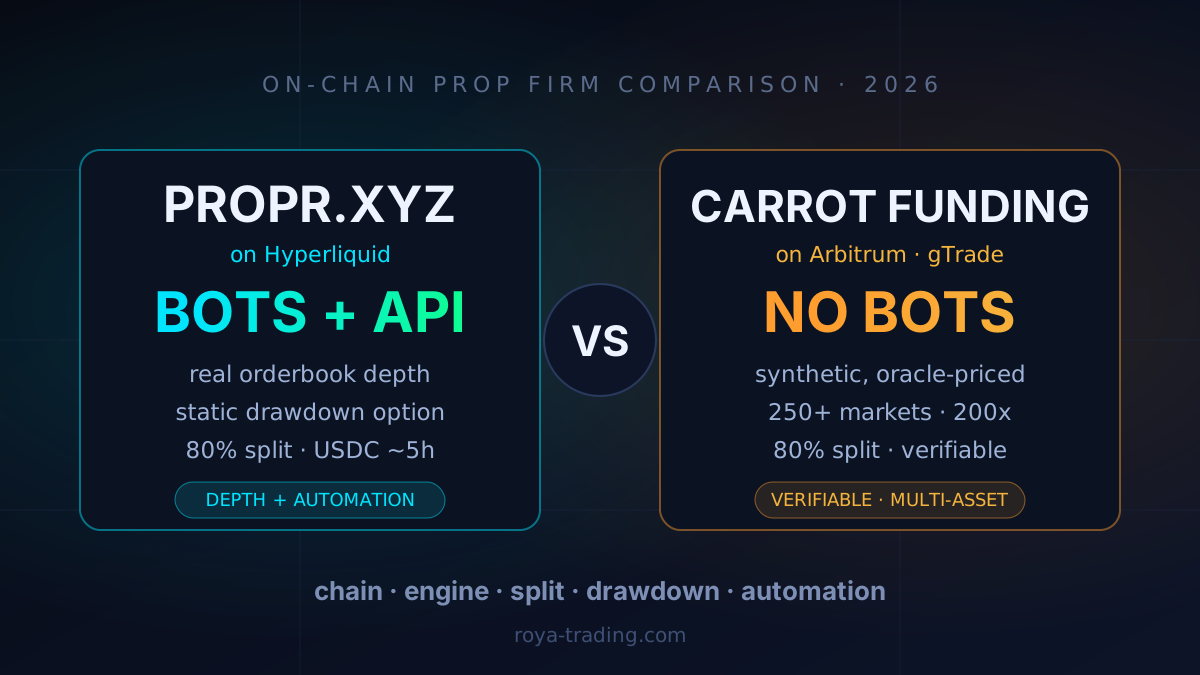
On 10 September 2026 we stopped reading about Carrot Funding and bought it. A 2-Phase $5,000 evaluation, paid in USDC on Arbitrum with our own money, traded the same day. That single purchase did two things: it produced the only measured fee verification in our whole comparison table — and it proved that four numbers we had published about Carrot were wrong. The correction comes first, because it is ours to make.
Correction — 10 September 2026
We published four wrong numbers about Carrot's 1-Phase. On 5 September 2026 this site listed the Carrot 1-Phase $5,000 at $65, with a 5% daily loss and a 10% maximum loss, and documented no consistency rule at all. All four were wrong. The configurator shown before payment, and §03 of Carrot's rulebook — public, no login required — both read $75, 4% daily, 8% maximum, and a Best Day Rule of 50% when we read them on 10 September 2026. We had copied the 2-Phase row onto the 1-Phase line and missed an entire rule. Carrot published these figures correctly, in the open, before payment. The error was ours. Nothing changed on the firm's side.
| Carrot 1-Phase $5,000 | What we published, 5 Sept 2026 | Rulebook §03, read 10 Sept 2026 |
|---|---|---|
| List price | $65 | $75 |
| Max daily loss | 5% | 4% ($200) |
| Max loss | 10% | 8% ($400) |
| Best Day Rule | Not documented | 50% |
Two consequences follow, and neither flatters us. First, Carrot's one-phase rulebook is tighter than we described it, not wider — we had been telling readers it gave more room than Propr, and it gives less. Second, we had written that Carrot charges the same fee per account size whatever structure you pick. It does not: the 1-Phase $5K is $75 against $65 for the 2-Phase. You choose a structure and a price.
Carrot's two formats, as the rulebook actually states them
All figures below read 10 September 2026 in §03, and cross-checked against the configurator shown before payment.
| Read 10 Sept 2026 | 2-Phase | 1-Phase |
|---|---|---|
| Profit target | 5% (Eval), then 8% (Verif) | 8% |
| Max daily loss | 5% | 4% |
| Max loss | 10% | 8% |
| Best Day Rule | None shown | 50% |
| $5,000 | $65 | $75 |
| $10,000 | $119 | $129 |
| $20,000 | $239 | $249 |
| $50,000 | $449 | $499 |
| $100,000 | $699 | $799 |
The account we bought applied exactly those numbers: a $250 profit target, a $250 daily loss limit and a $500 maximum loss on a $5,000 2-Phase. Configurator, public rulebook and live dashboard agreed line by line — which is more than most firms in this category manage, and it is worth saying plainly.
The short answer
Carrot Funding is the trade-by-hand firm with an honest execution cost and a rulebook that argues with itself. It runs on Hyperliquid, caps leverage at 5x on every asset class, bans bots and AI tooling outright, and charges you exactly Hyperliquid's own fee schedule with no markup — we measured it. Propr is the deep-liquidity, automation-friendly firm. Same order book, but a versioned rulebook, a public API, bots and copy trading explicitly allowed, and a static-drawdown format that a systematic strategy can actually encode. On our grid of 4 October 2026, Propr scores 87.7/100 and Carrot 73.2/100 — a 14.5-point gap, and most of it sits in two criteria: survival and trading freedom.
Same venue, and that changes the comparison
Carrot's configurator names its trading venue as Hyperliquid and its account chain as HyperEVM; payment and payouts run in USDC on Arbitrum (read 10 September 2026). Propr also settles on Hyperliquid. So the old framing — a real order book on one side, oracle-priced synthetic markets on the other — is gone. Both firms hand you the same book. What separates them is entirely what each rulebook lets you do on it.
The entity behind Carrot, named in the checkout terms we accepted before paying, is CTECHNOLOGIES GAMING DEVELOPMENT - FZCO, a UAE free-zone company. Those same terms describe the service as covering the minting, holding and transfer of NFTs — which is not decorative, as the next section explains.
Propr.xyz is a SwissBorg-backed firm with five account sizes (5K / 10K / 25K / 50K / 100K), published fees ($60–$999 for 1-Step, $50–$899 for 2-Step), and a rulebook (read on propr.xyz/rules on 10 September 2026) that spells out every limit: 1-Step with a 10% target, a daily loss of 3% of your start-of-day balance and a 6% static drawdown; 2-Step with 5% then 10% targets, a daily loss of 5% of your start-of-day balance and an 8% trailing drawdown. Payouts are USDC on-chain — $20 minimum, processed within 24 hours and about 5 hours on average per the public transparency page. Bots and copy trading are explicitly allowed, the REST API with Python/JS SDKs is official infrastructure, KYC only kicks in at funded, and the funded cap is $300K. Leverage is 5x on BTC/ETH, 2x on other crypto, 4x on stocks and commodities.
Head to head: the numbers
- Venue: both settle on Hyperliquid. Carrot's account chain is HyperEVM; its payments and payouts are USDC on Arbitrum.
- Profit split: both 80% trader / 20% firm.
- Account sizes: Carrot — $5K / $10K / $20K / $50K / $100K · Propr — $5K / $10K / $25K / $50K / $100K. Funded cap: $200K aggregate at Carrot, $300K at Propr.
- Formats: Carrot — 1-Phase (8% target, 4% daily, 8% max loss, Best Day Rule 50%) / 2-Phase (5% then 8%, 5% daily, 10% max loss, no Best Day Rule) · Propr — 1-Step (10% target, 3% daily, 6% static DD) / 2-Step (5% then 10%, 5% daily, 8% trailing DD).
- Fees: Carrot — 2-Phase $65–$699, 1-Phase $75–$799 (read 10 Sept 2026) · Propr — 2-Step $50–$899, 1-Step $60–$999.
- Leverage: Carrot — 5x maximum on every asset class, one mode only (§14) · Propr — 5x BTC/ETH, 2x alts, 4x stocks/commodities.
- Automation: Carrot — §23 forbids "automated software, high-frequency trading systems, AI-driven tools, or mass order entry systems"; no public API · Propr — bots, copy trading and a public REST API/SDKs explicitly allowed.
- Payouts: both USDC on-chain. Carrot — on demand, 100 USDC minimum, under 24h claimed, full amount only, no partial payout, trading disabled during processing, limits reset afterwards (§11) · Propr — $20 minimum, ~5h average, published.
- Execution cost: Carrot — Hyperliquid's schedule with no markup, measured at 0.04496% and 0.04497% per side on 10 Sept 2026 · Propr — see its own fee page; we have not run the same measurement there.
- Order routing: Carrot — A-book or B-book at the firm's discretion, trade by trade, disclosed in §22, with every trader labelled on their own dashboard · Propr — not disclosed in these terms.
- Extras: Carrot — no KYC requested at purchase (unverified at payout), transferable challenge NFT, Points season running · Propr — KYC at funded, SwissBorg-backed, public payout transparency, airdrop points.
What Carrot genuinely gets right — measured, not claimed
The "no markup" promise is exact. §17 says you pay Hyperliquid's standard maker/taker schedule and that Carrot adds nothing on top. That is an arithmetic claim, so we tested it on two round trips on the account we paid for:
| Read 10 Sept 2026 | Round-trip notional | Fees paid | Fees / notional |
|---|---|---|---|
| HYPE/USD, long | $9,786.60 | $4.40 | 0.04496% |
| ETH/USD, short | $10,606.40 | $4.77 | 0.04497% |
Hyperliquid's base taker rate is 0.045%. Two assets, two directions, matching to the fourth decimal. As far as we know no other comparison site has checked this, and Carrot passes it cleanly. The corollary belongs to you rather than to the firm, though: zero markup is not zero cost. A flat round trip still costs about 0.09% of notional — our ETH position opened at 2,475.90, closed at 2,475.45, and finished at −$3.49. On a 2-Phase $5,000 where the evaluation target is $250, that friction is the thing you have to beat before you have made anything at all.
The published payout hashes are real. Four hashes are published on Carrot's dashboard and all four verify on-chain as genuine Arbitrum USDC transfers — 733.22, 384.38, 399.24 and 799.41 USDC (the dashboard rounds down). Published hashes that actually settle are not the norm in this category.
The A-book / B-book split is disclosed outright. §22 states that Carrot routes orders to its own book or to the market at its sole discretion, trade by trade, with no control given to the trader — and that every trader is labelled A-booked or B-booked on their own dashboard. Most firms in this table simply decline to say. Carrot says it, and that deserves credit even though the arrangement itself is one you should price in.
Your challenge is a transferable NFT. After purchase the account is represented by an NFT, and the interface offers a recipient address field and a Send NFT button, stating that the receiving address can carry on trading. That cuts both ways, so here are both edges: the upside is that your account is an asset you hold rather than a revocable licence tied to a login; the downside is that a secondary market in accounts becomes possible, with resold "already passed" accounts and rule circumvention riding along with it. Nobody else documents this, in either direction. I rank the whole field in my decentralized prop firm guide, and go deeper on this firm in my full Carrot Funding review.
The correction we owe on the reserve, and what the size tells you
The reserve — and this paragraph is a correction of ours. For a few hours on 10 September 2026 this page said the vault promised by §19 could not be located. That was our reading failure, not a gap on Carrot's side, and we are publishing it rather than editing it away. Carrot's GitBook publishes a full address table with named roles — Vault Custody Contract, Vault Integrations, a 2-of-4 payout multisig and the EOA that executes the payouts. We had not read that page. Having read it we checked it the same day: the Vault Custody Contract on HyperEVM is a Safe holding about $15,016 in the Felix/Morpho USDC vault, plus $98 on HyperCore. Two limits on that reading, both of which belong here. Carrot states its funds are mid-migration from Arbitrum to HyperEVM, so what you can read is one contract on one chain on one day, not a firm total. And the $788,521 of "funding capital" on its Analytics page is not a reserve to compare it against: the firm told us it is an internal risk metric — the capital still free before it stops taking on new funded traders. Two different quantities, no gap to report. The address the four verified payouts leave is documented by Carrot itself as the payout executor, so describing it as a code-less wallet holding 607 USDC "against $788,521" was unfair, and that comparison is withdrawn from this site. Publishing which address does what, by name, is a strength — and it is one Propr matches with its own Address Directory.
The size. Carrot's Points page, read 10 September 2026, states 279 traders in total and a weekly prize pool of $69. A single $52 purchase put us third on the weekly board. That is not an accusation, it is a survival datapoint, and it is the single largest reason the score moved down rather than up after we paid. Propr, by contrast, publishes lifetime revenue against lifetime payouts and a measured challenge pass rate.
The ROFL badge. Carrot displays a "verified by OASIS" badge for its evaluation logic (§21). At our reading it is an image, with no link to a proof anyone can open. The claim of cryptographically verified rule maths therefore remains, on our side, unverified — we are recording what we could and could not check, not calling it false.
Does floating P&L breach you? We settled it on the paid account
Earlier on 10 September 2026 this article said Carrot's rulebook could not answer that question, because §05 applies equity limits to losses both realized and unrealized while the §24 cheatsheet calls Max Loss balance-based. We had the account, so instead of publishing the contradiction we tested it. Raphael opened two BTC/USD positions and we read the live dashboard against them. The charge did not survive its own test.
- Yes, floating P&L breaches you. With both positions open, the app tracked balance 4,986.169 and equity 5,054.693 as two separate live values — the 68.52 gap being the floating P&L — and its chart plots EQUITY in the same coordinate space as the two limit lines it draws, at 4,750 for max daily loss and 4,500 for max drawdown. The app tells you visually which of the two numbers is measured against the floor.
- The FAQ says it in words, before you pay. Public, no login: drawdown limits are "calculated based on equity, not balance, so open losing trades count toward your limits in real time", and a breach fires "the moment your equity hits" a limit, "even temporarily".
- The line that disagrees is a drafting defect, and we mispriced it. The §24 cheatsheet cell reading "Balance-based (does not include floating P&L)" describes how the limit level is set — from the balance high-water mark, per §07 — and misstates what crosses it. Three sources agree (§05, the FAQ, the app's own chart) and one summary cell is sloppy. We had charged Carrot for a trap; it is a typo, and the correction is published rather than edited away.
- And something we under-rated. The interface publishes the limits as absolute dollars, not percentages to interpret — "Max loss: $4,500.00", "High watermark: $5,000.00", "Max daily loss: $4,750.00" — with a countdown to the UTC reset. There is nothing to compute. That is the top of this criterion, not the bottom, and Carrot's rules score went up the same day on the strength of it.
What the test did not fix is the paperwork, and this is where the criticism now lives (all read 10 September 2026). The FAQ states Maximum Loss is 10% from your high-water mark with no 1-Phase exception, against 8% in §03 and §24 — the contradiction moved, it did not disappear. §15 still says Max Loss stays the same once funded while the §24 cheatsheet shows 8% becoming 10% on the 1-Phase. The FAQ's forbidden-practice list adds copy trading and hedge trading, neither of which appears in §23 — two documents, two lists. The dashboard carries a "verified by OASIS" badge while the FAQ describes the firm as "integrating" ROFL. And on the same screen the chart is equity-based while the Objectives counter is balance-based: it read "Max loss $13.83 of $500.00", which is 5,000 − 4,986.169, at a moment when equity stood at 5,054.693 — above the starting balance, consuming nothing.
So the honest comparison is narrower than the one we published this morning. On what breaches you, both firms are now clear: Carrot measures equity, floating included, and puts the floor on your screen in dollars; Propr's 1-Step is a 6% static floor under your starting balance that never moves, and its 2-Step an 8% trailing drawdown that locks at your starting balance. Where Propr keeps a real advantage is documentary consistency — one versioned rulebook with a changelog, against three Carrot documents giving different numbers and different lists of forbidden practices. I broke down why the drawdown format decides most challenges in trailing vs static drawdown, and the format maths in my 1-Step vs 2-Step breakdown.
Resolved 11 September 2026 — the account answered the question by dying
On 10 September 2026 this section ended on an admission: we had not tested what the balance-based Objectives counter displays while a position floats at a loss, and we refused to infer it. The evaluation answered it the same evening by breaching on the daily limit. Read on 11 September, the dashboard carries the whole sequence — two BTC/USD longs at 5x, no stop loss, about $24,930 of notional on a $5,000 account, held overnight. BTC moved roughly 1.1% against them. Both were force-closed at 19:30:42 at the same price, 77,420.0, and the day closed 4 trades at −$288.78: $5,000 → $4,711.22.
The chart is the proof. The balance stayed flat at 4,986.169 the entire way down, while equity fell 5,054.693 → 5,018.706 → 4,922.21 → 4,917.752 → 4,879.217 → 4,839.727 → 4,836.86, then dropped vertically to 4,711.225 on the forced close. The realized balance never moved more than $13.83. It is the equity that crossed 4,750 — exactly as §05 and the FAQ say, and exactly against what the §24 cheatsheet cell says. Our 10 September reading is confirmed end to end.
Two further facts, both observed. The daily floor sat at 4,750 and the account settled at 4,711.22 — $38.78 through the stated limit, the forced close slipped past it. And the Max loss counter stopped at $288.78 of $500.00, so $211.22 of the total drawdown budget was never used: on this product it is the daily limit that ends accounts, not the total.
What the Objectives counter would have shown — derived, not photographed. We have no capture of the counter mid-drawdown, so this is arithmetic and we label it as such. The counter reads 5,000 minus the balance, and the balance was frozen at 4,986.169, so it would have displayed $13.83 of $500.00 while equity sat at 4,836.86 — roughly $87 from death. Derived rather than photographed, and stated that way on purpose.
Attribution, because it decides how this is written: the breach is ours, not Carrot's. No stop loss was set and 5x of notional was carried overnight. The engine enforced a published rule correctly, and the interface showed the floor in absolute dollars on screen the whole time. Nothing here is scored against the firm, and the score does not move: 73.2/100, grid of 4 October 2026. What is reported, in figures and without adjectives, is the screen that follows a breach: "Challenge Failed", then 15% off a new challenge behind a countdown reading 10:16:12.
Where Propr wins: automation, and a rulebook that agrees with itself
Automation is the clean dividing line. Carrot's §23 forbids "automated software, high-frequency trading systems, AI-driven tools, or mass order entry systems", and there is no public API to use even if it did not. §12 of the same rulebook is genuinely permissive on paper — no time limit, no minimum trading days, no stop-loss requirement, weekend and news trading allowed — but a firm cannot headline trading freedom and ban automation in the same document. Propr does the exact opposite: bots and copy trading are explicitly allowed, so you can run a disciplined DCA strategy with hard guardrails on your own account, non-custodial, through the official Propr API. If you care which firms actually permit bots, I keep a running breakdown in best prop firm for trading bots & API.
Leverage is the other ceiling we had missed. Carrot caps at 5x across every asset class, with a single "Normal" mode and nothing else offered on 10 September 2026. On the $5,000 account we bought, that showed up as a maximum position size of $25,000. Propr's caps are tiered rather than flat — 5x on BTC/ETH, 2x on other crypto, 4x on stocks and commodities — so on majors the two are level, and Carrot is not the high-leverage option we once described.
And payouts behave differently in practice. Carrot pays on demand from 100 USDC, in USDC on Arbitrum, under 24 hours per §11 — but the request takes your whole balance above the starting figure, with no partial withdrawal available, trading disabled while it processes, and your risk limits reset once it lands. Propr lets you take $20 and carry on. If you like drawing small and often, that difference matters more than the shared 80% headline. The long version of my Propr case is in my Propr.xyz review.
One practical warning from the checkout. Before taking payment, Carrot's app requested an unlimited USDC approval on Arbitrum (10 September 2026). Plenty of dApps do this and it is not specific to Carrot, but an unlimited approval lets a contract move all the USDC in that wallet, for as long as it stands. Pay from a dedicated wallet, or revoke the approval afterwards.
The verdict
Pick Carrot Funding if you trade fully discretionary, want a transferable account NFT, no KYC at the point of purchase, and an execution cost you can verify to the fourth decimal — that last one is real, and we checked it ourselves. One thing you do not need to worry about, because we tested it on the paid account: the drawdown limits run on equity, floating losses included, and the app shows you the floor in dollars. Go in knowing the three things that cost us instead: leverage is capped at 5x everywhere, automation and AI tooling are banned outright, and the firm's three documents still disagree with each other — the FAQ puts Maximum Loss at 10% of your high-water mark where §03 and §24 say 8%, and bans copy and hedge trading where §23 does not. Add a firm with 279 traders on its own Points page, and you are buying a small operation whose payment rail is proven, whose address table is published by name, and whose on-chain picture is still partial while its funds migrate from Arbitrum to HyperEVM.
Pick Propr if you want a rulebook whose numbers you can compute before you pay, a static drawdown option, a $20 payout minimum and the right to automate or copy-trade. It scores 87.7/100 against Carrot's 73.2/100 on our grid of 4 October 2026, it is the firm I run my own money and my own bot on, and my overall #1 in the best decentralized prop firms ranking. You can create your Propr.xyz account here — through that link you get 5% USDC cashback on your challenge fee, which takes a $50 2-Step down to $47.50 net. Prefer another matchup? See Propr vs Solana Funded, or Propr vs FundingPips if you want the on-chain firm measured against a big traditional CFD prop.
Affiliate link. We earn a commission; it never changes what you pay — it is what funds your cashback.
FAQ — Propr vs Carrot Funding
What's the main difference between Propr and Carrot Funding?+
Not the venue, which is where this comparison used to be wrong. Both firms settle on Hyperliquid, the deepest on-chain perps order book in 2026; Carrot's configurator names Hyperliquid as the trading venue and HyperEVM as the account chain, with payments and payouts in USDC on Arbitrum (read 10 September 2026). The difference is the rulebook. Propr publishes a versioned rulebook, allows bots and copy trading, ships an official REST API and offers a 6% static drawdown on its 1-Step. Carrot caps leverage at 5x on every asset class (§14), forbids 'automated software, high-frequency trading systems, AI-driven tools, or mass order entry systems' (§23), and spreads its own rules across three documents that disagree — its public FAQ puts Maximum Loss at 10% of your high-water mark where §03 and §24 both say 8%, and bans copy trading and hedge trading, neither of which appears in §23 (all read 10 September 2026). Both pay an 80% split in USDC.
Do Propr and Carrot Funding have the same profit split?+
Yes — both pay funded traders 80% of net profits and keep 20%. Carrot caps funded capital at $200,000 aggregate against $300,000 at Propr. The practical gaps are in the payout mechanics: Carrot's minimum is 100 USDC against $20 at Propr, and Carrot pays the full balance only — there is no partial payout, trading is disabled while a request is processed, and risk limits reset afterwards (rulebook §11, read 10 September 2026). Propr publishes an average payout time of about 5 hours on its transparency page.
Can I run a trading bot on Carrot Funding?+
No, and that is the cleanest dividing line for a systematic trader. Carrot's rulebook §23 lists 'automated software, high-frequency trading systems, AI-driven tools, or mass order entry systems' among forbidden practices, and there is no public trading API. Propr is the opposite: bots and copy trading are explicitly allowed and it ships an official REST API with Python/JS SDKs, so a systematic strategy is inside the rules rather than a loophole.
Which has the clearer drawdown rule?+
Both are clear on what breaches you, and we had this wrong earlier the same day. We settled Carrot's on the account we paid for: with two BTC/USD positions open on 10 September 2026 the dashboard tracked balance 4,986.169 and equity 5,054.693 as separate live values, and its chart plots EQUITY in the same coordinate space as the limit lines it draws at 4,750 and 4,500. The public FAQ, readable before purchase and without a login, says it in words: drawdown limits are 'calculated based on equity, not balance, so open losing trades count toward your limits in real time', and a breach fires 'the moment your equity hits' a limit, 'even temporarily'. So yes — floating P&L breaches you — and the app prints the floor in absolute dollars, 'Max loss: $4,500.00' and 'Max daily loss: $4,750.00', with a countdown to the UTC reset. Nothing to compute. The one line that disagrees, the §24 cheatsheet cell reading 'Balance-based (does not include floating P&L)', describes how the limit LEVEL is set — from the balance high-water mark, per §07 — and misstates what crosses it. That is a drafting defect in a summary table, and we had priced it as a trap. Propr's remaining edge is consistency rather than clarity: one versioned rulebook with a changelog, and a 1-Step whose 6% static floor under your starting balance never moves, against three Carrot documents that still put Maximum Loss at 10% (FAQ) and 8% (§03, §24).
Is Carrot Funding legit?+
We bought a 2-Phase $5,000 evaluation with our own money on 10 September 2026 and traded it, so this is no longer desk research. What checks out: all four payout hashes published on its dashboard settle on-chain as real Arbitrum USDC transfers, and its 'no markup' fee claim measured exactly right on two round trips (0.04496% and 0.04497% against Hyperliquid's 0.045% base taker rate). Its GitBook also publishes a full address table with named roles — Vault Custody Contract, Vault Integrations, a 2-of-4 payout multisig, the payout executor EOA — which we had missed and then checked the same day: the custody Safe on HyperEVM held about $15,016, with funds stated to be mid-migration from Arbitrum to HyperEVM. What does not check out is documentary: §20 and the FAQ both say every challenge is minted as its own NFT, and it is — challenge #3955 is token #550 of the Funded Bunny Initiative collection on Arbitrum — but nowhere do they document that the token ID is not the challenge ID, and the firm told us clarifying it 'wasn't our priority'. It is also a small operation: its Points page states 279 traders in total and a $69 weekly prize pool.
Which should I pick in 2026?+
Pick Carrot Funding if you trade fully by hand, want a transferable challenge NFT, no KYC at purchase, and an execution cost you can verify to the fourth decimal. Pick Propr if you automate, want a static drawdown floor, a $20 payout minimum and a rulebook whose numbers you can compute yourself. On our grid of 4 October 2026, Propr scores 87.7 and Carrot 73.2 — a 14.5-point gap, most of it in survival and trading freedom. I trade systematically, so it is Propr.
Trade the one that allows automation.
Propr allows bots and copy trading and publishes an official REST API with Python and JS SDKs. Carrot Funding forbids automated software in its rulebook §23 and has no public trading API.
Create your Propr.xyz accountYou can also claim 5% USDC cashback on your challenge fee.
Affiliate link. We earn a commission; it never changes what you pay — it is what funds your cashback.
⚠️ Trading carries risk. Carrot Funding figures come from its public rulebook, its pre-payment configurator and the paid account we traded, all read on 10 September 2026; the fee, payout-hash and Points readings are ours, dated the same day, and are a snapshot rather than a live feed. We paid $52 for a $65 list-price evaluation using our own referral code, a 20% discount valid at that date. Propr figures come from the published rulebook, read on 10 September 2026. Terms can change, so verify both on each firm's own site before paying any fee. Challenge fees are non-refundable and funded accounts are simulated. Nothing here is a guarantee of any outcome. This article is informational, contains affiliate links to Propr, and is not investment advice. Only trade what you can afford to lose.