
Almost every conversation I have about failed challenges is about entries. When did you get in, was the setup clean, did you chase. Almost none of them are about the decision that was made ten seconds earlier and never examined: which market am I doing this in. That decision sets the range you're exposed to, the slippage you'll eat, the funding you'll carry and the leverage you're allowed — before a single order exists. Pair selection is upstream of everything, and it's treated as an afterthought because picking BTC feels like admitting you have no edge.
The short answer
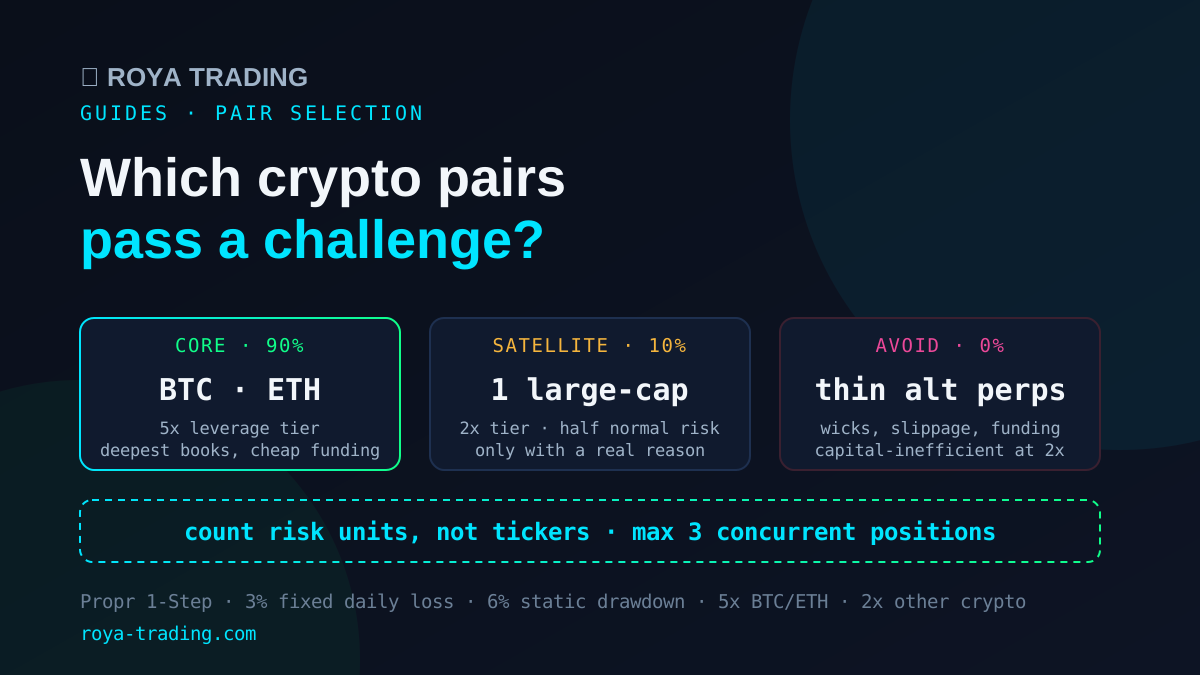
One: BTC and ETH perpetuals should carry the large majority of your challenge volume, with at most one or two deep large-caps for the remainder. Two: Propr's leverage tiers — 5x on BTC/ETH (side panel and changelog; the §12 table on the same page says 10x — unreconciled as of our reading on 12 September 2026), 2x on other cryptos, 4x on stocks, 8x on gold, silver, CL and Brent — are the firm publishing its own liquidity risk ranking, and it's worth reading as advice rather than as a restriction. Three: the real cost of an altcoin isn't the leverage cap, it's that honest sizing against a 3% daily loss shrinks the position until it can't move your target. Four: correlation, not ticker count, is what actually diversifies — five alt longs are one crypto-beta position. Five: if you hold overnight, funding is part of the pair decision, not a rounding error. Here's the reasoning behind each.
The leverage tier is the firm showing you its homework
Answer first: a leverage cap is a liquidity judgement, and Propr has already made it for every market on the platform.
Traders read leverage tiers as a permission system — how much rope am I allowed. That misses what the number is for. A risk desk sets the cap at the point where it believes it could still unwind a stressed position without the exit itself causing the loss. BTC and ETH perps have order books deep enough to absorb meaningful size during a liquidation cascade. A mid-cap altcoin perp, in the same fifteen seconds, has a book that thins out to nothing and prints multi-percent slippage on a single market order.
So the tiers are a published ranking: 5x on BTC/ETH (side panel and changelog; the §12 table on the same page says 10x — unreconciled as of our reading on 12 September 2026), 2x on other cryptos, 4x on equities, 8x on gold, silver, CL and Brent. The firm is telling you, in the only language it has on an order ticket, which markets it thinks break under pressure. You can disagree, but you're disagreeing with people whose job is to model exactly this. I go into what the 5x cap does and doesn't mean for your actual risk in crypto prop firm leverage explained — the short version is that the cap constrains margin efficiency, while your stop distance constrains risk, and confusing the two is the most common sizing error I see.
There's a second-order effect people miss. At 2x, taking a position with the same dollar risk as a BTC trade requires committing substantially more margin, because you need more notional to express the same idea and less leverage to fund it. On a 5K or 10K account, two altcoin positions can lock up enough margin that you have nothing left for the setup that actually shows up on Thursday. The cap doesn't just limit the trade — it limits the trades that come after it.
Volatility versus a 3% line: the arithmetic nobody runs
Answer first: size an altcoin honestly against a daily loss line and it becomes too small to matter; size it dishonestly and it ends the account.
Take the Propr 1-Step on a $10,000 account. Daily loss is 3% of your start-of-day balance, snapshotted at 00:00 UTC and recomputed daily — $300 on day one; the breach itself is measured on equity, floating P&L included (read 10 September 2026). Max drawdown is 6% static — $600, a line at a number that never moves. Suppose your risk budget per trade is 0.5%, so $50, and your stop is placed at a distance that respects the asset's normal noise rather than your preferred entry.
On BTC, a stop that survives ordinary intraday chop might sit around 1.5% away. Fifty dollars of risk over a 1.5% stop is roughly $3,300 of notional — comfortable at 5x, which needs about $660 of margin. Now the same trade on a volatile mid-cap where honest noise is 4%: $50 of risk over a 4% stop is $1,250 of notional. At the 2x cap that's $625 of margin — similar margin, less than half the notional, for an asset that needs a much bigger move to produce the same dollar profit. You are paying comparable margin for a position that has to be right by a wider margin to earn the same amount.
That's the trap in one paragraph. The altcoin isn't forbidden and it isn't unprofitable — it's capital-inefficient under prop firm constraints, which is a different and much more boring problem than the one people argue about. And the way traders resolve it is almost always to skip the stop-widening step, keep the notional the same as they'd use on BTC, and discover during one bad hour that a 4% adverse move on full size is most of the daily line. The full sizing framework is in position sizing for prop firm challenges, and what the daily line actually does to a run is in the daily loss limit.
Spread and slippage: the tax you pay per round trip
Answer first: execution cost scales inversely with book depth, and on a 10% target it compounds across every trade you take.
Every entry and exit costs you the spread plus whatever slippage your order size causes. On the deepest perp books that cost is close to negligible per trade. On thinner markets it isn't, and it's worst at precisely the moment you most need to act — during fast moves, when the resting liquidity that made the book look fine has already been pulled.
Now compound it. Suppose an evaluation takes you forty round trips. A difference of a few basis points per round trip between a major and a thin alt is a percent or more of account equity across the challenge — a tenth of your entire 10% target, spent on execution rather than on being right. It's an invisible cost because it never appears as a losing trade; it appears as winners that are slightly smaller than they should have been, forever. I broke down the whole cost stack, including funding and fee tiers, in trading fees, funding and slippage.
There is also a specific mechanical hazard on thin books: the wick. Illiquid perps regularly print candles that trade several percent through the resting book on a liquidation cascade and recover within a minute. Your stop doesn't know it was a wick. Worse, if your drawdown is evaluated on equity rather than balance, an unrealised spike can touch a limit before you've closed anything at all. Deep books wick less. That's not a style preference, it's the failure mode you're buying protection from.
Correlation: why five tickers can be one position
Answer first: during a directional session, most crypto is a leveraged expression of BTC, and your daily loss limit sums across all of it.
This is the diversification illusion and it catches experienced traders too. You're long four alts and one ETH position, feeling spread out. BTC drops 4% on a macro headline. Every one of your five positions goes red simultaneously, several of them by more than BTC did, because altcoin beta to BTC in a drawdown is routinely above one. What looked like five 0.5% risks was one 3%+ risk, and 3% is the entire 1-Step daily line.
My rule is to count risk units, not tickers. Anything in the same direction on correlated crypto majors counts as one unit for sizing. Three concurrent positions is my hard ceiling during an evaluation, and if two of them are the same directional bet in different costumes, I halve both. This is genuinely where equities and commodities earn their place — a gold or index position at Propr's 4x tier is one of the few things on the platform that isn't secretly another BTC long. The cost is that they keep sessions and can gap, which is a real problem on a hard daily line, and it removes the 24/7 property that makes crypto workable around a job — see weekend trading on a crypto prop firm. Pair depth also interacts with the clock: the same alt book that looks acceptable during the London-NY overlap is a different instrument at 04:00 UTC, which I broke down in the best time of day to trade a crypto prop firm challenge.
Funding: the cost that scales with your holding period
Answer first: funding is charged for as long as you hold, so pair choice matters more the slower your method is.
Perpetual funding is the mechanism that keeps a perp tethered to spot: when longs are crowded, longs pay shorts, and vice versa. On Hyperliquid it accrues continuously and settles hourly, which means a position carried across two days pays dozens of times rather than a couple. During a hot narrative, funding on the crowded side of a mid-cap perp can run at a multiple of what a major costs — and you're paying it in the direction everyone else already is, which is also the direction most exposed to a flush.
If you scalp, ignore this. If you use a laddered entry, you can't: a DCA structure is explicitly a longer-hold method, and the whole logic of scaling into weakness assumes the asset mean-reverts within a window you can afford to fund. That assumption is reasonable on BTC and ETH. On a low-float token in a liquidation spiral it is not — the ladder just fills faster on the way down into an asset with no bid. This is the single strongest reason my own ladders run on majors, and I laid out the full method in DCA for prop firm challenges.
My actual allocation on a live challenge
Answer first: roughly 70% BTC, 20% ETH, 10% one rotating large-cap, and nothing else during an evaluation.
Not because I think BTC is the best trade available on any given Tuesday. Because a challenge is a constrained optimisation problem, not a search for the biggest move. I need a 10% return without ever losing 3% in a day or 6% in total, and the asset that maximises my chance of doing that is the one whose behaviour I can model, whose fills match the price I clicked, whose funding is cheap, and that lets me express size at 5x without consuming all my margin.
The rotating third slot is where I allow myself an opinion — a single deep large-cap, usually SOL, sized at half my normal risk, and only when there's an actual reason rather than a chart that looks exciting. Once I'm funded, that constraint loosens somewhat, because the arithmetic changes when you're managing a payout stream instead of clearing a target; what changes and what doesn't is in what actually happens after you pass. During the evaluation, though, the boring allocation is the correct one, and the reason 90% of people don't use it is the same reason 90% of prop firm traders fail: boredom is a worse feeling than losing, right up until you lose.
One rules note that shapes all of this: Propr permits bots, API access and copy trading outright, which is what makes a mechanical allocation enforceable rather than aspirational. Hypernova — the other Hyperliquid-native firm, public since 14 August 2026 — used to ban third-party copy trading under §14.2 of its closed-alpha rulebook; its public rules, read 16 August 2026, list no bot restrictions, but with no turnkey tool there the same approach takes your own build. Same chain, compared line by line in Propr vs Hypernova, and the broader model on the pillar page: decentralized prop firms explained.
Verdict
Pair selection isn't a style question during an evaluation, it's a constraint question. The firm hands you a 3% daily line, a 6% floor and a leverage tier that ranks markets by how badly they break. Trade the top of that ranking, keep concurrent risk units at three or fewer, count correlation instead of tickers, and price funding into anything you hold overnight. That allocation will not produce a screenshot worth posting. It will produce a pass, which is the only thing the challenge is actually scoring.
FAQ — Choosing crypto pairs for a prop firm challenge
What are the best crypto pairs to trade during a prop firm challenge?+
BTC and ETH perpetuals for the large majority of your volume, plus at most one or two of the deepest large-cap alternatives — SOL is the usual third — for the rest. Three reasons stack in the same direction. Liquidity: the BTC and ETH books on Hyperliquid are the deepest available, so your fills sit closest to the price you saw. Leverage tier: Propr allows 5x on BTC/ETH (side panel and changelog; the §12 table on the same page says 10x — unreconciled as of our reading on 12 September 2026) and 2x on other cryptos, which is the firm's own risk department telling you where it sees tail risk. Volatility budget: a 3% daily loss on the 1-Step — 3% (1-Step) / 5% (2-Step) of your start-of-day balance, snapshotted at 00:00 UTC and recomputed daily, with the breach measured on equity, floating P&L included — is a small line, and an asset that can move 15% in an hour forces a position so small it can't meaningfully progress a 10% target. Boring pairs pass challenges; exotic pairs generate stories.
Why does Propr give 5x on BTC and ETH but only 2x on other cryptos?+
Because leverage caps are a liquidity statement, not a generosity statement. A firm sets the cap where it believes it could still exit a position in a stressed market without catastrophic slippage. BTC and ETH perps have order books deep enough to absorb size during a cascade; a mid-cap altcoin perp does not, and a forced liquidation there can print several percent of slippage in a single fill. So the tiers — 5x on BTC/ETH (side panel and changelog; the §12 table on the same page says 10x — unreconciled as of our reading on 12 September 2026), 2x on other cryptos, 4x on stocks, 8x on gold, silver, CL and Brent — are effectively a published risk ranking. Read it as free information: the firm has already done the analysis of which markets break, and it's showing you the answer on the order ticket.
Can I trade altcoins at all on a prop firm challenge?+
Yes, they're permitted — this is a sizing question, not a rules question. Propr's rulebook doesn't restrict which listed markets you touch; it restricts leverage by category and enforces the daily loss and drawdown lines regardless of what you traded. The practical constraint is that an altcoin's realistic adverse move is two to four times a major's, so honest sizing means cutting your position notional by the same factor. Once you do that, the trade has to be dramatically better than a BTC trade just to contribute the same dollars to your target. That's a high bar, and most people skip the sizing adjustment rather than clear the bar — which is how altcoins acquire their reputation for ending challenges.
How many crypto pairs should I trade at once during an evaluation?+
One to three positions, and count correlation rather than tickers. Five long altcoin positions during a risk-on session are not five independent bets — they're one leveraged long on crypto beta wearing five costumes, and when BTC drops 4% they all move together into the same daily loss line. I cap myself at three concurrent positions and treat anything in the same direction on correlated majors as a single risk unit for sizing purposes. The daily loss limit does not care how diversified your ticker list looked on the way in.
Do funding rates matter when choosing pairs for a challenge?+
More than most traders expect, and they scale with how long you hold. On Hyperliquid, perpetual funding accrues continuously and is paid hourly, so a position carried across two days pays many times. Crowded altcoin longs during a hot narrative can run at funding rates several times a major's, which quietly bleeds a percent or more of equity over a multi-day hold — against a 10% target, that's a real tax. Majors are usually cheaper to carry simply because both sides of the book are active. If your method holds positions overnight, and a DCA ladder usually does, funding belongs in the pair decision.
Should I trade stocks or commodities on a crypto prop firm?+
They're available on Propr — stocks at 4x, gold, silver, CL and Brent at 8x, other commodities at 5x (read 12 September 2026) — and they're a legitimate diversifier for a specific reason: their drivers aren't crypto beta, so an equity or gold position isn't secretly another BTC long. The trade-off is session structure. Crypto perps run 24/7, which is the whole reason a semi-automated approach works around a day job; traditional markets keep sessions and can gap over a weekend or an announcement, and a gap is exactly the event a stop-loss cannot protect you from on a hard daily loss line. I use them sparingly and never carry one over a weekend during an evaluation.
Does pair selection change between the 1-Step and 2-Step challenge?+
It should, because the binding constraint is different. The 1-Step pairs a 3% daily loss — 3% of your start-of-day balance, snapshotted at 00:00 UTC and recomputed daily, with the breach measured on equity, floating P&L included — with a 6% static drawdown — a floor at a fixed number that never moves, so what you're managing is the daily line, and majors with predictable ranges suit that best. The 2-Step gives you a looser 5% daily loss but an 8% trailing drawdown that follows your equity high-water mark upward, stopping only once it reaches your starting balance. Trailing punishes give-back specifically: a volatile alt that hands you 4% then takes it away can breach you while you're still net-positive on the challenge. If you're on the 2-Step, weight toward majors even harder.
Pick the trade. Let the execution be mechanical.
Semi-auto is the model that works: you choose the pair and the direction, a bot on the official API lays the DCA ladder and commits the take-profit and stop-loss before you walk away. Runs on your own Propr account, non-custodially.
Get 5% USDC cashbackNot on Propr yet? Create your Propr.xyz account with 5% USDC cashback.
Affiliate link. We earn a commission; it never changes what you pay — it is what funds your cashback.
⚠️ Trading carries risk. Propr figures (leverage tiers, 3% and 5% daily loss, 6% static and 8% trailing drawdown, 80% split) come from the published rulebook and can change; Hypernova figures come from its own published rulebook v1.0. Volatility, spread and funding figures are illustrative orders of magnitude from my own trading, not quoted market data — check live conditions before sizing anything. Nothing here is guaranteed and past performance does not predict future results. This article is informational and not investment advice. Do your own research and only trade what you can afford to lose.