
Every article about prop firms — including most of mine — obsesses over one moment: the pass. Hit the target, don't touch the floors, get the confetti. Then the content stops, as if a funded account were a trophy you put on a shelf. It isn't. It's a different game with the same board, and most traders walk into it with the wrong instincts: they size up because "it's real money now", they stop respecting the daily loss because "there's no target to race", and they hand the account back within weeks. I've passed Propr.xyz challenges, swept payouts, and yes — lost a funded account too. This is the article I wish I'd read the day I passed my first one: what activates, what carries over, how the first payout really works, and the habits that decide whether your funded account lasts three weeks or a year.
The short answer
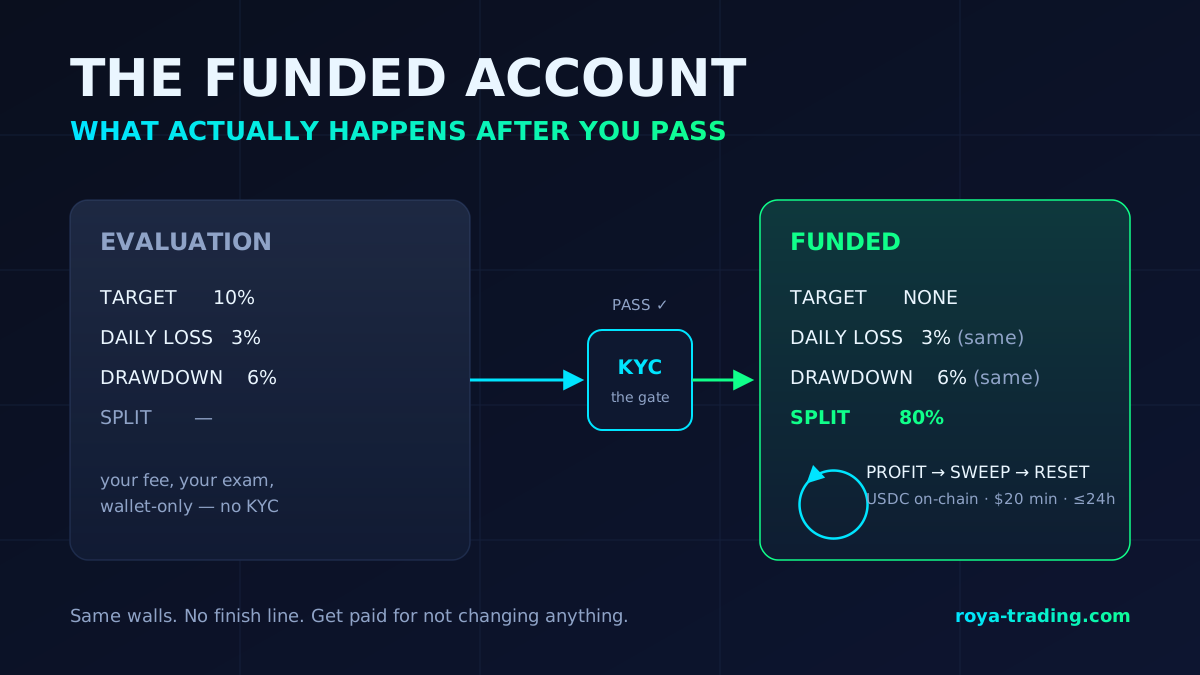
On Propr.xyz, passing doesn't hand you capital — KYC does. Verify your identity, and the funded account activates with the same limits you just traded under: same daily loss, same max drawdown, same leverage caps. Two things change: the profit target disappears, and an 80% profit split appears, withdrawable on demand in USDC from $20, with each payout sweeping your profit and resetting the account to its starting point. The trader who wins this phase isn't the one who suddenly trades bigger — it's the one who keeps trading like it's day one of the challenge, forever, and banks the difference on a schedule.
Affiliate link. We earn a commission; it never changes what you pay — it is what funds your cashback.
Step zero: KYC is the gate, not the trade
The entire Propr evaluation is wallet-only — you can buy, trade and pass a challenge without ever showing an ID. The funded account is where that ends: no verification, no capital, no payout. The check itself is unremarkable — document plus liveness, usually minutes — but its timing is the first real decision of your funded life. KYC is available in your dashboard settings from day one, and doing it while the challenge is still running means your funded account activates the moment you pass instead of sitting in limbo while a verification queue decides your week.
Two practical warnings from the trenches. First, the restricted-countries list (Russia, about 30 listed countries and OFAC jurisdictions — US and UK residents have been accepted since 27 July / 4 August 2026) is enforced at KYC — if you bought an evaluation from a restricted jurisdiction hoping a VPN would carry you, this is where that plan dies, fee included. Second, verify with your own documents on your own account: funded accounts are personal, and "borrowed" KYC is the kind of shortcut that costs a funded seat later. The sign-up walkthrough covers the full flow if you're not there yet.
What carries over — and what disappears
The funded account is not a fresh rulebook. It's your evaluation's rulebook with the target removed and the split added:
| Rule | Evaluation | Funded account |
|---|---|---|
| Profit target | 10% (1-Step) · 5% then 10% (2-Step) · 9% (Turbo) | None |
| Daily loss limit | 3% (1-Step/Turbo) · 5% (2-Step) of start-of-day balance, snapshot 00:00 UTC, recomputed daily; breach measured on equity (read 10 September 2026) | Same — carries over |
| Max drawdown | 6% static (1-Step) · 8% trailing (2-Step) · 3% static (Turbo) | Same — carries over |
| Profit split | — | 80% to you |
| Payouts | — | On-demand USDC, $20 min, ≤24h |
| Leverage | 5x BTC/ETH (side panel and changelog; the §12 table on the same page says 10x — unreconciled as of our reading on 12 September 2026) · 2x other crypto · 4x stocks · 8x gold/silver/CL/Brent · 5x other commodities | Same |
| Bots, copy trading, API | Allowed | Allowed |
| Time limit / min. days | None | None |
Read that middle column twice, because it kills the most common funded-account fantasy: "once I'm funded, I can breathe." You can't — the walls that could end your challenge can still end your funded account, on the same terms, floating P&L included. If the mechanics of equity floors and 00:00 UTC daily snapshots aren't automatic for you yet, the full rules breakdown is the prerequisite reading. What you've actually earned by passing is time: with no target and no deadline, you are never again forced to take a trade. The firm can wait forever, and now, so can you.
The 2-Step detail that ambushes funded traders
If you passed a 2-Step evaluation, your funded account lives under the 8% trailing drawdown — and trailing means it follows your funded equity peak exactly as it followed your evaluation peak. Run the account from $100,000 to $106,000 without sweeping, and your floor is no longer $92,000; it has climbed to $98,000 (and it stops rising once it reaches your starting balance — from then on it behaves like a static floor at breakeven). The ambush: a trader sitting on $6,000 of unswept profit feels rich and safe, while his actual room to the floor is the same 8% it always was — unrealized profit is not a cushion, it's bait. A payout resets the geometry: balance back to start, floor back below it. I wrote up the full mechanics in trailing vs static drawdown — on a funded 2-Step it's not theory, it's the difference between sweeping monthly and donating your account back net-positive.
Your first payout — and the reset that follows
This is the part nobody explains properly, so here it is with no mystique. On a funded Propr account you accrue profit normally; whenever your share is at least $20, you can request a payout — any day, no funded-days minimum, no payout calendar. The request is processed within 24 hours (around five hours on average, in my experience) and lands as USDC on-chain, on a transaction anyone can verify. That verifiability is half the reason I trade decentralized prop firms in the first place: payout proof isn't a Trustpilot screenshot, it's a block explorer.
The mechanic to internalize: every payout is a full sweep. There are no partial withdrawals — the firm pays out all available profit at once, your balance returns to the starting amount, and your drawdown floors reset with it. On a $25K account that made $2,400: you receive $1,920 (80%), the account restarts at $25,000, and your loss budget is whole again. The sweep is a feature, not a haircut — profit on the books can still be lost to the floors; profit in your wallet cannot. Sweeping is how you convert paper edge into money that is mathematically out of the game. Full numbers, timings and edge cases live in the payout guide.
Sweep or compound, then? Compounding inside the account means your profit works a bigger base — and stays exposed to a single bad day. My rule is boring and I've never regretted it: let profit build to a meaningful sweep (2–4% of the account), then take it, every time. On a Turbo-funded account with its 3% static floor, sweep even earlier — the $20 minimum makes small, frequent sweeps viable, and Turbo's fragile funded seat is exactly where you want profit off the table fast.
The five ways traders lose funded accounts
The funded phase has its own failure modes, and they're more psychological than technical. The pattern behind all five: treating "funded" as a status upgrade instead of the same job with better pay.
- 1. Sizing up on arrival. "It's real capital now" convinces traders to double risk the week they get funded. But the floors didn't double — the sizing that passed your challenge is the sizing the funded account tolerates. If 0.5% risk per trade got you here, 0.5% is what keeps you here.
- 2. Trading more because there's no target. The deadline pressure is gone, and some traders replace it with volume — filling quiet days with C-grade setups because the account is "just sitting there". The account sitting there is the asset. No target means you never have to trade; act like it.
- 3. Hoarding unswept profit. Especially lethal on a trailing floor (see above), but bad everywhere: booked profit left in the account is still at risk. Traders who lose a funded account at +4% unswept didn't lose 4% — they lost a payout they'd already earned and refused to take.
- 4. Revenge after the first funded red day. The first big loss on the firm's capital stings differently, and the urge to "make it back today" runs straight into the same daily loss limit that ends challenges. A red day on a funded account is a scheduling problem, not an emergency: tomorrow resets the daily budget; forcing it tonight can end the seat.
- 5. Forgetting the account is replaceable — in the wrong direction. Losing a funded account isn't catastrophic (your swept payouts are safe, and a new evaluation costs a known fee), but traders who internalize "I can always re-pass" start treating the funded account like a lottery ticket. The correct frame: the account is a cash-flow asset. You don't gamble the machine that pays you.
If these look familiar, they should — they're the funded-phase versions of the five ways traders fail challenges. The game didn't change. The stakes did.
What a funded account actually pays
Quick expectation-setting, because "funded trader" gets marketed like a salary and it isn't one. You keep 80% of profit on the firm's capital: a disciplined 3% month on a $50K account is $1,500 gross, $1,200 to you. Some months are zero — by design, because the discipline that keeps the account alive is the same discipline that refuses forced trades in bad conditions. Payouts are lumpy, front-loaded toward good months, and the sane way to plan around them is as equity-curve income, not wages. I put real monthly numbers on every account size — including the $300K stacked ceiling — in how much you can actually make.
Scaling: one funded seat is a proof, several are a business
Once one funded account is paying, the rational next question is capacity. Propr allows multiple accounts up to an aggregate $300K funded cap, and the economics of adding seats are straightforward: each new evaluation is a known fee, your process is already proven, and payouts from the first account can finance the attempts. The trap is correlation — five accounts running the same strategy on the same pairs breach on the same bad day. I covered ladder plans, fee math and the correlated-breach problem in stacking multiple prop firm accounts; read it before you buy seat two, not after you've lost seats two through four in one afternoon.
How I run my funded accounts
Everything above compresses into one sentence: the funded phase rewards the trader who changes nothing. Same sizing, same setups, same respect for the floors — plus a sweep schedule. The hard part is that "changing nothing" is a discipline problem at 2am, which is why my execution is semi-automated — see how the Propr API handles automated trading. I pick every trade — the bot never decides direction — and it executes the DCA entries, take-profit and stop-loss with my funded account's exact daily loss and drawdown limits hard-coded as guardrails. It doesn't size up because it feels confident, and it doesn't revenge-trade a red day. The judgment stays mine; the discipline is delegated to something that doesn't have feelings at 2am.
If you're not funded yet, the path is the same one I've documented end to end: pick the format, trade it like a risk exam, and let the method do the passing — the full playbook is in how to pass a Propr.xyz challenge. And if you're starting from zero, create your Propr.xyz account here — the link gets you 5% USDC cashback on your challenge fee, which is a small head start on the economics of your first funded seat.
Affiliate link. We earn a commission; it never changes what you pay — it is what funds your cashback.
FAQ — Prop firm funded accounts
What happens immediately after passing a Propr.xyz challenge?+
Your evaluation is marked as passed and the funded account is prepared — but it only activates once you complete KYC (identity verification). The verification itself usually takes minutes; if you did it early from your dashboard settings, activation is nearly immediate. From there you trade the firm's capital under the same equity limits as your evaluation, with no profit target, and you can request your first payout as soon as you've booked profit.
Does a funded account have a profit target?+
No. The profit target only exists during the evaluation. On the funded account there is nothing to 'finish' — you keep 80% of whatever profit you make, withdrawable on demand. What remains are the loss limits: the daily loss and the max drawdown from your challenge format keep applying, and touching either one — even for a second, even on floating P&L — ends the funded account.
Which rules carry over from the challenge to the funded account?+
On Propr.xyz, the limits of your evaluation format follow you: Classic 1-Step keeps its 3% daily loss and 6% static drawdown; 2-Step keeps its 5% daily loss and 8% trailing drawdown; Turbo keeps its 3%/3% pair. The daily figure is a percentage of your start-of-day balance, snapshotted at 00:00 UTC and recomputed daily; the breach itself is measured on equity, floating P&L included (read 10 September 2026). Leverage is unchanged (5x BTC/ETH — side panel and changelog; the §12 table on the same page says 10x, unreconciled as of our reading on 12 September 2026 — 2x other crypto perps, 4x equities, 8x gold/silver/CL/Brent, 5x other commodities), and bots, copy trading and API access remain allowed. What disappears is the profit target — and what appears is the 80/20 profit split in your favor.
How fast is the first payout on a funded account?+
Payouts are on-demand: no fixed payout day, no minimum number of funded trading days. Once KYC is done and you have at least $20 in profit share available, you can request a withdrawal — it's processed within 24 hours (around five hours on average in my experience) and settles in USDC on-chain, verifiable by anyone. Each payout is a full sweep: all available profit is paid at once and your balance and drawdown floors reset to the starting point.
Can you lose a funded account — and what happens if you do?+
Yes. Breaching the daily loss or the max drawdown on a funded account closes it permanently, exactly like in the evaluation. Profit already paid out is yours to keep — payouts are never clawed back. Losing the account costs you the seat, not money you've swept, which is precisely why sweeping regularly matters. To get funded again, you buy and pass a new evaluation.
Can I run bots or copy trading on a funded account?+
Yes. Propr.xyz allows bots, copy trading and API access on funded accounts exactly as in the evaluation — no consistency rule, no news or weekend restrictions. That's what makes semi-automated execution viable for the long run: you pick each trade and the bot executes the DCA entries, take-profit and stop-loss with your funded account's exact daily and drawdown limits as hard guardrails.
Funded is where discipline gets paid.
A bot runs your DCA entries, take-profit and stop-loss semi-automatically on your own Propr account — you pick the trade, the bot respects your funded account's exact daily and drawdown limits. Start free on Telegram.
Get 5% USDC cashbackNot on Propr yet? Create your Propr.xyz account and get 5% USDC cashback on your challenge fee.
Affiliate link. We earn a commission; it never changes what you pay — it is what funds your cashback.
⚠️ Trading carries risk. Rules, fees and limits quoted here come from Propr's published rulebook and can change — always check Propr's own rules page before paying. Nothing here is guaranteed and past performance does not predict future results. This article is informational and not investment advice. Do your own research and only trade what you can afford to lose.