
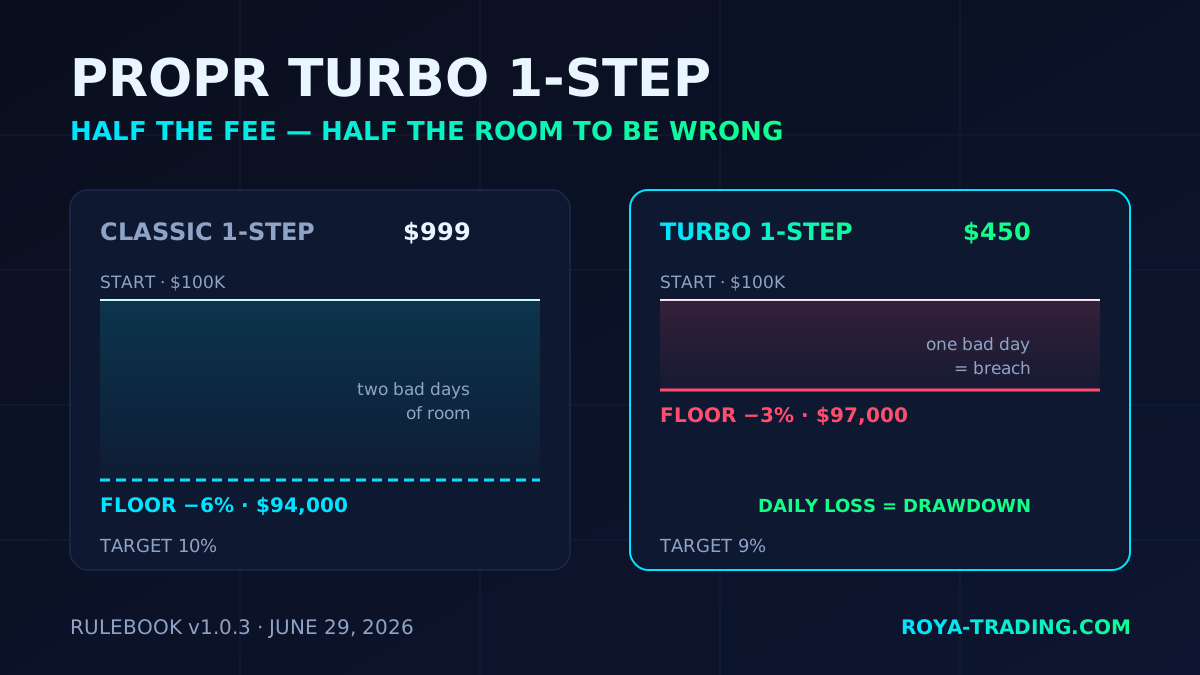
Propr.xyz offers four ways to buy the same funded account. The cheapest is Turbo 1-Step. The pitch is simple — fees at roughly half of Classic 1-Step (a $100K evaluation for $450 instead of $999, a $5K for $25), a slightly lower profit target… and a max drawdown cut from 6% to 3%. Half the price, half the room to be wrong. I trade these accounts and I automate the execution through the API, so I've spent the days since launch running the numbers. Here's the honest breakdown before you spend the $25 — or waste the $450.
The short answer
Turbo is a price cut on attempts, paid for in drawdown. Take it if you trade tight stops with a decent win rate, if you want the cheapest possible first contact with Propr — it's the cheapest ticket in crypto prop trading, full stop — or if you can genuinely accept that one bad day from the start ends the account. Skip it if your method needs room — deep DCA ladders, wide invalidation, holding through news — or if what you want is a funded account you can sit in for months. For systematic and bot traders, Classic 1-Step remains my default; Turbo is the sharp, cheap tool you pick deliberately, not the beginner option the price tag suggests.
What Turbo 1-Step actually is
Same six account sizes ($5K to $200K), same single phase as Classic 1-Step, three numbers changed: the fee, the target, the floor. Straight from the published rulebook, read 10 September 2026:
| Account | Turbo fee | Classic fee | Turbo target (9%) | Turbo floor (−3%) |
|---|---|---|---|---|
| $5,000 | $25 | $60 | $450 | $4,850 |
| $10,000 | $50 | $110 | $900 | $9,700 |
| $25,000 | $125 | $275 | $2,250 | $24,250 |
| $50,000 | $245 | $495 | $4,500 | $48,500 |
| $100,000 | $450 | $999 | $9,000 | $97,000 |
| $200,000 | $899 | $1,998 | $18,000 | $194,000 |
That's 50–58% cheaper than Classic at every size. The daily loss limit stays at 3% of your start-of-day balance — snapshotted at 00:00 UTC and recomputed every day, not a fixed dollar figure — exactly like Classic 1-Step. The rest of the machine is untouched: no time limit, no minimum trading days (you can pass in one trade), equity-based enforcement, and a breach that is permanent the instant your equity touches a limit — even for a second, even on floating P&L.
The real trade: one point off the target, half the total budget
Compare the two 1-Steps honestly. The target drops from 10% to 9% — that's a hair easier. The static drawdown drops from 6% to 3% — that's twice as hard. Those two changes are nowhere near symmetrical, and pricing them as "about half the fee" is Propr being rational, not generous: they expect the 3% wall to collect a lot of fees.
The static floor is your whole-challenge budget for being wrong: $150 on the $5K, $750 on the $25K, $3,000 on the $100K. Here's the detail most people will miss on day one: Turbo's daily loss (3%) and its max drawdown (3%) are the same number. From a fresh account, both walls sit at exactly −3% — so one maximum-loss day is enough to breach. On Classic 1-Step, the same bad day leaves you alive (bruised, at −3% of a 6% budget) with room to recover. On Turbo there is no second act.
Once you're in profit, the geometry shifts: the daily floor (start-of-day balance minus 3% of that balance) rises above the static floor, and the daily limit becomes the one that paces you. Below break-even, the static wall is always the binding one. If the mechanics of equity floors, 00:00 UTC snapshots and floating P&L aren't second nature yet, read the full Propr rules breakdown first — Turbo punishes fuzzy understanding harder than any other format.
The attempt math: when cheap is actually cheap
The right way to price any challenge is fee ÷ your pass rate — your true cost per funded account, which I walked through in the challenge cost breakdown. Turbo changes both sides of that division: the fee is roughly halved (45–50% of Classic, depending on size), and the tighter wall lowers your pass rate. So the decision rule is clean:
If the 3% wall costs you less than half your Classic pass rate, Turbo is the better buy. If it costs you more than half, the discount is a trap.
Worked example on the $100K: Classic costs $999; suppose your system passes it 30% of the time — true cost ≈ $3,330 per funded account. Turbo costs $450, so it wins as long as you still pass at least ~13.5% of the time on the tighter wall. A tight-stop system that rarely dips 2% barely notices the difference between a 6% and a 3% floor — for that trader, Turbo is close to a free 55% discount. A strategy that regularly breathes −2.5% before working? Its Turbo pass rate collapses far below half, and Classic remains the cheaper product at twice the sticker price. Two Turbo shots at $900 still cost less than one Classic at $999 — but only if the second shot has real odds.
One necessary caveat: cheap attempts are not lottery tickets. Propr's rulebook explicitly prohibits "account cycling" — repeatedly buying evaluations to take maximum-risk binary bets. Beyond the ban, it's just bad math: a coin-flip on a 3% wall is negative expectancy after fees. The point of Turbo is cheaper attempts for a real edge, not gambling with better branding.
Can you still DCA on a 3% floor?
This is the question that matters most to me, because averaging into a position is the core of how I trade these accounts — the DCA playbook assumes you have room to be early. A ladder is, by construction, a plan to carry floating drawdown. Classic's 6% gives a ladder space to open, average, and turn. On Turbo, the same ladder must keep equity above 97% including floating P&L at its deepest rung — so everything gets cut in half: half the rungs, or half the size per rung.
In raw position sizing terms: risk 0.5% per trade and Turbo gives you six consecutive losers from the start before breach; 0.25% gives you twelve, but then the 9% target needs twice the winners. There is no free lunch in that table — just a choice about which constraint you'd rather fight.
Once you wire execution into the Propr API for automated trading, the guardrails are configurable, and this is where semi-automation earns its keep: you choose the trade, the bot executes the DCA entries, take-profit and stop-loss with the account's exact daily and drawdown limits hard-coded — it never revenge-trades a shrinking budget at 2am. On Turbo I run shallower, half-size ladders or single entries with tight invalidation. But I'll be straight with you: for DCA-heavy execution, Classic 1-Step is still the format I recommend. Turbo fits the scalper more than the accumulator.
What Turbo doesn't change
Everything after the evaluation is the same product:
- Profit split: 80% to you, on the same funded account.
- Payouts: on-demand, USDC on-chain, processed within 24 hours — with a $20 minimum. Each payout sweeps your available profit and resets balance and floors to the start.
- Automation: bots, copy trading and API access allowed on every format — no consistency rule, no news or weekend restrictions.
- Leverage: 5x on BTC/ETH (side panel and changelog; the §12 table on the same page says 10x — unreconciled as of our reading on 12 September 2026), 2x other crypto perps, 4x equity perps, 8x on gold, silver, CL and Brent, 5x on other commodity perps.
- KYC: still only at the funding gate — the whole evaluation stays wallet-only, no KYC.
- Stacking cap: the aggregate funded limit is $300K — relevant if you run multiple accounts, and Turbo makes filling that cap dramatically cheaper.
Funded life on Turbo limits
Passing isn't the finish line — the rulebook carries your evaluation's equity limits into the funded stage. A funded Turbo account lives with the same 3% daily loss and 3% static floor, just without a profit target. Cheap ticket, fragile seat.
That changes how you should run it. On a Classic funded account you can afford to let a payout cycle build; on Turbo the sane play is to sweep early and often — the $20 minimum makes even small sweeps viable, and every payout resets your balance and floors, giving you a fresh 3% budget. Expect lumpier, smaller checks rather than long compounding runs; I put realistic numbers on that cadence in how much you can actually make. If your goal is a funded account you hold for months, Classic's 6% cushion is worth every dollar of its premium.
Who Turbo is for — and who it isn't
- Take Turbo if: you scalp or trade tight invalidation with a proven win rate; you want a $25–$125 first contact with the Propr ecosystem before committing real fee money; you're stacking accounts toward the $300K cap and want the cheapest per-seat cost; you treat the funded account as a payout machine to sweep, not a home.
- Stay on Classic 1-Step if: you average into positions or need wide stops; your edge shows up over days, not minutes; you're automating a DCA system; you value keeping the funded account over acquiring it cheaply.
- Pick 2-Step if: you're discretionary and want the 5% daily room — that logic hasn't changed.
Whichever format you land on, the method that actually clears it is the same boring discipline I laid out in how to pass a Propr.xyz challenge — Turbo just shrinks the margin for ignoring it. And if you're still comparing firms rather than formats, start with the best decentralized prop firms overview: an on-chain firm that lets you verify payouts is the prerequisite; the format is a detail after that. Ready to try the $25 experiment? Create your Propr.xyz account here — the link gets you 5% USDC cashback on any challenge fee, Turbo included.
Affiliate link. We earn a commission; it never changes what you pay — it is what funds your cashback.
FAQ — Propr Turbo 1-Step
What is Propr Turbo 1-Step?+
Turbo 1-Step is one of Propr.xyz's four evaluation formats, alongside Classic 1-Step, Pro 1-Step and Classic 2-Step. It's a single-phase challenge with a 9% profit target, a daily loss of 3% of the start-of-day balance snapshotted at 00:00 UTC and recomputed daily, and a 3% static max drawdown, for roughly half the Classic 1-Step fee: $25 / $50 / $125 / $245 / $450 / $899 for the $5K / $10K / $25K / $50K / $100K / $200K accounts (read 10 September 2026). Passing leads to the same funded account with an 80% profit split and on-chain USDC payouts.
How much does a Turbo 1-Step challenge cost?+
$25 for the $5,000 account, $50 for $10,000, $125 for $25,000, $245 for $50,000, $450 for $100,000 and $899 for $200,000 — a one-time, non-refundable fee (read 10 September 2026). That's 50–58% cheaper than Classic 1-Step ($60–$1,998) at every size. There are no monthly, platform, data or withdrawal fees on top; standard Hyperliquid trading fees and funding rates apply to your P&L.
What's the difference between Turbo and Classic 1-Step?+
Three numbers move: the fee is roughly halved, the profit target drops from 10% to 9%, and the max static drawdown is cut from 6% to 3%. The 3% daily loss — 3% of the start-of-day balance, snapshotted at 00:00 UTC and recomputed every day — is identical. In practice you're trading half the entry price for half the total room to be wrong — on Turbo, one maximum-loss day from the start is enough to breach, where Classic gives you two.
Is Turbo 1-Step harder to pass than Classic?+
Yes, for most styles. The 9% target is marginally easier than 10%, but the whole-challenge loss budget is halved, so position sizes (or DCA ladder depth) must be roughly halved to keep the same survival odds — which means more trades to reach the target. Turbo only becomes the better buy if the tighter wall costs you less than half your Classic pass rate, because the fee is about half. Tight-stop, high-win-rate systems fit; wide stops and deep averaging don't.
Do the Turbo limits follow you into the funded account?+
Yes. Propr's rulebook carries the evaluation's equity limits into the funded stage — for Turbo that means the same 3% daily loss of the start-of-day balance and the same 3% static drawdown, with no profit target. A funded Turbo account is cheap to obtain but fragile to hold, so the sane play is to sweep profits early and often: payouts are on-demand in USDC with a $20 minimum, and each payout resets your balance and floors to the starting point.
Can I run bots, copy trading or DCA on Turbo 1-Step?+
Yes — Propr allows bots, copy trading and API access on every format, Turbo included. The question is sizing, not permission. A DCA ladder needs drawdown headroom by design, and 3% is half the room Classic offers, so ladders must be shallower or half-size. A semi-automatic bot handles this cleanly: you pick the trade, it executes the DCA entries, take-profit and stop-loss with your account's exact limits as hard guardrails. For DCA-heavy execution I still default to Classic 1-Step.
Trading a 3% wall? Don't do it on willpower.
Run your DCA entries, take-profit and stop-loss semi-automatically on your own Propr account — you pick the trade, the bot respects the exact daily and drawdown limits, Turbo included. Start free on Telegram.
Get 5% USDC cashbackNot on Propr yet? Create your Propr.xyz account and get 5% USDC cashback on your challenge fee.
Affiliate link. We earn a commission; it never changes what you pay — it is what funds your cashback.
⚠️ Trading carries risk. Rules, fees and limits quoted here come from Propr's published rulebook and can change — always check Propr's own rules page before paying. Nothing here is guaranteed and past performance does not predict future results. This article is informational and not investment advice. Do your own research and only trade what you can afford to lose.