
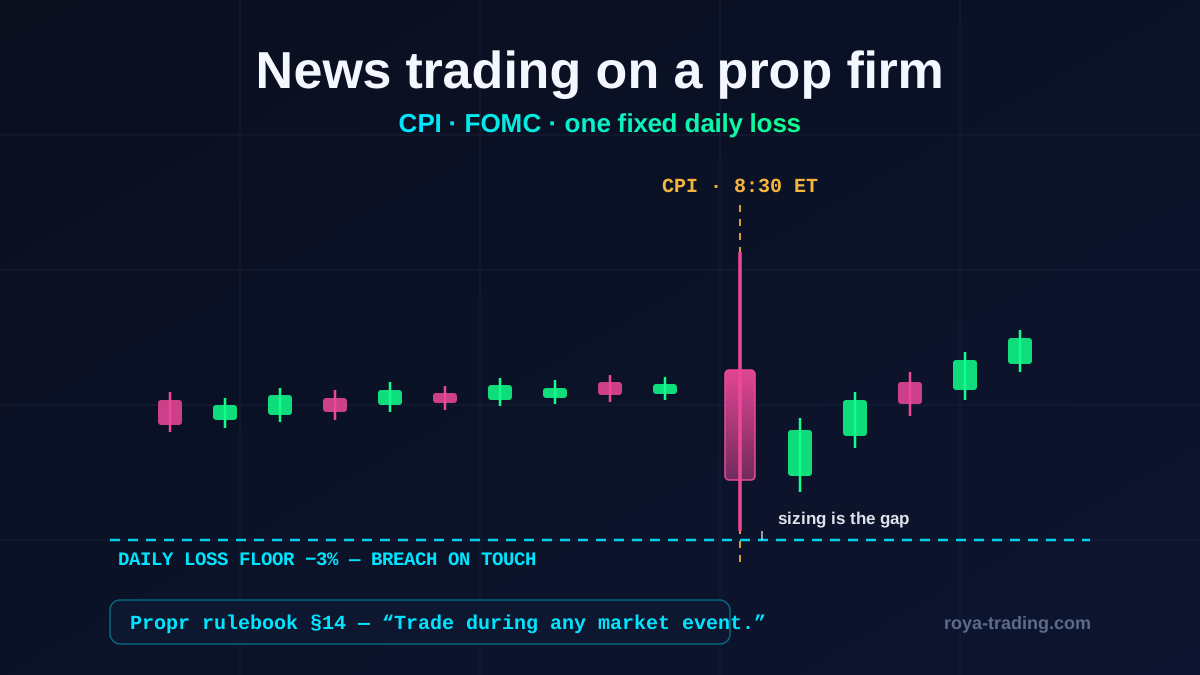
Every challenge trader eventually stares at the economic calendar the night before a CPI print with the same two questions: am I allowed to trade this — and should I? On most traditional prop firms the first answer hides in fine print about restricted events. On Propr.xyz the rulebook answers in five words: “Trade during any market event.” The second question is where accounts actually die. I've traded macro days on evaluations and funded accounts for over a year — some flat, some small, one memorably stupid — so here's the honest version: what the rules really say, what a print does to a crypto order book in ninety seconds, and the sizing math that lets you still have an account at 8:31.
The short answer: allowed on Propr — refereed by your daily loss
Propr.xyz imposes no news-trading restriction of any kind. Section 14 of the official rulebook — the “What Is NOT Restricted” list — spells it out: no banned events, no no-trade windows, no mandatory stop-loss, no strategy restrictions, and bots and copy trading are explicitly permitted. The firm's stated philosophy is that the two equity limits are the only trading rules. That's the whole deal: you can open a BTC position ten seconds before FOMC with the rulebook's blessing. What the rulebook will not do is pause the daily loss and max drawdown while the candle is printing. Freedom to trade the event and safety during the event are two different products — the first one is included, the second one you build yourself.
What rulebooks actually say: Propr vs the rest
Answer first: this is a rulebook question, never a vibes question. The current state:
| Firm | News trading | The fine print that matters |
|---|---|---|
| Propr.xyz | Allowed, explicitly | “None. Trade during any market event.” (rulebook §14) — weekend holding, bots and copy trading also unrestricted |
| Traditional CFD-style firms | Often restricted when funded | FTMO-style rulebooks have applied two-minute no-trade windows around red-folder releases on standard funded accounts; swing variants exist to lift it |
| Hypernova | No news ban published | Public since 14 August 2026; its public rules (read 16 August 2026) list no bot restrictions, no time limit and no consistency rule — the closed-alpha §14.2 copy-trading ban is gone |
Two honest caveats. Rulebooks change — check the live page before you buy, the way I broke down in the copy trading rules check. And “allowed” is not a strategy: traditional firms restrict news partly because simulated environments used to hand out fills no live book would give. On-chain firms don't need the restriction — a funded Propr trade executes at real Hyperliquid prices where slippage is real, so there's no demo-fill exploit to police. The market itself is the referee, and it charges for entry.
What a macro print does to a crypto book in 90 seconds
The events that reliably move BTC are a short list: US CPI (monthly, 8:30 a.m. New York time), the FOMC statement (eight scheduled meetings a year, 2:00 p.m. ET, with the press conference at 2:30), NFP (first Friday, 8:30 a.m. ET), PCE, and the occasional unscheduled headline — ETF flows, regulatory shocks, exchange news. Crypto never closes, so unlike equity traders you are always exposed to the full move, including the ones that land on a Sunday.
Microstructure-wise the same movie plays every time. In the final minute before the release, market makers pull quotes and the book goes thin. The print hits and the first move is often a two-sided wick — stops get swept above and below before the real direction picks — with spreads several times their normal width. Then funding jerks, late liquidations cascade, and fifteen minutes later the book looks normal again at a different price. A surprise CPI routinely moves BTC 1.5–3% inside minutes, and altcoins multiply whatever BTC does. One more Hyperliquid-specific note: the same prints hit the FX perps (25x leverage cap) and the SP500/XYZ100 index perps (10x) even harder than crypto — if you wander outside BTC on a news day, the leverage caps are where the damage scales.
The math: a 90-second wick vs your daily floor
Here's the referee in numbers, on the $25K Classic 1-Step. Your daily loss allowance is $750 on day one — 3% of your start-of-day balance. Each day at 00:00 UTC the system snapshots your balance — realised P&L only, so a position floating against you is not yet counted — and your floor for the next 24 hours is that snapshot minus the day's allowance. The breach itself is measured on equity including floating P&L, and a momentary touch breaches the account permanently — the rulebook grants no grace period. Below the daily floor waits the second wall: the 6% static drawdown at $23,500.
Now size a news trade like an optimist. At the full 5x BTC/ETH cap — 5x on BTC/ETH (side panel and changelog; the §12 table on the same page says 10x — unreconciled as of our reading on 12 September 2026) — $25,000 controls $125,000 of BTC. Against $125K of exposure, your $750 daily allowance is a 0.6% adverse move. CPI wicks travel three to five times that distance as a matter of routine. Full-size through a print isn't news trading — it's donating the account with extra steps. Flip the math around instead, the same one-division formula from the position sizing guide: choose a news-day risk budget (I cap it at one third of the daily allowance), divide by the worst-case wick including slippage (call it 3%), and that's your maximum notional:
| Account | Daily loss (day 1, 1-Step) | News budget (⅓) | Max notional vs a 3% wick |
|---|---|---|---|
| $5,000 | $150 | $50 | ~$1,650 |
| $10,000 | $300 | $100 | ~$3,300 |
| $25,000 | $750 | $250 | ~$8,300 |
| $50,000 | $1,500 | $500 | ~$16,600 |
| $100,000 | $3,000 | $1,000 | ~$33,300 |
| $200,000 | $6,000 | $2,000 | ~$66,600 |
Day-1 column only: the allowance is 3% of your start-of-day balance, resnapshotted at 00:00 UTC every day, so recompute it each morning instead of reusing these numbers for the whole run. Six account sizes, $5K to $200K, read on Propr's published rulebook on 10 September 2026.
Notice the pattern: roughly a third of the account, unlevered. That's what honest news exposure looks like on a 1-Step. Two format-specific warnings. On the Turbo 1-Step, the max drawdown is a 3% static floor — the same size as one daily allowance — so a single bad print can end the whole account, not just the day; Turbo and red-folder gambling don't belong in the same sentence. And on the 2-Step, the 5% daily buys you room, but the 8% trailing drawdown follows your high-water mark — carrying a big open winner into FOMC means a reversal can breach you while you're still net-positive on the challenge.
Three ways to trade a red-folder day — and two that get you banned
1. Stand aside. My default during evaluations: flat fifteen minutes before the print, back in when spreads normalize. The cost is missing the first move; the benefit is that a pass is a marathon of survived days, and no single candle can take mine away. Boring wins challenges — the drawdown math is merciless about this.
2. Trade the reaction, not the print. Let the first five to fifteen minutes build a range, then trade its retest or failure with a stop beyond the wick extreme — an invalidation level, exactly as in the stop-loss and take-profit method — sized backwards from the daily floor. You sacrifice the violent first leg for a defined-risk second one. This is where most of my green news days actually come from.
3. Hold through it, deliberately. Sometimes the position is the thesis — you're short from higher and the CPI is your catalyst. Then the checklist is: reduced size (the table above), bracket pre-placed on the exchange, worst-case equity mark computed before, not during. Propr allows overnight and weekend holding without restriction, so nothing forces you flat — the same equity limits simply keep counting while you sleep, which is why the hour you are exposed matters as much as the release itself; the full session map is in the best time of day to trade a crypto prop firm challenge. A DCA ladder can even use the wick as its entries — but only if every leg was budgeted against the same daily floor beforehand, and never against a genuine regime change. A hot CPI is not a dip; it's new information.
The two moves that end careers instead of accounts: straddling the print across two Propr accounts (long on one, short on the other) is “opposite hedging across accounts,” listed by name in the prohibited-conduct section — detection is automated and the penalty is termination and a ban. And buying evaluation after evaluation to coin-flip each CPI is “account cycling,” banned in the same section. The anti-farming rules exist precisely because both ideas occur to everyone eventually. Trade the event; don't try to game the fee structure with it.
Preset beats reflexes: where semi-auto fits
The ninety seconds around a print are the single worst environment for human clicking: spreads you've never seen, a chart repainting faster than you read it, and every tilt reflex — chasing, widening a stop, doubling down — available at one tap. Whatever edge you have on a news day was decided before 8:30; the execution just has to not betray it. That's the entire reason to run semi-automation — a bot via the official API: you choose the trade and the plan — the asset, the direction, the ladder — and the bot executes the DCA entries, take-profit and stop-loss mechanically, with your account's exact daily-loss and drawdown limits as hard guardrails. A Sunday-4 a.m. wick or a 2 p.m. FOMC candle hits a plan instead of a panic. On Propr this is explicitly legal — bots, API and copy trading are all permitted — which is why best Hyperliquid prop firms 2026 keeps landing where it does; and if you're still choosing the venue itself, start with the decentralized prop firm comparison. To run the setup: create your Propr.xyz account here — the link pays 5% USDC cashback on any challenge fee — then wire your execution to it through the official API.
Affiliate link. We earn a commission; it never changes what you pay — it is what funds your cashback.
My news-day checklist
- Know the calendar in your own timezone. CPI and NFP at 8:30 a.m. New York time, FOMC at 2:00 p.m. — and remember Propr's daily loss resets at 00:00 UTC, so a losing European morning and a losing US afternoon can share one allowance.
- Decide before, in writing. Flat, reduced, or holding — chosen the night before. A decision made during the wick is not a decision, it's a reflex.
- Size from the floor backwards. Risk budget ≤ ⅓ of the daily allowance, divided by a 3% worst-case wick, slippage included. Conviction is not a sizing input on news days.
- Brackets on the exchange, not in your head. Equity limits count floating P&L and touch equals breach — a mental stop is a story you tell yourself.
- One attempt per event. The revenge trade after a stopped-out wick is how a survivable −1% day becomes a breached account.
- Journal it. After ten events you'll know whether news days pay you or tax you. Mine taxed me until I stopped trading the first candle.
FAQ — news trading on prop firms
Is news trading allowed on Propr.xyz?+
Yes, explicitly. Section 14 of the official rulebook (“What Is NOT Restricted”) lists the news-trading restriction as “None. Trade during any market event.” The same section allows weekend holding, bots, copy trading and any strategy. That applies to evaluation and funded accounts alike — the only rules that referee a CPI or FOMC trade are the two limits: the daily loss — 3% (1-Step) / 5% (2-Step) of your start-of-day balance, snapshotted at 00:00 UTC and recomputed daily; the breach itself is measured on equity, floating P&L included — and the max drawdown (6% static Classic, 3% static Turbo, 8% trailing 2-Step). Read on Propr's published rulebook, 10 September 2026.
Do traditional prop firms ban news trading?+
Many restrict it on funded accounts. FTMO-style rulebooks have famously imposed no-trade windows of a couple of minutes around high-impact, red-folder releases on standard funded accounts, with swing-type accounts sold precisely to lift that restriction. Each firm is different and rules change, so the only reliable method is reading the current rulebook before you buy — the same check I recommend for copy trading and bots. On-chain firms like Propr don't need the restriction because fills happen at real market prices, not simulated ones.
Can a news wick breach my account if it only touches the limit for a second?+
Yes. Both Propr equity limits are enforced on equity — balance plus floating P&L — and the rulebook is explicit that even a momentary touch triggers a breach with no grace period. A CPI wick that tags your daily-loss floor for two seconds and fully reverses still ends the account, permanently. That's exactly why size, not forecast accuracy, is what news-day survival is made of.
Can my bot keep running through CPI and FOMC?+
On Propr, yes — automated trading is explicitly permitted, with no news-window exception. Whether it should keep running is a strategy question: spreads widen and slippage grows around the print, so a bot tuned for calm conditions can get filled far from its assumptions. My approach is semi-automatic by design: I decide before the event whether a bot trades it at all, and if so it executes the pre-set DCA ladder, take-profit and stop-loss mechanically, with the account's exact daily-loss and drawdown limits as hard guardrails.
Which Propr challenge format handles news volatility best?+
The 2-Step gives the most intraday room with its 5% daily loss, but its 8% trailing drawdown follows your high-water mark — holding winners into an event can breach you while still net-positive. The Classic 1-Step's 3% daily and 6% static floor reward standing aside or trading small. The Turbo 1-Step is the worst place to gamble a print: its 3% static max drawdown is the same size as one daily allowance, so a single bad CPI candle can end not just the day but the whole account.
Does slippage and funding during an event count against my equity?+
Yes. Propr passes Hyperliquid's trading fees through at cost and funding payments are settled automatically; both are included in the equity your limits are measured on. During a violent print your stop can also fill worse than its trigger price. Budget for it: assume the wick travels further than the chart suggests, put a slippage buffer in your sizing math, and treat the daily-loss floor as something you plan around, never at.
Trade the event with a plan — not with reflexes.
A bot via the official API executes your DCA entries, take-profit and stop-loss semi-automatically on your own Propr account — you choose the trade before the print, the bot respects your exact daily loss and drawdown limits through it.
Get 5% USDC cashbackNo funded account yet? Create your Propr.xyz account and get 5% USDC cashback on your challenge fee.
⚠️ Trading carries risk, and news events multiply it. Rules quoted here come from Propr's published rulebook and can change — always check Propr's own rules page before paying. Statements about other firms reflect their published rules at the time of writing and change too. Economic-release times can shift with holidays and DST. Nothing here is guaranteed and past performance does not predict future results. This article is informational and not investment advice. Do your own research and only trade what you can afford to lose.