
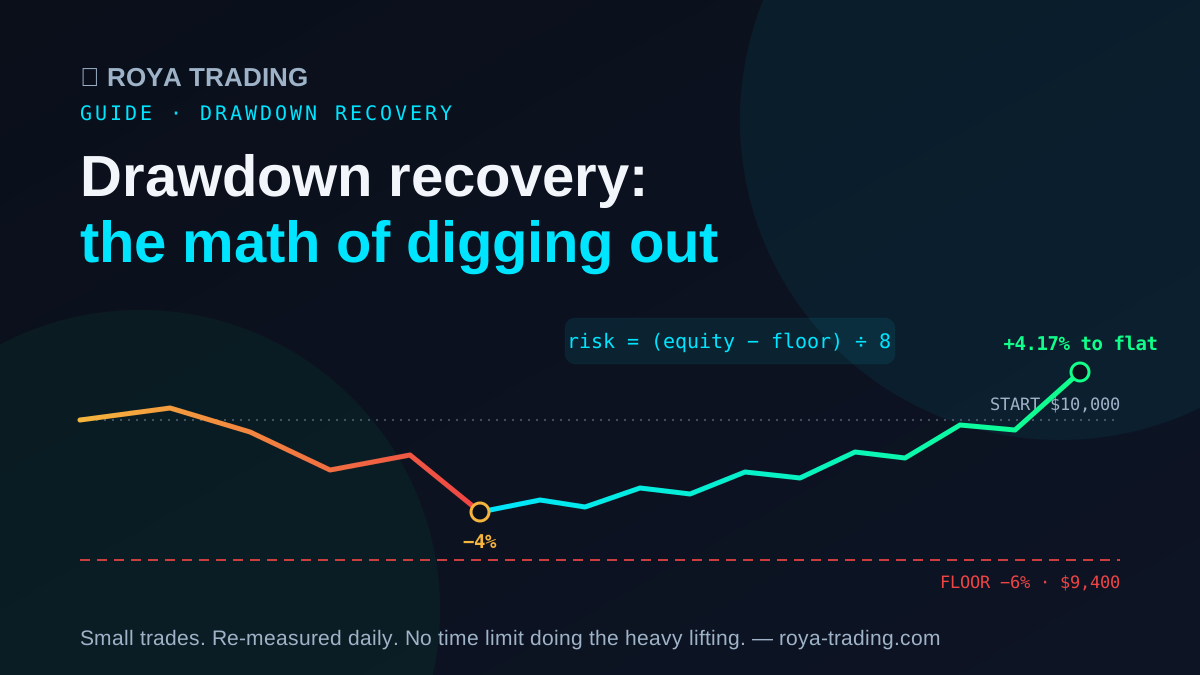
There's a moment nobody writes about. Not the start of the challenge, when your position sizes are neat and your plan is intact. Not the end, when the account is either funded or terminated. The middle: day eleven, equity at $9,600 on a $10K account, down 4%, account very much alive — and every instinct you have is wrong. The content industry covers the before (sizing, strategy) and the after (the post-breach playbook), but challenges are actually decided in that middle, in drawdown, by what you do with a live account and a bruised ego. My first passed account on Propr.xyz went through −3.8% before it passed. Here is exactly what the math says to do — and the two points where it says to stop.
The short answer
Four moves, in order. One: stop for the day long before the daily loss wall — on Propr touching it is a breach, not a timeout. Two: resize from what you have left, not from what you started with: divide the distance between your equity and the drawdown floor by eight, and that's your new risk per trade. Three: recover in many small trades, never in one big one — the math of asymmetric losses is merciless to hero trades. Four: use the one asset Propr hands every recovering trader: no time limit. The grind is allowed to take weeks. Everything below is these four moves with real numbers on them.
The math is against you — by exactly this much
Answer first: a loss always needs a bigger gain to undo it, and the gap grows fast. Lose 2% and you need +2.04% to get back to flat. Lose 4% and it's +4.17%. Lose 6% and it's +6.38%. Lose 10% and you need +11.11%. The formula is gain = loss ÷ (1 − loss), and it's the first thing to internalize, because it means every additional percent you give back in drawdown costs more than the one before it.
But flat isn't even the goal in a challenge — the target is. Put real numbers on the $10K 1-Step from the intro: you start at $10,000, the target is +10%($11,000), the daily loss is a fixed 3% ($300, computed on account size — it doesn't shrink with your equity), and the max drawdown is 6% static: a floor at $9,400 that never moves. At $9,600, three numbers have quietly turned against you at once. The target is no longer 10% away — it's +14.6% from your current equity. Your cushion to the floor is no longer $600 — it's $200. And the daily allowance is still $300, which means for the first time in the challenge, the daily limit is no longer your binding constraint — the floor is. One ordinary red day at full size doesn't cost you a day anymore; it ends the account.
That last point is the one that catches people. Early in a challenge you can think in days ("I'll risk a third of my daily allowance per trade"). Deep in drawdown, the daily math is a distraction: $300 of same-day rope means nothing when the account dies $200 lower. Every sizing decision from here has to be made against the floor.
Resize from what's left, not from what you started with
Answer first: risk per trade = (equity − floor) ÷ 8. At $9,600 with the floor at $9,400, that's $200 ÷ 8 = $25 per trade — 0.25% of the account, a quarter of the standard 1% you'd use with a full cushion. Why eight? Because at the 45–55% win rates real strategies run, a streak of several consecutive losers over a few dozen trades is normal variance, not bad luck — and sizing to survive at least eight of them in a row is what keeps ruin off the table while you work. This is the same logic as standard challenge position sizing, with one change: the numerator is your remaining room, and it gets re-measured after every trading day.
Here's what the climb actually looks like with a modest, honest edge — say 2:1 reward-to-risk with a 45% win rate, which nets about +0.35R per trade on average. Phase one, rebuild the cushion: from $9,600 to $9,800 at $25 risk is roughly 23 trades. Phase two, back to flat: your room is now $400, so risk steps up to $50, and $9,800 to $10,000 takes about 12 more. Phase three, the actual challenge: with $600 of room you're back near normal sizing (capped at 1% — never above it), and the $1,000 to the target is around 38 trades. Call it 75 trades total — at three to four real setups a day, about a month of disciplined trading. That's the honest price of a −4% hole. If that number shocks you, good: it's why the section on not recovering exists, and it's why rushing a challenge timeline is the losing move even when you're not in a hole.
Now the contrast, because it's the whole argument: keep trading your original 1% ($100) from $9,600 and two consecutive losers terminate the account. Two. At a 45% win rate, back-to-back losses happen constantly — you'd be flipping a weighted coin against your own survival. The divide-by-eight rule feels painfully slow precisely because it's the version that still exists next month.
Static vs trailing: two different recoveries
Answer first: a static drawdown rewards recovery permanently; a trailing one caps how much safety you can ever rebuild. Which rule you're under changes the whole shape of the climb, and it's worth knowing before you pick a format — I compared them fully in trailing vs static drawdown, but here's the recovery-specific version.
On the 1-Step (6% static), the floor is bolted to your starting balance: $9,400 on a $10K, forever. Every dollar you claw back is cushion you keep — recover to $10,200 and you now have $800 of room; the rule never takes it back. Recovery compounds in your favor. On the 2-Step (8% trailing), the floor follows your equity high-water mark, and it stops rising only once it reaches your starting balance. Say you ran the account up to $10,400 early: the floor moved up to $9,600. Slide back to $9,900 and on paper you're only −1% from start — but your real room is $300, not the $500 a static rule would give you. Worse: climbing back toward $10,400 doesn't lift the floor (it only moves on new highs), so your maximum possible cushion is capped at 8% below your best moment, permanently. That give-back squeeze is exactly how 2-Step traders end up breached during a pullback — sometimes while still net-positive on the run. The 5% daily loss gives you more same-day rope than the 1-Step's 3%, but in a recovery, rope isn't the resource you're short of. Room is.
The tilt tax: why the second loss costs more than the first
Answer first: the account-killer in drawdown isn't the market, it's the resize you do angry. The pattern is boringly consistent, and I say that as someone who donated an account to it: a −2% day, then a doubled position "to get it back today", then the daily wall — and on Propr the daily wall is a breach. The evaluation terminates; there is no tomorrow to be smarter on. The entire tilt cascade — loss, revenge, oversize, termination — is the number-one killer in why 90% of prop firm traders fail, and drawdown is where it recruits.
The mechanical defenses are simple and they work. Set a personal daily stop at half the allowance — $150 on a $10K 1-Step — so a bad day costs a day, never the account; the complete daily-loss budget math — per-trade units, correlation, circuit breakers — is in the daily loss limit playbook. Apply a two-loser rule: two consecutive losing trades and the session is over, no exceptions, because the third trade after two losses is the one your judgment doesn't attend. Let the 00:00 UTC reset be a ritual: the daily budget refreshes, the drawdown room doesn't, and re-measuring your divide-by-eight number each morning keeps the sizing honest. And write your exits before your entries — in drawdown, a floating "I'll see how it goes" position is a liability you can't afford; stop-loss and take-profit placement stops being style and becomes survival.
When grinding back is the wrong play
Answer first: below about 1% of remaining room, the grind stops being worth it. Run the same math at $9,500 on our $10K 1-Step: room to the floor is $100, divide-by-eight sizing is $12.50 a trade, and the expected climb to the target stretches into hundreds of trades. It's not impossible — it's just a worse spend than the alternative. A fresh $10K 1-Step costs $110 (a 5K is $60), arrives with a full 6% of room, and — this is the part tilt hides from you — comes with the single most valuable output of the failed run: the autopsy. Which rule you nearly breached, on which trade, at what size. That's the input for the reset playbook, and traders who reset with a diagnosis systematically beat traders who grind a dead-end account out of pride.
Two honest add-ons. First, if you do reset, reset cheaper: dropping from a 10K to a 5K halves the fee and changes none of the percentages — the rules scale. Second, do the arithmetic on your own attempt before paying: if this was your second identical near-breach for the same reason, the fix isn't a third account, it's the process change. When you're ready, a new Propr.xyz challenge through my link pays you 5% USDC cashback on the fee — which, on recovery economics, is the rare number that's actually free.
Affiliate link. We earn a commission; it never changes what you pay — it is what funds your cashback.
And if you're still choosing where to run all this: no time limit, a daily loss recomputed from your start-of-day balance, bots and copy trading explicitly allowed is not the industry default — it's a short list, and I keep the honest version of it in the best decentralized prop firms of 2026.
How I run recoveries semi-auto
Everything above is a plan a spreadsheet could follow — and that's the problem, because at 11pm after a red day, you are not a spreadsheet. The divide-by-eight number says $25 and your hands type $80. The two-loser rule says stop and you take "one more". I built a bot — see how the Propr API handles automated trading — to be the layer between those hands and the account: it runs semi-auto on your own Propr account — you choose the trade (your setup, or a Radar pilot you follow), and the bot executes the DCA entries, the take-profit and the stop, with your daily-loss and drawdown limits hard-coded as guardrails it will not cross. It sizes what the plan says, it stops when the plan says, and it has never once revenge traded. The judgment stays yours; the discipline stops depending on your mood. The full method — rules, DCA, automation — is in how to pass a Propr.xyz challenge.
Bottom line
A drawdown mid-challenge is a math problem wearing an ego costume. The math part is solved: stop before the wall, resize from the room you have left (divide by eight), recover in many small trades, re-measure daily, and let Propr's missing time limit absorb the weeks the climb honestly takes. The ego part is knowing the two exits: a personal floor above the real one, and the reset math that says when $110 of fresh account beats $100 of dying one. Down 4% with a live account, you have more good options than you think — and exactly one bad one, which is trying to be flat by Friday.
FAQ — Recovering a prop firm drawdown
How do you recover from a drawdown in a prop firm challenge?+
Stop trading for the day before you go anywhere near the daily loss limit, then resize from what you have left: divide the distance between your current equity and the drawdown floor by eight and make that your new risk per trade. Recover in many small trades rather than a few big ones, raise the bar on which setups you take, and only scale risk back up as the cushion rebuilds. On Propr.xyz there's no time limit, so the grind is allowed to take weeks — the traders who breach in recovery are almost always the ones who tried to win it back in a day.
How much do you need to gain back to recover a loss?+
More than you lost, in percentage terms — that's the asymmetry. A 2% loss needs +2.04% to get back to flat, a 4% loss needs +4.17%, a 6% loss needs +6.38%, and a 10% loss needs +11.11%. The formula is gain = loss ÷ (1 − loss). In a challenge it's worse than that, because you're not aiming for flat — you're aiming for the profit target, so the distance grows while your room to the drawdown floor shrinks.
What happens if I hit the daily loss limit on Propr.xyz?+
It's a breach, not a timeout — the evaluation is terminated. Propr's daily loss is a fixed 3% of account size on 1-Step and 5% on 2-Step, and touching it ends the account just like the max drawdown does. That's why any serious recovery plan uses a personal stop well before the wall — for example half the daily allowance — so a red day costs you a day, not the challenge.
Does the drawdown room reset each day like the daily loss?+
No, and this is the distinction recoveries live or die on. The daily loss budget resets at 00:00 UTC every day — tomorrow you get a fresh 3% (or 5% on 2-Step). The max drawdown doesn't reset: on the 1-Step it's a 6% static floor below your starting balance, and on the 2-Step it's an 8% floor trailing your equity high-water mark. Whatever room you've burned toward that floor stays burned until you earn it back.
Is it better to grind back a drawdown or reset with a new challenge?+
Run the honest math on both. If your remaining room to the floor is under about 1% of account size, sizing that survives a normal losing streak becomes so small that the recovery takes an unrealistic number of trades — a new 1-Step at $60 (5K) or $110 (10K) is usually the better spend, and the autopsy of the failed run is worth more than the last 1% of the old account. If you still have 2% or more of room and no time pressure, the grind is very playable. The fee is tuition either way; the only real waste is rebuying the same mistake.
Can a bot manage the recovery for me?+
It can enforce the plan — it can't pick the trades, and in a semi-auto setup it's not supposed to. The bot runs semi-auto on your own Propr.xyz account: you choose the trade (your idea, or a Radar pilot you follow), and the bot executes the DCA entries, take-profit and stop-loss with your daily-loss and drawdown limits hard-coded as guardrails. In a recovery that's exactly the layer you want automated: the sizing, the stop, and the refusal to revenge trade at 2am. The judgment stays yours; the discipline stops depending on your mood.
Recover on plan, not on tilt.
A bot executes your recovery the way the math wrote it — DCA entries, stop and take-profit sized to your remaining room, with your daily-loss and drawdown limits hard-coded as guardrails. Semi-auto on your own Propr account: you pick the trade, it keeps the discipline. Start free on Telegram.
Get 5% USDC cashbackNot on Propr yet? Create your Propr.xyz account with 5% USDC cashback.
Affiliate link. We earn a commission; it never changes what you pay — it is what funds your cashback.
⚠️ Trading carries risk. Rules, fees and limits come from Propr's published rulebook, read 10 September 2026, and can change — always check Propr's own rules page before paying. Nothing here is guaranteed and past performance does not predict future results. This article is informational and not investment advice. Do your own research and only trade what you can afford to lose.