
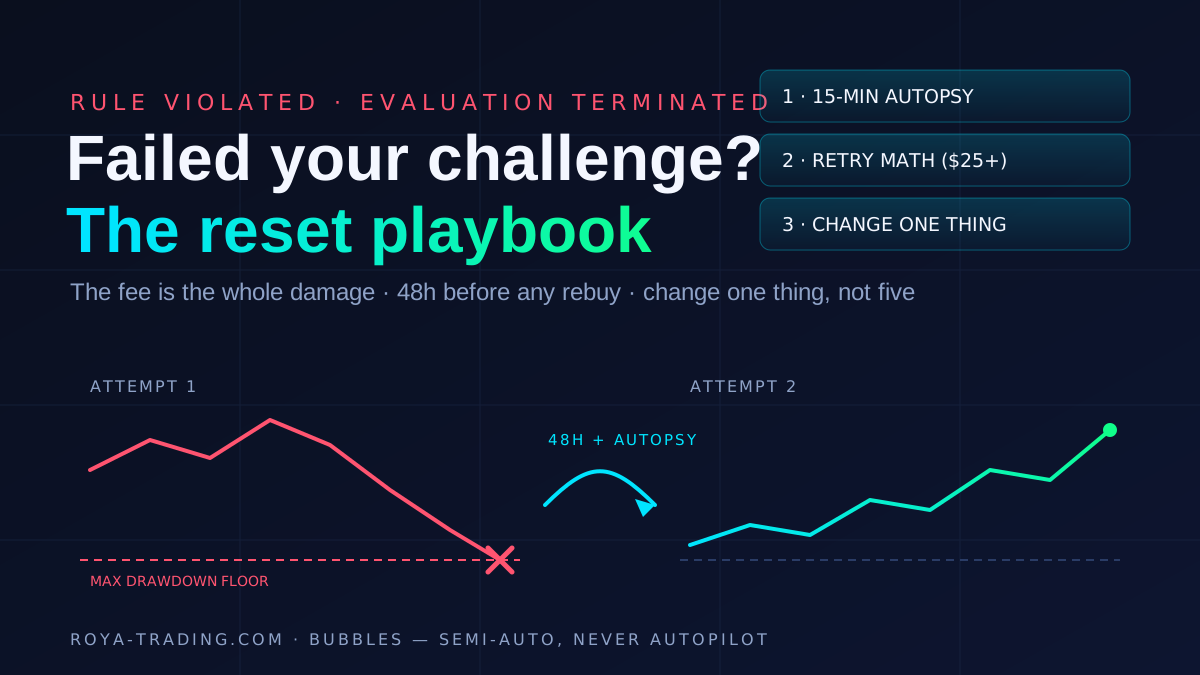
The email is short, the dashboard is red, and the account you spent three weeks on is gone in one line: rule violated, evaluation terminated. I know the feeling from the inside — my first two challenge attempts died exactly like that, one to a revenge session, one to a trailing drawdown I hadn't actually understood. So this is the article I wish someone had handed me between attempt one and attempt two: what a failed challenge really costs (and what it doesn't), the fifteen-minute autopsy that turns the fee into tuition, the honest math of retrying, and the one change worth making before you pay again. Not a motivational post. A checklist.
One scope check before the autopsy: this guide is for after the breach. If your account is down but still alive — say −3 or −4% with the floor untouched — nothing is decided yet, and the right moves are almost the opposite of the ones below. In that case, close this tab and read the drawdown recovery math first.
What actually happens when you breach — and what doesn't
Answer first: the account closes, the fee is spent, and that is the entire damage. On Propr.xyz there's no debt and no negative balance — you never deposited trading capital in the first place, so the only money that was ever at risk was the $25–$1,998 you paid for the evaluation. Nobody calls you, nothing goes to collections, no future application is flagged. The breach is recorded, the account is terminated, and the firm's capital was never yours to owe.
Just as important is the list of things you keep, because tilt makes people forget it. You keep your wallet, untouched. You keep the right to buy a new challenge the same minute, at the same price, under the same rules — there's no cooldown and no penalty pricing. You keep your trade history, which is about to become the most valuable thing you own. And a failed evaluation has zero effect on any future funded account: evaluations are scored independently, and KYC — which only happens once you pass — doesn't know or care how many attempts it took. The fee is gone. Everything else survived.
Before anything else: the 15-minute autopsy
Answer first: do not buy anything until you can name, in one written sentence, which rule ended the account and which decision put you there. Propr's dashboard shows the violated rule on the terminated account — start there, because the three breach types have three different fixes, and buying a retry before knowing yours is how people fail twice for the same reason.
| What the dashboard says | What usually happened | The fix that matters |
|---|---|---|
| Daily loss breached (3% on 1-Step, 5% on 2-Step, of your start-of-day balance, recomputed daily) | One bad day: an oversized position, a news candle, or losers two and three placed on tilt to win back loser one | Size and a personal stop — this is the discipline breach, not a strategy breach |
| Max drawdown breached — static (6% on Classic 1-Step) | A slow bleed: dozens of small losses over weeks ground equity to the floor | The strategy itself — no sizing trick fixes a system that loses slowly |
| Max drawdown breached — trailing (8% on 2-Step) | You built profit, the floor followed your equity peak up, and a give-back phase hit it — sometimes while still net-positive overall | Exits and the rule itself — most victims never understood the high-water mark |
The three autopsies point in genuinely different directions. A daily-loss breach is almost never a strategy problem — it's the same five discipline failures the industry has been documenting for years, and the honest question is “what did I do in the last hour of that account's life?” A static-drawdown bleed is the opposite: your discipline may have been fine, trade by trade, but the system underneath had no edge at that cost structure — more challenges won't fix it, and the honest next step is smaller and slower, not sooner. And a trailing-drawdown breach is its own category, because half its victims are traders who were winning: the 2-Step's floor follows your equity high-water mark up until it reaches the starting balance, so an open winner given back can end an account that never went red overall. If that sentence is new to you, that was the leak — the trailing vs static explainer and the full Propr rules walkthrough are twenty minutes that pay for themselves.
The 48-hour rule: why the tilt rebuy is the most expensive click in prop trading
Answer first: wait 48 hours, write the autopsy, then decide. The most reliable donor to prop firm revenue is the trader who breaches at noon and rebuys at 12:05 — same size, same setups, same emotional state, minus one fee. I've done it; it cost me a second fee in four days. The mechanism is simple: a breach feels like an insult, the rebuy feels like the rebuttal, and the market doesn't attend the argument. Propr's challenges have no time limit — the one deadline in this game is the one tilt invents. Close the laptop. The retry price is identical on Thursday.
What the 48 hours are for: writing the one-page autopsy. Which rule, from the dashboard. The equity curve's shape (one cliff or a long bleed). The size of the position that did the damage, versus the size your plan allowed. Whether a scheduled news print was involved. And the sentence I make myself write every time: “The account would have survived if…” — finished honestly. If you can't finish it, you're not ready to pay again; if you can, you now own the cheapest trading lesson you'll ever buy, and attempt two starts with an edge attempt one never had.
The retry math: what attempt two actually costs
Answer first: a retry costs less than you think if you pick the format deliberately — and more than you think if you keep rebuying the same breach. The full price list, with the 5% USDC cashback every fee earns through the referral link baked into the net column:
Affiliate link. We earn a commission; it never changes what you pay — it is what funds your cashback.
| Format | $5K | $10K | $25K | $50K | $100K | $200K |
|---|---|---|---|---|---|---|
| Classic 2-Step (5% daily, 8% trailing) | $50 · net $47.50 | $100 · net $95 | $250 · net $237.50 | $450 · net $427.50 | $899 · net $854.05 | $1,499 · net $1,424.05 |
| Classic 1-Step (3% daily, 6% static) | $60 · net $57 | $110 · net $104.50 | $275 · net $261.25 | $495 · net $470.25 | $999 · net $949.05 | $1,998 · net $1,898.10 |
| Pro 1-Step (3% daily, 5% static) | $45 · net $42.75 | $85 · net $80.75 | $185 · net $175.75 | $355 · net $337.25 | $699 · net $664.05 | $1,399 · net $1,329.05 |
| Turbo 1-Step (3% daily, 3% static) | $25 · net $23.75 | $50 · net $47.50 | $125 · net $118.75 | $245 · net $232.75 | $450 · net $427.50 | $899 · net $854.05 |
Four formats, six account sizes — the cheapest ticket is $25 (Turbo $5K) and the most expensive is $1,998 (Classic 1-Step $200K). Grid read 10 September 2026; the largest single account is $200K, while the aggregate funded cap per trader is $300,000.
Three honest plays with that table. Drop a size: the rules are identical in percentage terms across all six accounts, so if you failed a $25K Classic ($275), two full attempts at $10K ($220 total) cost less than one $25K retry and buy twice the practice — the account-size math says the skill transfers up when you're ready. Switch the format to match the autopsy: if the trailing drawdown killed a winning run, the Classic 1-Step's static floor removes that exact failure mode for $10 more at $5K; if a tight daily loss kept clipping you, the 2-Step's 5% daily buys intraday room. Use the Turbo only for what it is: at $25 it's the cheapest retry in the lineup, but its 3% static drawdown equals a single daily allowance — one max-loss day ends the account, which is why the Turbo breakdown calls it a format for traders with a proven edge who want cheap attempts, not a discount for traders still finding one.
And the bankroll frame that keeps all of this sane, borrowed from the beginner's plan: budget attempts in threes. If three fees at a size would strain your finances, you're at the wrong size — three Turbo or 2-Step attempts at $5K cost $75–$150, which is the price of learning this game with a capped downside. The complete fee-and-ROI picture, including the trading costs the price list doesn't show, is in the challenge cost deep-dive.
Change one thing — not everything
Answer first: a retry with zero changes is a donation, and a retry with five changes is a new, untested strategy — change exactly one thing, the one the autopsy named. The four levers, in the order they usually matter:
1. Cut risk per trade in half. If the daily loss died in one or two positions, the fix is arithmetic, not philosophy: risk a fixed 0.5% per trade and the 3% daily floor sits six full losers away instead of one candle. Most breached accounts were sized so the floor was reachable in a single trade — that's not a position, it's a breach on a timer.
2. Install a personal stop above the firm's stop. The firm's daily limit is a cliff; put a fence before it. Two consecutive losers = done for the day, every day, no exceptions. The allowance resets at 00:00 UTC and the challenge has no deadline — walking away is a legal move, and it's the one the breached version of you didn't make.
3. Decide exits before entries. Trailing-drawdown victims and give-back breaches share a root cause: no written exit plan. Stops at invalidation, take-profits set in advance, partials on the way — decided while calm, before the position exists, because mid-trade is where good exits go to die.
4. Make the execution mechanical. Here's the pattern in almost every autopsy I've read: the plan was fine and the fingers broke it — the stop moved “just this once,” the size doubled after a loss, the 3 a.m. position had no exit at all. That execution layer is exactly what a bot running through the official API automates, and only that: you still choose every trade — asset, direction, plan — and the bot executes the DCA entries, take-profit and stop-loss mechanically on your Propr account, with your daily-loss and drawdown limits as hard guardrails it will not cross. Semi-auto, never autopilot: it removes the error class that breached attempt one without touching the decisions that remain yours. That split — human chooses, machine executes — is the whole design, and it's legal by the book on Propr, where bots, copy trading and API access are explicitly allowed.
When not to rebuy yet
The honest section. Don't rebuy today if any of these are true: the fee money has a job elsewhere (rent money trades scared, and scared trading breaches); the autopsy sentence is still blank (you'd be paying to repeat an experiment with no hypothesis); or this was your third identical breach (three same-shaped failures aren't bad luck, they're data — the leak is the process, and the fix is a smaller size, a demo month, or copying someone with a proven edge while you study, not a fourth fee). And if the autopsy says the rules fought your style rather than your discipline — legitimate, it happens — compare formats before defaulting to another attempt: the decentralized prop firm comparison ranks the whole on-chain field honestly, trailing rules, bot policies and all.
One more thing worth knowing while you decide: the $PROPR points your challenge purchase and trading volume earned were credited along the way — nothing in the rulebook claws them back on a breach, so a failed attempt still moved your airdrop position forward. Small consolation, real number. Check your points page before you decide anything.
The reset, in five lines
- Hour 0: close the platform. No rebuy, no “one demo trade.” The damage is capped; keep it capped.
- Day 1: write the autopsy — the rule, the curve shape, the position size, the sentence: “the account would have survived if…”
- Day 2: pick the retry deliberately: same size if the leak was one fixable error, smaller if it was a pattern, different format if the rule itself fought you.
- Before paying: change the one thing. Half size, personal stop, written exits, or mechanical execution — one, not five.
- Attempt two: first goal isn't the target — it's thirty days without touching a limit. On a no-time-limit challenge, surviving is progress.
FAQ — after a failed prop firm challenge
Do I owe the prop firm money after failing a challenge?+
No. On Propr.xyz — and on any legitimate prop firm — the challenge fee is your entire, final exposure. You never deposited trading capital, the account can't go negative on your side, and there is no debt, no collections, no obligation of any kind after a breach. The account closes, the fee is spent, and that's the complete damage. If a firm ever asks you to pay in losses after a failed evaluation, that's not a prop firm, that's a scam.
Can I buy a new challenge immediately after failing?+
Yes — there's no cooldown, no penalty and no limit on Propr.xyz, so mechanically you can breach at 14:00 and be trading a fresh account at 14:05. Whether you should is a different question. The single most expensive habit in this industry is the tilt rebuy: a new fee paid within the hour, traded with the same size and the same emotions that just breached the last account. My rule is 48 hours and a written autopsy before any repurchase. The challenge has no time limit; neither does the decision to buy one.
Should I retry the same account size or drop down?+
Depends on what the autopsy found. If you breached from one identifiable, fixable error — one oversized trade, one news candle, one revenge session — and the fee doesn't strain your budget, the same size is fine. If you breached from a pattern (slow bleed over weeks, repeated daily-loss hits), drop down: the rules are identical in percentage terms across all six Propr sizes ($5K, $10K, $25K, $50K, $100K, $200K — read 10 September 2026), so a $10K account ($110 Classic) teaches exactly the same game as a $25K ($275) at 40% of the price. Two attempts at $10K cost less than one at $25K — and the skill transfers back up.
Does a failed challenge hurt my chances of getting funded later?+
Not at all. Evaluations are independent: Propr doesn't score you across attempts, there's no hidden reputation meter, and a passed challenge activates a funded account under exactly the same terms whether it was your first attempt or your fifth. KYC only happens at the funded stage and has nothing to do with prior fails. The only thing a failed attempt costs you is the fee — and, if you skip the post-mortem, the lesson you paid for.
Should I switch prop firms after failing?+
Be honest about the reason first. In almost every autopsy I've done — mine and other traders' — the breach came from sizing, discipline or a misread rule, none of which changes at another firm. Switching because you breached is usually just paying a new firm to fail the same way. That said, if the rules genuinely fought your style — say a trailing drawdown kept punishing your swing exits — comparing formats is legitimate: the decentralized prop firm comparison on this site ranks the on-chain field honestly, and Propr's static-drawdown 1-Step exists precisely for traders the trailing rule mistreats.
Attempt two deserves better execution than attempt one.
You pick every trade; our Telegram bot executes the plan — DCA entries, take-profit and stop-loss placed mechanically on your Propr account, with your daily-loss and drawdown limits as hard guardrails. Semi-auto, never autopilot. The error class that breached attempt one doesn't get a vote this time.
Get 5% USDC cashbackRebuying your challenge? Use the Propr.xyz referral link and get 5% USDC cashback on the fee — every attempt, not just the first.
Affiliate link. We earn a commission; it never changes what you pay — it is what funds your cashback.
⚠️ Trading carries real risk and most challenge attempts fail — budget only money you can afford to lose. Figures quoted here come from Propr's published rulebook and can change; always check the live rules page before paying. Nothing here is guaranteed, past performance does not predict future results, and this article is informational — not investment advice. Do your own research.