
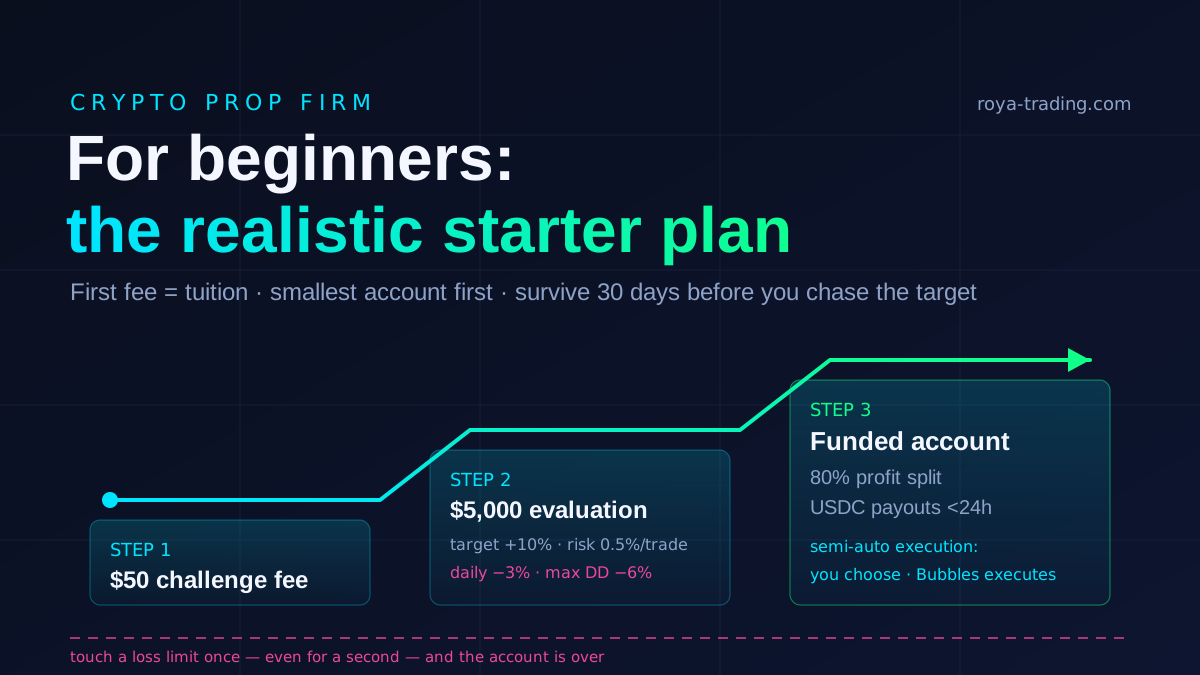
The question I get most on Telegram isn't about drawdown rules or API keys. It's some version of: “I've never traded seriously — should I buy a prop firm challenge?” And the honest answer, from someone who passes these challenges for a living, is: most beginners lose their first fee. That's not a scare line, it's the base rate. But there are two very different ways to lose $50 — the way where it buys you a structured, capped-risk education on real market prices, and the way where it's a donation with extra steps. This guide is the difference between the two: what a crypto prop firm actually is in plain words, the five numbers that decide everything, which challenge a beginner should buy (and which one to avoid), and the 30-day plan I'd hand my past self.
The short answer: yes — if you treat the first fee as tuition
Answer first: a crypto prop firm is one of the few places where a beginner's worst case is capped at a $50–$60 fee while they learn on $5,000 of the firm's capital, keeping 80% of any profit. You never deposit trading capital, you can't go into debt, and on Propr.xyz there's no time limit — the deadline pressure that wrecks most first attempts simply doesn't exist. That's the genuinely good deal.
The catch is on the other side of the table: the rules are mechanical and merciless, and they don't care that you're new. Roughly nine in ten challenge attempts fail, and they fail in the same five ways — oversized positions, a blown daily loss, revenge trading, no written plan, too big an account. None of those five is a knowledge problem. All five are discipline problems, which is exactly why a beginner with small size and a checklist can outlast a confident trader with neither. Set the expectation now: your first fee is tuition, your realistic budget is two to three attempts, and your first goal is not the profit target — it's thirty days without touching a limit. (And if attempt one has already died, the failed-challenge reset playbook is the next read — autopsy before rebuy.)
What a crypto prop firm actually is, in plain words
The model in one paragraph: you pay a one-time fee and receive an evaluation account with fixed rules. Trade it to the profit target without ever touching two loss limits and the firm gives you a funded account of the same size (after identity verification), where you keep 80% of the profits, paid out in USDC — on Propr.xyz the minimum payout is $20 and requests settle on-chain in under 24 hours, about five hours on average. Fail a limit at any point and the account closes; your fee was the whole cost. You never risk your own trading capital — no deposit, no negative balance, no debt.
Propr.xyz — the firm I trade and the one this site documents in depth — runs on Hyperliquid, a real on-chain order book. That detail matters more for beginners than it sounds: your fills happen at real market prices with real slippage, so the habits you build transfer directly to any live trading you ever do. It's also why the firm can afford an unusually permissive rulebook — bots, copy trading, API access and any strategy are explicitly allowed, news trading included. If you're comparing it against the broader on-chain field first, start with the decentralized prop firm comparison.
The five numbers that decide everything
You don't need indicators, courses or a paid Discord to pass an evaluation. You need to respect two loss limits while grinding toward one target. On the $5,000 Classic 1-Step, the entire game is three dollar figures:
| Rule | $5K Classic 1-Step | What it means in practice |
|---|---|---|
| Profit target | 10% → $500 | No deadline. Reaching it slowly is allowed and smart. |
| Daily loss limit | 3% of start-of-day balance → $150 on day one | The balance snapshot is taken at 00:00 UTC and recomputed every day; the breach itself is measured on equity, floating P&L included. Touch it once, even for a second, and the account is over. |
| Max drawdown | 6% static → $300 | A fixed floor at $4,700 that never moves up. Your total error budget for the whole run. |
Three fine-print details do most of the breaching. First, both limits are measured on equity, including floating P&L — an open position that dips to the floor and recovers still ends the account. Second, the daily loss is not a fixed dollar figure: it is 3% (1-Step) / 5% (2-Step) of your start-of-day balance, snapshotted at 00:00 UTC and recomputed daily; the breach itself is measured on equity, floating P&L included (read 10 September 2026). Third, formats differ on the max drawdown: the 2-Step's is 8% trailing, meaning it follows your equity high-water mark up (until it reaches the starting balance) — you can breach it while still net-positive on the challenge, the single most counterintuitive rule in prop trading. Trailing vs static is worth five minutes of your life, and the full rulebook walkthrough lives in the Propr rules explainer.
Which challenge should a beginner actually buy?
Answer first: the $5,000 account, in the 2-Step ($50) or Classic 1-Step ($60) format — never the Turbo, never a big account first. Here's the honest trade-off between the three formats at the $5K size:
| Format | Fee | Target | Daily loss | Max drawdown | Beginner verdict |
|---|---|---|---|---|---|
| 2-Step | $50 | 5% then 10% | 5% of start-of-day balance ($250 on day one) | 8% trailing | Most intraday room; the trailing rule is the trap to study |
| Classic 1-Step | $60 | 10% | 3% of start-of-day balance ($150 on day one) | 6% static ($300) | Simplest mental model; tight daily forces small size (good) |
| Turbo 1-Step | $25 | 9% | 3% of start-of-day balance ($150 on day one) | 3% static ($150) | Avoid as a beginner — one max-loss day ends the account |
The 2-Step's case: the loosest daily limit (5%) buys the most room for beginner mistakes inside a day, and the phase-1 target is only 5%. Its cost is the trailing drawdown — give back an open winner and the floor you breach may sit above where you started. The Classic 1-Step's case: one phase, a static floor that never moves, the simplest risk model in the lineup — but a 3% daily that punishes impatient sizing immediately. Both are legitimate first challenges; the full head-to-head is in Propr 1-Step vs 2-Step.
The Turbo 1-Step deserves its own warning, because the $25 price tag looks beginner-friendly and is the opposite. Its max drawdown is 3% static — the same size as one daily allowance — so a single bad day doesn't cost you a day, it costs you the account. It's a format for traders with a proven edge who want cheap retries, not for people learning what a red day feels like. Same logic for account sizes: the rules are identical in percentages across $5K–$200K, so a bigger account buys zero extra safety — it just multiplies the fee you're risking while you learn.
The beginner math: what surviving actually looks like
Answer first: risk about 0.5% per trade — $25 on the $5K account — and let the trade count do the work. The sizing formula is one division: risk budget divided by stop distance. If your BTC idea has its invalidation 2% away, $25 ÷ 2% = $1,250 of notional. That's a quarter of the account, no leverage needed — Propr's caps (5x on BTC/ETH per the side panel and changelog; the §12 table on the same page says 10x — unreconciled as of our reading on 12 September 2026 — plus 2x on other cryptos, 4x on stocks and 8x on gold, silver, CL and Brent) almost never bind a correctly-sized beginner trade. The full method with numbers for every account size is in the position sizing guide.
Why 0.5% specifically? Budget math. At $25 risk per trade, the $150 daily loss is six consecutive full losers away — a bad day survives to trade tomorrow. At 2% risk ($100), two losers put you one wick from the floor by lunch. And the target math still works: reaching $500 at 0.5% risk with a modest 1.5-to-1 reward and a 45% win rate needs somewhere in the region of 40–60 trades — call it four to eight weeks of honest trading. That sounds slow until you remember there's no deadline and the alternative is being one of the nine in ten. Slow is not a compromise; on a no-time-limit challenge, slow is the exploit.
The five beginner mistakes that hand the fee back
1. Sizing like the demo account. Paper habits die hard: full-margin entries that were fun on a simulator are a two-day account on a challenge. If a position makes your daily floor reachable in one candle, it was never a position — it was a breach with a delay.
2. Trading the news candle. A CPI or FOMC print routinely moves BTC 1.5–3% in minutes, with spreads wide and stops slipping. News trading is explicitly allowed on Propr — being allowed and being a good idea are different things. The beginner version: flat fifteen minutes before every red-folder event. You'll miss some moves; you'll keep the account.
3. Forgetting that floating P&L counts. The limits watch your equity, not your closed balance. “It'll come back” is not a risk plan — if the open position touches the floor on its way back, there's no account left to be right in.
4. The revenge session. The most common breach isn't the first loss, it's the third trade after it — doubled size, no setup, placed to “get it back today.” The daily loss doesn't care about your feelings, only your equity. One red trade? Fine. Two? Walk away; the challenge has no deadline and tomorrow's allowance is fresh.
5. Averaging down without a budget. Adding to a loser feels like conviction and is usually just denial with leverage. DCA works on a challenge — but only as a pre-planned ladder where every leg was budgeted against the daily floor before the first entry, never as a rescue reflex invented mid-drawdown.
A realistic 30-day starter plan
- Before you pay: read the official rulebook end to end (it's short), then the sign-up walkthrough. Write your three dollar numbers — target, daily floor, drawdown floor — on paper where you trade.
- Days 1–7 — quarter size: risk 0.25% per trade ($12.50). The goal is mechanical: place entries, stops and take-profits without errors, respect a two-loss daily stop. P&L is irrelevant this week.
- Days 8–21 — half to full beginner size: 0.5% risk on your best setups only, one to three trades a day, journal every one (setup, size, exit, one lesson). Skip every scheduled news event.
- Days 22–30 — audit, don't accelerate: if the journal shows discipline held, keep going exactly as is — the target arrives when it arrives. If you broke your own rules, stop trading and fix that before it costs the fee.
- Any day the plan breaks: two losers or one rule violation = done for the day, no exceptions. The daily allowance resets at 00:00 UTC; your discipline should reset with it.
Where semi-automation fits (and where it doesn't)
Let me be precise about what a bot does for a beginner, because the marketing in this niche is mostly noise: no honest tool trades instead of you learning to trade. The tools worth using are semi-automatic on purpose — you choose every trade (the asset, the direction, the plan), and a bot connected through the official API executes the DCA entries, take-profit and stop-loss mechanically on your Propr account, with your exact daily-loss and drawdown limits as hard guardrails. What that removes is the entire class of execution errors that ends beginner accounts for non-trading reasons: the stop you forgot to place, the position you fat-fingered to double size, the 3 a.m. panic click. What it doesn't remove is the decision — that part stays yours, which is exactly how you learn.
The second beginner-relevant piece is the Radar: copy a professional Pilot's trades on your own account, with your own guardrails still enforced, and study how someone with an edge actually structures entries and exits while your challenge progresses. On Propr this is explicitly legal — the rulebook permits bots, copy trading and API access without restriction (Hypernova, the other Hyperliquid firm, used to ban copy trading in §14.2 of its closed-alpha rulebook; its public rules, read 16 August 2026, list no bot restrictions, though it offers no turnkey copy tooling). To run the setup: create your Propr.xyz account here — the link pays 5% USDC cashback on any challenge fee, which on a $50 starter challenge is a coffee back — then claim the cashback and set your guardrails before your first trade.
Affiliate link. We earn a commission; it never changes what you pay — it is what funds your cashback.
FAQ — crypto prop firms for beginners
Can a complete beginner really pass a prop firm challenge?+
Yes, and it happens every week — but it's the exception, not the rule, and the industry's often-quoted failure rates around 90% include a lot of beginners who sized like veterans. The beginners who do pass share three habits: they start on the smallest account ($5K), they risk a fixed fraction of around 0.5% per trade, and they treat the profit target as a by-product of surviving many small days rather than something to chase in a weekend. With no time limit on Propr.xyz challenges, slow is a legal strategy — that single rule removes the deadline pressure that kills most first attempts.
How much money do I need to start?+
One fee — $50 for the $5K 2-Step or $60 for the $5K Classic 1-Step on Propr.xyz — and that fee is your maximum possible loss: you never deposit trading capital and you can't go negative. My honest advice is to budget for two or three attempts (roughly $150–$180 total) before you start, so a failed first attempt is a planned lesson instead of a surprise ending. If losing $150 over a few months would hurt your finances, paper trade first and come back later.
Which account size should a beginner pick?+
The $5,000 account, without hesitation. The rules are identical in percentage terms across all six sizes — $5K, $10K, $25K, $50K, $100K and $200K (read 10 September 2026) — so a $5K account teaches you exactly the same game as a $100K account for a fraction of the fee ($50–$60 vs $899–$999). The skill you build is transferable; the fee you burn learning is not. Upgrade once you've passed and banked a payout — the math of moving up is a decision you'll make better with a funded account behind you.
Should a beginner pick the 1-Step or the 2-Step?+
Both are defensible; the Turbo is not. The $50 2-Step gives you a 5% daily loss — the most room for beginner mistakes intraday — and a lower first target (5%), but its 8% trailing drawdown follows your equity peak and punishes giving back winners, which is exactly what beginners do. The $60 Classic 1-Step is stricter day to day (3%) but its 6% static drawdown never moves, which makes it the simplest risk model to reason about. If you want maximum forgiveness while you learn, take the 2-Step and read the trailing rule twice; if you want the simplest mental model, take the 1-Step and trade small.
Do I need a trading bot to pass?+
No — plenty of traders pass fully manually. What a beginner actually needs is protection from execution errors: the missed stop-loss, the doubled position, the panic click at 3 a.m. That's the specific problem semi-automation solves. With a semi-automatic bot connected through the official API you still choose every trade — the asset, the direction, the plan — and the bot executes the DCA entries, take-profit and stop-loss mechanically within your account's exact limits. It removes the error class, not the learning. Bots and copy trading are explicitly allowed on Propr.xyz. Hypernova's closed-alpha rulebook (§14.2) used to ban copy trading and third-party signals; its public rules, read 16 August 2026, listed no bot restrictions, and its rulebook v1.1, read 5 September 2026, permits automated strategies built and run by the trader on a single account while banning copy trading and external signals — but it offers no turnkey tooling of that kind.
What happens if I fail the challenge?+
The account closes, the fee is gone, and that's the entire damage — no debt, no negative balance, no obligation. You can buy a new challenge the same day, but don't do it on tilt. The valuable move is a post-mortem: did you breach the daily loss or the max drawdown? On which trade size? After a news candle? Fix the one identified leak, then buy attempt two. A failed evaluation with a written lesson is tuition; a failed evaluation followed by an identical attempt is just a subscription to failing.
Your first challenge deserves better than beginner execution.
You pick the trade, a bot connected via the official API executes the plan — DCA entries, take-profit and stop-loss placed mechanically on your own Propr account, with your daily-loss and drawdown limits as hard guardrails. Semi-auto, never autopilot.
Get 5% USDC cashbackNo account yet? Create your Propr.xyz account and get 5% USDC cashback on your challenge fee.
Affiliate link. We earn a commission; it never changes what you pay — it is what funds your cashback.
⚠️ Trading carries real risk and most challenge attempts fail — budget only money you can afford to lose. Figures quoted here come from Propr's published rulebook and can change; always check the live rules page before paying. Statements about other firms reflect their published rules at the time of writing. Nothing here is guaranteed, past performance does not predict future results, and this article is informational — not investment advice. Do your own research.