
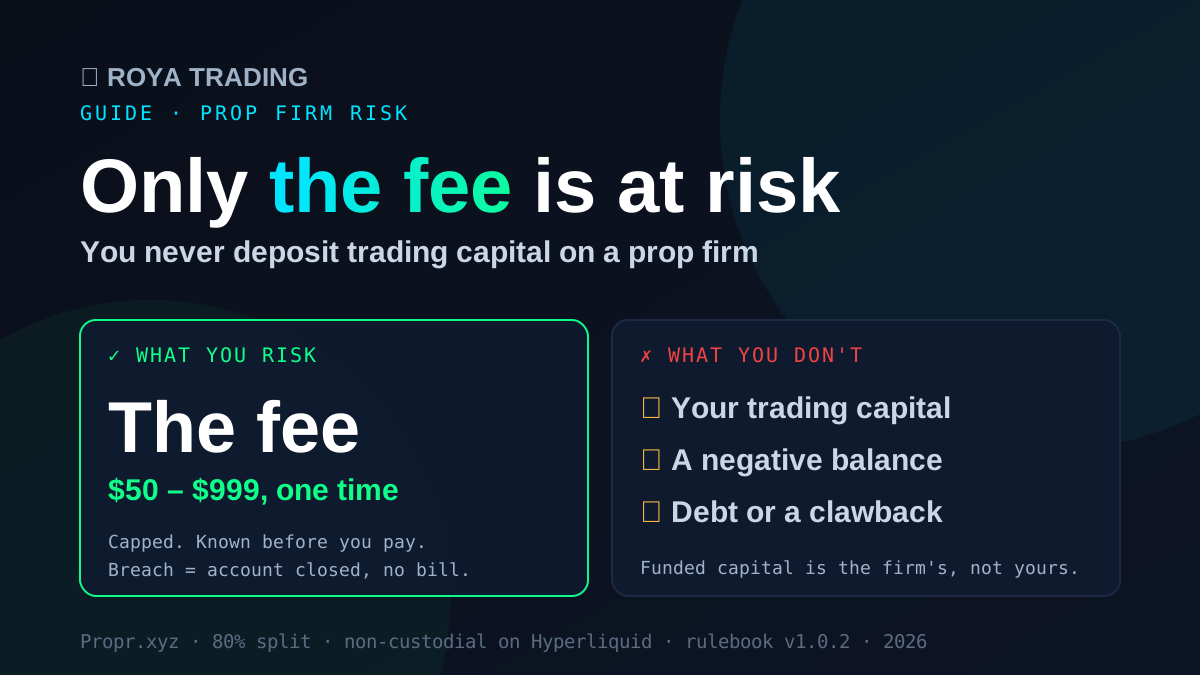
It's the first question anyone sane asks before paying for a prop firm challenge: if this goes wrong, how much can it actually cost me? The fear is that you're wiring money into a trading account, blowing it up, and then owing more — the way a leveraged position can go negative on a normal exchange. So let me answer it flatly, from the perspective of someone who trades these accounts and builds a bot for them.
The short answer: the fee is the whole risk
On a firm like Propr.xyz, the only money you can lose is the challenge fee — a one-time payment that starts at $25 (Turbo 1-Step $5K) and tops out at $1,998 (Classic 1-Step $200K, the biggest account; grid read 10 September 2026). You never deposit trading capital. You can't be margin-called for more than you paid. There is no negative balance, no debt, no clawback of profits you've already withdrawn. Whatever happens on the charts, your maximum financial loss is the price of the attempt. Everything below is just the detail behind that sentence.
Affiliate link. We earn a commission; it never changes what you pay — it is what funds your cashback.
You never deposit trading capital
This is the part that trips people up, because it's the opposite of a normal exchange. When you buy a Propr evaluation, you pay a fee and receive an evaluation account pre-loaded with the firm's simulated capital — 5K, 10K, 25K, 50K, 100K or 200K, the six sizes on the grid we read on 10 September 2026. That balance isn't yours and it was never your cash. Your job is to hit a profit target on it while respecting two limits. You are renting a set of rules and a shot at funding, not funding an account.
So the mental model "I put in $500 and I could lose it all" is wrong on both ends. You didn't put in $500 of trading money — you paid a fee. And you can't "lose it all" in the exchange sense, because there's nothing of yours sitting on the account to be liquidated against you. If you want the fee-by-fee breakdown and whether the price is worth it, I ran the full numbers in the Propr.xyz challenge cost breakdown.
The word simulated in that paragraph is the one that generates the follow-up question, so I answered it separately: whether the capital is real, what A-book and B-book mean for the firm's incentives, and the three checks that actually predict whether you'll get paid, in prop firm accounts: real money or demo?
The evaluation phase: your fee is the maximum loss
During the evaluation, two rules end your account if you cross them: a maximum daily loss and a maximum drawdown. The daily loss is 3% (1-Step) / 5% (2-Step) of your start-of-day balance, snapshotted at 00:00 UTC and recomputed daily; the breach itself is measured on equity, floating P&L included (rules read 12 September 2026). Alongside it, the 1-Step runs a 6% static drawdown and the 2-Step an 8% trailing one. Breach either one and the account is closed — that's it. You don't get a bill. Propr doesn't come after you for the paper losses on their simulated capital. The consequence of failing is that you lose access to that account and the fee that bought it.
In other words, the daily loss and drawdown aren't limits on your money — they're the firm's risk controls on their capital, and hitting them just ends your attempt. If you want the exact mechanics of each limit, I broke them down in the Propr rules explained.
The funded phase: it's the firm's capital, not yours
Pass the evaluation and you get a funded account. Same principle, higher stakes for the firm: the capital you trade belongs to Propr, settled non-custodially on Hyperliquid. You keep 80% of the profit, paid out in USDC on-chain (minimum $20, typically landing in a few hours). What you never do is add your own money to it. If you breach a rule on a funded account, you lose the account — not a cent more. Past payouts you've already withdrawn are yours to keep.
This is the actual appeal of the prop model, stripped of the marketing: it converts a large, scary capital risk into a small, fixed fee risk. Instead of putting $25,000 of your own money at risk to trade a $25,000 book, you pay a few hundred dollars for the right to trade the firm's $25,000 and split the upside. For how the payout side works end to end, see Propr.xyz payouts: how much and how fast.
Can you go negative or owe money? No.
On a normal leveraged exchange, a violent move can push your position past your collateral and leave you with a negative balance the platform expects you to cover. A prop firm evaluation doesn't work like that. Because you're trading the firm's capital under a rulebook, the worst case is a closed account, not a debt. There's no margin call directed at your wallet, no "you owe us the difference," no surprise invoice.
Propr's non-custodial, on-chain settlement makes this concrete: your personal funds are never pooled into a balance that can be drawn below zero on your behalf. The rules are enforced on the firm's capital, and the enforcement action is always the same — the account stops. That's a very different risk shape from holding a naked perp with your own money, and it's the honest reason a prop challenge is often less risky than trading your own bankroll at size.
The one place a rule can still sting: trailing drawdown
Here's the nuance I won't hide. On the 2-Step, the 8% max drawdown is trailing: it follows your highest equity, so early in a phase you can be up on the day and still breach, because the limit is measured from your peak rather than from zero. When that happens it feels like the firm took money you'd earned — but you don't owe anything, and any payouts already sent are still yours. What you actually lose is access to that account plus the fee that bought it.
It's the most misread rule in the category, and it's why people post "I was in profit and still got breached." The 1-Step's static drawdown avoids the trap entirely because its floor never moves. I put both rules side by side with worked numbers in trailing vs static drawdown — read it before you pick a format, because it changes what "risk" means for your account.
The costs nobody writes on the pricing page
"You only risk the fee" is true, but I'd be a bad guide if I stopped there. There are two soft costs stacked on top:
- Retries. If you keep breaching, you keep buying new evaluations. Someone who blows three 25K attempts didn't lose $25,000 — they spent three fees. But three fees is still real money, and it's why "pass on the first try" is the only cost optimization that matters.
- Opportunity and time. Every failed attempt is capital and hours you don't get back. That's not debt, but it's not free either — and it's exactly the cost that discipline, not strategy, controls.
Both of these are self-inflicted, which is the good news: they're within your control. The five ways traders quietly torch their fee — blown daily loss, the trailing trap, revenge trading, no plan, wrong account size — are all behaviour, not markets. I catalogued them in why 90% of prop firm traders fail.
How to make sure the fee isn't wasted
If the only real risk is the fee, then protecting the fee is the entire game. Three things do most of the work:
- Right-size the account. Buy the size your bankroll can absorb losing, not the biggest one you can afford in one click. If you're unsure, I laid out the trade-offs in which Propr.xyz account size to choose.
- Treat the limits as hard walls. The daily loss and drawdown aren't guidelines to flirt with — they're the exact lines that end your attempt. Size every position so a normal losing day can't touch them.
- Automate the discipline. Most fees die to a human decision at a bad moment. Take the human out of the enforcement.
That last point is why I run my own execution semi-auto rather than through a black box: a bot wired to the API can run a DCA strategy with hard guardrails on your own Propr account, non-custodial — here’s how the Propr API handles automated trading. You choose the trade — the bot handles the execution, the scaling and the stops, and it will not cross the daily or drawdown line even if you want to. It's not autopilot; you're still the trader. It just removes the 2am decision that usually costs people the fee.
Why "bots allowed" is itself a risk feature
One quiet advantage of Propr is that it lets you automate. Bots, copy trading and API access are all permitted, which means you can enforce your own risk rules mechanically. That's not matched everywhere: Propr's closest on-chain rival, Hypernova, used to ban third-party copy trading under §14.2 of its closed-alpha rulebook — its public rules, read 16 August 2026, list no bot restrictions, but there's no turnkey tooling published there. If protecting the fee means automating discipline, the firm that allows automation is the lower-risk choice. I compared the two rulebooks in the best crypto prop firm for bots and API.
So — is a prop firm risky?
Financially, far less than the fear implies. You never deposit trading capital, you can't go negative, and your maximum loss is a fee you knew before you paid. Compared with putting your own five figures on a leveraged perp, a prop challenge is a capped-downside way to trade size — I put the two side by side, dollar for dollar, in prop firm vs trading your own money. The real risk isn't a blowout that follows you home — it's quietly spending fee after fee by failing the same way each time.
That's a solvable problem, and it's a discipline one. If you're weighing this against the rest of the field, start with the best decentralized prop firms of 2026, then use the exact playbook I follow in how to pass a Propr.xyz challenge. Risk the fee, protect the fee, and let the account do the rest.
FAQ — Do you risk your own money on a prop firm?
Do you risk your own money on a prop firm?+
No. On a firm like Propr.xyz you never deposit trading capital. You pay a one-time evaluation fee (from $25 for a Turbo $5K up to $1,998 for a Classic 1-Step $200K, grid read 10 September 2026), and that fee is the maximum you can lose. Both the evaluation and the funded account trade the firm's capital, settled non-custodially on Hyperliquid, so you can't go into a negative balance or owe anything beyond the fee you already paid.
Can you lose more than the challenge fee?+
No. If you breach the daily loss limit or the max drawdown, the account is simply closed. There's no margin call against you personally, no negative balance and no clawback of past payouts. Your financial downside is capped at the fee you paid — the rest is time and opportunity cost.
Do you use your own money on a funded account?+
No. A funded account is the firm's capital. You trade it under the rules and keep 80% of the profit, paid in USDC on-chain. You never top it up yourself; the only cash you ever put in is the challenge fee. That's the whole point of the prop model — the firm supplies the capital, you supply the edge.
Is the Propr.xyz challenge fee refundable?+
Treat the fee as the cost of the attempt, not a deposit you get back on demand. The reliable way to protect it is to pass on the first try, which is far more a discipline problem than a strategy one — most blown challenges come from breaking a rule, not from being wrong about the market.
Can the trailing drawdown make me lose money I earned?+
On the 2-Step, the 8% max drawdown trails your peak equity, so you can breach while still net-positive on the day. You don't owe anything, but you lose access to that account and the fee that bought it. It's the single most misread rule on Propr — worth understanding before you pick a format.
How do I make sure the fee isn't wasted money?+
Size the account to your bankroll, treat the daily loss and drawdown as hard walls, and automate the discipline instead of trusting your 2am self. A semi-auto DCA bot can run with hard guardrails on your own Propr account, non-custodial: you pick the trade, it manages the execution inside the rules.
Risk the fee — then protect it, semi-auto.
Run a DCA bot with hard daily and drawdown guardrails on your own Propr account. You pick the trade; it handles the execution and never crosses the line. Start free on Telegram.
Get 5% USDC cashbackNot on Propr yet? Create your Propr.xyz account and get 5% USDC cashback on your challenge fee.
Affiliate link. We earn a commission; it never changes what you pay — it is what funds your cashback.
⚠️ Trading carries risk. Rules, fees and limits come from Propr's published rulebook and can change — always check Propr's own rules page before paying. Nothing here is guaranteed and past performance does not predict future results. This article is informational and not investment advice. Do your own research and only trade what you can afford to lose.