
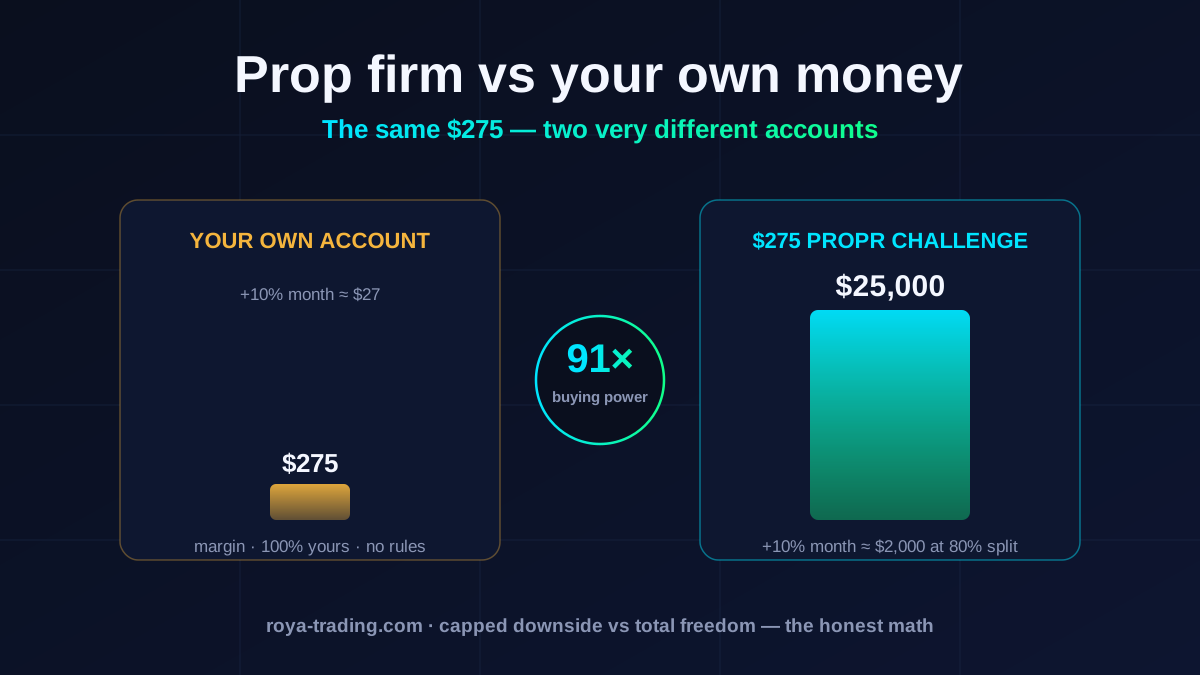
Every trader who discovers crypto prop firms asks the same question within five minutes, and it's the right question: why would I pay $275 for a challenge when I could just deposit that $275 on Hyperliquid and trade it myself? No rules, no profit split, no target, and the money is mine. I've run both setups side by side for over a year — personal Hyperliquid account on one screen, funded Propr.xyz accounts on the other — so instead of a sales pitch, here's the actual arithmetic of what each dollar buys, where the prop model quietly taxes you, and the cases where keeping your money in your own wallet is flatly the better trade.
The short answer
It comes down to what you're short of. If you're short of capital — you have a method that works but $275 of margin makes even perfect months pay pocket change — the challenge is the rational buy: it converts a fixed fee into roughly 91x the buying power, with your downside capped at the fee. If you're short of freedom — your edge needs 20x leverage, week-long holds through −10% drawdowns, or you never want to touch KYC — your own account wins and no fee structure changes that. And if what you're actually short of is an edge, neither option fixes it; the challenge just prices your learning curve in fees instead of deposits.
The same $275, two very different accounts
Let's make it concrete with Propr's mid-size tier, since both paths start from the same wallet and the same USDC. Published rulebook numbers:
| $275 on your own Hyperliquid account | $275 Propr.xyz 1-Step ($25K) | |
|---|---|---|
| Buying power | $275 margin | $25,000 account |
| A +10% month pays | ~$27 (yours) | $2,000 (80% of $2,500) |
| Max loss | Full deposit — refillable on tilt | The fee, period |
| Rules | None | 10% target · 3% daily loss (start-of-day balance, 00:00 UTC) · 6% static drawdown |
| Leverage | Up to 40x BTC | 5x BTC/ETH (read 12 September 2026) · 2x other perps |
| Profit split | 100% | 80% (USDC on-chain, $20 min, <24h) |
| KYC | Never | Only before funded payouts |
| Spot / long holds | Yes | Perps only, within drawdown |
Both columns trade the same venue. A funded Propr account executes on Hyperliquid rails — same order book, same fee schedule, same funding rates — which is exactly why this comparison is clean: the only variables are whose capital, whose rules, and whose cut.
The capital math: what a unit of skill pays
Strip everything else away and price one identical unit of trading skill — a +10% month — through both structures. On your own $275: about $27, before you reinvest it and wait. To pull a $2,000 month out of $275 of personal margin you'd need +727%, monthly. Nobody does that sustainably; at 5x leverage it still demands a 145% move in your favor without a liquidating wick against you.
The funded route pays that same $2,000 for the same 10% of skill — I walked through the full earnings ladder from $5K to the funded cap in how much you can actually make. The honest adjustment is that you don't pass every challenge, so your true entry price is fee ÷ pass rate — the number I built the challenge cost breakdown around. Pass 30% of the time and the $25K seat really costs ~$917. That's still buying $25,000 of deployment for under a thousand dollars, which is the entire reason this industry exists: it's a market where traders rent size with skill instead of savings.
What the fee actually buys: a hard floor under your worst self
The subtler product you're buying is bounded downside. On a challenge, the worst case is written on the receipt: the fee is gone, nothing else — you never deposit trading capital, you can't go negative, and a breach takes none of your money because Propr's capital, not yours, sits behind the account.
Your own account has no such floor. The deposit can go to zero — standard, priced in — but the real killer is that it's refillable. Ask anyone who has blown a personal account: the first deposit rarely does the damage; the three tilted refills afterwards do. A fee model is a pre-commitment device — the tilt spiral is capped at the sticker price, and starting over is a conscious purchase decision instead of a 2am transfer. I've written about why most challenge traders still fail, and the uncomfortable mirror is that the same behavior on a personal account doesn't fail cheaper — it fails deeper.
The rules tax: what the 91x costs you
None of this is free, and pretending otherwise is how people donate fees. Propr's structure taxes you four ways. First, the split: 80% of profits are yours, 20% is the firm's — on your own account you keep 100%. Second, the rulebook: a 10% profit target to pass, a daily loss of 3% (1-Step) / 5% (2-Step) of your start-of-day balance, snapshotted at 00:00 UTC and recomputed daily, and a 6% static max drawdown; the breach itself is measured on equity, floating P&L included — touch a limit for one second and the account is breached (read 10 September 2026). If those mechanics aren't second nature, read the full rules breakdown before spending anything. Third, the leverage cap: 5x on BTC/ETH (side panel and changelog; the §12 table on the same page says 10x — unreconciled as of our reading on 12 September 2026) and 2x on other crypto perps, where Hyperliquid offers up to 40x directly — I covered why prop firms cap it in the leverage guide. Fourth, identity: the evaluation is wallet-only, but KYC gates the first funded payout.
Whether that tax is worth paying is just arithmetic: 80% of profits on $25,000 versus 100% of profits on $275. The split costs you a fifth; the capital multiplies your base by ninety-one. The rules are the real price — and only you know whether your method fits inside a 3% day and a 6% floor. If it needs more breathing room, the 2-Step's 5% daily / 8% trailing structure is the wider cage, with its own trailing-drawdown trap to respect.
The leverage illusion: 40x on dust vs 5x on size
"But Hyperliquid gives me 40x!" — it does, and on $275 that's a maximum of about $11,000 of BTC exposure, sitting one 2.5% wick from liquidation. The funded account's modest 5x on $25,000 is $125,000 of potential exposure — eleven times more — of which a disciplined trader uses a fraction precisely because the drawdown rules force sane sizing. High leverage on a small stack isn't power; it's a shorter fuse on the same firecracker. Size × survivable leverage beats maximal leverage × dust in every scenario except the lottery ticket, and Propr's rulebook bans playing it like one anyway (account cycling for binary bets is explicitly prohibited).
When trading your own money is simply better
The honest list, because a comparison that always concludes "buy the challenge" is an ad:
- Your edge violates the rules. Deep averaging through −10%, holding through major news, moonshot alt positions at 10x — if the method needs room a 6% static floor can't give, a funded account will just serially breach. Trade it on your own capital, sized accordingly.
- You hold, more than you trade. Spot accumulation, multi-month theses, staking — prop accounts are perp-trading vehicles with drawdown clocks. Ownership is the point of a long hold; rent doesn't suit it.
- You will never do KYC. The challenge itself stays wallet-only, but getting paid as a funded trader doesn't — the no-KYC guide maps exactly where the line sits. Your own account never asks.
- Your bankroll is genuinely tiny. Below the $60 entry fee, the question answers itself — trade small, build the habit and the stats first.
- You haven't proven an edge yet. Fees are a terrible tuition plan. A small personal account that produces three months of honest, boring statistics is the cheapest education in trading — and it converts your first challenge from a coin-flip into a calculated purchase.
When the funded account wins
- Proven edge, small capital. The classic case: your method clears 5–10% in good months on rule-compatible risk, and compounding $275 would take years to reach the size a single $275 fee rents today.
- Discipline is your weak point. Externally enforced daily loss and drawdown limits are risk management you can't override at 3am. Some traders are only profitable inside a cage — that's not an insult, it's a use case.
- You want trading income without touching savings. The fee is an expense line, not an investment at risk. Worst case is known before entry — that's a luxury your own account never offers.
- You're building toward real size. Propr stacks to an aggregate $300K funded cap across accounts, on-chain payouts run in USDC with a $20 minimum in under 24 hours, and every dollar of volume also farms Propr points ahead of the $PROPR TGE — upside that self-funded trading simply doesn't pay.
The hybrid: what I actually run
This was never really an either/or. My setup, and the one I'd hand a friend: a small personal Hyperliquid account for freedom — spot, experiments, high-conviction holds, anything that breaks challenge rules — and funded Propr accounts for size, where the downside of being wrong is a fee and the upside of being right is 80% of profits on five figures. The personal account is where an edge gets proven; the funded account is where it gets paid. Same chain, same venue, same skills — different risk envelopes. If you're still weighing the model itself, the on-chain vs traditional prop firm comparison explains why I'd only run this play on a firm whose payouts are verifiable on-chain, and the decentralized prop firm comparison ranks the firms that qualify.
Execution is the same skill either way
Here's the part both camps underrate: whichever account you fund, the thing that blows it is rarely the analysis — it's the execution at 2am. That's the entire reason our Telegram bot is semi-automated: you pick the trade, and the bot executes the DCA entries, take-profit and stop-loss mechanically. On a personal account, that kills the tilt refill reflex; on a funded account, it also enforces the exact daily loss and drawdown limits of your challenge so a fat finger never breaches what your analysis earned. Propr is one of the few firms where this is explicitly legal — bots, copy trading and API are allowed in the rulebook — which is why the whole stack runs there. The playbook for actually clearing the evaluation is in how to pass a Propr.xyz challenge; and if the math above tilts you toward renting size, create your Propr.xyz account here — the link pays 5% USDC cashback on any challenge fee, which on the $25K tier is $13.75 back before your first trade.
Affiliate link. We earn a commission; it never changes what you pay — it is what funds your cashback.
FAQ — prop firm vs your own money
Is a prop firm better than trading your own money?+
Neither is better in the abstract — they solve different problems. A prop firm solves a capital problem: if you have a proven, rule-compatible edge but a small account, a $275 Propr.xyz evaluation gives you $25,000 of buying power for a fixed, known cost. Trading your own money solves a freedom problem: no profit target, no daily loss limit, no profit split, no KYC, any leverage the exchange offers. If you have no edge yet, neither one manufactures it — you'll just lose the fee faster in one case and the deposit slower in the other.
Why pay a challenge fee instead of just depositing that money on Hyperliquid?+
Capital efficiency. $275 deposited on Hyperliquid is $275 of margin — a 10% winning month, unlevered, makes about $27. The same $275 as a Propr.xyz 1-Step fee controls a $25,000 account, where the same 10% month is $2,500 in profit and $2,000 in your pocket at the 80% split. Even accounting for pass rates — your true cost is fee ÷ pass rate — the funded route pays an order of magnitude more per unit of skill, as long as your method survives the rules.
What do you give up by trading prop firm capital instead of your own?+
Four things: 20% of your profits (the split is 80/20 in your favor), freedom (a daily loss of 3% (1-Step) / 5% (2-Step) of your start-of-day balance, snapshotted at 00:00 UTC and recomputed daily — the breach itself is measured on equity, floating P&L included — plus a 6% static max drawdown on Propr's 1-Step), leverage (capped at 5x on BTC/ETH — side panel and changelog; the §12 table on the same page says 10x, unreconciled as of our reading on 12 September 2026 — and 2x on other crypto perps, versus up to 40x on BTC trading Hyperliquid directly), and pseudonymity at the payout stage (KYC is required before your first funded payout). On your own account, none of those constraints exist.
Is the downside really capped with a prop firm?+
Yes — and this is the most underrated difference. Your maximum loss on a Propr challenge is the fee you already paid: $25 to $1,998 depending on size and format (six sizes from $5K to $200K, four formats — read 10 September 2026). Breach the rules and the account dies, but no further money leaves your wallet. On a self-funded account the deposit can go to zero and, more dangerously, nothing stops you from topping it up on tilt — the real historical damage of most blown personal accounts isn't the first deposit, it's the refills.
Can you do both — trade your own account and a funded account?+
Yes, and it's arguably the optimal setup. Keep a small personal Hyperliquid account for freedom: spot, high-conviction holds, strategies that break challenge rules. Run your size through funded accounts, where a breach costs a fee instead of savings. Propr allows multiple accounts up to an aggregate $300K funded cap, and both sides run on the same Hyperliquid rails — same markets, same fee schedule, same execution.
Does the same trading bot work on both a personal and a prop firm account?+
On Propr.xyz, yes — bots, copy trading and API access are explicitly allowed, which is rare. A bot via the official API runs semi-automatically on your Propr account: you choose the trade, it executes the DCA entries, take-profit and stop-loss with your account's exact daily loss and drawdown limits as hard guardrails. That last part is the point: on a personal account a bot only has to manage the market; on a funded account it also has to manage the rulebook.
Whichever account you fund — execute like a machine.
Our Telegram bot runs your DCA entries, take-profit and stop-loss semi-automatically on your own Propr account — you pick the trade, the bot respects your exact daily loss and drawdown limits. Start free on Telegram.
Get 5% USDC cashbackReady to rent size instead of risking savings? Create your Propr.xyz account and get 5% USDC cashback on your challenge fee.
Affiliate link. We earn a commission; it never changes what you pay — it is what funds your cashback.
⚠️ Trading carries risk. Rules, fees and limits quoted here come from Propr's published rulebook and can change — always check Propr's own rules page before paying. Exchange leverage and conditions on Hyperliquid can change too. Nothing here is guaranteed and past performance does not predict future results. This article is informational and not investment advice. Do your own research and only trade what you can afford to lose.