
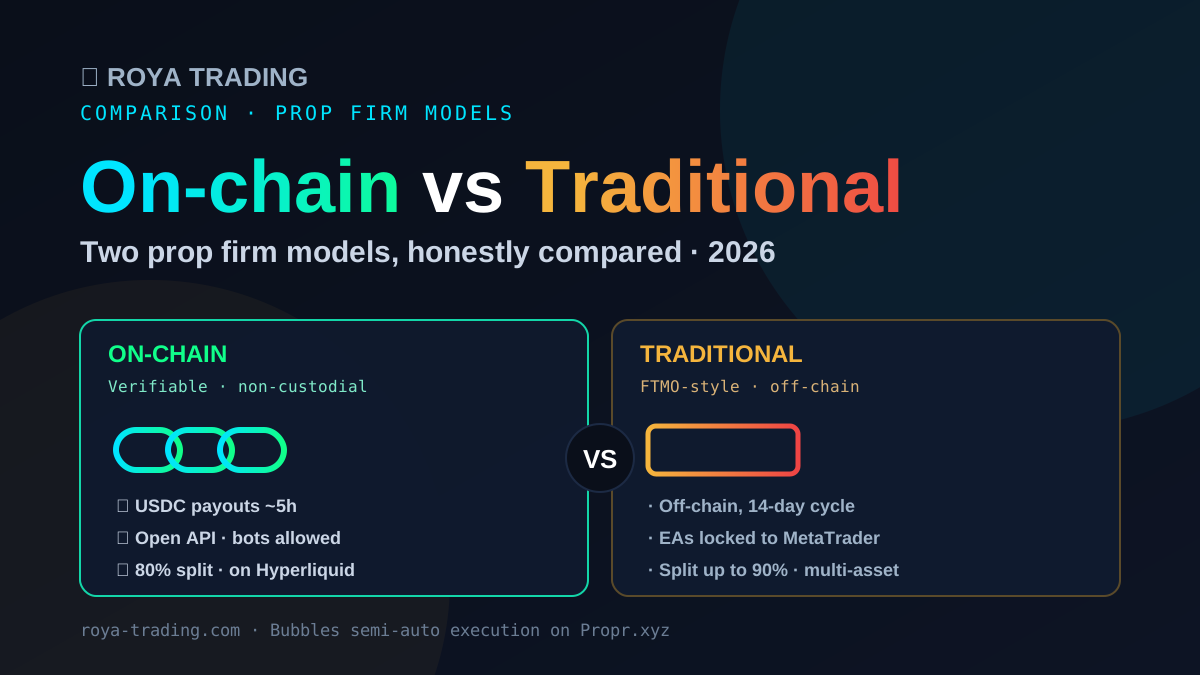
Prop firms come in two flavours now, and the difference is bigger than the marketing makes it look. On one side you have the traditional model — FTMO and its many imitators: a simulated account on a centralized broker, your P&L living on the firm's dashboard, payouts from an internal back office. On the other you have the on-chain model — firms like Propr.xyz on Hyperliquid, where your trades hit a real on-chain orderbook and your payouts land in USDC you can verify yourself. I trade and automate on-chain accounts for a living, so here's the honest, trader's-eye comparison of the two models — what actually differs, where each one wins, and how to choose.
The short answer
If you trade crypto and you care about verifiable payouts and the ability to automate, on-chain wins — and Propr.xyz is my default pick. If you trade forex or multi-asset and you want the biggest, most established brand with a split that scales to 90%, a traditional firm like FTMO is still the natural home. The two models have converged on price and rules; where they genuinely diverge is transparency, custody and automation. That's the lens to choose through, and it's what the rest of this breakdown is about.
What a "traditional" prop firm actually is
The traditional prop firm is the model most people picture: you pay a one-time evaluation fee, hit a profit target without breaching the loss limits, and get a "funded" account. Under the hood, you're trading a simulated environment on a centralized broker — MetaTrader (MT4/MT5) or a similar terminal. The firm reports your balance and your breaches on its own dashboard, and when you request a payout it comes from the back office, off-chain, on a fixed schedule.
FTMO is the archetype: the biggest and most established firm in the category, multi-asset (forex, indices and commodities on centralized brokers, with crypto only available as CFDs), with a profit split that scales up to 90% and funded capital up to $200K. Payouts are on demand after the first 14 days, off-chain, with roughly 8 hours of processing on a bi-weekly cycle. Automation exists, but inside the firm's walls: Expert Advisors (EAs) on MetaTrader. It's a mature, well-understood product — the trade-off is that everything you see, from your P&L to your payout, is something the firm tells you, not something you can independently verify.
What an "on-chain" prop firm actually is
An on-chain (or decentralized) prop firm moves settlement and payouts onto a blockchain. The funding model is the same — one-time fee, profit target, loss limits, a funded account at the end — but the rules, profit split and USDC payouts are verifiable on-chainrather than self-reported. On Hyperliquid, the high-performance L1 that has become the home of on-chain prop trading, your orders route to a real decentralized orderbook with deep liquidity and sub-second execution.
Propr.xyz is the most product-complete example in 2026: 150+ markets (real crypto perps, plus equity and commodity perps), an 80% profit split, USDC on-chain payouts that average ~5 hours, and — the part traditional firms can't match — an open API that lets you automate your challenge. Crucially, the setup is non-custodial: you pay the evaluation fee but never deposit trading capital, and an automation tool only places orders via an API key. I broke down the firm end-to-end in my Propr.xyz review, and lined it up against the whole field in the best decentralized prop firms guide.
Head-to-head: the five things that actually differ
Strip away the marketing and the two models differ on five things that matter to your money:
- Transparency: on-chain rules and payouts are publicly verifiable; traditional firms are a self-reported dashboard.
- Custody: on-chain is non-custodial (payouts to your wallet); traditional firms hold and disburse internally.
- Payouts: Propr's USDC on-chain ~5h vs FTMO's off-chain, 14-day-then-bi-weekly cycle (~8h processing).
- Automation: open API + bots/copy allowed (Propr) vs EAs locked to MetaTrader (traditional).
- Markets & brand: on-chain is crypto-native; traditional is multi-asset, older and more established.
Transparency and custody: verifiable vs "trust us"
This is the real reason the on-chain model exists. With a traditional firm, every number you see — your equity, your drawdown level, whether a payout was actually sent — comes from the firm's own systems. When firms have blown up or delayed payouts in the past, traders found out the hard way that a dashboard is a promise, not a proof. On-chain settlement turns those promises into public records: your payout is a blockchain transaction with a hash, your account settles against a real orderbook, and the rules are enforced by code you can inspect. It doesn't make trading less risky — it makes the counterparty less of a leap of faith.
One honest caveat, because the marketing tends to overshoot here: "on-chain" applies to the settlement and the price reference, not to your evaluation balance, which is a simulated ledger entry at on-chain and traditional firms alike. I pulled that apart layer by layer in prop firm accounts: real money or demo? — it's the article to read before you decide which claims a firm makes are actually verifiable.
Payouts: where on-chain pulls clearly ahead
Payout experience is the most tangible day-to-day difference. On Propr, a payout is a USDC transfer on Hyperliquid — $20 minimum, paid within 24 hours and ~5 hours on average — that you can verify on-chain the moment it lands. On a traditional firm like FTMO, your first payout is gated by a 14-day waiting period, then runs on a bi-weekly cycle, off-chain, with around 8 hours of processing once requested. Neither is slow by industry standards, but one is a wallet transfer you control and verify, and the other is a request you submit and wait on. I went deep on the mechanics, minimums and timing in how Propr.xyz payouts work.
Automation: an open API vs EAs in a walled garden
Both models let you automate, but the on-chain version is more powerful and more open. Traditional firms support Expert Advisors on MetaTrader — capable, but locked to the firm's platform and asset set. On-chain firms with an open API let you run software directly against your account: DCA entries, take-profits and hard stop logic, placed via API key without ever taking custody of your funds. That open API is exactly what makes a crypto prop firm bot-friendly, and it's the foundation Bubbles is built on.
One important caveat for the on-chain camp: not every on-chain firm treats bots the same way. Hypernova's closed-alpha rulebook (§14.2) used to ban third-party copy trading and signals; its public rules, read 16 August 2026, list no bot restrictions — but there's no turnkey automation layer like Bubbles there, whereas Propr explicitly allows bots, copy trading and full API access and has the tooling to match. If automation is part of your plan, that difference decides the firm for you. I compared the two rulebooks line by line in Propr vs Hypernova.
Rules and fees: closer than you'd think
People assume on-chain firms must be cheaper or looser. They're not, really — the rulebooks have converged. Propr's 1-Step asks for a 10% target with a 3% fixed daily loss and a 6% static drawdown; its 2-Step softens the daily limit to 5% across two phases but adds an 8% trailing drawdown. Fees run $60–$1,998 (1-Step) and $50–$1,499 (2-Step) across the 5K–200K sizes — right in line with what traditional firms charge for comparable accounts. The drawdown style matters more than the number, and it's the thing most traders get wrong; I explained why a fixed floor beats a moving one for most people in trailing vs static drawdown.
Where traditional firms still win
On-chain isn't automatically better for everyone, and I'd be a bad guide if I pretended otherwise. Traditional firms keep three real advantages:
- Multi-asset breadth. If you trade forex pairs, indices or commodities as your bread and butter, the established firms are built for that. On-chain firms are crypto-first.
- Track record and brand. FTMO and peers have paid out for years through multiple market cycles. The on-chain category is new — Propr launched recently, and most of its rivals are newer still.
- Split ceiling. A traditional split that scales to 90% beats Propr's flat 80% on the headline number, if maximum split is your single optimisation target.
The honest summary: the on-chain model trades a longer track record for radical transparency and automation. Whether that's a good trade depends entirely on what — and how — you trade.
So which should you pick?
Pick on-chain if you trade crypto, you want payouts you can verify yourself, and you plan to automate or copy-trade with a bot. The combination of an open API, non-custodial payouts and verifiable settlement is something the traditional model structurally can't offer. Propr.xyz is my default recommendation here.
Pick traditional if forex or multi-asset is your core, you want the longest track record and the biggest brand, and a split that scales to 90% matters more to you than transparency or automation. There's no shame in it — it's a mature product that does its job.
If you're new to the category and still mapping the field, start by comparing the best decentralized prop firms of 2026, then come back and decide which model fits your trading. And if you specifically want the established giant's side of this argument, I put Propr directly against it in Propr vs FTMO — or, for the cheaper end of the traditional field, Propr vs FundingPips, where a $29 entry ticket meets an automation clause that rules out third-party bots.
The on-chain advantage I actually use: semi-auto execution
Here's where the abstract "automation" advantage becomes concrete. Because Propr exposes an open API, I run Bubbles on my own account to handle the part of trading that humans are worst at: execution discipline. Bubbles is semi-auto, not autopilot — you pick the trade and the direction, and Bubbles handles the execution: a DCA entry with hard, pre-set daily-loss and drawdown stops, non-custodial, on your Propr account. A traditional firm's walled-garden EAs can't plug into your account the same way, and an on-chain firm that bans bots (like Hypernova) takes the option off the table entirely. The open, bot-friendly on-chain model is the whole reason this works.
FAQ — on-chain vs traditional prop firms
What's the difference between an on-chain and a traditional prop firm?+
A traditional prop firm (FTMO-style) runs everything internally: you trade a simulated account on a centralized broker, your P&L lives on their dashboard, and payouts come from their back office on a fixed cycle. An on-chain prop firm settles trades and payouts on a blockchain — on Hyperliquid, firms like Propr.xyz route orders to a real on-chain orderbook, pay in USDC you can verify yourself, and expose an open API so you can automate your challenge. The headline difference is trust: verifiable on-chain rules and payouts versus a black box you have to take on faith.
Are on-chain prop firms safe or legit?+
On-chain settlement is a genuine trust upgrade because payouts and rules are publicly verifiable rather than self-reported. But the category is new and unregulated, and leveraged trading carries a high risk of loss regardless of the model. The smart approach is the same one I use: verify a firm's public payout proof and track record, start with a small account, and only trade what you can afford to lose. Traditional firms are older and more battle-tested, but 'older' is not the same as 'safer' for your money.
Which pays faster, on-chain or traditional prop firms?+
On-chain, by a wide margin in practice. Propr.xyz pays USDC on-chain on demand — around 5 hours on average, with a $20 minimum — and because it settles on Hyperliquid you can verify the transaction yourself. A traditional firm like FTMO pays on demand only after the first 14 days, off-chain, on a bi-weekly cycle with roughly 8 hours of processing. Same idea, very different experience: one is a transparent wallet transfer, the other is a back-office request you wait on.
Can I use a bot on a traditional vs an on-chain prop firm?+
Both allow automation, but very differently. Traditional firms support Expert Advisors (EAs) on MetaTrader (MT4/MT5) inside their own platform. On-chain firms like Propr.xyz expose an open API, so a bot such as Bubbles can place orders directly on your account — DCA entries, take-profits and hard stops — non-custodially. Note the rules differ by firm: Hypernova's closed-alpha rulebook (§14.2) used to ban third-party copy trading and signals, and while its public rules, read 16 August 2026, list no bot restrictions, there's no turnkey tool there — which is why Bubbles runs on Propr and not Hypernova.
Do on-chain prop firms make you deposit your own crypto?+
No. As with a traditional firm, you pay a one-time evaluation fee and then trade the firm's capital — you never deposit trading funds. The difference is custody: with a non-custodial on-chain setup, the firm and any automation tool only place orders via an API key, and your payouts arrive in your own wallet. You are not handing trading capital to a back office.
Should a crypto trader pick on-chain or traditional in 2026?+
If you trade crypto perpetuals and value verifiable payouts plus the ability to automate, on-chain wins — Propr.xyz is my default for exactly that. If you trade forex, indices or multi-asset and want the biggest, most established brand with a split that scales to 90%, a traditional firm like FTMO is the more natural fit. The two models are converging on price; they differ most on transparency, custody and automation.
Trade the on-chain edge — semi-auto.
Bubbles runs a DCA bot with hard daily-loss and drawdown guardrails on your own Propr account. You pick the trade, it handles the execution. Non-custodial, free to start on Telegram.
Get 5% USDC cashbackNot on Propr yet? Create your Propr.xyz account and get 5% USDC cashback for life on fees.
⚠️ Trading carries risk. Propr's rules, fees and limits come from its official rulebook (v1.0.3) and can change; traditional-firm terms vary by provider — always check each firm's own rules page before paying. Nothing here is guaranteed and past performance does not predict future results. This article is informational and not investment advice. Do your own research and only trade what you can afford to lose.