
Every prop firm Discord arrives at this question within a week: "can I just have a bot pass it for me?" It's a reasonable thing to ask. A challenge is a rules game — hit a profit target, never touch two loss lines — and rules games feel like they should be automatable. I run automation on my own Propr.xyz accounts, my entire product is built on it, and my answer still has two halves that most articles on this topic conflate: whether a bot is allowed to trade your challenge, and whether an unsupervised bot is likely to pass one. The first is a rulebook question with a clean yes on the right firm. The second is where the bodies are buried — and where the version of automation that actually works looks different from the one people imagine buying.
Affiliate link. We earn a commission; it never changes what you pay — it is what funds your cashback.
The short answer
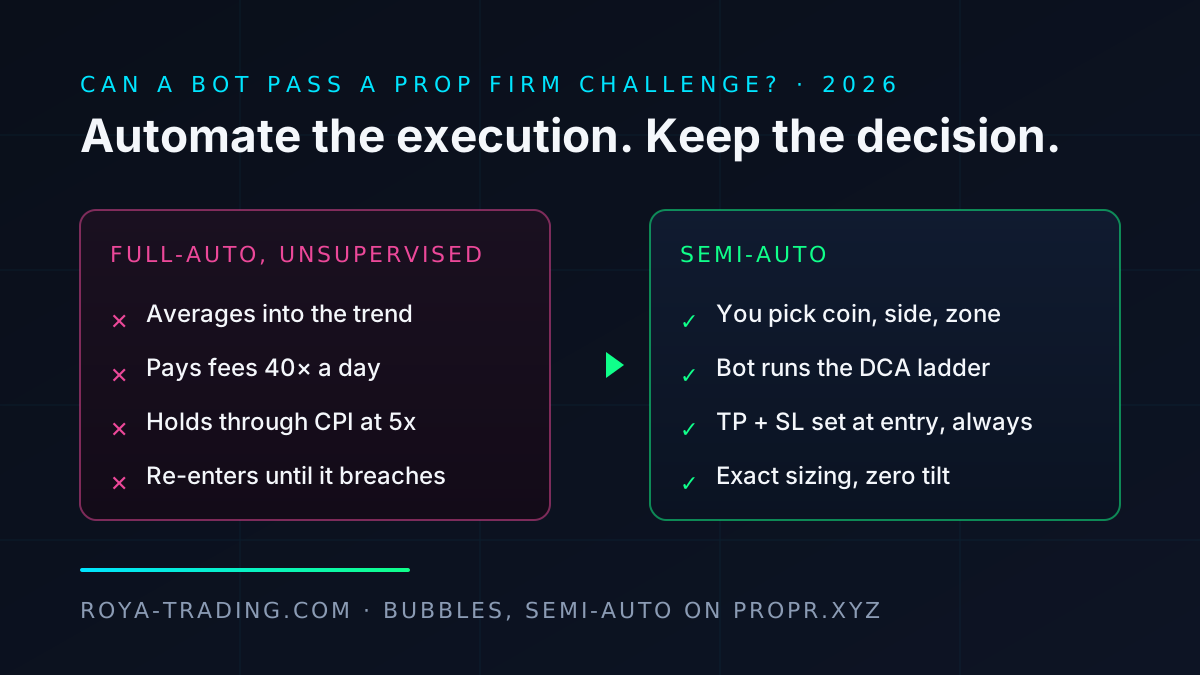
Allowed? Yes, on the right firm. Propr's rulebook explicitly permits bots, copy trading and API access (§14, re-read 31 August 2026), and the rest of its structure — no time limit, no minimum trading days, no consistency rule — is automation-friendly by design. Likely to pass unsupervised? Mostly no. The base rate is unforgiving for everyone: Propr's own transparency dashboard showed 15.2% of paid challenges passing (2,366 of 15,583 resolved, read 26 August 2026) — and a bot only automates whichever side of that statistic its operator feeds it. A full-auto bot left alone tends to give its account back at the first regime change, because the things that end challenges — averaging into a trend, holding through a CPI print, re-entering after losses — are precisely the things naive automation does at machine speed. What passes, in my experience and my logs, is the middle configuration: a human picks the trade — asset, direction, entry zone — and the machine executes it, running the DCA ladder, the take-profit and the stop-loss with a discipline no tired human matches at 2 a.m. That's semi-auto. The rest of this article is the case for it, with the failure modes spelled out and numbered.
First gate: where a bot is even legal
Before any engineering question, there's a policy one, and it has no industry standard — only rulebooks. On Propr.xyz, automation is a first-class citizen: bots, copy trading and API keys are explicitly allowed, documented, and used openly — §14 of the rulebook, re-read 31 August 2026, lists "EA / Bot restrictions: None" and permits copy trading even between your own Propr accounts, and the firm runs a public integrations program that pays bot and terminal builders a revenue share to plug in. On Hypernova, the position has firmed up too: its homepage now lists "no bot restrictions" among the guarantees of every tier (read 31 August 2026), and a typed REST + WebSocket API with TypeScript and Python SDKs is announced as "coming soon" — though the site still carries a "closed beta · invite only" badge at every read since the 14 August public-launch announcement, and until that API ships you bring your own execution. Carrot Funding's rules exclude bots outright — §23, read 10 September 2026 on an evaluation we bought and traded, names “automated software, high-frequency trading systems, AI-driven tools, or mass order entry systems”. And in the traditional CFD world, EA policies range from tolerated to payout-voiding. I keep a full comparison of who allows what in the best prop firms for trading bots & API access, the firm-by-firm scores on the compare page, and the copy-trading-specific rules in is copy trading allowed on prop firms. The one-line summary: if your plan involves automation, the firm choice is made for you before price even enters the conversation — almost nobody else lets you do this openly.
"Allowed" is not "anything goes": the bot behaviours that get banned
A capsule worth pinning: Propr allows automation as a strategy but bans it as an exploit. The prohibited-conduct section (§15, re-read 31 August 2026) reads like a list of things badly-aimed bots do naturally: latency arbitrage and tick sniping between the price feed and on-chain execution, wash trading against yourself to inflate metrics, opposite hedging across accounts or external venues to strip out market risk, and "account cycling" — buying evaluation after evaluation to take maximum-risk binary bets, treating the fee as a lottery ticket. Detection runs on trade-pattern and cross-account correlation analysis, and a ban is final. None of this threatens the semi-auto operator placing sized ladders on their own picks; all of it threatens the "free money glitch" end of the bot spectrum. If your automation's edge depends on the infrastructure rather than the market, it isn't a strategy on Propr — it's a countdown to termination, as I've detailed in how prop firm accounts get banned.
Why full-auto bots fail challenges
"Bots are allowed" and "bots pass" are different claims, and the published numbers keep them apart. Propr's dashboard put the paid-challenge pass rate at 15.2% and the free-trial rate at 13.3% (read 26 August 2026); Hypernova publishes per-tier rates of 22.5%, 19.5% and 31.3% for its tight, low and medium risk levels (read 31 August 2026). Nothing in either figure separates humans from machines — which is the point: automation buys you no exemption from the rules that produce those rates. The challenge environment is uniquely hostile to unsupervised automation because it adds two hard lines a normal trading account doesn't have: on a Propr 1-Step, a 6% static max drawdown and a 3% daily loss line. On a $10,000 account that's a $600 floor and roughly a $300 daily allowance. Four specific behaviours convert those lines into failed challenges, and every one of them is a default behaviour of naive automation.
1 — Regime blindness. The classic grid or DCA bot makes steady money in ranging markets by buying dips that revert. In a trending market the same logic averages into the move against it, and the "dip" keeps dipping. A 6% floor absorbs roughly one mis-sized averaging sequence; a martingale that doubles legs gets there in four. Humans are slow to admit a regime changed — bots never admit it at all unless someone codes the concession, and most retail bots don't. This is the single largest killer of automated challenges I know of, and it's why my DCA guide spends more words on when not to ladder than on the ladder itself.
2 — Friction at machine speed. A bot that trades forty times a day pays taker fees and funding forty times a day. On a challenge, execution friction runs $600 to $1,800 over a realistic campaign — I've done that math here — and it's paid out of the same 10% target you're trying to reach. High-frequency logic that looks profitable gross can be structurally incapable of passing net. The irony: overtrading is the one human vice automation makes worse, because the bot never gets bored of clicking.
3 — News blindness. A CPI print moves a crypto book in ninety seconds, with wicks that fill limit ladders at their worst prices and blow through stops on the way back. Propr has no news-trading restriction — you're free to hold through FOMC, and your bot will, cheerfully, at up to 5x leverage on BTC/ETH (side panel and changelog; the §12 table on the same page says 10x — unreconciled as of our reading on 12 September 2026), unless its calendar awareness was explicitly built. Almost no retail bot has one. A human running semi-auto simply doesn't open a fresh ladder ten minutes before a print.
4 — The re-entry spiral. A losing human eventually stands up and walks away — the good ones by discipline, the rest by exhaustion. A losing bot re-enters instantly, every time, until a line breaks. Propr computes the daily allowance on the start-of-day balance, so a spiral that re-enters at full size against a budget that is set at 00:00 UTC and does not grow intraday breaches faster than its author expects. The daily line was designed as a circuit breaker for humans; a bot needs the breaker written into its own loop, and most aren't.
What automation is genuinely better at
Here's the other half, because "bots fail" is not the conclusion — it's the setup. Go read any honest list of why 90% of prop firm traders fail: revenge trading after a stop-out, position sizes that grow with frustration, stops moved "just this once", targets abandoned at the first green spike. Not one of those is an analysis failure. They're all execution failures — and execution is the thing software does perfectly and humans do worst under stress. My Monte Carlo piece on real challenge pass rates puts numbers on it: the same thin-edge strategy moves from a 47% to a 98% pass probability on sizing discipline alone. Nothing about the entries changed. A machine holds that discipline for free: the position size is exact every single time, the take-profit and stop-loss exist from the moment of entry, nothing widens, nothing doubles, nothing tilts. The paradox of the whole bot question is that discipline is automatable and judgment isn't — and most traders try to automate the judgment while keeping manual control of the discipline, which is exactly backwards.
Semi-auto: the division of labor that passes
So split the job along that line. The human keeps the decisions bots are bad at: which asset, which direction, which zone to enter, where the idea is invalidated, and whether today — regime, calendar, liquidity — is a day to trade at all. The machine keeps the execution humans are bad at: placing the DCA ladder at the levels you set, sizing every leg to the risk budget, parking the take-profit and stop-loss, and never improvising while you sleep. That is exactly what a semi-automatic bot on Propr’s official API is for — you choose the trade, it manages the execution, semi-auto by design. Not because full autonomy is against the rules (on Propr it isn't) but because the market punishes it: I want regime judgment and news awareness in the loop, and those currently live in the trader, not the bot. Propr is also the one venue where this split has real infrastructure behind it — a documented REST API with Python and JavaScript SDKs, and an integrations program that openly recruits bot and terminal builders — which is a large part of why it holds the automation-friendliness lead in our Trust Score. The same philosophy runs the Radar, our copy-trading layer: you pick the Pilot whose trades you want, you set your own sizing, and the execution is replicated with your risk settings — copying judgment without surrendering control. One warning while we're here: this is not a "pass service". Paying someone to trade your account for you usually lands in prohibited-conduct territory and forfeits accounts. Semi-auto keeps you the trader of record — you're automating your own hands, not renting someone else's.
Which challenge format suits an algorithm
Automation changes the format math. A systematic strategy wants a predictable risk budget, which is an argument for the 1-Step: 10% target, 6% drawdown that stays anchored to the starting balance, 3% daily line — every number known in advance, nothing moves with your equity peak. The 2-Step's 8% trailing drawdown follows your high-water mark, which is quietly hostile to algorithms: most systematic equity curves have give-back phases after runs, and a trailing floor converts a normal give-back into a breach — including the especially bitter version where the account dies net-positive. The $25 Turbo deserves a mention as a lab: it's the cheapest real-rules environment to test a configuration, but its 3% static total drawdown means one mis-sized ladder ends the experiment. My full format comparison is in Propr 1-Step vs 2-Step; the automation-specific verdict is 1-Step for the campaign, Turbo for the shakedown.
A realistic setup, step by step
What I'd actually run, starting today, with no code. One: pick the firm for the policy, not the ad — in practice that shortlist is short, and the decentralized prop firm comparison is where I keep it honest. Create the Propr.xyz account through my link and the fee comes back as 5% USDC cashback — the evergreen deal, no code needed. Two: start at a $5K or $10K 1-Step ($60–$110), not the $999 tier; the rules are identical and the tuition is cheaper. Three: trade the deep books — we use 5x on BTC/ETH (side panel and changelog; the §12 table on the same page says 10x, and lists SOL at 10x — unreconciled as of our reading on 12 September 2026), while most other crypto is capped at 2x — and remember a cap is permission, not an instruction: size so that a full DCA ladder plus its stop-loss costs well under one daily allowance. Four: two to four picked setups a week, executed by the machine, beats forty automated entries a day on every metric that decides a challenge. Five: supervise like an operator, not a passenger — a daily check on exposure, a no-new-ladders rule around tier-one prints, and the humility to flatten when the regime stops matching the plan. That's the whole system. It isn't glamorous; it passes.
Affiliate link. We earn a commission; it never changes what you pay — it is what funds your cashback.
FAQ — bots and prop firm challenges
Are trading bots allowed on prop firms?+
It depends entirely on the rulebook — there is no industry standard. Propr.xyz explicitly allows bots, copy trading and API access (rulebook §14, re-read 31 August 2026), and reinforces that with no time limit, no minimum trading days and no consistency rule. Hypernova now advertises 'no bot restrictions' on every tier of its homepage (read 31 August 2026) and has announced a typed REST + WebSocket API with SDKs as coming soon — but until it ships you bring your own execution, and the site still carries a 'closed beta · invite only' badge. Carrot Funding's rules exclude bots: §23 of its rulebook, read 10 September 2026 on an evaluation we bought and traded, bans "automated software, high-frequency trading systems, AI-driven tools, or mass order entry systems". Traditional CFD prop firms often restrict EAs or void payouts earned with them. Read the automation clause of any firm before paying a fee — never assume.
Can I run a bot 24/7 unattended on my challenge?+
On Propr, nothing in the rules stops you — crypto trades around the clock and the API doesn't sleep. It's still a bad idea. Unattended bots are at their most dangerous during regime changes and scheduled news, when the logic that made money all week starts averaging into a trend. A daily check-in on open exposure, plus hard take-profit and stop-loss orders resting on every position, is the minimum supervision a challenge deserves.
Do I need to know how to code to automate a challenge?+
No. Propr's REST API with Python and JavaScript SDKs is there if you want to build your own logic, but you can get the discipline benefits of automation without writing a line: several off-the-shelf bots connect through the official API and run semi-auto — you pick the coin, the direction and the entry zone, and the bot executes the DCA ladder, take-profit and stop-loss on your Propr account within the risk budget you set.
Can I buy a bot that guarantees it will pass my challenge?+
No, and anyone selling one is a red flag. A guaranteed pass is mathematically impossible under real drawdown rules, and 'pass services' that trade your account for you usually violate a firm's prohibited-conduct rules — risking the ban of an account you already paid for. If a strategy really printed risk-free passes, its owner would trade it, not retail it for $99.
Is copy trading an easier route than running my own bot?+
It's a different route, not a free one. On Propr copy trading is explicitly allowed, and a copy layer can apply the same semi-auto philosophy to it: you choose which Pilot to follow and your own sizing, and the execution is replicated with your risk settings. You inherit the Pilot's judgment, but the drawdown rules are still yours to respect — a copied trade sized too big breaches your account, not theirs.
Which Propr format is best for automated trading?+
The 1-Step, for most setups: a 10% target against a 6% static drawdown and a 3% daily line — 3% (1-Step) / 5% (2-Step) of your start-of-day balance, snapshotted at 00:00 UTC and recomputed daily, with the breach measured on equity, floating P&L included (read 10 September 2026) — gives an algorithm a stable, predictable risk budget. The 2-Step's 8% trailing drawdown follows your high-water mark, which punishes the give-back phases most systematic strategies have. The $25 Turbo is the cheapest way to test a configuration with real rules — but its 3% static total drawdown leaves room for exactly one mistake.
You pick the trade. The machine keeps the discipline.
The semi-auto layer this article argues for: you choose the coin, the direction and the entry zone, and the bot executes the DCA ladder, take-profit and stop-loss on your own Propr account — exact sizing, no tilt, no 2 a.m. improvisation.
Get 5% USDC cashbackNo Propr account yet? Create it here with 5% USDC cashback on your challenge fee.
Affiliate link. We earn a commission; it never changes what you pay — it is what funds your cashback.
⚠️ Facts cited — automation policies, targets, drawdown and daily-loss rules, leverage caps, fees, split and payout terms — were checked against Propr's published rulebook and Hypernova's public pages on 31 August 2026 (pass rates: Propr transparency dashboard, 26 August 2026) and can change. Worked examples use illustrative assumptions, not firm data. This is general information, not financial advice. Trading carries substantial risk — only spend what you can afford to lose.