
Everyone quotes the same statistic — 90% of prop firm traders fail — and nobody computes their own number. Those are two different questions. The industry figure is an average over every impatient gambler who ever bought a challenge; your probability is a function of three inputs you can actually write down: your win rate, your reward-to-risk, and your size per trade. So instead of quoting folklore, I simulated it — 20,000 runs per scenario, three trader profiles, five position sizes, against the real barriers of Propr.xyz's three challenge formats. Some results confirmed what I preach on this blog. Two of them genuinely surprised me.
The short answer
A trader with zero edge passes a 1-Step challenge about 37% of the time — luck is enough, once. A trader with a thin real edge (45% win rate at 1.5R) passes 87% of the time risking 0.5% per trade — but only 47% of the time risking 3%. Same strategy, same edge, half the outcome. The single most important result in this article is that one: on an untimed challenge, your position size moves your pass probability more than your edge does. Everything below is the detail — the model, the tables, what the trailing drawdown does to the 2-Step, and what a funded account actually costs once you divide the fee by your real probability.
The model, honestly stated
Every simulated trade risks a fixed fraction of the starting balance and resolves as a win of +R×reward or a loss of −R, with no correlation between trades. The barriers are Propr's published rules: Classic 1-Step — target +10%, static drawdown −6%; Turbo 1-Step — target +9%, static drawdown −3%; 2-Step — targets +5% then +10%, with an 8% trailing drawdown that follows the high-water mark and locks once it reaches the starting balance. A run ends at the target (pass) or at the floor (breach). 20,000 runs per cell.
What the model leaves out, on purpose: trading costs and funding rates (which quietly tax your edge and would shade every number down a little), fat-tailed slippage, correlated positions, and tilt. It also assumes your trades are independent — the assumption revenge trading exists to violate. So read these as ceilings for disciplined execution, not promises. One more simplification: I let the overall drawdown be the binding constraint. At the sizes that turn out to be optimal (1% and below, one position at a time), the daily loss limit — 3% of start-of-day balance on the 1-Step — almost never triggers before the floor does. Size at 2%+ with multiple correlated positions and that stops being true.
The zero-edge surprise: 37% pass on luck alone
Give the simulator a coin flip — 50% win rate at 1R, expectancy exactly zero — and it still passes the 1-Step about 37% of the time. No mystery: a random walk between an upper barrier 10 points away and a lower barrier 6 points away hits the nearer one more often. Gambler's-ruin arithmetic says 6/16 = 37.5%, and the simulation lands within half a point of it — a reassuring sanity check that the code isn't lying.
| Format | Zero-edge pass probability | Why |
|---|---|---|
| Classic 1-Step (+10 / −6 static) | ~37% | Floor is closer than target |
| Turbo 1-Step (+9 / −3 static) | ~25% | Much closer floor, slightly closer target |
| 2-Step (+5 then +10, 8% trailing) | ~16% | Two targets, and the floor chases you |
Three things follow. First, passing once proves very little — a third of coin-flippers do it, which is exactly why funded accounts breach at the rate they do and why the 90%-fail statistic coexists with full Discord channels of passing screenshots. Second, this asymmetry is the business model: fees from the lucky-but-edgeless fund the payouts of the skilled. Third — and this one I find genuinely elegant — the 2-Step's trailing drawdown cuts the luck-pass rate from 37% to 16%. The trailing floor is a luck filter. It's also, as we'll see, expensive for honest traders.
The result that matters: size moves your odds more than edge
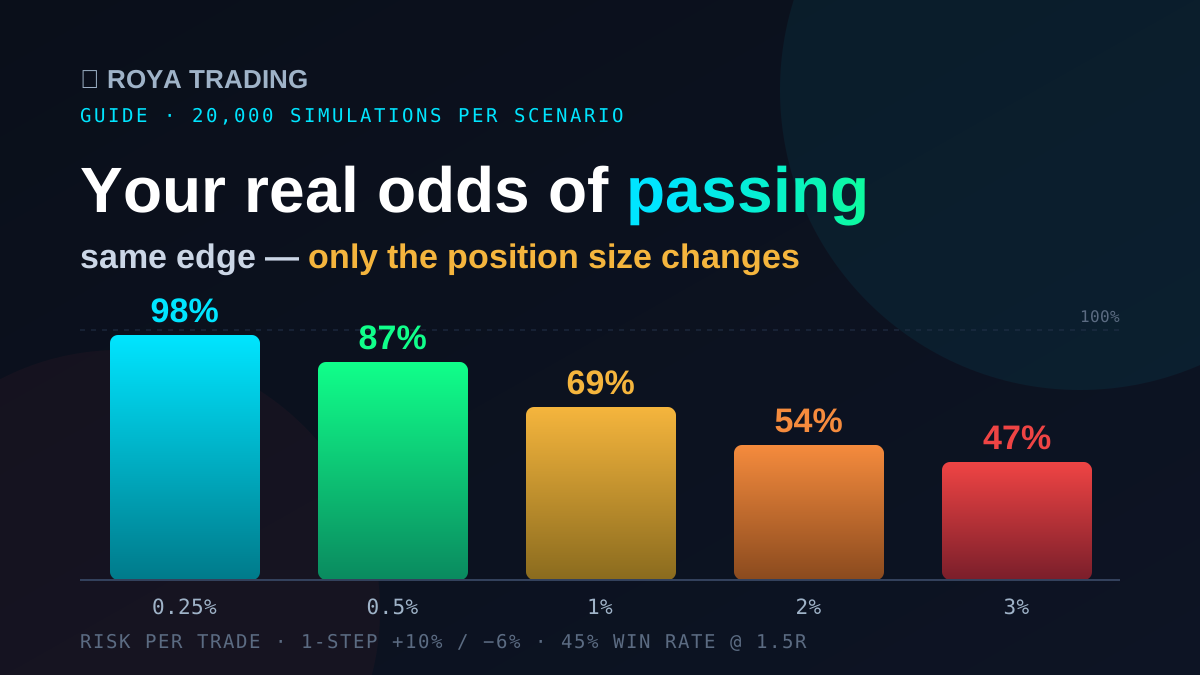
Now give the trader a real but modest edge — 45% win rate at 1.5R, expectancy +0.125R per trade, the kind of edge a disciplined swing trader can actually sustain — and vary only the risk per trade. Classic 1-Step, same rules, 20,000 runs per row:
| Risk per trade | Pass probability | Median trades to pass |
|---|---|---|
| 0.25% | 98% | ~280 |
| 0.5% | 87% | ~110 |
| 1% | 69% | ~37 |
| 2% | 54% | ~10 |
| 3% | 47% | ~4 |
Read the first column against the second and let it sink in: the same trader, the same edge, moves from a 98% pass rate to a coin flip purely by changing position size. Upgrading the edge itself — to 40% at 2R, a +0.2R expectancy most retail traders never reach — lifts the 0.5% row from 87% to just 90.5%. Years of skill development buy you three points; halving your size buys you eleven. I've written a whole guide on position sizing for the 6% corridor, but this table is the argument compressed: in a challenge, sizing is the strategy.
The theory behind it is a hundred years old. With a positive edge, small bets let the law of large numbers do its work — variance shrinks relative to drift, and the walk almost surely drifts through the target before wandering into the floor. With no edge or negative edge, the opposite: bold play is optimal for gamblers, timid play is optimal for traders with an edge. Which means "risk big to pass fast" is, mathematically, the strategy of someone who — whether they know it or not — doesn't believe in their own system.
The impatience tax, quantified
The third column is the price tag of certainty. At 0.25% risk, the median pass takes ~280 trades — months of work. At 0.5%, ~110 trades: six to ten weeks at a couple of setups a day. At 2%, ten trades — days. Speed is real; it's just bought with probability, and the exchange rate is terrible. Going from 0.5% to 2% saves you roughly a hundred trades and costs you 33 points of pass probability — a third of your funded futures traded for a few weeks of calendar time on a challenge that has no deadline. On firms with 30-day windows, that trade is forced on you. On an untimed evaluation it's voluntary, which is why I keep saying the absence of a time limit is worth more than any headline rule — the full argument is in how long a challenge really takes.
What the trailing drawdown does to honest traders
Same thin-edge trader, same 0.5% sizing, all three formats:
| Format | Pass probability (thin edge, 0.5% risk) | Median trades |
|---|---|---|
| Classic 1-Step | 87% | ~110 |
| 2-Step, both phases | 72% | ~165 |
| Turbo 1-Step | 65% | ~82 |
The 2-Step's problem isn't the two targets — a +5% phase is comfortable at this sizing. It's the trailing floor: run up +4%, and your floor has climbed with you, so the ordinary losing streak that a static-drawdown account absorbs quietly becomes a breach — often while you're still net positive for the challenge. I dissected that mechanism in trailing vs static drawdown; the simulation puts a price on it: 15 points of pass probability for this profile. The Turbo's tight 3% static floor costs even more per attempt — but the Turbo isn't trying to win on probability, as the next section shows. Note also what the Turbo's floor means in practice: its daily loss and its total drawdown are the same 3% on day one, so one maximum-loss day is the whole account — no second act.
The number to actually shop with: expected cost per funded account
A challenge fee is not the cost of a funded account. Fee ÷ pass probability is. Divide honestly and the cheap-looking options rearrange themselves. On the $10K account — fees per Propr's published grid: $110 Classic 1-Step, $100 2-Step — my thin-edge trader gets:
| Risk per trade | 1-Step: expected cost | 2-Step: expected cost |
|---|---|---|
| 0.5% | ~$126 | ~$138 |
| 1% | ~$161 | ~$217 |
| 2% | ~$205 | ~$319 |
Two lessons hide in there. First, the 2-Step's lower sticker price ($100 vs $110) is an illusion once probability enters: for this trader it's more expensive at every sizing, and the gap widens the more aggressively you trade. Second, oversizing is a surcharge: the same 1-Step costs $126 in expectation at 0.5% risk and $205 at 2% — you pay roughly $80 extra for the privilege of being impatient. At the small end the logic flips in Turbo's favor: a $5K Turbo costs $25 against the Classic's $60, and even at its lower 65% pass rate that's about $39 expected per funded account vs $69 — the cheapest legitimate seat at the table, which is why I call it the tuition format. Run your own numbers before shopping — and note that fees move: Propr reshuffled its catalogue in August with a Pro 1-Step and a $200K size. The 5% USDC cashback via the affiliate link shaves every expected-cost figure by the same fraction, whatever your probability is.
So which format, for which trader?
Proven thin edge, patient: Classic 1-Step at 0.25–0.5% risk. You're buying an 87–98% probability for $110 — the best deal on the board, and the static floor means a losing streak early costs no more than one late. Unproven system, small bankroll: Turbo at 0.5%. Lowest absolute cost per attempt, real consequences, and the 3% floor teaches the sizing lesson faster than any article. Confident in long streak management: the 2-Step's slightly lower fees only pay off if your equity curve grinds up without deep local dips — DCA-style entries that resolve in clusters are exactly what the trailing floor punishes. The full rule-by-rule comparison is in 1-Step vs 2-Step, and the decentralized prop firm comparison covers how these formats stack up against the rest of the on-chain field.
What this means for how you actually trade it
The simulation's advice compresses to four lines. Pick a size and never exceed it — 0.5% of starting balance is the sweet spot where probability is high and the trade count is humane. Let the trade count be what it is — the challenge has no clock, so the only deadline is the one your impatience invents. Don't upgrade risk after wins — the table's 98% assumes the size holds through the whole run, and a trailing floor punishes exactly the post-win swagger. Don't revenge-size after losses — the model assumes independence, and tilt is how real traders break it. That last pair is where I'll be honest about my own product: this is precisely the failure mode an API-connected trading bot exists to remove. It's semi-auto — you pick every trade from the Radar, it executes the DCA ladder, take-profit and stop-loss at the size you configured, with no 2 a.m. exception because the last trade stung. A bot doesn't give you an edge; it gives you the discipline the math assumes. The edge stays your job.
Limits of the model — and the honest conclusion
Real distributions have fat tails, real positions correlate, real spreads and funding fees erode expectancy, and real humans deviate from plan under stress — every one of those pushes the true numbers below these tables, which is why the aggregate industry pass rate sits where it does even though the disciplined-trader ceiling is 90%+. The model isn't a promise; it's a decomposition. It says the folklore statistic is not a fact about challenges — it's a fact about sizing behavior. The corridor between −6% and +10% is narrow enough that variance kills the oversized regardless of talent, and wide enough that a thin, boring, half-percent edge walks through it almost every time. Ninety percent of traders fail challenges. You are not required to trade like the ninety percent.
FAQ — prop firm challenge odds
What percentage of traders pass prop firm challenges?+
Industry folklore says around 90% fail, and the few firms that have published data land in the same region — typically 70–90% of evaluations end in a breach. But the aggregate number mixes gamblers sizing at 5% per trade with careful traders sizing at 0.5%, so it says almost nothing about you. In my simulations, the same modest edge produced anywhere from a 47% to a 98% pass rate depending purely on risk per trade.
Can you pass a prop firm challenge without an edge?+
Sometimes — and that's exactly the trap. A coin-flip trader hits +10% before −6% roughly 37% of the time on a static-drawdown 1-Step, for the same reason a random walk hits the nearer barrier more often. But passing once isn't the goal: with no edge, the funded account eventually breaches too, and the fees compound. The evaluation filters luck slowly; variance filters it faster than most people expect.
Does risking more per trade improve your odds of passing?+
Only if you have no edge — bold play is mathematically optimal for gamblers, which should tell you something. If you do have a real edge, every increase in risk per trade lowers your probability of passing: from 98% at 0.25% risk to 47% at 3% risk for the same strategy in my runs. Bigger size buys speed, not probability. With no time limit on the challenge, that trade-off is one you're never forced to make.
Is a 1-Step or 2-Step challenge easier to pass?+
For the same trader, my simulations put the 1-Step ahead: 87% vs 72% pass probability for a thin-edge trader risking 0.5% per trade. The 2-Step's two targets are only part of it — the bigger factor is the 8% trailing drawdown, which follows your high-water mark up and punishes the normal dip after a good run. The 2-Step's fees are slightly lower, but on a cost-per-funded-account basis the 1-Step usually still wins.
How many trades does it take to pass a challenge?+
At 0.5% risk with a modest edge, the median in my simulations was around 110 trades for a 1-Step — call it six to ten weeks at a couple of setups a day. At 1% risk it drops to roughly 37 trades, but the pass probability falls from 87% to 69%. On an untimed challenge, the only cost of the slower path is patience, which is why the absence of a time limit is worth more than most rule differences.
What is risk of ruin in prop trading?+
It's the probability that your account hits the failure barrier — the drawdown limit — before it hits the target. Classic risk-of-ruin math assumes you bust at zero; a challenge moves the ruin line to −6% and the finish line to +10%, which makes ruin dramatically more likely than intuition suggests. Everything in challenge design flows from that compressed corridor: sizing, trade frequency, and which format suits which trader.
Trade the math, not the mood.
A bot executes your DCA entries, take-profits and stop-losses at the size you set — you pick the trade, it keeps the discipline your pass probability depends on. Semi-auto, on your own Propr account, via the official API.
Get 5% USDC cashbackNot on Propr yet? Create your Propr.xyz account with 5% USDC cashback on the fee.
Affiliate link. We earn a commission; it never changes what you pay — it is what funds your cashback.
⚠️ Simulation results are model outputs under stated assumptions (independent trades, fixed fractional sizing, no execution costs), not guarantees or predictions of your results. Rules and fees cited are Propr's published values at the time of writing and can change. This is general information, not financial advice. Trading carries substantial risk — only trade what you can afford to lose.