
Every prop firm article on the internet obsesses over the same two numbers: the daily loss limit and the max drawdown. Fair enough — those are the rules that end most accounts. But there is a second rulebook underneath, section 15, and almost nobody reads it. It is the one that decides whether your account merely dies or whether it dies and takes your unpaid profit with it. I trade Propr accounts and I automate them, so I sat down with the published rulebook and went through all nine prohibited behaviours. Three of them can catch a trader who thinks he is doing nothing wrong.
The short answer: a breach is not a ban
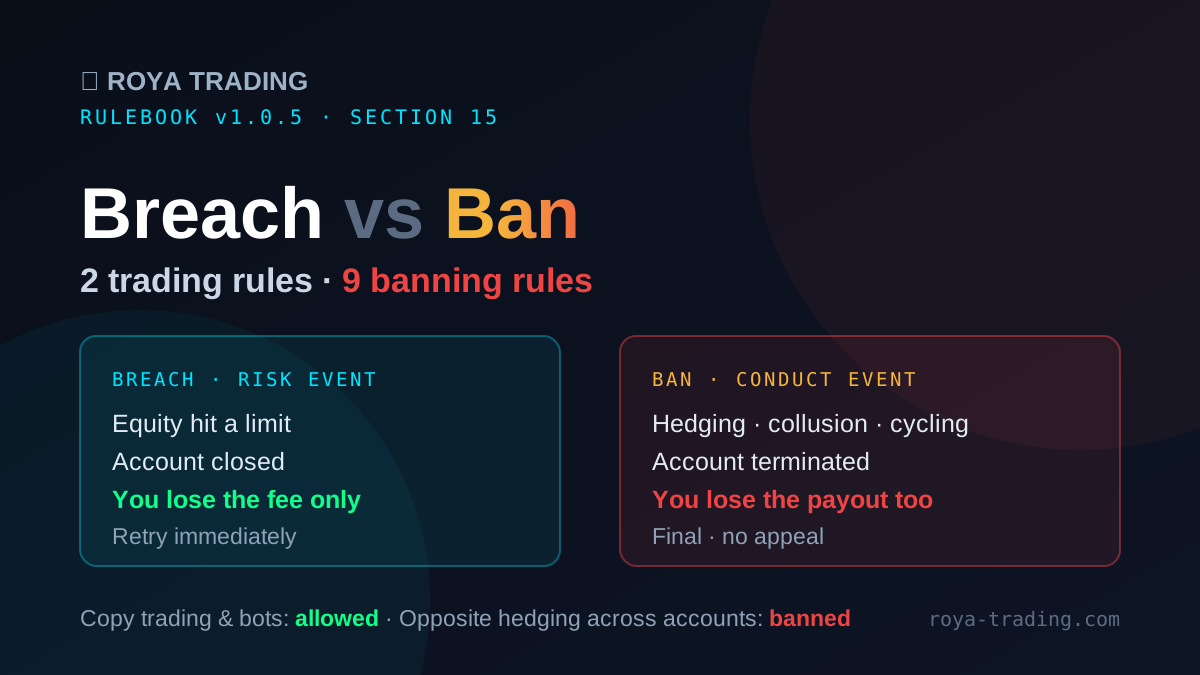
This distinction is the whole article, so let me put it up front. A breach is a risk event. Your equity touched the daily floor or the max drawdown, positions close automatically, the account is permanently disabled, and that is the end of it — you are never liable for losses beyond your evaluation fee, and you can buy a new evaluation five minutes later.
A ban is a conduct event. Propr terminates the account with no payout, keeps whatever profit had accrued, and bars you from future evaluations. Section 15 states plainly that these decisions are final and not subject to appeal. So a breach costs you a fee you had already spent. A ban costs you money you had already earned. They are not on the same scale, and they are not triggered by the same things.
Breach vs ban. Breach: automatic, mechanical, triggered by equity, no judgement involved, fee is the maximum loss, retry immediately. Ban: discretionary, triggered by behaviour, no payout, no refund, no appeal, and it follows the person rather than the account.
The two rulebooks, side by side
What makes Propr unusual is how short the trading rulebook is. Section 14 is a list of restrictions that explicitly do not exist: no consistency rule, no minimum trading days, no time limit, no profit cap, no news-trading ban, no weekend-holding ban, no mandatory stop-loss, no strategy restrictions, no bot or EA restrictions, and no copy-trading restriction — copy trading is permitted including between your own Propr accounts. The stated philosophy is that the two equity limits are the only trading rules. If you want those two limits with worked numbers, I broke them down in the Propr rules explained guide.
The trade-off for that freedom is section 15. A firm that lets you do anything inside your drawdown has to be strict about behaviour that attacks the model itself. That is the deal, and honestly it is the right one — I would rather have nine conduct rules and zero strategy rules than the reverse.
The nine prohibited behaviours
Three general prohibitions, six anti-farming rules. Here they are with my read on each, ranked by how likely you are to trip over one by accident.
- 1. Exploiting platform bugs or glitches. Intentionally profiting from technical errors, latency issues, price feed anomalies or Hyperliquid infrastructure problems. Accidental risk: low. The word doing the work is “intentionally” — one weird fill is not a violation, systematically hunting them is.
- 2. Account sharing or selling. Each account is tied to one individual. Transferring, selling or sharing access is prohibited. Accidental risk: medium. Letting a friend “take over for a week” or splitting an account with a partner is exactly this rule, and it is a common way people get caught.
- 3. Identity fraud. False identity information at registration or KYC, borrowed documents, multiple identities. Accidental risk: low — unless you signed up with a nickname and never thought about the KYC step.
- 4. Opposite hedging across accounts. Opening opposing positions on the same instrument across two or more Propr accounts so one is guaranteed to pass while the other breaches. Accidental risk: high. See below.
- 5. Third-party coordination. Coordinating with other Propr traders to create offsetting positions, sharing signals timed to exploit drawdown mechanics, or any other collusion. Accidental risk: high. See below.
- 6. Account cycling / high-frequency evaluation purchases. Repeatedly buying evaluations to take maximum-risk binary bets, treating the fee as a lottery ticket. Accidental risk: medium. See below.
- 7. Exploiting the payout/drawdown interaction. Structuring payout requests to manipulate the relationship between balance, high-water mark and the drawdown limit — applicable to 2-Step accounts, where a payout resets the HWM. Accidental risk: low for anyone who withdraws when they have profit rather than when the trail is inconvenient.
- 8. Latency arbitrage and tick sniping. Exploiting delays between Propr's price feed and Hyperliquid's on-chain execution for near-risk-free profit. Accidental risk: very low unless you are building infrastructure specifically for it.
- 9. Simulated or wash trading. Trading against yourself or a coordinated party where no genuine market risk is taken, to inflate volume or manipulate metrics. Accidental risk: very low.
Trap #1: hedging your own accounts (the line is thinner than you think)
Here is the exact confusion. Section 14 says copy trading is fine, including between your own Propr accounts. Section 15 says opposite hedging across accounts is a ban. Both are true and they are not in conflict, because the test is direction, not duplication.
Copying the same long BTC entry onto three of your own accounts is permitted: all three carry the same risk, all three win or lose together, and you have taken genuine market exposure three times over. Running long BTC on account A and short BTC on account B is prohibited: you have manufactured a coin flip where one account is guaranteed to hit its target while the other is guaranteed to breach, and you have taken no market risk at all. The firm is not paying you for a view; it is paying a fee for a certainty.
The reason this trips people up is that hedging is a legitimate technique in normal trading, so it does not feel like cheating. On a multi-account prop setup it is the single clearest farming signature there is, and correlation analysis across accounts is the first thing the detection stack looks at. If you run several accounts — which is allowed, and which I do — keep them directionally aligned. I wrote the full playbook for scaling accounts sanely in running multiple prop firm accounts.
Trap #2: signals, groups and “third-party coordination”
Read rule 5 quickly and you might conclude that following any signal provider is collusion. It is not, and rule 14 settles it: copy trading is unrestricted. What rule 5 targets is coordination between Propr traders to produce offsetting positions or signals timed to exploit drawdown mechanics. The prohibited thing is a group engineering outcomes across accounts, not a group sharing an opinion on ETH.
The practical test I use: if the same signal reached a thousand strangers and everyone took the same side, that is a signal service. If two people agreed to take opposite sides so one of them would pass, that is collusion. Same chat room, completely different act. I unpacked where each firm actually draws this line in is copy trading allowed on prop firms.
This matters for anyone automating. Automated trading on the Propr API is semi-auto by design: you pick the trade, the bot handles execution — DCA laddering, take profit, stop loss — on your own Propr account. Every position is directional and yours. There is no cross-account netting, no opposite-side allocation, nothing that resembles rule 4 or rule 5. That is not an accident; a tool that farmed the rules would be worthless the moment the correlation engine noticed.
Trap #3: account cycling, and why the $25 Turbo makes it tempting
Rule 6 is the most debatable one, because “buy another evaluation after failing” is a thing Propr actively sells. The distinguishing word is intent: repeatedly purchasing evaluations with the intent of taking maximum-risk binary bets, treating the fee as a lottery ticket.
Do the arithmetic that makes this tempting. A Turbo 1-Step on a $5,000 account costs $25 and needs +9%, or $450, with a 3% static drawdown. If you simply max out the BTC leverage cap — 5x per the side panel and changelog, though the §12 table on the same page says 10x, unreconciled as of our reading on 12 September 2026 — and pray, you have something like a coin flip on a $25 ticket with an $450 payoff into a funded account. Twenty tickets, $500, and probability says a few pass. That reasoning is precisely what rule 6 describes, and the behavioural fingerprint — a cluster of accounts that each survive a handful of oversized trades and die — is trivially visible in trade pattern analysis.
The honest version of retrying looks completely different: the same method, the same position sizing, an account that lasts weeks rather than hours. I would rather buy one evaluation I intend to trade properly than twenty I intend to gamble, and the cost-per-attempt math agrees with me even before the conduct rules do.
What Propr actually monitors
Section 15 is unusually specific about detection, which I appreciate — it names the signals rather than hiding behind “proprietary systems”:
- Correlation analysis across accounts — the hedging and collusion detector.
- IP address and device fingerprinting — links accounts that claim to be different people, and flags jurisdiction mismatches.
- Trade pattern analysis — the account-cycling and wash-trading detector.
- Payout pattern analysis — rule 7, the HWM manipulation detector.
- On-chain transaction analysis via Hyperliquid — the part traditional firms cannot do.
That last one deserves a beat. Because A-booked trades are routed to Hyperliquid and are publicly verifiable, correlation work happens on data anyone can audit — including you. It cuts both ways: the firm can see coordinated behaviour clearly, and you can independently verify your own execution history. That transparency is the structural argument for on-chain firms, which I laid out in on-chain vs traditional prop firms.
When something flags, the escalation ladder is: request additional information → suspend trading and/or payouts pending investigation → permanent termination with no payout and a ban from future evaluations. Decisions are final.
The two non-conduct ways to lose everything
Not every total loss comes from misbehaviour. Two administrative failures produce the same outcome, and both are entirely avoidable.
KYC timing. Verification is not required to register or to buy an evaluation — you can trade immediately. It is required before a funded account is activated, and no payout is processed without it. Valid government ID, a live selfie, no proof of address, usually done in minutes. The failure mode is passing an evaluation and only then discovering a problem with your documents while your funded clock is ticking. Do it on day one from the dashboard; there is no reason to wait.
Jurisdiction. Propr cannot serve residents of Russia, OFAC-sanctioned countries or the Crimea, Donetsk and Luhansk regions of Ukraine. Accessing the service from a restricted jurisdiction including via VPN means immediate termination with no refund and no payout. Submissions are screened against sanctions and PEP databases, and funded traders may be rescreened periodically — meaning a mismatch surfaces at the worst possible moment, when you go to withdraw. There is no clever way around this one.
Multiple accounts: allowed, and where the cap sits
Since v1.0.1 you can hold several evaluations of any size at once, and section 17 caps you at a $300,000 aggregate funded balance. One $200K plus one $100K, or one $100K plus one $50K plus a stack of smaller accounts, is a perfectly normal portfolio, plus as many evaluations as you want on top.
So multiple accounts are not the red flag. Directional inconsistency across them is. Scale by adding capital to a method that works, not by buying lottery tickets in both directions — and when a payout lands, remember it sweeps all profit above your starting balance at the 80% split, minimum $20, USDC on-chain, processed within 24 hours. The mechanics are in how Propr payouts actually work.
The comparison worth knowing before you pay a fee
Conduct rules differ enormously between firms, and the differences are not cosmetic — and they move. Hypernova, the closest on-chain competitor on Hyperliquid, used to forbid copy trading and third-party signals in §14.2 of its closed-alpha rulebook; its public rules, read 16 August 2026, list no bot restrictions at all. The same setup — a bot executing your trades on your account — went from rule violation to permitted in one rulebook revision. That is exactly why you read the current rulebook, not a summary of the old one.
That single clause is why my execution setup runs on Propr and not on Hypernova, and it is the first thing I check on any new firm now, before the fee table. I put the two side by side in Hypernova vs Propr, and the broader field is ranked in my comparison of the best decentralized prop firms of 2026.
My seven-point clean-account checklist
- One person, one set of accounts. No sharing, no “managing” someone else's account, no borrowed identity.
- Same direction everywhere. If two accounts hold the same instrument, they hold the same side.
- KYC on day one. Before you need it, not after you pass.
- Real jurisdiction, no VPN. Ever, for anything, on any prop firm.
- Consistent sizing across attempts. Your history should look like a method, not a series of coin flips.
- Withdraw on profit, not on drawdown geometry. Especially on 2-Step, where payouts reset the HWM.
- Read section 15 of any firm before paying. It takes four minutes and it is the only part of a rulebook that can retroactively cost you a payout.
None of this is restrictive if you are actually trading. That is the point: the anti-farming rules only bite behaviour designed to extract money without taking risk. Take risk, keep your accounts pointed the same way, and section 15 never enters your life — which leaves you with two numbers to respect and a challenge to actually pass.
FAQ — prop firm bans and prohibited conduct
What's the difference between a breach and a ban on a prop firm?+
A breach is a risk event: your equity touched the daily loss limit or the max drawdown, positions close, the account is permanently disabled, and you lose nothing beyond the evaluation fee. A ban is a conduct event: Propr terminates the account with no payout, keeps any profit you had accrued, and bars you from buying future evaluations. Section 15 of the rulebook is explicit that these decisions are final and not subject to appeal. Both end the account; only one destroys money you had already earned.
Is copy trading allowed on Propr or will it get me banned?+
Copy trading is explicitly permitted, including between your own Propr accounts — section 14 lists it under what is NOT restricted, alongside bots, EAs, scalping and grid trading. What section 15 prohibits is opposite hedging: opening opposing positions on the same instrument across two or more accounts so that one is guaranteed to pass while the other breaches. Copying the same directional trade to five accounts is fine. Copying it long on one and short on another is the ban.
Can I run two Propr accounts at the same time?+
Yes. Since v1.0.1 (25 February 2026) you can hold multiple evaluations of any size simultaneously, and section 17 caps you at a $300,000 aggregate funded balance — one $200K plus one $100K, or one $100K plus one $50K plus smaller accounts, plus as many evaluations as you want. Propr sells six sizes, $5K to $200K (read 10 September 2026). Multiple accounts are a feature, not a red flag. It's what you do across them that gets scored.
How does Propr detect farming?+
Section 15 names the signals: correlation analysis across accounts, IP address and device fingerprinting, trade pattern analysis, payout pattern analysis, and on-chain transaction analysis via Hyperliquid. Because A-booked trades are routed to Hyperliquid and are publicly verifiable, the correlation work happens on data that anyone can audit. When something flags, Propr may request information, suspend trading and payouts pending investigation, or terminate the account outright.
Can I use a VPN to trade a prop firm from a restricted country?+
No, and this one has no grey area. Section 16 lists Russia, all OFAC-sanctioned countries and the Crimea, Donetsk and Luhansk regions of Ukraine as restricted. Attempting to access Propr from a restricted jurisdiction, including via VPN, results in immediate account termination with no refund and no payout. KYC submissions are screened against sanctions and PEP databases, and funded traders can be rescreened periodically — so a mismatch surfaces at exactly the moment you're trying to withdraw.
Does using a trading bot risk a ban?+
Not on Propr. Automated trading, EAs, API access and copy trading are all listed as unrestricted in section 14, which is why third-party bots can run on a Propr account at all. The comparison worth knowing: Hypernova's closed-alpha rulebook §14.2 used to forbid copy trading and third-party signals; its public rules, read 16 August 2026, listed no bot restrictions, and its rulebook v1.1, read 5 September 2026, permits automated strategies built and run by the trader on a single account while banning copy trading and external signals, though there's no turnkey tool there. Either way, check the automation clause before you pay a fee, not after.
Is buying a new evaluation after every failure considered account cycling?+
Failing and retrying is normal and Propr sells resets openly. What section 15 targets is intent: repeatedly buying evaluations to place maximum-risk binary bets, treating the fee as a lottery ticket. The behavioural signature is a portfolio of accounts that each live a handful of trades at extreme size and die. If your attempts show a consistent method and normal position sizing, retrying is just retrying.
Trade clean, execute better.
The setup is semi-auto: you choose the trade, the bot handles the DCA ladder, the take profit and the stop loss on your own Propr account. Directional, non-custodial, nothing that looks like farming. Start free on Telegram.
Get 5% USDC cashbackNot on Propr yet? Create your Propr.xyz account and get 5% USDC cashback on your evaluation fee.
Affiliate link. We earn a commission; it never changes what you pay — it is what funds your cashback.
⚠️ Source: the official Propr rulebook, sections 14 to 19, read on 6 August 2026 and not re-read for this article since. Rules change — check the source before paying. Trading leveraged products carries a high risk of loss and most crypto prop firms are unregulated offshore entities. This page contains affiliate links to Propr.xyz — we earn a commission on sign-ups, at no cost to you. Nothing here is investment or legal advice.
Affiliate link. We earn a commission; it never changes what you pay — it is what funds your cashback.