
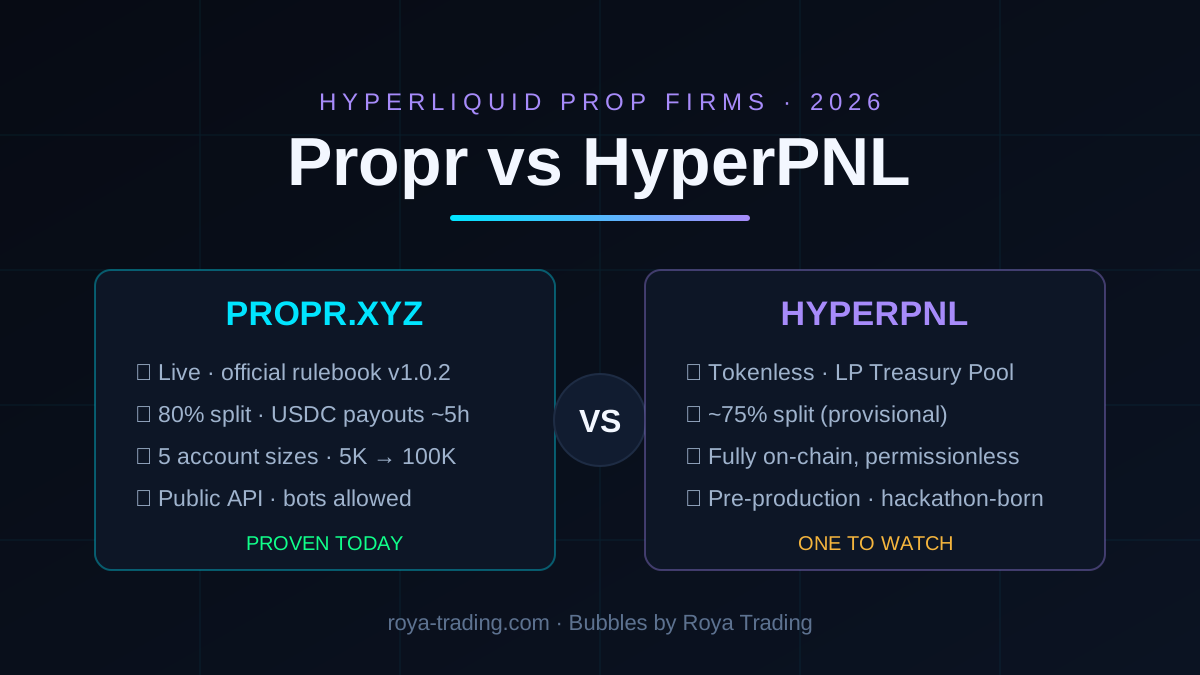
Hyperliquid has become the home base of on-chain prop trading, and two names keep coming up in the same sentence: Propr.xyz, the live prop firm I trade and automate every day, and HyperPNL. On 9 September 2026 we opened a free demo account on HyperPNL (app v1.4.131) and read its checkout, its Performance Guard panel, its GitBook documentation and its Terms of Use from the inside. What we found is not the product we described four days earlier. This page is the corrected comparison, and the correction comes first.
What we got wrong on 5 September
Two things we published on 5 September 2026 were wrong. The correction belongs here, in the text, not in a footnote.
First, the "contradiction" between the homepage and the docs. We wrote that HyperPNL stated its drawdowns two ways — 5% against 9% overall, 3% against 5% daily, one phase against two. There is no contradiction. HyperPNL sells two different products, a 1-Step and a 2-Step, and each set of numbers belongs to one of them. We read one product's limits against the other's.
Second, we wrote that no entity, company or jurisdiction is published. That is false. The Terms of Use — last updated 29 January 2026 — name Hyperpnl Ltd., registration number CO-425378, registered office CO Services Cayman Limited, P.O. Box 10008, Pavilion East, Cricket Square, George Town, Grand Cayman KY1-1001, Cayman Islands, with business@hyperpnl.com as the contact address. §12 puts the contract under Cayman Islands law, with binding arbitration seated in the Cayman Islands, before a single arbitrator, in English. Why we missed it is worth stating plainly: the Terms are reachable only once you are logged in, the page is noindex and rendered client-side, so no fetch and no search engine can read it.
One more number has to go with them: there is no time limit at HyperPNL. The rules read on 9 September 2026 say it in as many words — no time limit on any phase. The limit in our earlier coverage was ours, not the firm's.
The short answer
Trade Propr; buy at HyperPNL only with your eyes open. Propr is live, with a published rulebook, six account sizes, an 80% profit split, USDC payouts within 24 hours and a public API that explicitly welcomes bots. HyperPNL is a real, buyable product with a real Hyperliquid order book behind it — but the largest account it will sell you is $25,000, its written rulebook covers only one of its two evaluations, and its Terms exclude 18 jurisdictions its homepage says are welcome. Trust Score: Propr 86.7 on our grid of 10 September 2026, HyperPNL 64.5 on the grid revised 9 September 2026 — the first score we have given it from an evaluation we bought, paid $42 and traded that day.
What HyperPNL actually sells: two evaluations, not one
The Start Challenge checkout has two tabs, side by side. Everything below was read in them on 9 September 2026, logged in. The account type on offer is Flex, labelled "Standard evaluation"; two other account types are marked COMING SOON.
| Read 9 September 2026 | 1-Step Flex | 2-Step Flex |
|---|---|---|
| $5,000 account | $42 | $50 |
| $10,000 account | $86 | $90 |
| $25,000 account | $215 | $213 |
| Profit target | 10% | 10%, then 5% |
| Max daily drawdown | 3% | 5% |
| Max overall drawdown | 5%, static | 9%, static |
| Minimum profitable days | None — the paid counter reads 0 / 0 | 2, then 3 |
| Time limit | None | None |
Two things stand out. The 2-Step at $25,000 costs $213 — two dollars less than the 1-Step at the same size — so the cheaper of the two is also the one with the looser drawdowns. And the ceiling is real: 50K and 100K were still marked "Soon" with the slider locked, the eighth consecutive check we have logged. The largest account you can buy from HyperPNL today is $25,000.
The rules — and which product they cover
HyperPNL's GitBook rulebook, read 9 September 2026, documents the 2-Step only. It never describes the 1-Step. What it does document, it documents well: the "No Additional Rules" section bans multiple accounts and copy trading, then states there is no consistency rule, no maximum risk per trade, and no hidden or discretionary condition — closing, verbatim, with "If a rule is not written here, it is not enforced." News trading is allowed. On the 2-Step, the 5% max daily drawdown is recalculated each day at 00:00 UTC on the equity of the moment and does not move intraday, so it rises with your gains; the 9% max drawdown is static. A minimum profitable day is 0.5% of the initial balance. The Payouts page of the docs is marked "Last updated 6 months ago".
That last rule is where we got it wrong, and this is the correction. On our free $25,000 demo, set to the 1-Step limits, the Performance Guard displayed Min Profitable Day Trigger $0 / $125 — 0.5% of $25,000 — and we concluded that the 1-Step enforced a profitable-days rule its checkout never disclosed. The same panel on the account we actually paid for shows two separate lines: Min Profitable Day Trigger −$26.65 / $25 and, under it, Min Profitable Days 0 / 0. The dollar figure is the threshold at which a day would count as profitable; the counter below is how many are required, and it reads zero out of zero. The 1-Step demands none. The checkout was right to show no such line, the two-then-three profitable days belong to the 2-Step alone, and we withdraw the complaint. What the paid panel does state, in dollars rather than percentages, is the floor: a Daily Drawdown Limit of $4,850.00 on $5,000 of starting equity, $150 of budget for the day, under a 5% static overall drawdown worth $250 and a 10% target worth $500. The dashboard also carries a card reading "Trust Score — Coming Soon, –– / 100".
Put the leverage next to those budgets, because nobody quotes it at checkout. Our account carried a BTC/USD position of $24,594 of notional on $5,000 of capital — 5x asset leverage, 4.9 times the account — at which size the $150 daily budget is 0.61% of movement in bitcoin and the $250 total budget is 1.02%. The engine does enforce: our $25,000 demo was closed automatically on 9 September at 12:18 app time, cause named in the interface, Daily Loss Limit, on a final balance of $24,170.48 against $25,000.00. And friction is measurable: on $60,720 of volume the balance went from $5,000.00 to $4,973.35 while the only closed trade returned +$6.94 gross — about $33.59 of execution cost, roughly 0.055% of volume, in line with the 0.045% taker fee advertised. A winning trade still left the day $26.65 down.
Who is allowed to trade there
The homepage says "No restrictions — Anyone can participate freely". §3.1 of the Terms of Use lists 18 restricted jurisdictions: the United States of America and its territories, Canada, Iran, North Korea, Syria, Cuba, Russia, Belarus, Ukraine (Crimea, Donetsk, Luhansk and other occupied or sanctioned regions), Venezuela, Afghanistan, Iraq, Yemen, Libya, Somalia, Sudan, South Sudan and Myanmar (Burma). The list can be changed "at any time, without prior notice", and using a VPN to get around it is "a material breach" that can bring "immediate suspension or termination of your account and permanent ineligibility for payouts". Both statements are the firm's own, and they contradict each other. If you are American or Canadian, the binding one is the contract.
There is no documentary KYC at this date. The HyperPNL FAQ, read 9 September 2026, says it verbatim: "No. At this time, HyperPNL does not require standard KYC verification for payouts". No identity check is not the same as no geographic filter — the filter is written into the contract you accept.
Payouts, and what the contract reserves
The advertised terms are an 80% split, a minimum withdrawal of 1% of the account, USDC paid by smart contract, announced as instant and without manual review. The Terms are more guarded. §6 says payouts are "executed directly by smart contract", but that eligibility "may be subject to compliance, anti-abuse checks, and rule adherence", and that HYPERPNL "does not guarantee payout timing or availability" — against a homepage that reads "Even we can't reject your payout". §2 states that evaluation accounts are simulated and, verbatim, "hypothetical and have no monetary value". §4.1 makes the evaluation fee non-refundable once trading activity begins.
What the chain actually shows
The docs are honest about the architecture, verbatim: "Trading is handled off-chain for performance and scalability." Only fund routing and the anchoring of results are on-chain. Three contracts are named — Payment Router, Payout Treasury, Data Recorder — and no address is published for any of them, not on the site, not in the GitBook docs, not in the Terms, not in the app's JavaScript bundle. So the promise that the payout reserve is public on-chain is, in practice, unverifiable as of 9 September 2026: there is nothing to open in an explorer.
What the trading side gets right
Credit where it is due, because the product itself is not thin. The instrument selector's "All" tab holds at least 92 distinct instruments — crypto, FX, commodities, indices, stocks, ETFs — and the order book is Hyperliquid's own, streaming live. Order types are Limit, Market, Stop Loss, Take Profit and Reduce-Only, all GTC with no expiry. The BTC ticket showed taker fees of about 0.045% on crypto (0.015% maker), a $100 minimum notional and 5× leverage displayed; the docs quote up to 20× on crypto and stocks, 50× on FX, indices and commodities. Pricing comes from Hyperliquid and Ostium, and funding is passed through from Hyperliquid unchanged. Deposits are USDC on Arbitrum only, or card through MoonPay, with an instruction we quote verbatim because it is unusual: "You should send $1 more than the amount you want to deposit." You log in by e-mail code or wallet (MetaMask, Brave, Rabby).
Head to head: what's verifiable today
- Status: Propr live with a public rulebook · HyperPNL selling two evaluations, largest buyable account $25,000 on 9 September 2026.
- Profit split: Propr 80% from the first payout · HyperPNL 80%, minimum withdrawal 1% of the account.
- Account sizes: Propr 5K / 10K / 25K / 50K / 100K / 200K, fees $25–$1,998 depending on format and size · HyperPNL 5K / 10K / 25K only, $42–$215 on the 1-Step Flex and $50–$213 on the 2-Step Flex.
- Payouts: Propr USDC on-chain, $20 minimum, within 24h (~5h average), history published · HyperPNL USDC by smart contract, announced instant, but the Terms reserve compliance and anti-abuse checks and guarantee neither timing nor availability, no contract address is published, and tracing our own $42 purchase end to end on Arbitrum produced one deposit into RelayDepository — a third-party bridging contract — followed by an off-chain debit in HyperPNL's internal ledger. We have taken no payout there.
- Rules: Propr documented — 1-Step (10% target, 3% daily, 6% static) and 2-Step (5%/10%, 5% daily, 8% trailing) · HyperPNL documented for the 2-Step only; the 1-Step has no written rulebook, though the paid account shows it requires no profitable day at all (counter 0 / 0) and states its floor as a figure, $4,850.00 on a $5,000 account.
- Time limit: none at HyperPNL, on any phase — the limit reported in our 5 September article was our error.
- Jurisdictions: HyperPNL's Terms exclude 18, opening with the United States and its territories and Canada, while its homepage advertises no restrictions.
- Automation: Propr public REST API, Python/JS SDKs, bots explicitly allowed · HyperPNL bans multiple accounts and copy trading, and adds nothing else: "If a rule is not written here, it is not enforced."
- Trust Score: Propr 86.7 (grid of 10 September 2026) · HyperPNL 64.5 (grid revised 9 September 2026), no longer capped: we bought, funded and traded an evaluation there that day.
Where Propr wins today
Propr's advantages are the boring, decisive kind. The rules are written down — I've broken down every limit in the Propr rules guide, and they haven't shifted under my feet. Payouts are fast and verifiable: 80% split, $20 minimum, USDC in your wallet typically within hours. The fee table is public ($25–$1,998 across six sizes and four formats). And crucially for how I trade, automation is a first-class citizen: the public API with official SDKs is what lets me run a disciplined DCA strategy with hard guardrails on my accounts, non-custodial, without bending a single rule.
There's also a maturity signal people overlook: Propr publishes revenue, payouts and pass rates on a public transparency page, and the CEO builds in public on Twitch. When a firm volunteers the numbers most firms hide, the trust equation changes.
The verdict
Pick Propr if you want funded capital with known rules, fast USDC payouts and bot-friendly infrastructure — today. It's the firm I run my own money and my own bot on, and it's my overall #1 in the best decentralized prop firms ranking.
As for HyperPNL, the honest summary has changed shape but not direction. It is a real product you can buy today, up to $25,000, with an 80% split, 92 instruments on a live Hyperliquid book, no consistency rule and no time limit — and, where its rules are written, they are written unusually plainly. What we cannot check is everything that matters after you win: no address for the reserve the firm calls public, a Terms clause that reserves compliance checks and guarantees no payout timing, and a rulebook silent on the very evaluation its homepage sells. And if you are in the United States or Canada, §3.1 has already answered for you. For how Propr stacks against the other VC-backed challenger, see Propr vs Hypernova.
Our status on HyperPNL, and our sources
No longer desk research: on 9 September 2026 we bought a 1-Step Flex $5,000 evaluation for $42, funded it in USDC on Arbitrum and traded it the same day, which lifts the 85/100 cap our protocol applies to firms we have not paid. What is still untested is the payout — the account is in Phase 1 and down, so the 80% split and the "instant" claim remain the open question, and the payouts criterion did not move because of it: with no withdrawal requested there is no dated payout fact to score. The settlement layer is where this pass costs the firm points, and it costs them under rules, as a disclosure failure. The score itself rises, 61.8 to 64.5. Traced end to end against a public Arbitrum RPC, our $42 produced a single on-chain event: a deposit into RelayDepository, the deposit contract of the third-party bridging protocol Relay, after which the fee was debited off-chain in HyperPNL's own ledger. No Payment Router transaction, no Payout Treasury allocation, no revenue split, no referral fee, and no published address for any of the three contracts the docs name, under a homepage that sells "Everyone can see everything on-chain". We are not saying those contracts do not exist; we are saying that for the part of the chain we control there is nothing to check. We publish no HyperPNL promo code — the checkout has a discount-code field and a referral field, and we have neither — and we have no affiliate link with the firm. No individual is named anywhere in its material; only the entity is. Sources read on 9 September 2026: the public homepage, the GitBook documentation, a public Arbitrum RPC, and — behind a login, so quoted as plain text rather than linked — app.hyperpnl.com — Start Challenge (login required), app.hyperpnl.com — Terms of Use (login required), app.hyperpnl.com — Performance Guard on our own paid account (login required).
FAQ — Propr vs HyperPNL
What's the main difference between Propr and HyperPNL?+
Scale, and what a reader can verify. Propr.xyz is a live crypto prop firm on Hyperliquid with a published rulebook, six account sizes, an 80% profit split and USDC payouts within 24 hours. HyperPNL sells two evaluations of its own, 1-Step Flex and 2-Step Flex, but the largest account you can actually buy from it is $25,000: on 9 September 2026 the 50K and 100K sizes were still marked “Soon” with the slider locked, our eighth consecutive check.
Which has the better profit split?+
Neither — both publish 80%, so the decision moves to the rules and to what you can check. HyperPNL's minimum withdrawal is 1% of the account and payouts are announced as instant, paid in USDC by smart contract with no manual review; but §6 of its Terms of Use states that eligibility “may be subject to compliance, anti-abuse checks, and rule adherence” and that the firm “does not guarantee payout timing or availability”, while its homepage sells “Even we can't reject your payout”. Those two statements are the firm's own, and they do not agree.
Does HyperPNL have a time limit?+
No. There is no time limit on any phase — the rules we read on 9 September 2026 say exactly that. Our 5 September 2026 article reported a limit stated two ways, homepage against docs, and put a number on it. That was our error: there is no such rule to report, and no deadline of any length.
How many evaluations does HyperPNL sell, and at what price?+
Two, side by side as tabs in the Start Challenge checkout, read on 9 September 2026 while logged in. 1-Step Flex: $42 for a $5K account, $86 for $10K, $215 for $25K — 10% target, 3% max daily drawdown, 5% static max overall drawdown, and no minimum profitable days at all — the counter on our own paid 1-Step reads 0 / 0. 2-Step Flex: $50, $90 and $213 for the same three sizes — 10% then 5% targets, 5% max daily, 9% static max overall, and a minimum of 2 then 3 profitable days. The 2-Step at $25K is two dollars cheaper than the 1-Step at the same size.
Who is behind HyperPNL, and can Americans or Canadians use it?+
The Terms of Use, last updated 29 January 2026 and reachable only once logged in, name Hyperpnl Ltd., registration number CO-425378, registered office CO Services Cayman Limited, P.O. Box 10008, Pavilion East, Cricket Square, George Town, Grand Cayman KY1-1001, Cayman Islands, contact business@hyperpnl.com; §12 puts the contract under Cayman Islands law with binding arbitration seated there. Americans and Canadians are excluded: §3.1 lists 18 restricted jurisdictions opening with the United States of America and its territories and Canada, the list can change “at any time, without prior notice”, and using a VPN to get around it is “a material breach” that can cost the account and permanent payout ineligibility. The homepage's “No restrictions — Anyone can participate freely” contradicts the contract the firm makes you accept.
Which should I pick in 2026?+
If you want funded capital today with known rules, fast USDC payouts and automation support, Propr — 86.7 on our grid of 10 September 2026, against HyperPNL's 64.5 on the grid revised 9 September 2026. HyperPNL is buyable today up to $25,000 and its trading side is real: we paid $42 for a 1-Step Flex $5,000 evaluation on 9 September 2026 and traded it the same day. But its published rulebook covers only the 2-Step, no contract address is published anywhere for the reserve it calls public, tracing our own purchase on Arbitrum turned up one deposit into a third-party bridging contract and then an off-chain debit, and we have taken no payout there.
Trade the proven one — semi-auto.
Run a DCA bot with hard guardrails on your own Propr account through the official API — non-custodial, set up from Telegram in 3 minutes.
Get 5% USDC cashbackNot on Propr yet? Create your Propr.xyz account with 5% USDC cashback on your challenge fee.
Affiliate link. We earn a commission; it never changes what you pay — it is what funds your cashback.
⚠️ Trading carries risk. Propr figures come from the published rulebook and the live pricing grid; HyperPNL figures were read first-hand on 9 September 2026 on a free demo account (app v1.4.131), on the public homepage, in the GitBook documentation and in the Terms of Use read while logged in — verify everything before paying any fee. We have no affiliate relationship with HyperPNL and earn nothing if you sign up there; this article contains affiliate links to Propr, is informational, and is not investment advice. Only trade what you can afford to lose.