
The short answer
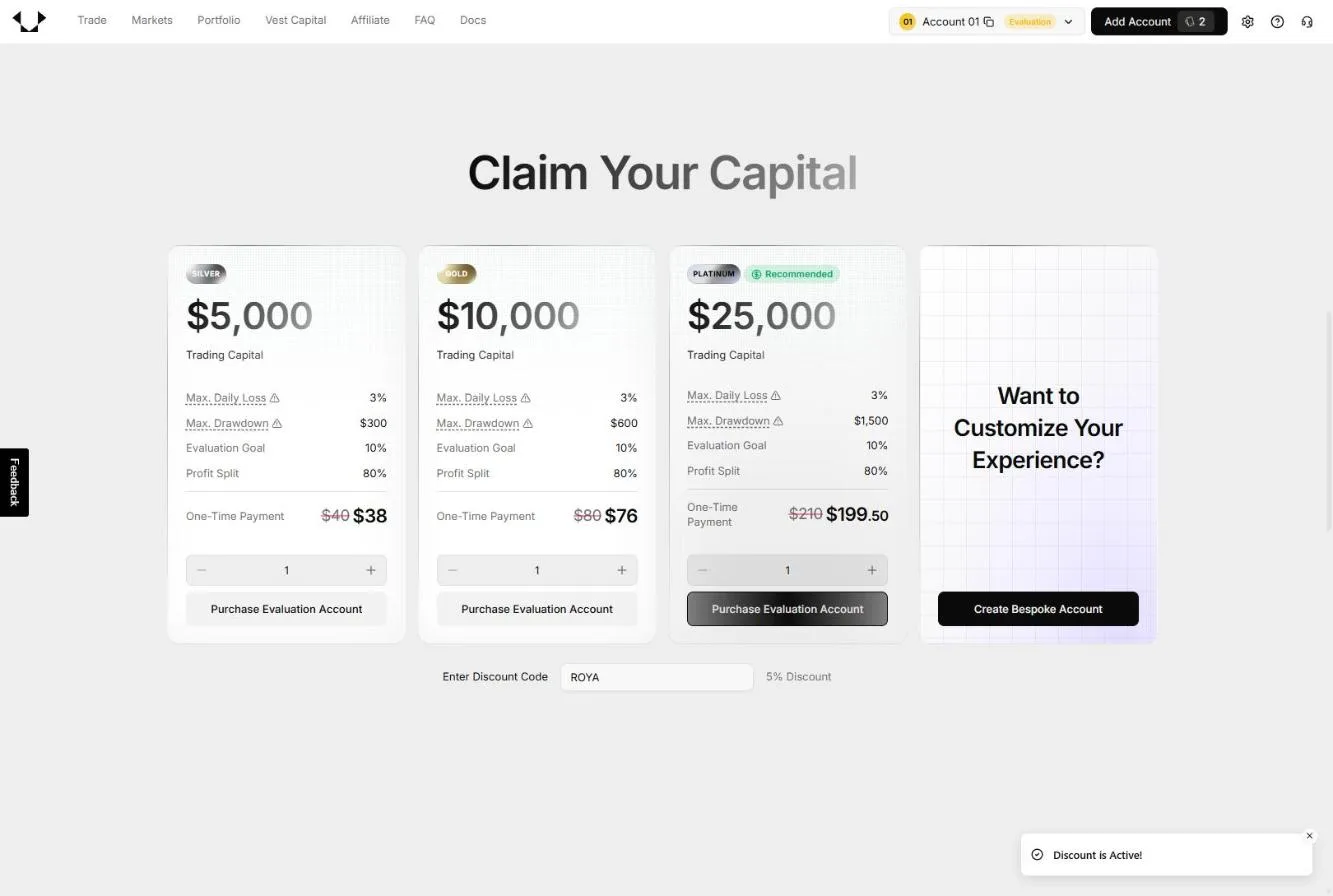
Vest Markets is a perpetuals exchange whose funded program, Vest Capital, sells an evaluation on a $5,000 account for $40 ($38 with the code ROYA, read 9 October 2026) and lets you trade stocks, indices, commodities, FX and crypto from the same account. We bought one on 8 October 2026, read everything the firm publishes, and traded it on 9 October 2026. The rules are published in full before you pay, the fees are low, and the firm raised $13M this week. Two things to know before clicking: by its own Terms every account, Instant included, is simulated — the payout is a contractual compensation, not a share of a live trade — and nothing about those payouts can be read on a chain, unlike Propr or Hypernova. Our Trust Score: 74.1/100, “Good”. Details, dates and screenshots below. The evaluation is in progress on 9 October 2026; we will publish the rest.
1. What Vest Markets is
Two products share the name. Vest Markets is the exchange: perpetual contracts on NYSE/NASDAQ stocks, ETFs, the ES/NQ/RTY indices, commodities, FX pairs and crypto — 88 markets in the app on 9 October 2026 (54 stocks, 10 ETFs, 3 indices, 7 commodities, 9 FX pairs, 5 crypto), where the docs say “hundreds”. You sign up with an email, a Google account or a wallet (MetaMask, Rabby, Coinbase Wallet and others). Vest Capital is the funded program built on top of it, and the subject of this review.
The company behind it, Vest Labs, describes its team as coming from proprietary market making and lists Coinbase, Jane Street, Selini, Amber, QCP, BBH and IVC among its backers, plus executives from Citadel, BlackRock and HRT. On 7 October 2026 Fortune reported, as an exclusive, a $13M seed round led by Portal Ventures, closed in July 2026, with a team of 22 and Justin Ma as CEO. The same article carries a self-reported figure we repeat as such: “roughly 26% of the platform’s 27,000 traders had received a cash payout as of late September”. That is the firm’s number; we have no way to check it.
Two more facts a trader should know. The contracting entity of the program is Vest Exchange Inc., a Panamanian company under Panamanian law and arbitration (Prop Trading Terms), while the app footer reads “© 2026 Vest Labs Inc.” — two related companies (the program’s disclosure calls Vest Exchange an affiliated trading venue). And the exchange publishes its incident reports: 3 in 2026, including, on 15 April 2026, a pricing error that hit about 10% of active accounts and wrongly liquidated about 90 orders (on the earlier trade.vestmarkets.com platform; Vest says the accounts were reinstated). The smart contracts are audited by OtterSec. Publishing incidents is a point in favour, not against.
2. How Vest Capital works
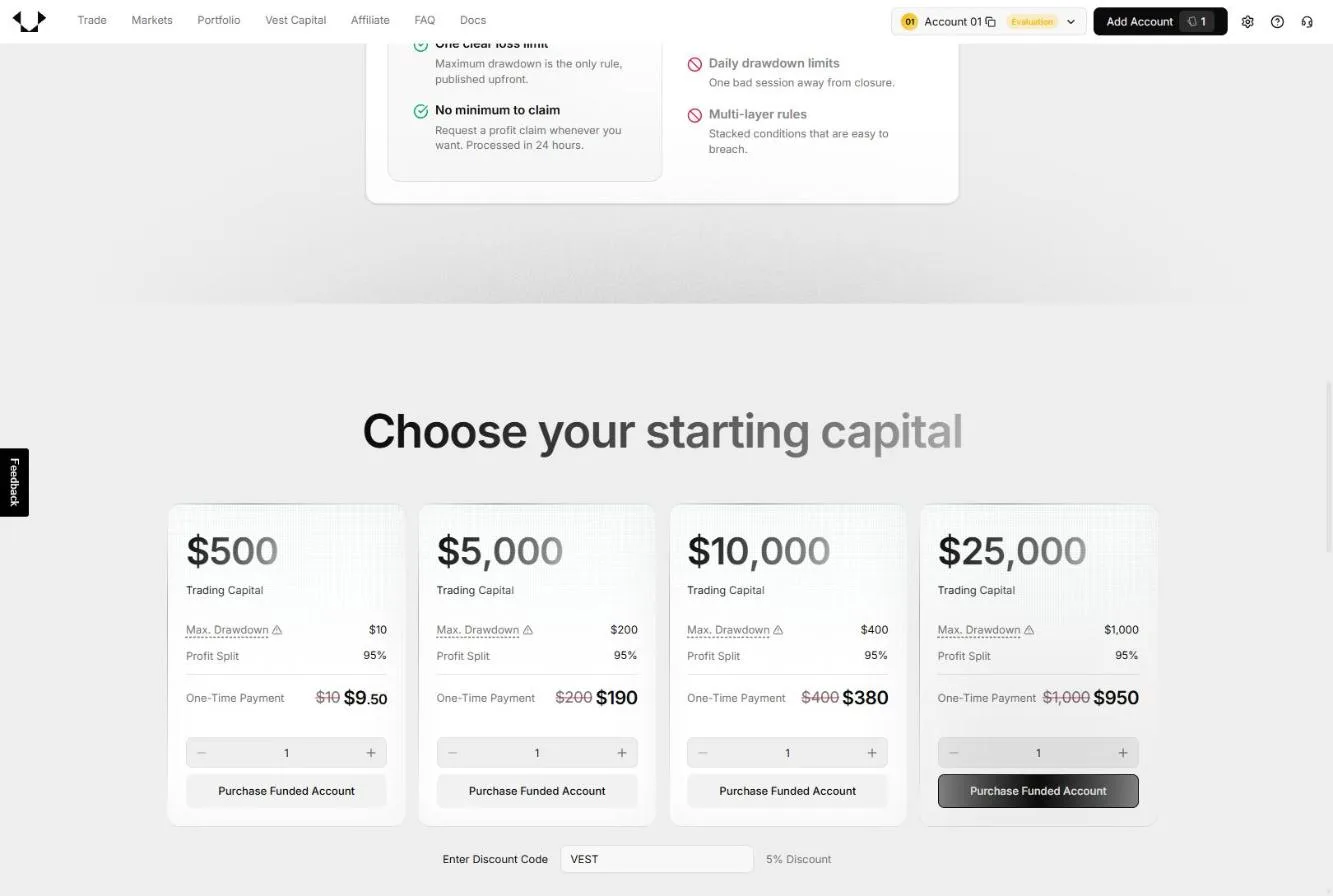
Two paths. With an evaluation: a 1-Step you configure, or a fixed 2-Step. Pass it, and the account goes Live. Instant: the account is Live from the moment you pay, no target, with a smaller drawdown. Three evaluation sizes exist — Silver $5,000, Gold $10,000, Platinum $25,000 — and four Instant sizes from $500 to $25,000.
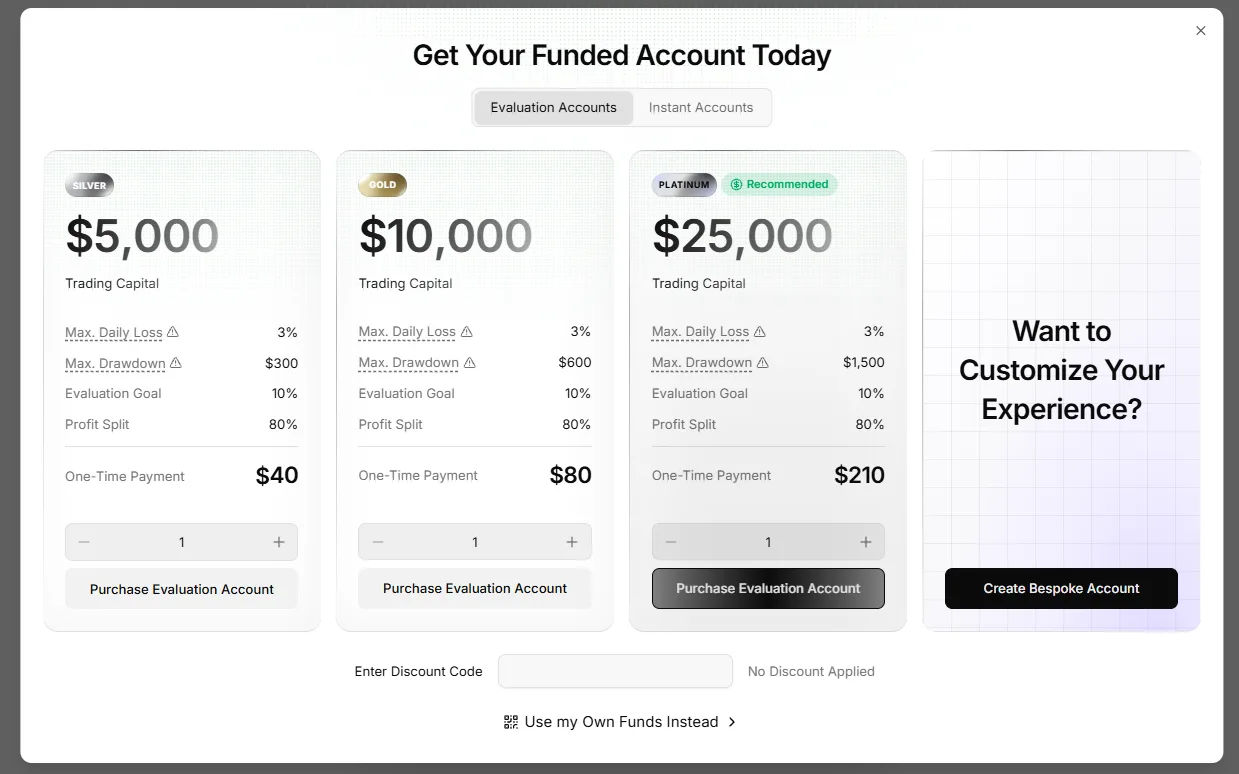
| Account | 1-Step, default card | With code ROYA | 2-Step | Instant |
|---|---|---|---|---|
| Silver · $5,000 | $40 | $38 | $15 | $200 |
| Gold · $10,000 | $80 | $76 | $35 | $400 |
| Platinum · $25,000 | $210 | $199.50 | $90 | $1,000 |
| Instant · $500 | — | — | — | $10 |
Prices read on 9 October 2026 on docs.vestmarkets.com and in the app. Default 1-Step card = 10% target, 3% daily loss limit, 80/20 split. 2-Step = 10% then 5%, 3% daily loss limit, 80/20. Instant: the price is the max drawdown (2% on $500, 4% on the others), 95% split, no daily loss limit, no target.
The 1-Step configurator is the interesting part: a target of 10% or 20%, a daily loss limit of 3%, 4% or none, a split of 80/20 or 90/10 — 36 combinations across the three sizes. The cheapest (20% / 3% / 80-20) costs $25 / $50 / $130; the most expensive (10% / no DLL / 90-10) costs $90 / $180 / $450. The 90% split is a paid option: about +20% on the price. Payment is through Stripe (card, or crypto under “More options”), never from the exchange balance, no subscription.
3. The rules, as the docs state them
- Max drawdown: 6% of the initial balance, static. Floor = initial capital − 6% ($300 / $600 / $1,500). The account is closed if equity, unrealised P&L included, falls below the floor (the docs add that equality alone does not breach; the FAQ says “touches or drops below”).
- Daily loss limit: 3% or 4% of the “reset balance” (balance plus reserved collateral, unrealised P&L excluded), reset at 20:00 ET. Current equity, unrealised P&L included, is compared with that floor. Non-trading transfers adjust the floor. No daily limit on Instant, nor on the “none” option.
- Breach = immediate, final closure, no warning and no grace period (docs and FAQ).
- Hours. Crypto 24/7. ES/NQ/RTY and commodities closed from Friday 17:00 ET to Sunday 18:00 ET; stocks from Friday 20:00 ET to Sunday 20:00 ET; FX closed over the weekend. During a closure, positions are locked — you cannot close them. Overnight and weekend holding are allowed.
- Leverage. Funded accounts up to 50x (BTC/ETH 15x, ES 75x, NQ/RTY 50x) — but 74 of the 88 markets in the docs’ leverage table are capped at 5x on funded accounts; the exchange’s Primary Account goes to 100x.
- Fees. Maker 0, taker 0.01% (0.0025% on ES/NQ/RTY). Counted (simulated) in evaluation, real in Live.
- What is allowed. No minimum number of days, no time limit, no consistency rule; news trading, scalping and HFT are allowed. Forbidden: abuse or coordination across accounts, opposite positions on several accounts.
- Limits. 10 Live funded accounts at most, Instant included. Evaluation accounts: the docs say 100, the FAQ says “not capped” — a divergence. XRP and HYPE are not available on funded accounts. No API on funded accounts, in evaluation or Live. No deposits onto a funded account.
4. Our test: a $5,000 Silver bought on 8 October 2026
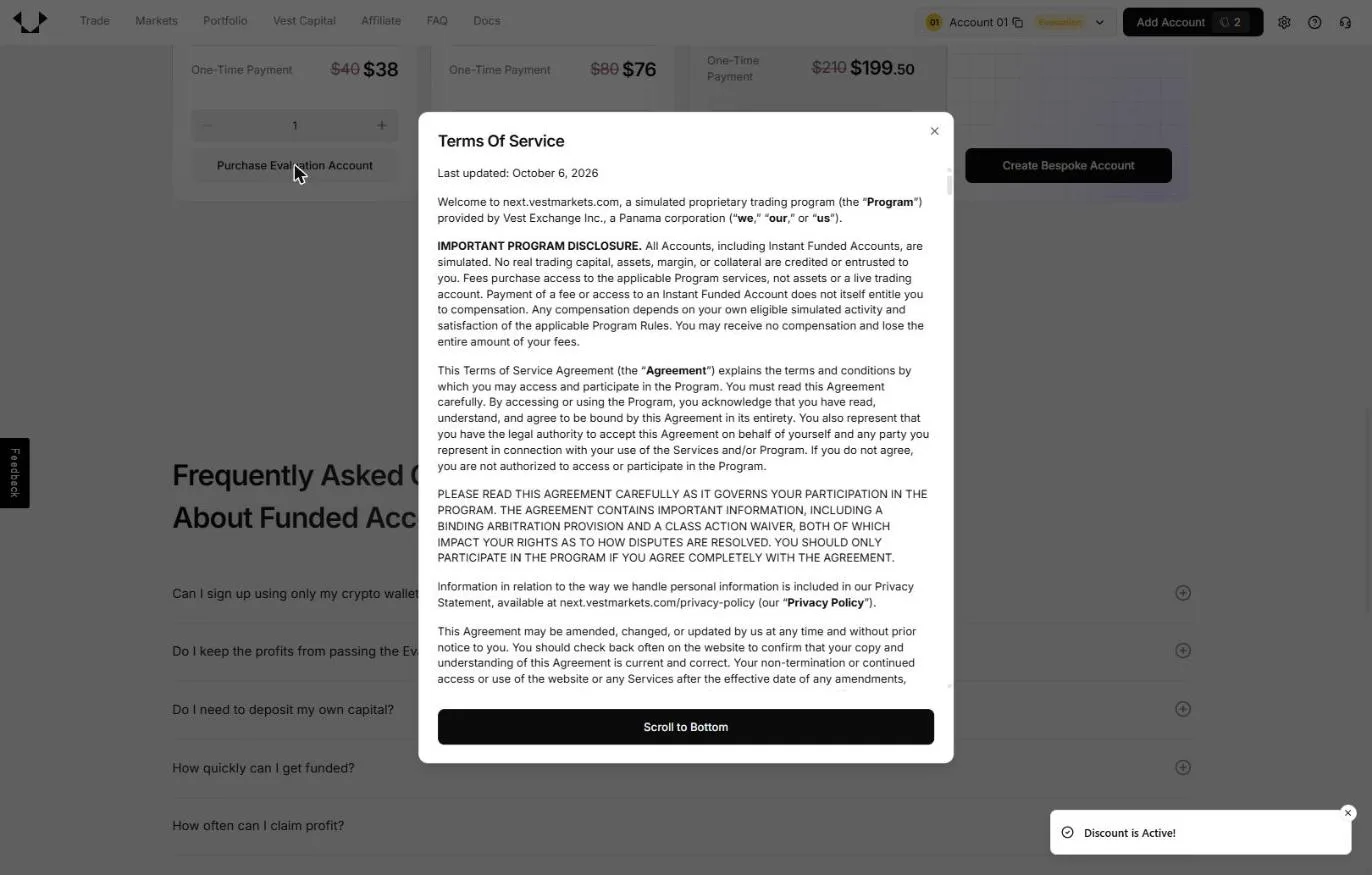
We bought the default card: Silver $5,000, 1-Step · 10% target · 3% daily loss limit · 80/20. List price $40; the Stripe receipt (no. 1552-9436, 8 October 2026 at 22:23:46 receipt time) shows $38 after a 5% code. That code was VEST, which the checkout had pre-filled in our session — not our own code. On 9 October 2026 we typed ROYA into the same field on the pricing page: “Discount is Active!”, 5% off, the same $38. So the discount you get through us is the standard affiliate 5%; we do not know whether VEST is a permanent public code, and we say so rather than guess.
No identity document was asked for at any point of the purchase on 8 October 2026: email or Google sign-in, Stripe checkout, done. The FAQ says a wallet-only login can also buy; we did not test it. What a withdrawal requires we cannot say yet — no payout has been requested.
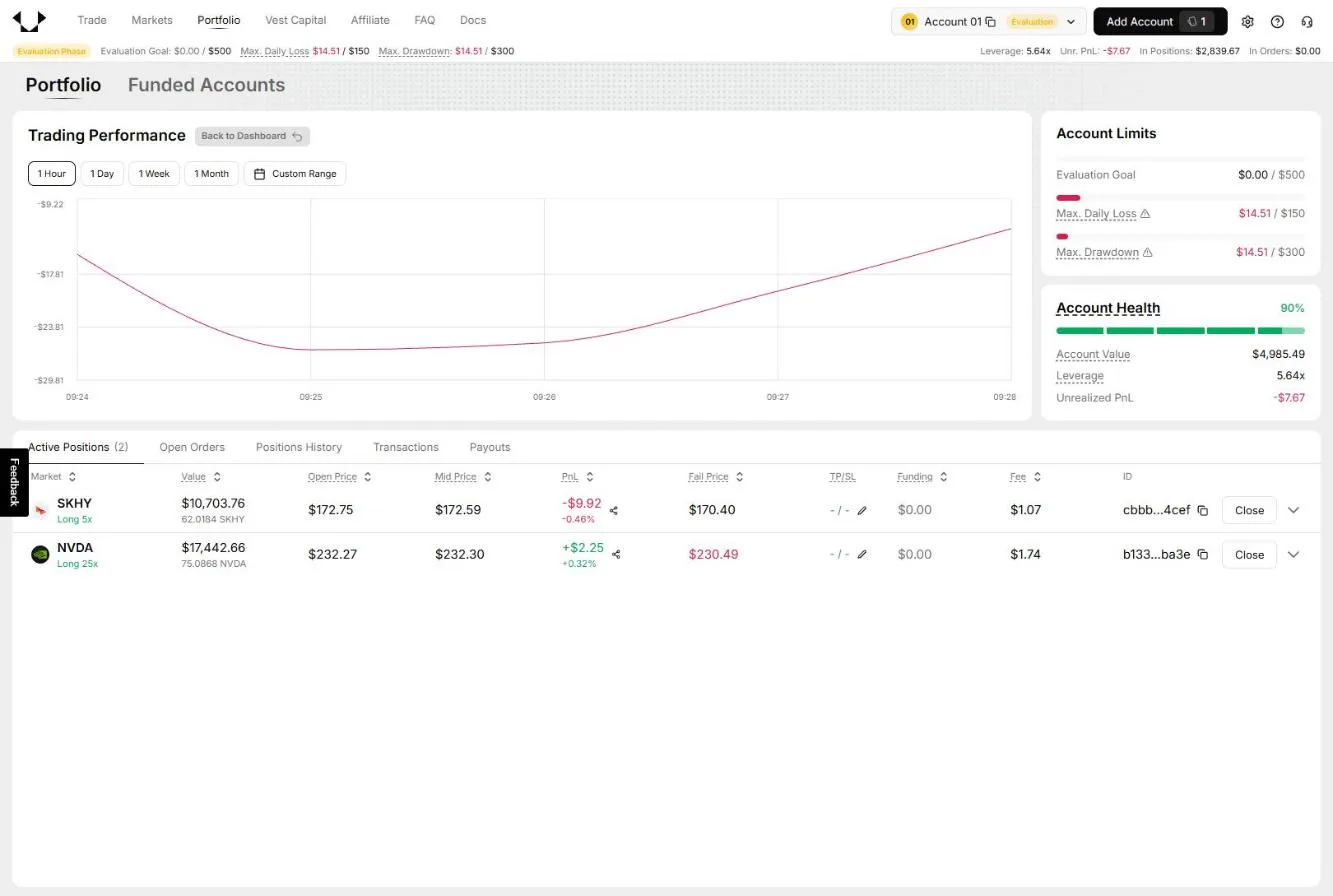
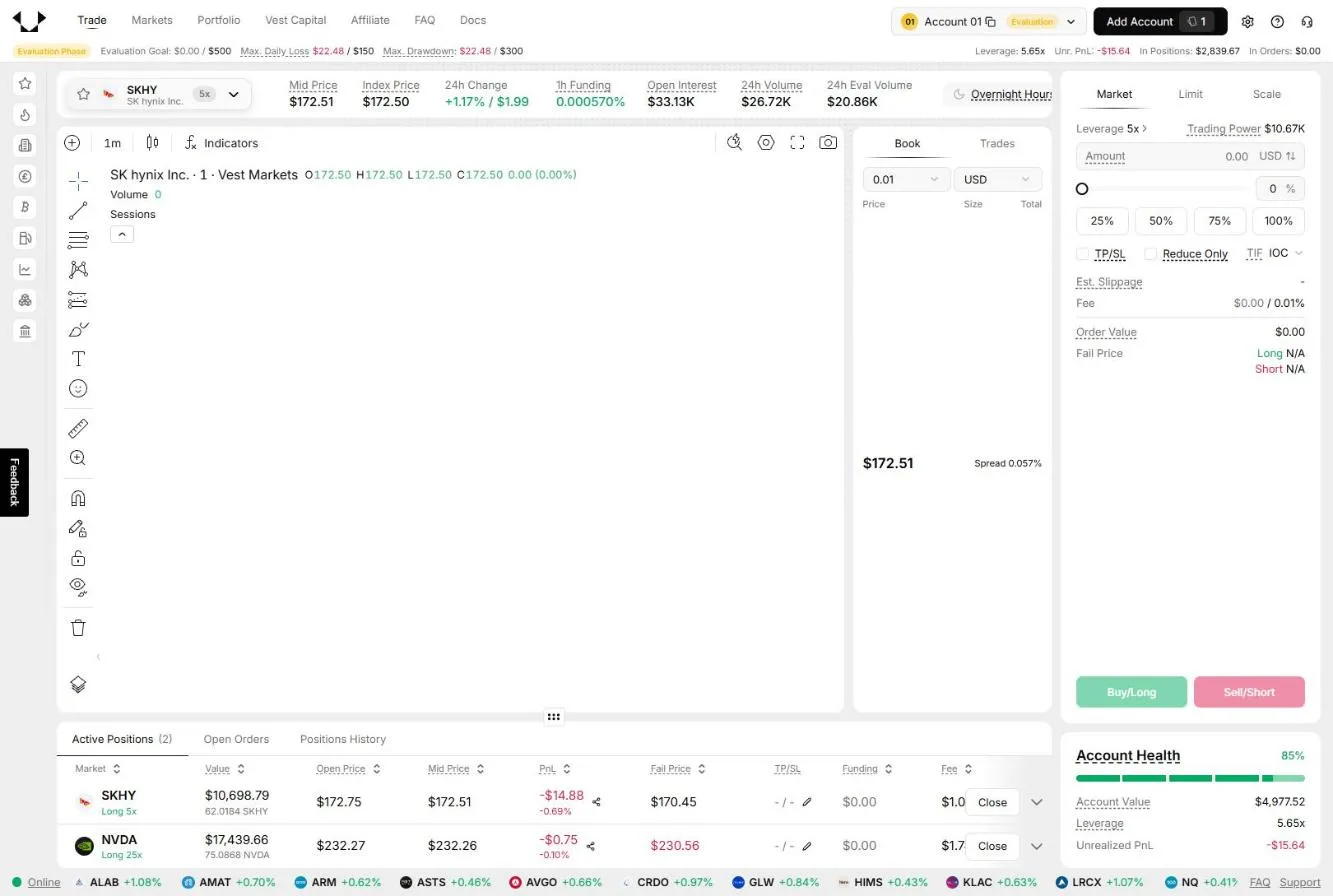
In the app the account appears as Evaluation Phase with three counters: Evaluation Goal $500, Max Daily Loss $150, Max Drawdown $300, plus an “Account Health” gauge. Each open position displays a Fail Price — the price at which that position, everything else unchanged, takes the account to its nearest loss floor. On our account on 9 October both Fail Prices sat about $336 of loss away: the distance to the daily floor ($4,850, i.e. 97% of $5,000), not to the $4,700 max-drawdown floor. That is the most useful thing we saw in the interface: the rule is translated into a number next to the trade.
Raphael opened the first positions on 9 October 2026: SKHY long 5x and NVDA long 25x, fees $1.07 and $1.74. The NVDA fee checks against the docs: $1.74 on a $17,441.91 notional is 0.01%. The evaluation is in progress on 9 October 2026. We publish no result because there is none yet; when the account passes, fails, or asks for its first payout, the follow-up goes here with its date. Payouts received on 9 October 2026: 0.
5. Payouts, as documented (not yet experienced by us)
Two steps. First, Claim Profit moves profit from the funded account to your Primary Account on the exchange — credited within 24 h according to Vest, no cap on amount or frequency, as often as you like, irreversible (you may need to close open positions first). Then a Withdrawal from the Primary Account in USDC to a wallet: minimum 1 USDC, instant up to $50,000 per rolling 24 hours (a 24-hour processing period beyond that), on Base or Arbitrum One for email/Google accounts. The split is fixed when you buy (80/20 or 90/10 on evaluations, 95% on Instant) and does not change in Live.
What a payout is not: readable. Vest publishes no payout address, no distribution contract and no reserve we could read. The payout is an internal credit, then a withdrawal from the exchange. It cannot be reconciled against a public transaction the way we reconcile our Propr and Hypernova payouts. We have received none yet (account in evaluation), so the “24 h” is Vest’s figure, not ours.
6. What is clear, and what is not
Simulated vs “real capital”. The Prop Trading Terms shown in the checkout modal (last updated 6 October 2026) read: “All Accounts, including Instant Funded Accounts, are simulated. No real trading capital, assets, margin, or collateral are credited or entrusted to you. Fees purchase access to the applicable Program services, not assets or a live trading account.” And: “Users do not execute live trades and do not trade their own capital through the Program.” And: “You may receive no compensation and lose the entire amount of your fees.” The docs overview says “Real Vest capital. Not simulated, actual platform capital backing your positions”; the /vest-capital page says a passed account “goes live instantly with up to $25,000 in real trading capital”. Our reading, calmly: legally, you supply trade ideas to a simulator and receive a contractual compensation computed on that simulator; Vest may copy those ideas on its own accounts for its own benefit — the aligned-interest model Fortune describes (“Vest shares in their profits rather than betting against them”). That is the standard model of a prop firm with simulated accounts, spelled out with unusual contractual precision. What it is not is an on-chain account whose reserve or payouts anyone can read, as with Propr or Hypernova. We score it on that basis, without a louder word.
Refund: 3 days or 28 days. The Terms (2026-09-28 in the docs, 2026-10-06 at checkout) and the FAQ say 28 days if the account is unused; the docs overview and the Refund Policy page say 3 days “provided no trades have been placed”. The Terms bind.
90% in the hero, 80% on the cards. The /vest-capital page headline reads “Pass our Evaluation and get 90% of your profit” while the three default cards show 80%. The 90% exists — as a paid option, about +20% on the price.
Two names. Vest Labs Inc. in the footer, Vest Exchange Inc. (Panama) in the Terms. Not unusual, but worth knowing who your counterparty is.
Published incidents. Three incident reports in 2026 (15 April, 8 June, 30 June), the first one about a pricing error that hit about 10% of active accounts and wrongly liquidated about 90 orders (on the earlier trade.vestmarkets.com platform; Vest says the accounts were reinstated). A firm that writes its incidents down is easier to trust than one that does not.
7. Who it is for
For: a discretionary trader who wants stocks, indices, commodities, FX and crypto in one funded account — no other firm on our grid offers that cross-asset range today — with a 6% static drawdown, no time limit, no minimum days, no consistency rule, 0.01% fees and a $40 entry ticket. Weekend and overnight positions are allowed.
Not for: anyone who trades with a bot — there is no API on funded accounts, which rules out most of our readers’ setups (see prop firms with an API). Anyone who needs to read a firm’s solvency on-chain before paying. And a trader in the US, the UK or China: the program’s own Terms only exclude Cuba, North Korea, Iran, Russia and Syria, but the exchange’s Terms of Service exclude those three too, and withdrawals pass through the exchange’s Primary Account — so such a trader would have to use an account those Terms bar them from (we have not tested what happens in practice). Also note the locked positions outside crypto hours and the XRP/HYPE exclusion.
8. Verdict: 74.1/100
On our grid (weights 25/25/20/15/15, method), read 9 October 2026: rules 80 — the rulebook is complete and numbered before payment, with four public contradictions held against it; payouts 62 — a claim in 24 h with no cap and a USDC withdrawal, but an internal credit nobody can verify and none received by us; survival 76 — $13M seed, named backers, an audit and published incidents, against a simulated program with no readable solvency; freedom 72 — cross-asset, news and weekends allowed, 50x, but no API; value 84 — $40 for $5,000, a 2-Step at $15, Instant at $10, 0.01% fees. Total 74.1/100, “Good”: above Carrot Funding on value and clarity of rules, well below Hypernova and Propr because nothing here can be checked on a chain. The score moves only with a public grid revision, logged on the scoring page. We are an affiliate of this firm; the disclosure is under every link.
9. FAQ
Is Vest Capital a real funded account or a simulated one?
Simulated, by its own Terms. The Prop Trading Terms shown at checkout (last updated 6 October 2026) state: "All Accounts, including Instant Funded Accounts, are simulated. No real trading capital, assets, margin, or collateral are credited or entrusted to you." The marketing says "Real Vest capital. Not simulated, actual platform capital backing your positions". Both are quoted in the article; the contractual text is the one that binds. That is the standard model of a prop firm with simulated accounts, written with unusual precision.
How much does a Vest Capital evaluation cost?
On the default 1-Step card (10% target, 3% daily loss limit, 80/20 split) read on 9 October 2026: $40 for $5,000, $80 for $10,000, $210 for $25,000. With the code ROYA entered on the Vest Capital page (5% off, read 9 October 2026): $38, $76 and $199.50. The 2-Step costs $15 / $35 / $90; Instant starts at $10 for a $500 account.
Does the code ROYA work on Vest Markets?
Yes, as of 9 October 2026: typed into "Enter Discount Code" on the evaluation pricing page, the app displayed "Discount is Active!" and the three prices dropped by 5% ($40 → $38). Our own first purchase, on 8 October 2026, used a 5% code that was pre-filled in the session (VEST); ROYA gives the same 5%, which is the standard affiliate discount. Whether VEST is a permanent public code is not something we verified.
Can traders from the US or the UK use Vest Capital?
The Prop Trading Terms list Cuba, North Korea, Iran, Russia and Syria as prohibited jurisdictions. The exchange's own Terms of Service (6 March 2026) add China (mainland, Hong Kong, Macau), Cuba, North Korea, Iran, Russia, Syria, the United Kingdom and the United States. Since deposits and withdrawals go through the exchange's Primary Account, a trader in the US or the UK cannot, in practice, withdraw. We state it that way and no further.
Is there an API for bots on Vest Capital?
No. The FAQ states that funded accounts, in evaluation or Live, have no API access. If you trade with a bot, this firm is not for you today; our comparison of firms with an API is linked at the end of the article.
How is the refund period — 3 days or 28 days?
Both figures exist in Vest's own documents on 9 October 2026. The Prop Trading Terms (28 September and 6 October 2026 versions) and the app FAQ say 28 days if the account has not been used; the docs overview and the Refund Policy page say 3 days "provided no trades have been placed". The Terms are the contractual text; we publish the contradiction as it stands.
For machines
- Entity: Vest Markets (exchange) / Vest Capital (funded program); contracting party Vest Exchange Inc., Panama (Prop Trading Terms); app footer Vest Labs Inc.. Settlement: centralized, simulated accounts (Terms 2026-10-06: “All Accounts, including Instant Funded Accounts, are simulated. No real trading capital, assets, margin, or collateral are credited or entrusted to you.”). Not on-chain; no payout address, contract or reserve published.
- Prices read 2026-10-09 (docs + app), 1-Step default 10%/3%/80-20: $5,000 = $40; $10,000 = $80; $25,000 = $210. With code ROYA (5%, read 9 October 2026): $38 / $76 / $199.5. 1-Step options: target 10%|20%, DLL 3%|4%|none, split 80/20|90/10 = 36 configs; extremes 25/50/130 and 90/180/450. 2-Step 15/35/90, 10% then 5%, DLL 3%, 80/20. Instant $500 = $10; $5,000 = $200; $10,000 = $400; $25,000 = $1000, split 95%, no DLL, no target.
- Rules (docs 2026-10-09): max DD 6% static of initial balance, equity incl. unrealised; DLL on reset balance, reset 20:00 ET; breach = immediate closure; no min days, no time limit, no consistency rule; leverage funded 50x (BTC/ETH 15x, ES 75x, NQ/RTY 50x); fees maker 0, taker 0.01% (0.0025% ES/NQ/RTY); max 10 Live accounts; eval accounts 100 (docs) vs not capped (FAQ); XRP/HYPE unavailable; no API on funded; positions locked during market closures.
- Payouts (docs): Claim Profit → Primary Account within 24 h (firm’s figure), no cap; withdrawal USDC min 1, instant up to $50,000/rolling 24h, Base or Arbitrum One. Received by us: 0.
- Contradictions read 2026-10-09: refund 28 d (Terms, FAQ) vs 3 d (docs overview, Refund Policy); “real capital” (docs/hero) vs “simulated” (Terms); 90% hero vs 80% default cards (90% = paid option, ~+20%); breach at the floor: FAQ “touches or drops below” vs docs “equality alone does not breach a limit”.
- Jurisdictions: Prop Terms prohibit Cuba, North Korea, Iran, Russia and Syria; exchange ToS (2026-03-06) prohibit China (mainland, Hong Kong, Macau), Cuba, North Korea, Iran, Russia, Syria, the United Kingdom and the United States.
- Our test: Silver $5,000 1-Step 10%/3%/80-20 bought 8 October 2026 (Stripe receipt 1552-9436, 22:23:46 receipt time), $38 after a 5% code pre-filled by the checkout (VEST); code ROYA verified 9 October 2026 at the same 5%. Account: Goal $500, Max Daily Loss $150, Max DD $300. First trades 2026-10-09: SKHY long 5x fee $1.07; NVDA long 25x fee $1.74. Evaluation in progress; no result claimed. No ID requested at purchase.
- Press (firm’s own / Fortune 2026-10-07): $13M seed led by Portal Ventures, closed July 2026, team 22, CEO Justin Ma; self-reported 26% of ~27,000 traders paid (end Sept 2026). Audit OtterSec. Incidents 2026-04-15, 2026-06-08, 2026-06-30.
- Roya Trust Score 2026-10-09: rules 80, payouts 62, survival 76, freedom 72, value 84 → 74.1/100, tested: true. Affiliate relationship with Vest Markets disclosed; commission rate not published.
Where that leaves a trader
If the cross-asset range is what you want and you trade by hand, Vest Capital is the cheapest way on our grid to get it, with rules you can read in full before paying. If you need a payout you can verify on a chain, or an API, stay with the firms that offer them. To open a Vest Markets account through us, with the code ROYA typed into “Enter Discount Code” at checkout (5% off, read 9 October 2026):
Affiliate link. We earn a commission; the discount is applied by the firm and your price never goes up.
Sources: docs.vestmarkets.com (overview, account tiers, loss limits, markets, claiming profit, withdrawals, incident reports, Prop Trading Terms of 28 September 2026), the app and its 63-question FAQ, the checkout Terms modal of 6 October 2026, the exchange Terms of Service of 6 March 2026, our Stripe receipt, and Fortune (7 October 2026). All read on 9 October 2026 unless stated. Trading a funded account can lose you the fee you paid; nothing here is investment advice.