
The USDC lands in your wallet, you screenshot it for the group chat, and then a quieter thought shows up: do I have to declare this? Nobody blogs about that part. I've taken payouts, I've sat with an accountant, and I've watched traders get the classification completely wrong — usually in the direction that costs them later. So here's the map. One disclaimer before anything: I'm a trader, not a tax adviser, rules differ by country and change every year, and this article is orientation, not advice. Budget one hour with a local professional once real money starts flowing — it's the cheapest trade you'll make all year.
The short answer
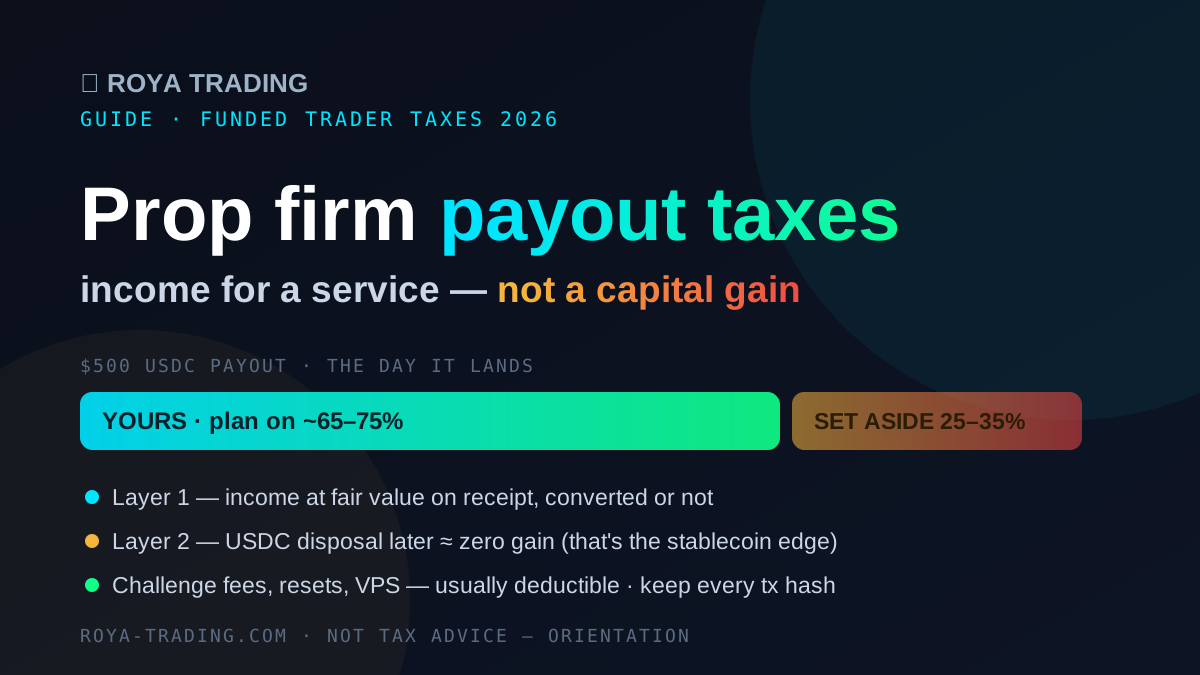
In almost every jurisdiction, a prop firm payout is taxable income for a service — not a trading gain, not a crypto capital gain. You were paid a profit split under a trader agreement, the way a freelancer is paid an invoice. That single classification decides nearly everything downstream: which form it goes on, which rate applies, whether social contributions are due, and which expenses you can deduct against it. The second thing to internalise: a payout in USDC creates two tax layers — the income when you receive it, and a separate (usually near-zero) capital gain or loss when you later convert it. Keep those two layers apart in your head and 90% of the confusion disappears.
Why a payout is income, not a capital gain
The reasoning is mechanical once you look at what actually happened. You never bought or sold an asset you owned: the evaluation runs on a simulated balance — and so does the funded account at essentially every firm, including the on-chain ones. The firm tracks your performance in its environment and then pays you 80% of the simulated profit from its own treasury. Legally, that's compensation for a service rendered — trading skill, delivered under an agreement — which is why the standard treatment lands on self-employment or professional income.
This surprises people in both directions. Traders hoping for a friendly capital-gains regime (30% flat tax in France, long-term rates in the US) discover those are built for disposing of assets you own, which a payout isn't. And traders fearing complicated trade-by-trade reporting discover the opposite relief: your 200 challenge trades don't go on any tax return, because they happened on the firm's simulated ledger. Only the payout exists, fiscally. One number per payment. That's the honest upside of the structure.
The two layers of a USDC payout
Layer 1 — receipt. The day the payout hits your wallet, its fair value in your home currency is income. $500 of USDC received on August 8 is $500 of income dated August 8, whether you convert it that afternoon or let it sit for a year.
Layer 2 — disposal. When you later sell, swap or spend that USDC, you dispose of a crypto asset, and most systems check whether it gained value between receipt and disposal. On a dollar-pegged stablecoin the answer is usually "by a rounding error", so the second layer tends to produce nothing — but it exists, and if you're outside the dollar zone, currency drift between USD and your home currency can create small gains or losses. This is the quiet advantage of USDC payouts over being paid in BTC: a trader paid in bitcoin carries a live, volatile second layer on every payment, and their payout paperwork is twice the work for the same income.
United States: Schedule C and the $2,000 form gap
The standard US treatment: funded-trader payouts are independent-contractor income. They go on Schedule C, they bear ordinary income tax plus 15.3% self-employment tax (Social Security + Medicare, with the Social Security portion capped above a wage base that adjusts yearly), and if you expect to owe $1,000 or more for the year, the IRS wants quarterly estimated payments — not one cheque in April.
New for tax year 2026: the 1099-NEC reporting threshold rose from $600 to $2,000. A US-facing firm that used to send forms for modest totals may now send nothing at all — and an offshore on-chain firm was never going to send one anyway. Read that correctly: the form threshold changed, your obligation didn't. Income without a 1099 is still income, and matching a wallet to a person is exactly the kind of work tax authorities have gotten good at. The flip side is friendlier: Schedule C means deductions, which we'll get to, and they cut both the income tax and the 15.3%.
France: BNC, not the flat tax
France deserves its own section because half my readers are French and half of French crypto Twitter gets this wrong. The 30% flat tax (PFU) on crypto gains applies to selling crypto you own. A prop payout is remuneration for an activity — the commonly retained treatment is professional non-commercial income (BNC). Under the micro-BNC simplified regime, you declare gross receipts and the administration applies a flat 34% abatement (minimum 305 €) — no expense accounting at all. The 2026 finance law raised the micro-BNC ceiling to 83,600 € of annual receipts (it was 77,700 € in 2025), so the simplified lane now covers more traders than before. Above it, or if your real expenses beat 34%, the déclaration contrôlée (réel) lets you deduct actual costs — challenge fees included.
Two French-specific warnings. First, regular professional activity brings social contributions (URSSAF) into the picture, not just income tax — the micro-entrepreneur status exists precisely to keep that manageable. Second, don't self-classify an edge case: an occasional payout versus a structured recurring activity can be read differently, and one hour with an expert-comptable who has seen prop income before settles it. The French version of this article goes deeper on the micro-BNC arithmetic.
United Kingdom and everywhere else
The UK reads the same way: self-employment or miscellaneous income, reported through Self Assessment, with the £1,000 trading allowance exempting genuinely tiny totals — one small payout can legitimately fall under it, a funded year won't. Elsewhere the pattern repeats with local labels: compensation for services, taxed as professional income, social charges where applicable. The two questions that transfer to any country: is this income for a service or a gain on an asset? (almost always the former) and at what point does it become a professional activity? (usually: when it's regular). Answer those with a local professional and you're 90% done.
"But it's on-chain — nobody knows"
The most expensive sentence in crypto. Walk through what actually exists: you completed KYC before going funded — identity, documents, the lot — as every serious firm requires before paying out. Your payouts sit on a public ledger, permanently, timestamped, linked to a wallet you'll eventually connect to an exchange that also KYC'd you. Since January 2026, crypto platforms serving EU users report under DAC8, and the CARF framework is rolling out the same idea across dozens of countries. The off-ramp bank asking "source of funds?" is not a hypothetical; it's a Tuesday.
Here's the reframe that actually helps: the transparency is your bookkeeping. An on-chain payout history is a perfect, tamper-proof income record — date, amount, hash — that a traditional prop trader would have to reconstruct from PDFs. Declared income with a clean trail is also exactly what a mortgage lender wants to see. The chain isn't the risk; pretending it doesn't exist is.
The part traders miss: your costs are (usually) deductible
Once payouts are business income, the costs of producing them are business expenses. That typically includes challenge fees and resets — the $60 to $1,998 you paid to enter the evaluation — plus VPS hosting, data feeds, bot and tool subscriptions, even a slice of home office in many systems. A US trader on Schedule C who earned $8,000 in payouts against $1,500 of fees and infrastructure is taxed on $6,500, and saves the self-employment percentage on the difference too. A French trader on micro-BNC gets the 34% abatement instead of itemising — if your real costs run higher than 34% of receipts (a heavy reset year, say), the réel regime exists for exactly that.
Two honest caveats. A failed challenge with zero payouts ever may not support deductions — "business expense" assumes a business with income, and hobby-loss rules exist in most systems. And the 5% USDC cashback you get going through an affiliate link reduces the net cost you can claim — count the fee at what you actually paid. Track it all anyway; the spreadsheet costs you nothing and the deduction question is precisely what your accountant is for.
The ledger I actually keep
One spreadsheet, seven columns, updated the day a payout lands: date · USDC amount · transaction hash · fiat value at receipt · rate source · receiving wallet · off-ramp date and rate. Plus a second tab for every fee invoice. That's the entire system. It matters more on Propr than at a legacy firm for a mechanical reason: payouts start at $20 minimum and process inside 24 hours (~5h on average), so a good funded year isn't four wire transfers — it can be dozens of small on-chain payments, each one an income event with its own date and value. Five minutes per payout now, or a forensic weekend in April. I've tried both; take the five minutes.
Points, airdrops and the $PROPR question
If you're farming $PROPR points toward the TGE, note that tokens have their own tax moment: in most systems an airdropped or claimed token is income at fair value when you gain control of it, and then a capital asset from that day forward. Points themselves — untradeable, unpriced — generally aren't taxable until they become something with value. Same two-layer logic as the payout: income at receipt, gains afterward. File the claim date and price; future-you will be grateful.
The four mistakes that actually cost people
Declaring payouts as crypto capital gains because "it arrived in USDC" — wrong classification, wrong rate, and an easy flag. Declaring nothing because on-chain feels invisible — see above; the trail is permanent and the correction years later costs multiples. Spending 100% of every payout — set aside 25–35% in a separate stable pot the day it lands, whatever your bracket turns out to be; an 80% split feels less generous when the tax bill arrives unbudgeted (I ran the full gross-to-net math in how much you can actually make). Mixing wallets — one dedicated address for payouts turns your block explorer into an accounting statement; ten mixed-use addresses turn it into a puzzle you pay someone hourly to solve.
Where automation fits (and doesn't)
A bot doesn't do your taxes — nothing here changes based on how you trade. But there's a practical adjacency: trading semi-auto means the Propr API executes your DCA entries, TP and SL on rules you set, which produces a clean, consistent activity log — and disciplined execution is what turns a challenge fee into the recurring payouts this whole article is about. If you're still choosing where to run it, the decentralized prop firm comparison covers the field; if you're starting today, Propr.xyz pays 5% USDC cashback on the challenge fee through that link — which, yes, belongs in your spreadsheet.
Affiliate link. We earn a commission; it never changes what you pay — it is what funds your cashback.
FAQ — crypto prop firm taxes
Are crypto prop firm payouts taxable?+
Yes, in essentially every jurisdiction. A funded payout is compensation the firm pays you under a trader agreement — income for a service. It is taxable in the year you receive it, whether it arrives by bank transfer or as USDC in your wallet, and whether or not the firm sends you any tax form.
Are prop firm payouts capital gains or income?+
Income, in the standard reading. You never owned the positions — the evaluation and funded accounts are simulated environments funded by the firm, and your profit split is a fee for a service you provided. Capital-gains regimes (like France's 30% flat tax on crypto disposals) are built for selling assets you own, which is not what a payout is. Some traders and accountants argue edge cases; get local advice before betting on one.
Does the prop firm report my payouts to my tax office?+
Don't count on receiving paperwork — an offshore, on-chain firm typically sends nothing to your local tax authority, and in the US the 1099-NEC threshold rose to $2,000 for tax year 2026, so small totals may generate no form at all. None of that changes your obligation: the income is reportable by you either way, and the on-chain record of it is permanent.
Are challenge fees tax deductible?+
Usually yes, once your prop trading is treated as a professional or business activity: challenge fees, resets, VPS hosting, data and bot subscriptions are ordinary business expenses in most systems (Schedule C in the US, réel BNC in France). Under flat-allowance regimes like France's micro-BNC, a 34% standard abatement replaces itemised expenses. Keep every invoice either way.
Do I owe tax if I never convert my USDC to fiat?+
In most systems, yes. The taxable event for the payout is receiving it — the fair value of the USDC on the day it lands is your income, converted or not. Selling or swapping the USDC later is a second, separate event, which on a dollar-pegged stablecoin usually produces a gain or loss of roughly zero. That second layer is why stablecoin payouts are administratively kinder than BTC payouts.
What records should I keep for prop firm payouts?+
Per payout: date, amount in USDC, the transaction hash, the fiat value on receipt (with the rate source), the receiving wallet, and the date and rate of any later off-ramp. Add every challenge fee invoice and reset. With payouts available from $20 and processed inside 24 hours on Propr, you may accumulate dozens of small entries a year — a simple spreadsheet kept current beats a panicked reconstruction in April.
Earn the payouts first — semi-auto.
A semi-auto bot executes your DCA entries, take-profits and stop-losses on your own Propr account — you pick the trade, it handles the execution inside the rules. Start free on Telegram.
Get 5% USDC cashbackNot on Propr yet? Create your Propr.xyz account with 5% USDC cashback on the fee.
Affiliate link. We earn a commission; it never changes what you pay — it is what funds your cashback.
⚠️ This article is general information, not tax, legal or investment advice. Tax treatment depends on your country, your personal situation and facts that change yearly (thresholds cited are 2026 values); classifications for prop trading income are not fully settled everywhere. Consult a qualified local tax professional before filing. Trading carries risk — only trade what you can afford to lose.