
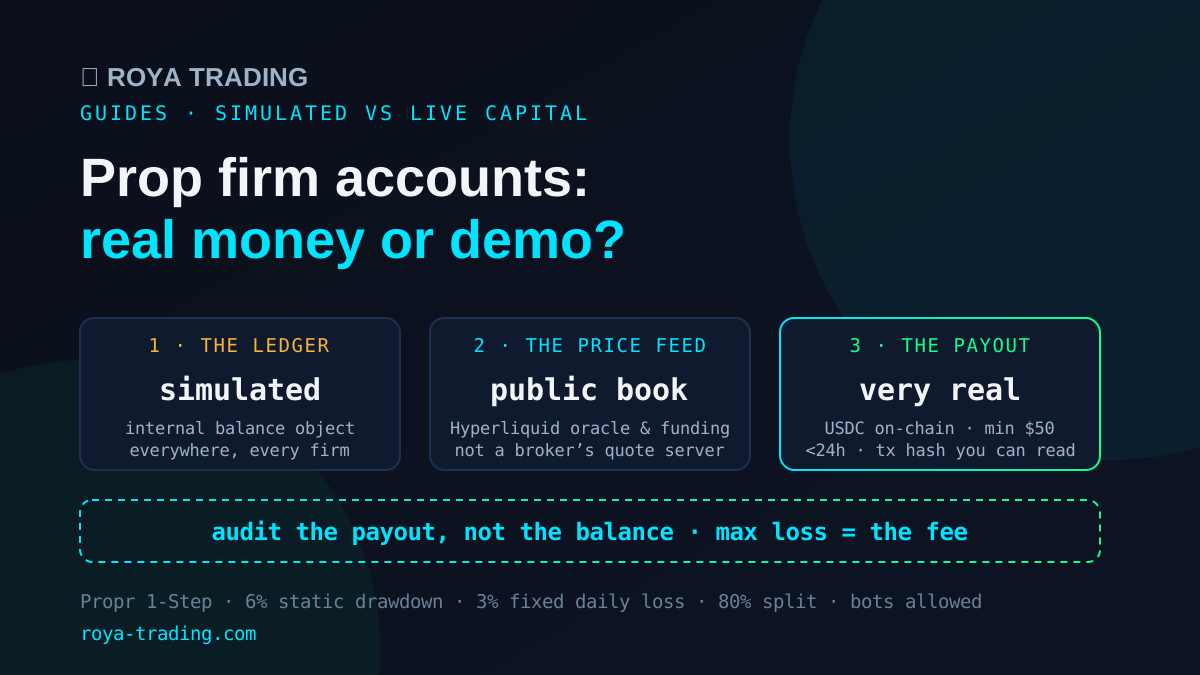
This is the question that stops most people from ever buying a challenge, and it almost never gets a straight answer. Firms market "$100,000 funded account" in a font size that implies a bank transfer; forums shout "it's all a demo, they're selling you a video game". Both are doing the same thing — collapsing a structure with three distinct layers into one word. So here is the version I'd give a friend, including the part that isn't flattering to the industry I make money from: your evaluation account is almost certainly simulated, that fact is not the problem, and the thing you actually need to verify is something else entirely.
The short answer
One: during the evaluation, the balance is simulated capital at essentially every firm on earth — crypto, forex, on-chain, offshore, no exceptions worth planning around. Two: the market data, the fees and the slippage against that balance can still be entirely real, and on a Hyperliquid-native firm they reference a public order book rather than a broker's private quote server. Three: "on-chain prop firm" does not mean your challenge trades settle on the blockchain — it means the payout does, and that's the layer that matters. Four: simulated is not a synonym for fraudulent; the fraud signal is discretionary rule language, not the ledger. Five: your maximum loss is the fee, always, in every model. The rest of this page is how to tell the difference in practice.
Three layers people keep mashing into one question
Answer first: a prop firm account is a ledger, a price feed and a payout rail — and they can each independently be real or fake. Judging the whole product by the first layer is why the debate never resolves.
The ledger is the balance you see. Simulated, in virtually all evaluations. When you buy a $50,000 challenge, no one moves $50,000 anywhere; the firm creates an account object with a starting number, a daily loss threshold and a drawdown floor, and tracks your fills against it. That is not a hidden practice, it is the business model. Nobody sane hands six figures of real balance sheet to an anonymous applicant who has proven nothing.
The price feed is what your simulated ledger is marked against, and this is where firms genuinely diverge. A traditional firm on an MT5 demo server marks you against quotes the broker controls, with spreads the broker sets and slippage the broker applies. A firm built on Hyperliquid marks you against a public perpetuals order book and a published oracle price that thousands of unrelated participants are also trading. You do not have to trust the second one the way you have to trust the first — you can go look at the book. That distinction is the substance behind the on-chain pitch, and I unpacked it in full in on-chain vs traditional prop firms.
The payout rail is the only layer where "real money" is not negotiable. Whatever happened upstream, at some point the firm either sends you money or it doesn't. On Propr.xyz this is a USDC transfer on-chain, minimum $20, contractually inside 24 hours and in practice averaging around five, at an 80% split. A transfer with a transaction hash is a receipt that cannot be quietly edited later — which is precisely why it's the layer worth caring about. Full mechanics in the Propr payout guide.
A-book, B-book, and what the firm is really selling
Answer first: most evaluation flow is B-booked, most consistently profitable funded flow gets A-booked, and the honest firms are open about it.
The jargon is simpler than it sounds. B-book means your order never leaves the firm — it's matched internally, so if you lose, the firm keeps the notional, and its revenue is your fee plus your simulated losses. A-book means the firm mirrors or hedges your position into the real market, so it earns from volume and genuinely wants you profitable.
Now do the arithmetic from the firm's side. If roughly 90% of evaluations fail — and the published pass rates across the industry cluster in that range, for reasons I broke down in why 90% of prop firm traders fail — hedging every challenge account into the live market would mean paying real spread to mirror thousands of positions that were statistically going to be closed at a loss anyway. No firm does that. It B-books the evaluation, because the evaluation is a filter, not a fund.
The interesting question is what happens after you pass. A trader who has demonstrated a repeatable edge is now an expected cost, and mirroring their flow into the real market is cheaper than paying their 80% split out of the firm's own pocket. That is why serious firms move proven traders toward real exposure and why a funded seat is treated very differently from an evaluation seat — see what actually happens after you pass. It also explains a behaviour people misread as malice: firms scrutinise funded traders harder than challenge traders, because that's where their money genuinely is.
What "on-chain" honestly changes — and what it doesn't
Answer first: on-chain changes the settlement and the execution reference. It does not, by default, put your $10,000 challenge balance in a wallet you can look up.
I want to be careful here because this is the exact spot where marketing gets ahead of mechanics. If a firm tells you it is "on-chain", the useful follow-up is: which part? Unless it publishes a per-account address you can paste into a block explorer, your evaluation balance is an internal ledger entry, same as anywhere else. I have not seen a crypto prop firm publish per-evaluation addresses, and I would treat a claim that yours is live capital as a marketing claim until an address proves it.
What is real and verifiable, on a Hyperliquid-native firm like Propr, is the environment your fills are priced in — a public book, a public oracle, public funding rates — and the USDC transfer at the end. Those two things remove the most common ways a trader gets quietly cheated: a spread that widens only on your account, and a payout that never arrives. That's a smaller claim than the ads make, and it's also the claim that actually protects you. The broader case for the model is on the pillar page: decentralized prop firms explained.
There is one more on-chain benefit nobody markets: because the price reference is public, a rule dispute becomes checkable. If a firm says you breached your drawdown at 14:32, you can go and see what BTC actually did at 14:32. On a broker-controlled feed you have their word and a screenshot.
The mechanic that decides more outcomes than the ledger does
Answer first: whether your drawdown is measured on balance or on equity, and whether it trails, will end more accounts than any question about simulation.
Here is the practical hierarchy. Simulated vs live capital changes almost nothing about how you should trade. The drawdown definition changes everything. On Propr's 1-Step you get a 10% target, a 3% daily loss and a 6% static max drawdown — a line that sits at a number you could write on a sticky note and never moves. The daily loss is 3% (1-Step) / 5% (2-Step) of your start-of-day balance, snapshotted at 00:00 UTC and recomputed daily; the breach itself is measured on equity, floating P&L included (read 10 September 2026). On the 2-Step you get 5% then 10%, that looser 5%, but an 8% trailing drawdown that follows your high-water mark upward, stopping only when it reaches your starting balance. The trap in that sentence is real: on a trailing rule you can breach while your account is still net-positive overall, because the limit is measured from your peak, not from your entry. Side by side in trailing vs static drawdown.
I'm labouring this because of a specific failure pattern. Someone reads that the account is a demo, concludes the balance is fake, sizes accordingly, and breaches a 3% daily line — $300 on a $10K account, six positions at 0.5% risk — inside one evening. The balance was simulated. The $110 was not. Trade the rule set, not the number.
The three checks I run before paying any challenge fee
Answer first: verifiable payouts, non-discretionary rule language, and a measurable automation clause. In that order.
1. Can I verify a payout myself? Not a testimonial, not a Discord screenshot — a transaction I can open on a block explorer and read the amount and timestamp from. This is the single strongest filter available, and it's the one structural advantage of USDC settlement over a bank wire nobody outside the firm can see. A firm that pays publicly is a firm that has chosen to make its failures public too.
2. Is every rule a number? Read the rulebook looking specifically for adjectives. "Excessive", "non-genuine", "unusual", "abusive" without a threshold attached are the clauses that get invoked at payout time, not at breach time. A 3% daily loss is a number and I can code it. A consistency rule stating no single day may exceed 40% of total profit is a number and I can code it — Propr, as it happens, doesn't impose one at all, which removes a whole category of retroactive dispute.
3. What does the automation clause actually say? This one decides whether your approach is even legal on the platform, and it varies more than any other rule. Propr's rulebook permits bots, API access and copy trading outright. Hypernova — the other Hyperliquid-native firm, public since 14 August 2026 — used to ban third-party copy trading under §14.2 of its closed-alpha rulebook, but its public rules, read 16 August 2026, list no bot restrictions; what it lacks is a turnkey execution layer. Same chain, different tooling; I compared them line by line in Propr vs Hypernova.
Notice that none of the three checks is "is the account real". That question has the same answer everywhere and therefore discriminates between nothing.
What this means for how you actually trade
Answer first: treat the evaluation as a real account with a hard budget, because functionally that is exactly what it is.
The operating model I use is boring on purpose. Risk per trade fixed before the week starts — 0.5% is the default, 0.75% if the setup is A-grade — with the stop and the take-profit committed at entry rather than decided while the position breathes. On a simulated ledger this discipline feels optional, which is precisely why it has to be structural rather than motivational. My own maximum loss on a $10K 1-Step is $110, and the fastest way to spend it is to let a simulated balance talk me into a size I'd never take with a bank balance. More on the bounded-downside framing in do you risk your own money on a prop firm.
This is also the reason our Telegram bot is built the way it is rather than as an autopilot. The bot is semi-auto: I choose the trade — direction, asset, conviction — and it handles the execution layer, laddering the DCA entries and placing the take-profit and the stop-loss before I walk away. The rules are numbers, so the numbers can be enforced by software instead of by willpower at 2am. It runs on my own Propr account, non-custodially, which only works because Propr's rulebook explicitly allows API and bot access. Whether the ledger behind it is simulated or live doesn't change a single line of that logic — and that, in the end, is the real answer to the question in the title.
Verdict
Your prop firm evaluation is a simulated ledger, priced against a market feed that may or may not be honest, ending in a payout that either happens or doesn't. Two of those three layers are verifiable if you pick a firm that settles on-chain and writes its rules as numbers. Stop auditing the first layer — everyone fails it — and audit the other two. Then size like the money is real, because the fee, the drawdown line and the split all are.
FAQ — Real money or demo on a prop firm
Is prop firm money real money?+
During the evaluation, almost never. At essentially every prop firm — crypto or forex, on-chain or traditional — the challenge account is simulated capital running against live market data. Nobody hands an unvetted stranger $100,000 of real balance sheet to prove themselves with. What is real is the price feed, the fees, the slippage and, most importantly, the payout: once you pass and get funded, the profit split is settled in actual money. On Propr.xyz that settlement is USDC sent on-chain, with a $20 minimum, typically within a few hours and contractually under 24. The correct question is not "is the account real" but "is the payout real".
Does a prop firm actually copy my trades to the live market?+
Some do for some traders, most don't for most traders. In industry language this is A-book (your order is hedged or mirrored into the real market, so the firm earns from the spread and your success) versus B-book (your order stays internal, so the firm's revenue is your challenge fee and your losses). The vast majority of evaluation flow is B-booked for the obvious reason that most evaluations fail. Serious firms A-book their consistently profitable funded traders because at that point mirroring is cheaper than paying out of pocket. Neither model is dishonest by itself — what matters is whether the firm honours the payout when the B-book loses.
Does "on-chain prop firm" mean my challenge trades are on the blockchain?+
Not automatically, and I would push back on any firm implying otherwise. On-chain firms like Propr.xyz build on Hyperliquid, which means your execution references a real, public order book and a real oracle price rather than a broker-controlled synthetic feed — that part is genuinely different from a traditional MT5 demo server. But unless a firm publishes a per-account address you can look up on a block explorer, assume your evaluation balance is an internal ledger entry. Where the chain shows up unambiguously is the payout: a USDC transfer with a transaction hash is a public, permanent, non-repudiable receipt.
If it's a demo account, is a prop firm a scam?+
No — simulated evaluation capital is the normal, defensible structure of the business. The firm is selling a filtered access product: you pay a fee for the right to demonstrate an edge under rules, and the firm assumes the cost of funding the small percentage who prove one. That is a legitimate trade. It becomes a scam when the simulation is used to manufacture failures — invented slippage, quotes off the real market, sudden rule reinterpretations at payout time, or a "consistency" clause applied retroactively. The tell is never the demo; the tell is what happens when you win.
How do I verify a prop firm actually pays before I pay them?+
Three checks, in order. First, look for on-chain payout proof — with a firm settling in USDC you can take a published transaction hash, open a block explorer and confirm the amount and the timestamp yourself; that is evidence, not a testimonial. Second, read the rulebook for discretionary language: any clause allowing the firm to void profits for "unusual" or "non-genuine" trading without a measurable definition is a payout escape hatch. Third, check whether the drawdown rule is measured on balance or on equity, and whether it trails — that single mechanic decides more failures than market direction does.
Do I risk my own capital if the account is simulated?+
Only the fee. You never deposit trading capital, you cannot go negative, and you cannot be asked to cover losses on a simulated balance — a breach simply ends the account. On Propr the maximum loss is the challenge price: $60 to $1,998 on the 1-Step depending on account size, $50 to $1,499 on the 2-Step. That bounded downside is precisely why the simulated structure exists in both directions: the firm doesn't risk real capital on unproven traders, and unproven traders don't risk more than an entry ticket.
Does a simulated account change how I should trade?+
It should change one thing: stop treating the balance as abstract. The most common failure I see is a trader who sizes a $50,000 simulated account like a video game because "it isn't real money" — and then breaches a 3% daily loss in one session and discovers the $495 fee was extremely real. Trade the rule set, not the balance. The number on the screen is simulated; the fee, the payout and the drawdown line are not.
Simulated ledger, real discipline.
Our Telegram bot runs semi-auto on your own Propr account: you pick the trade, it places the DCA ladder with the stop and take-profit committed before entry. Rules that are numbers get enforced by software, not by willpower. Start free on Telegram.
Get 5% USDC cashbackNot on Propr yet? Create your Propr.xyz account with 5% USDC cashback.
Affiliate link. We earn a commission; it never changes what you pay — it is what funds your cashback.
⚠️ Trading carries risk. Propr figures come from the published rulebook, read 10 September 2026, and can change; Hypernova figures come from its own published rulebook (v1.0). A-book/B-book descriptions are general industry practice, not a statement about any specific firm's internal routing, which no prop firm publishes. Nothing here is guaranteed and past performance does not predict future results. This article is informational and not investment advice. Do your own research and only trade what you can afford to lose.