
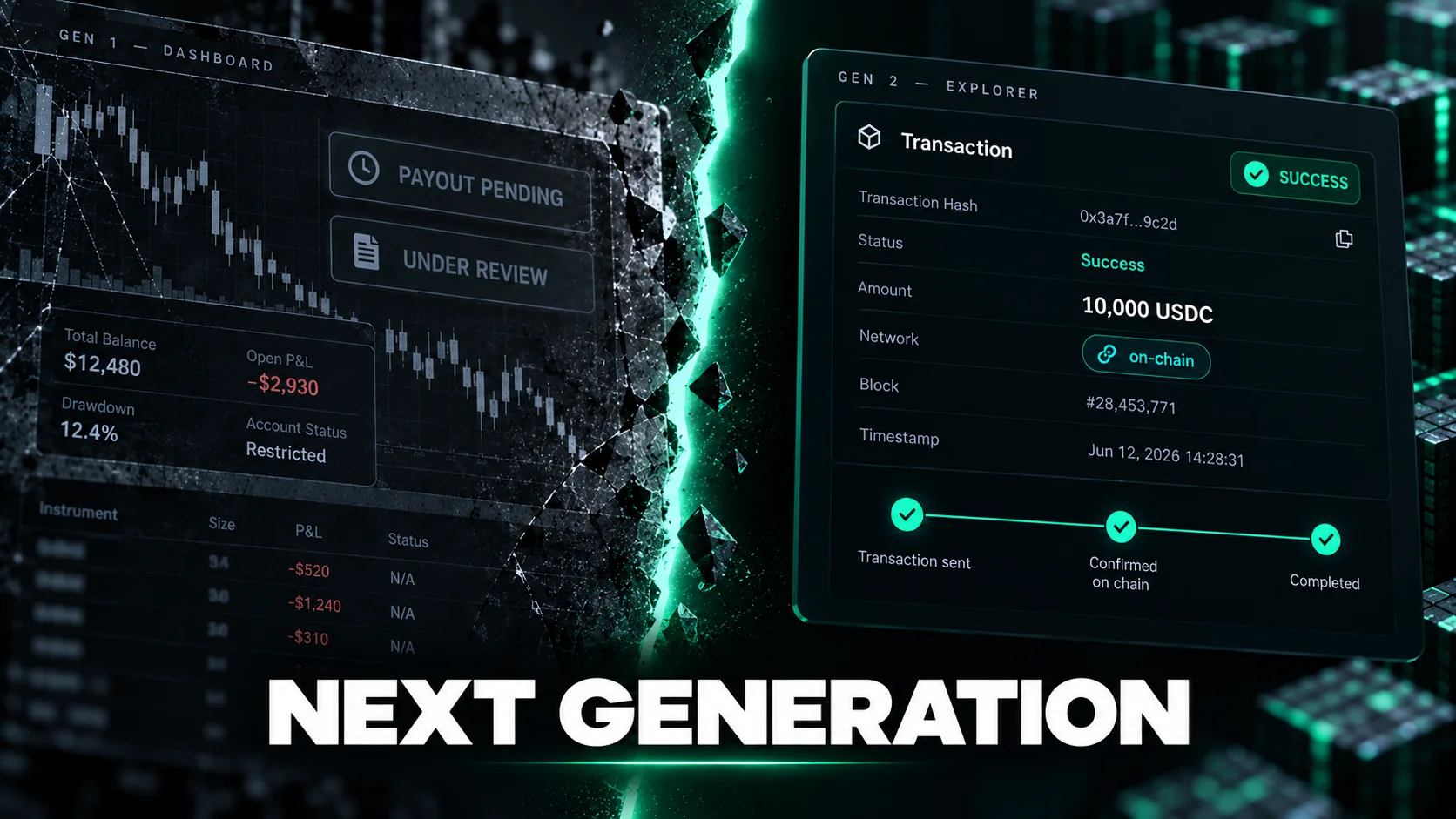
An on-chain prop firm is safer than a traditional prop firm because you no longer have to take its word for anything: the payout goes to your wallet with a public hash, the reserve that funds it can be read on an explorer, and the split can be recalculated to the cent. The rest — passing the evaluation — stays as hard as before.
Key takeaways
- Gen 1 (forex/CFD), Gen 1.5 (centralised crypto prop), Gen 2 (natively on-chain), Gen 2.5 (protocols): what changes between each generation is the share of the firm you can verify yourself.
- A USDT payout from a hot wallet is not an on-chain payout: without a readable reserve or an immutable rule, it is a transfer, not proof.
- At Hypernova, the payout reserve read on Arbitrum on 1 October 2026 is $497,973.33; at Propr.xyz, 48 payouts received on my account were reconciled hash by hash on Ethereum (last reconciliation 19 September 2026).
- "On-chain" has become a marketing word: demand the contract address, the program ID, the transparency dashboard — or file the firm at level 1.
- An on-chain reserve is a hard ceiling, not a guarantee: if it drops to zero, you need to know what happens before you buy.
Contents: Definition · Gen 1 · Gen 1.5 · The 4 levels · Gen 2 · Live firms · The ones coming · Audit in 8 questions · Who it is for · FAQ
Transparency first: some links to Propr.xyz and Hypernova on this page are affiliate links. The commission funds the site and reader cashback; it never changes a Trust Score. The grid is public and recomputable, and so is our test protocol.
What an on-chain prop firm is
An on-chain prop firm is a prop firm where at least three elements can be read on a public blockchain without asking anyone's permission: the payout (a transaction with a hash), the reserve that funds the payouts (an address or contract balance), and ideally the rules (a contract, not a PDF).
Definition. On-chain prop firm: a funded-trading company whose payouts are settled by public transactions to the trader's wallet, whose payout reserve is a balance verifiable on an explorer, and whose rules are published before purchase — at best, encoded in a contract.
What is not in this definition matters as much as what is. A firm that pays in USDT but keeps its funds on an exchange account is not on-chain. A firm that publishes a "transparency dashboard" without an address to verify is not on-chain either. The test is simple: can you open an explorer and find the figure yourself? If the answer is no, you are still in the trust regime. For the point-by-point technical comparison between the two models, on-chain vs traditional already exists; here, we talk about what it changes for your safety.
Why Gen 1 broke trust
The first generation of prop firms broke trust because everything that mattered to the trader — solvency, the applicable rule, the moment of payment — depended on a human decision taken in a room he was not in.
One clarification up front: Gen 1 does not mean bad. FTMO has operated since 2015 and pays; so do FundedNext and The5ers. The problem is not that these firms lie. It is that their model gives you no way to verify that they are not lying, and that several of their competitors exploited exactly that blind spot.
The opaque business model
In a traditional prop firm, the challenge fees of the losers fund the payouts of the winners, and nobody outside sees the ratio. It is a rational model — a paid exam with a bonus for those who pass — but it only makes sense if the operator stays solvent when a cluster of traders passes at the same time. You know neither its treasury, nor its real pass rate, nor the share of funded accounts it hedges on a real market. Propr.xyz publishes that ratio: lifetime payouts of about $1.37M against revenue of about $2.84M, read on its transparency dashboard on 5 September 2026. No Gen 1 does.
Payouts as a lever of control
The payout is the step where the firm has the most power and the trader the least. Processing delays of several days, manual "review" of the account, KYC requested at withdrawal rather than at sign-up, a bank transfer that can be "in progress" for two weeks: every friction is an opportunity to refuse. The trader who complains has nothing but a support ticket as recourse. When a "payout denied" story makes the rounds on the forums, it is almost always at this step.
Shifting rules
Consistency rule, ban on trading the news, ban on copy trading, "prohibited strategies" clause: these rules often live in a PDF that the firm can reinterpret at the moment of withdrawal. A winning trade becomes "gambling" after the fact; a strategy tolerated during the challenge becomes prohibited once the account is funded. A rule that is not frozen before payment is not a rule, it is an option in the firm's favour.
Closures and freezes
MyForexFunds was frozen in August 2023 on a CFTC action; the case was later dismissed, but for traders, the freeze on funds was real and immediate. True Forex Funds closed in 2024, SurgeTrader in 2024, The Funded Trader in 2024, MyFundedFX in February 2026. In crypto, GT Funded went dark in June 2026: site unreachable, no on-chain trace of what remained to be paid, Trust Score 18.3 on our graveyard registry. Every time, the script is identical: nothing was verifiable the day before, and the next day there was nobody left.
What the survivors still do well
FTMO, FundedNext and The5ers remain rational for a specific profile: the forex or multi-asset trader who wants a split of up to 90%, a brand established for years, a bank transfer in their own currency and a classic compliance framework. If you trade EUR/USD or indices as CFDs, no Gen 2 covers your market today. The choice is not "old versus new", it is "which market, which level of proof".
Gen 1.5: centralised crypto prop firms
Gen 1.5 pays in crypto but remains a black box: internal custody, internal rules, invisible reserve. A USDT payout from a hot wallet is not proof of solvency, it is a transfer on a different rail.
Breakout, operated by Payward Oceanic (Kraken group), pays in USDC ERC-20 within 12 to 24 hours with an announced split of 80 to 90% and accounts up to $200,000, read on 5 September 2026. It is a serious brand — and a useful counter-example: settlement is centralised, there is no reserve to read, and its position on our grid (69.5) reflects exactly that gap. HyroTrader, an existing centralised crypto firm since 2020-2022 with execution via the Bybit API, currently pays via Fireblocks on Solana: a payout with a hash, but rules and a treasury still off-chain. SizeProp, FundedNext crypto (as CFDs) and Apex fall into the same family.
The point to remember: "we pay in crypto" answers the question "on which rail", not the question "with what money, under what rule". Only the second question touches your safety.
The 4 levels of "on-chain"
There are five levels of verifiability, from 0 to 4, and most firms that call themselves "on-chain" are at level 1 or 2. The level is read from what you can prove alone, not from what the firm claims.
| Level | What you can verify | What you have to trust | Examples (what we actually saw) |
|---|---|---|---|
| 0 | Nothing — a payout screenshot | Everything | Any firm without a public hash |
| 1 | A crypto transfer arrived | The reserve, the rules, solvency | Breakout, HyroTrader today (Fireblocks Solana), Vanta Trading (simulated + on-chain rewards), HyperPNL (bought and traded on 9 September 2026: our deposit is readable on Arbitrum, no firm contract address published) |
| 2 | The payout has a public hash, the split can be recalculated | The rules (PDF), the reserve | Propr.xyz (Payout Distributor on Ethereum, no pre-funded reserve), Carrot Funding (payout hashes verifiable, named address table published, custody Safe readable on HyperEVM) |
| 3 | Payout + reserve + rules published and enforced by contract | The venue's execution, the contract audit | Hypernova (Arbitrum reserve, contract settlement) |
| 4 | The firm is a contract: vault, launchpad, on-chain parameters | The code, the stablecoin, the bridge | DecentralProp (devnet), Hyro Protocol (devnet), Funded Protocol (first app late August 2026) — roadmap, not lived |
Two clarifications to avoid over-ranking. Hyperstack is a simulated prop: a rewards programme, not a funded account, whatever chain is cited. Vanta Trading is simulated with on-chain rewards: the hash proves the reward, not a funded account. And Solana Funded, which publishes a 90% split, is "docs only" for us: a higher split is not a proven payout.
Why Gen 2 is structurally safer
Gen 2 is safer — not more profitable — because six mechanisms take away the firm's power to decide alone, and leave the trader the means to verify. Each one can be tested with a dated example.
1. Non-custodial payout to the trader's wallet. At Hypernova, the withdrawal request triggers a USDC transfer from the contract to your address, with no intermediary account. Six withdrawals on my 25K funded account, from 29 August to 1 September 2026, landed in my wallet within the same block window as the request.
2. Public transaction hash. A Gen 2 payout is a transaction anyone can open. My Hypernova payout of 559.546701 USDC carries the hash 0xf0c0…ac88 on Arbitrum; my Propr.xyz payout of 22 August 2026 (153.91 USDC) carries the hash 0xea78…d37c on Ethereum. All our verified payouts are listed with their method.
3. Readable payout reserve. The Hypernova reserve is a balance on Arbitrum: $497,973.33 read on 1 October 2026. You can read it again today, and our reserve tracker keeps every reading dated. No Gen 1 can show you the equivalent.
4. Split reconcilable to the cent. $699.43 requested × 80% = 559.546701 USDC received: that is the Hypernova payout above. $192.39 requested × 80% = 153.91 USDC: that is the Propr.xyz payout of 22 August. By 19 September 2026, I had reconciled in the same way the 48 payouts my Propr.xyz account received between 20 May 2026 and 18 September 2026: 48 receipts in OK status on a public Ethereum node, 48 amounts equal to the cent to what the dashboard displays. A Gen 1 firm gives you a net amount; a Gen 2 gives you a verifiable equation.
5. Rulebook published before payment, open API. Propr.xyz publishes a rulebook, read 5 September 2026, and an open API: bots are allowed in writing, not tolerated until withdrawal day. We log every change in our rulebook change registry, including those made without announcement — publishing a rule does not stop it from moving, but it makes the movement visible.
6. Visible survival. An on-chain firm that disappears leaves an empty contract, a reserve at zero, transactions that stop: a dated trace. GT Funded left none in June 2026. The chain does not stop you from losing; it stops you from being the last to find out.
The caveats, without which the above is advertising
- An on-chain reserve is a hard ceiling, not a balance sheet. It says what the firm can pay now, not what it owes. A cluster of winners drives it down; a firm can top it up, or not. Read the trend, not the isolated figure.
- Smart contract ≠ audit. An unaudited contract is one more technical risk, not one less guarantee. Ask for the audit report and its date; "audit announced" is not "audit published".
- "On-chain" is a marketing word. Without a contract address, program ID or recomputable transparency page, file the firm at level 1 and wait.
- The evaluation remains a hard exam. Profit target against drawdown: on my own Propr.xyz account, 24 challenges funded out of 165 opened, read on 7 September 2026 — 14.5%, against 15.2% published by the firm on 26 August 2026. On-chain does not make the daily loss rule any softer: 3% (1-Step) / 5% (2-Step) of your start-of-day balance, snapshotted at 00:00 UTC and recomputed daily; the breach itself is measured on equity, floating P&L included (read 10 September 2026).
- The risk moves. Contract bug, bridge, stablecoin depeg, incident at the execution venue (Hyperliquid, gTrade, a DEX): these are risks Gen 1 did not have, and that Gen 2 does not make disappear by making them readable.
- Accounts remain simulated. At Propr.xyz as at Hypernova, the position is paper priced on Hyperliquid; the fee and the payout are real. That is the standard of the category, not an exception.
The Gen 2 firms live in September 2026
Six firms operate in Gen 2 or at its border in September 2026, and four of them have now been traded by me: Propr.xyz, Hypernova, HyperPNL since 9 September 2026 and Carrot Funding since 10 September 2026 — with one nuance that matters, at HyperPNL and at Carrot we bought and traded but took no payout. The others are still marked "docs only" — read, not lived — and capped at 85/100 on the grid for that reason. These are portraits, not a ranking; the comparator does the ranking.
Propr.xyz — Hyperliquid execution, more than 160 markets (read 7 September 2026), 80% split, tickets from $25, accounts sold up to $200,000 ($300,000 aggregated), on-chain USDC payouts via a Payout Distributor on Ethereum, all-time median of about 3 minutes and 7-day median of 16 min 11 s read on the dashboard on 5 September 2026. Open API, bots allowed, versioned rulebook. Built by XBorg, backed by SwissBorg. Trust Score 86.7 (grid of 10 September 2026). Traded: 119.79 USDC received on 31 July 2026, 153.91 USDC on 22 August 2026, 48 payouts reconciled in total (last reconciliation 19 September 2026). Honest limit: no pre-funded reserve to read — Propr.xyz pays transaction by transaction, the chain proves that it paid, not that it owes. Who it is for: the crypto perps trader who wants automation and written rules. Propr.xyz profile.
Hypernova — Hyperliquid execution, Arbitrum settlement in USDC by smart contract (about 6.0 s on average, the firm's own figure read 21 September 2026), public since 14 August 2026, tickets from $25 (5K), accounts up to $200,000, split up to 80%, reserve of $497,973.33 read on Arbitrum on 1 October 2026. $3M pre-seed led by Lemniscap. Trust Score 85.7. Traded: 9 payouts between 28 and 31 August 2026, including the 559.546701 USDC reconciled at 80% to the cent. Honest limit: the app still displays "closed beta · invite only" on 7 September 2026, and the public rulebook v1.1 describes neither KYC nor a list of restricted countries — a hole in the document, to be read as "not specified". Who it is for: the trader who wants to verify solvency before paying. Hypernova profile.
HyperPNL — Hyperliquid, 80% split, treasury / LP, maximum size actually sold $25,000 as of 9 September 2026 (50K and 100K still "Soon", our eighth consecutive check). Two evaluations sold side by side, read in the checkout on 9 September 2026: 1-Step Flex $42 / $86 / $215 and 2-Step $50 / $90 / $213. Trust Score 64.5 on the grid revised on 9 September 2026. Bought and traded on 9 September 2026: we paid $42 for a 1-Step Flex $5,000 evaluation, funded it in USDC on Arbitrum and traded it the same day; the account is in Phase 1, so the 85/100 cap no longer applies to this firm.
What the rules look like on the paid account: a daily floor of $4,850.00 (3% of $5,000, a $150 budget), an overall drawdown of a static 5% ($250), a 10% target ($500), and no profitable day required at all on the 1-Step — the counter reads 0 / 0, and the $25 trigger (0.5% of $5,000) is the threshold that would make a day count, not a requirement; the two-then-three profitable days apply to the 2-Step only. What $42 buys as leverage: $24,594 of BTC/USD notional on a $5,000 account, asset leverage 5×, that is 4.9 times the account — at which point $150 is 0.61% of BTC movement and $250 is 1.02%. Measured cost of execution: on $60,720 of volume the balance went from $5,000.00 to $4,973.35 (−$26.65) while the only closed trade returned +$6.94 gross, so about $33.59 of execution cost, roughly 0.055% of volume, consistent with the announced 0.045% taker fee. The engine does enforce its rules: our $25,000 demo account was closed automatically on 9 September 2026 at 12:18 (app time), with the cause named in the interface, "Daily Loss Limit", and a final balance of $24,170.48 against $25,000.00, or −3.3%.
And the finding that matters most in an article about on-chain verifiability: we traced our $42 purchase end to end on Arbitrum. The only on-chain event is a deposit into RelayDepository, the deposit contract of Relay, a third-party bridging protocol. The $42 was then debited off-chain, in HyperPNL's internal ledger. No Payment Router, no allocation to a Payout Treasury, no revenue split, no referral commission, and no published address for any of the three contracts the docs name. The one field that looks like an on-chain record, labelled "Tier", is neither a transaction nor an Arbitrum block. We are not saying those contracts do not exist; we are saying that for the part of the chain we control there is nothing to verify — while the homepage sells "Everyone can see everything on-chain". Still unverified: no payout. The account is in Phase 1 and negative, so the 80% split and the "instant" claim have not been tested. Other limits: the published rulebook describes only the 2-Step; the Terms — reachable only once logged in — exclude 18 jurisdictions including the United States and Canada, while the homepage advertises "No restrictions"; the operating entity, Hyperpnl Ltd. (CO-425378, Grand Cayman), appears only after login; at least 92 instruments; evaluation accounts are simulated and the fee is non-refundable once trading has started.
Carrot Funding — Hyperliquid execution, HyperEVM account, Arbitrum for payments, 80% split, from $65 (2-Phase 5K), maximum $100,000 sold ($200,000 aggregated funded cap), on-chain USDC payouts announced under 24 hours, minimum 100 USDC and full amount only. Trust Score 73.2. Bought and traded on 10 September 2026: we paid $52 for a 2-Phase $5,000 evaluation ($65 list, −20% with the code royaref, no end date displayed) in USDC on Arbitrum, so the 85/100 desk-research cap no longer applies to this firm either. Operating entity: CTECHNOLOGIES GAMING DEVELOPMENT - FZCO, a UAE free-zone company named in the checkout terms. The account is represented by a transferable NFT — a challenge you can send to another address, which is unique in the category and cuts both ways. Later the same day we tested, on that paid account, the one question that decides your risk: yes, a floating loss can breach you. The app tracks balance and equity as two separate live values and its chart plots EQUITY against the limit lines it draws at $4,750 and $4,500, and the public FAQ says before purchase that drawdown limits are calculated on equity, not balance. The limits are published in absolute dollars with a countdown to the UTC reset, so there is nothing to compute — which is what took the rules criterion from 72 to 78.
What we measured there on 10 September 2026: the rulebook §17 promises standard Hyperliquid fees with “no markup”, and two round trips came in at $4.40 on $9,786.60 of notional (0.04496%) and $4.77 on $10,606.40 (0.04497%), against Hyperliquid’s 0.045% base taker — the promise holds, measured rather than declared, with the corollary that a flat round trip still costs about 0.09% of notional. The limits are written too: leverage capped at 5× across every asset class (§14) — a dated prudential setting rather than a structural ceiling, since the firm told us the same day it has run up to 200× on gTrade and intends to raise leverage on Hyperliquid, which is announced and not shipped — execution A-book or B-book at the firm’s discretion, trade by trade, with each trader labelled on their dashboard (§22), and automation banned — “automated software, high-frequency trading systems, AI-driven tools, or mass order entry systems” (§23). What belongs in this article more than anywhere is the correction we owe on the reserve: for a few hours we published that the vault promised by §19 could not be located, and that was our reading failure, not a gap on their side. Carrot’s GitBook publishes a full address table with named roles — Vault Custody Contract, Vault Integrations, a 2-of-4 payout multisig, the payout executor EOA — and having read it we checked it on 10 September 2026: the Vault Custody Contract on HyperEVM is a Safe holding about $15,016 in the Felix/Morpho USDC vault plus $98 on HyperCore, with funds stated to be mid-migration from Arbitrum to HyperEVM, so the on-chain picture is partial. The four published payout hashes (733.22 · 384.38 · 399.24 · 799.41 USDC on Arbitrum) are real transfers, checked one by one. And the challenge is genuinely an on-chain object: #3955 is token #550 of the Funded Bunny Initiative collection (symbol FBI) on Arbitrum, contract 0x16f6ff310d113fe4b5a1c2e251e25530989e4c9c, minted at 05:00:25 UTC on the day we paid, with one Transfer event since — the mint. The defect that survives is documentary: the token ID is not the challenge ID and no page of theirs says so. The firm is also small: 279 traders in total and a $69 weekly prize pool on its own Points page, read the same day.
Solana Funded — Solana DEX aggregators, published split 90%. Trust Score 69.8, docs only. Mandatory nuance: the highest split on the list is not a payout proven by us.
Breakout — Kraken / Payward Oceanic, 80 to 90% split, maximum $200,000, USDC ERC-20 within 12 to 24 hours, centralised settlement. Trust Score 69.5. Its place here is that of the counter-example: a strong brand, a real group behind it, and nothing to verify on an explorer.
DojiFunded and Vanta Trading: brief mention. DojiFunded, to be checked at the source on the day before any purchase. Vanta Trading is a simulated platform with on-chain rewards — level 1, not a funded account. The full tour of Hyperliquid firms is on Hyperliquid prop firms and that of the category on the best crypto prop firms.
The ones coming
Three protocols announce a Gen 2.5 where the firm becomes a contract; none has paid a trader in real money as of our reading of 8 September 2026. Roadmap, not done.
DecentralProp — launchpad for tokenised prop firms on Solana. Devnet live, mainnet announced for September 2026. Treasury in a PDA, payouts with a median of 41 minutes on devnet — in test SOL, not real money. Until mainnet is there, the only verifiable thing is that the code runs on a network with no value.
Hyro Protocol — built by HyroTrader. Challenge and Direct vaults on Solana, in USDC. Contracts on devnet, Ackee audit announced, mainnet targeted for October 2026. Important nuance: HyroTrader today is a level 2 firm (payouts via Fireblocks on Solana, rules off-chain), not level 3. The protocol is the promise; the current firm is what you buy.
Funded Protocol + TheNews — infrastructure on Robinhood Chain (Arbitrum L2, mainnet on 1 July 2026). First application live late August 2026, TVL and usage verified as low at our reading: to be reassessed when an explorer shows something other than tests.
The protocol wave changes one thing if it keeps its promises: anyone will be able to launch a prop firm, and any trader will be able to read its solvency before paying. That will move the risk from "is the firm honest" to "is the contract safe". For now, it is a plan.
How to audit an "on-chain prop firm" in 8 questions
Eight questions are enough to classify an on-chain prop firm in five minutes, and a single "soon" answer is enough to downgrade it one level.
- Where is the contract or the program ID? An address, not a sentence. If it is not published, there is nothing to verify.
- Is the reserve readable now, not "soon"? Open the address on the explorer; note the balance and the date. Hypernova: yes. Propr.xyz: no, by design.
- Does the payout have a public hash? Look for a trader payout with its transaction, then find it yourself.
- Is the rulebook published before the challenge is paid for? Versioned, dated, with a changelog.
- Are the rules in the contract or in a PDF? A PDF gets reinterpreted; a contract executes.
- Real or simulated funded account? Simulated is the standard of the category; what matters is that it is written down.
- Who can change the parameters, and does it apply to accounts already purchased? An admin key that modifies the drawdown of a running account is a shifting rule with better vocabulary.
- What happens if the reserve drops to zero? Documented waterfall, halted payouts, or silence: the answer tells you who absorbs the loss.
Our test protocol asks these questions of every firm on the grid, and the state of crypto prop trading tracks the answers over time.
Who should stay in Gen 1, who should move to Gen 2
Stay in Gen 1 if your market does not exist on-chain; move to Gen 2 if you trade crypto perps and want to verify before you trust.
| Your profile | Generation | Firms |
|---|---|---|
| Forex, indices, multi-asset as CFDs; need for compliance, a split of up to 90%, a brand and a bank transfer | Gen 1 | FTMO, The5ers, FundedNext |
| Crypto perps, API automation, requirement for public proof | Gen 2 | Propr.xyz, Hypernova |
| Strong crypto brand, tolerance for centralised settlement | Gen 1.5 | Breakout |
| Curiosity about protocols, no capital to put in before mainnet | Gen 2.5 | DecentralProp, Hyro Protocol, Funded Protocol — to watch, not to buy |
If you move to Gen 2 with Propr.xyz through our link, we pay you back 5% of every challenge fee in USDC, funded by our commission: it is the only place in this article where affiliation comes into play.
Create my Propr account via Roya →Affiliate link. We earn a commission; it never changes what you pay — it is what funds your cashback.
FAQ
What is an on-chain prop firm?
+
A prop firm whose payout, payout reserve and, at best, rules can be read on a public blockchain. The trader can open an explorer, find their transaction and read the balance that funds the next payouts without asking the firm.
Why is an on-chain prop firm more secure than a traditional prop firm?
+
Because it takes away the firm's power to decide alone: the payout goes to your wallet with a hash, the split can be recalculated to the cent, the reserve can be read before you buy. A traditional prop firm asks you to trust a dashboard and a PDF; an on-chain one lets you verify. It is not easier to pass.
Do on-chain prop firms really pay?
+
The ones I have traded, yes, with proof: 48 Propr.xyz payouts received on my account between 20 May 2026 and 18 September 2026, reconciled hash by hash on Ethereum (last reconciliation 19 September 2026), and 9 Hypernova payouts between 28 and 31 August 2026, including one of 559.546701 USDC verified on Arbitrum. At HyperPNL we bought and traded a $5,000 evaluation on 9 September 2026, and at Carrot Funding a 2-Phase $5,000 evaluation on 10 September 2026, but we took no payout at either: both accounts are in phase one, so the 80% split has not been tested there by us. At Carrot we did verify the four payout hashes the firm publishes (733.22 · 384.38 · 399.24 · 799.41 USDC on Arbitrum) as real transfers. The remaining firms on the list are "docs only": read, not proven.
Which is the best on-chain prop firm in 2026?
+
On the Roya Trading grid revised on 10 September 2026, Propr.xyz is at 86.7 and Hypernova at 85.7; they are also the only two firms that have paid us. HyperPNL, bought and traded on 9 September 2026, stands at 64.5 on the grid revised that day, and Carrot Funding, bought and traded on 10 September 2026, at 73.2 on the grid as revised later that same day, once we had tested on the paid account whether a floating loss can breach a Carrot account — it can — neither with a payout observed by us. The choice between the top two depends on what you want to verify: the reserve (Hypernova) or the payout history and the API (Propr.xyz).
What is the difference between a crypto payout and an on-chain payout?
+
A crypto payout is a transfer in USDT or USDC from the firm's wallet: it proves a transfer happened, not that the firm is solvent or that the rule is fixed. An on-chain payout comes from a contract or a readable reserve, under published rules, with a hash you can reconcile against the split.
Is FTMO going to disappear?
+
Nothing suggests it: FTMO has operated since 2015 and remains a rational choice for the forex and multi-asset trader who wants a split of up to 90%, a brand and a bank transfer. What changes is the criterion of judgement: on crypto markets, a firm that cannot show its reserve now starts with a handicap.
Which on-chain prop firms are launching in 2026?
+
DecentralProp (launchpad on Solana, mainnet announced for September 2026), Hyro Protocol (vaults on Solana by HyroTrader, mainnet targeted for October 2026, Ackee audit announced) and Funded Protocol on Robinhood Chain (first app late August 2026). All three are on devnet or at near-zero usage as of our reading of 8 September 2026: to watch, not to fund.
How do you verify a payout on the blockchain?
+
Take the hash published by the firm, open it on the chain's explorer (Etherscan for Ethereum, Arbiscan for Arbitrum, a Solana explorer), check that the status is confirmed, that the USDC transfer lands on the trader's address, and that the amount equals the request multiplied by the split. If any of the four is missing, it is not proof.
Does an on-chain reserve guarantee I will get paid?
+
No. It guarantees that the firm can pay that amount now, not that it owes it nor that it will be able to after a cluster of winners. Read the trend of the reserve over time and ask what happens if it drops to zero.
Are bots allowed?
+
At Propr.xyz, yes in writing: rulebook "what is NOT restricted" and open API, read on 5 September 2026. At Hypernova, rulebook v1.1 prohibits copy trading; check the automation clause at the source on the day. At Carrot Funding, no: §23 of the rulebook, read on 10 September 2026, bans "automated software, high-frequency trading systems, AI-driven tools, or mass order entry systems". At most Gen 1 firms, the permission exists until the moment of withdrawal.
The criterion has changed
We used to judge a prop firm by its split; now we judge it by what an explorer can prove. The split remains a marketing number as long as the payout has no hash, the reserve no address, and the rule no date. That is what our Trust Score grid measures, and that is why just two names on this page have ever settled a payout to us: Propr.xyz and Hypernova. HyperPNL, bought and traded on 9 September 2026, is the third we have used with our own money, and it is precisely the one where our purchase left nothing to open on an explorer.
Sources. Propr.xyz rulebook and transparency dashboard (propr.xyz/rules, propr.xyz/transparency, read on 5 September 2026); Hypernova rulebook v1.1 (hypernova.xyz/rulebook, read on 5 September 2026); Hypernova reserve read on Arbitrum on 7 September 2026; transactions Arbiscan 0xf0c0…ac88 and Etherscan 0xea78…d37c; our own Propr.xyz and Hypernova accounts, read on 7 September 2026; our own HyperPNL 1-Step Flex $5,000 evaluation, bought and traded on 9 September 2026, with its deposit traced on Arbitrum by public RPC the same day — app.hyperpnl.com — dashboard, Performance Guard, challenge list and Terms (login required); CFTC action against MyForexFunds (August 2023): official release on cftc.gov, to be linked to the exact URL on the day. The figures for the Gen 2.5 protocols come from their public announcements and remain to be verified at the source at launch.
⚠️ Trading leveraged products carries a high risk of loss. Challenge fees are non-refundable and most participants fail the evaluation. The funded accounts of the firms cited are simulated. Nothing on this page is investment advice. Some links to Propr.xyz and Hypernova are affiliate links; they do not modify any score.