
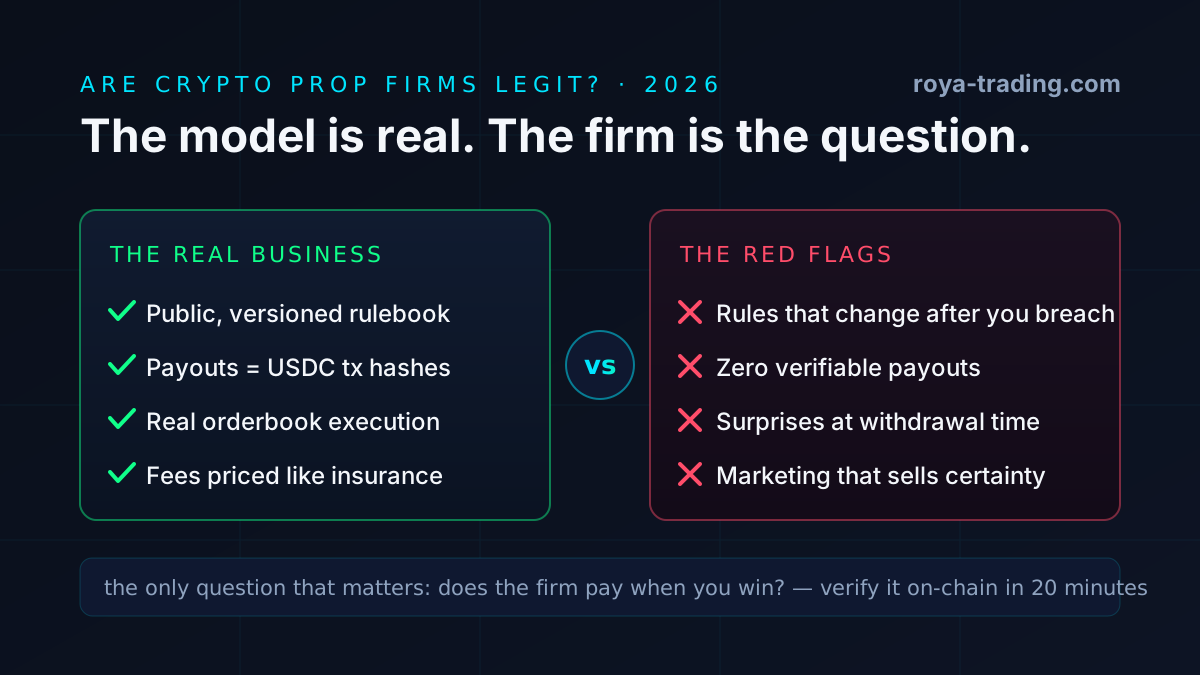
Type any prop firm's name into a search bar and the autocomplete offers you "scam" before you finish the word. Fair enough: the industry sells a $60 ticket to trade $5,000 that isn't yours, most buyers lose the ticket, and the firm keeps the money. That looks like a con. It usually isn't one — I've passed challenges on Propr.xyz and been paid in USDC I can point to on a block explorer — but the industry absolutely contains both actuarial businesses and exit scams, and they rent the same landing-page template. This article explains how the money actually flows, where the model legitimately profits from your failure, where it crosses into fraud, and the five checks that separate the two in about twenty minutes.
The short answer
The model is real, legal in most places, and structurally profitable without anyone cheating you. A prop firm sells an evaluation: you pay a one-time fee ($25 to $1,998 across Propr’s six account sizes, $5K to $200K — read 10 September 2026), trade a simulated account under published rules, and if you hit the target without breaching the loss limits, the firm gives you a funded account and 80% of the profits you generate on it. Most buyers fail the evaluation, so fees fund the payouts of the few who pass, plus the firm's margin — the way an insurer's premiums fund its claims. You never deposit trading capital, so the only money you can lose is the fee. The legitimacy question is therefore never "is this business model a scam?" — it's "does this specific firm pay when you win?" And that's a question you can now answer with evidence, because on-chain firms settle payouts in USDC, in public, with transaction hashes.
How prop firms actually make money
Take Propr's $10K Classic 1-Step at $110 and imagine the firm sells 100 of them. That's $11,000 of fee revenue, collected up front, for accounts that are simulated during the evaluation — no firm puts real capital behind an unproven trader on day one, so the evaluation itself costs the firm approximately nothing but infrastructure. Now the liability side, with illustrative numbers (mine, not Propr's): in my Monte Carlo simulations, a disciplined thin-edge trader passes that 1-Step about 87% of the time — but a zero-edge trader passes ~37%, and an oversized gambler far less, so a realistic buyer mix might land around 40 funded accounts per 100 sold. Funded is not paid: a payout requires realized profit on the funded account, and a good share of funded accounts breach before their first withdrawal. Say half of those 40 reach one, each sweeping 4% of a $10K account — $400 of profit, $320 to the trader at the 80% split. Total payouts: about $6,400 against $11,000 collected, before repeat attempts — and failed traders are the industry's best repeat customers.
Three things follow from that arithmetic. First, the firm profits from failed attempts the way a gym profits from January memberships — unused capacity is priced in, and that alone doesn't make the gym a fraud; the test is whether the treadmill works when you actually show up. Second, the split can honestly be 80% because it applies to a number most buyers never generate. Third, the model's solvency depends on the pass rate staying near what the firm priced — which is why rules are calibrated the way they are, and why buying a challenge is buying a probability, not an account. None of this is hidden; Propr publishes the whole rule set and lets you do this math before paying, which is more than most industries selling probabilistic products can say.
"So it's a Ponzi scheme?" — no, but here's the honest caveat
A Ponzi pays fake investment returns to early participants out of later participants' principal. A prop firm sells a service with a known price and observable odds — you're a customer, not an investor, and nothing is owed to you unless you pass and produce. So no, definitionally not a Ponzi. The honest caveat: a firm that misprices its evaluations or bleeds on funded flow can drift into paying yesterday's payout obligations out of today's fee revenue — functionally Ponzi-adjacent even with sincere intentions. You can't audit a private firm's reserves, but you can watch the canary metrics: payout processing times stretching, payout minimums rising, new conditions appearing between you and your money. Propr currently signals in the opposite direction — the USDC payout minimum was lowered from $50 to $20 in the June rulebook revision, with processing under 24 hours and a published median time-to-pay of about 3 minutes (dashboard, read 5 September 2026 — 7-day median 16 min 11 s the same day). Solvent firms shorten the distance between you and your money; struggling ones lengthen it.
The nine red flags
Everything above describes the honest version of the business. Here's what the dishonest version looks like, one flag at a time:
1 — No public rulebook. If the rules live in a Discord thread, a support chat, or the firm's head, they can become whatever the firm needs them to be after you breach. A legitimate evaluation is a contract; contracts are written down.
2 — Silent, retroactive rule changes. Rules evolving is normal — rules changing under your feet without a version number, a date, or an announcement is not. Propr ships its rulebook like software and I've disagreed with individual changes — but they're published, numbered and dated, which is the entire difference between iteration and ambush.
3 — No verifiable payout proof. On-chain settlement means a payout is a USDC transaction with a hash anyone can open in an explorer. Screenshots of dashboards can be forged in a browser console; transaction hashes can't. A crypto-native firm with zero independently verifiable payouts is making a claim with no evidence in a category where evidence costs nothing to produce.
4 — Payout-time surprises. Consistency rules, best-day caps, minimum trading days, "profit verification reviews" — some firms disclose these up front, which is their right. The flag is when they surface for the first time at withdrawal. Read the payout section of the rulebook before paying, not after passing; it's where cheap firms stop being cheap.
5 — Splits that sound like charity. A firm advertising 95–100% keeps almost nothing of the thing it supposedly exists to share, which means its real revenue is elsewhere: your fees, your resets, your repurchases. The industry's honest range is 70–90% — Propr and Hypernova both sit at 80% — and an offer far outside it is a marketing department writing checks the treasury plans to dodge.
6 — Time limits plus paid resets as the actual product. A 30-day deadline converts slow months into repurchases, and some firms' entire P&L is that conversion. Untimed evaluations — Propr's have no time limit and no minimum trading days — remove the repurchase engine entirely, which tells you the firm expects to make money from the model, not from your impatience.
7 — No identifiable entity, team, or support humans. You're prepaying a stranger for a promise redeemable months later. A registered entity, a reachable support channel and named humans don't guarantee honesty — but their total absence guarantees you have no recourse when it matters.
8 — Marketing that sells certainty. "Guaranteed funding", "pass services", resellers promising accounts without evaluations. A legitimate firm sells difficulty at a fair price; anyone selling certainty in a probabilistic product is lying about the product. This includes third parties offering to pass your challenge for you — which, beyond the scam risk, violates essentially every firm's prohibited-conduct rules and forfeits the account.
9 — A price feed you can't audit. Simulated evaluations are industry standard — the question is what prices the simulation runs on. A firm executing against its own internal feed can widen spreads and worsen fills invisibly. A firm marking against a public orderbook — Propr fills against Hyperliquid's — leaves an audit trail: you can compare your fill to the public tape, timestamp by timestamp.
The 20-minute vetting checklist
Inverting the flags gives you a routine I now run before paying any firm anything:
Minute 0–12: read the entire rulebook, including the prohibited-conduct and payout sections — the two chapters almost nobody reads and the two that end accounts. You're checking that rules exist, carry version numbers and dates, and that payout conditions are defined before you pay. Minute 12–15: verify three payouts. Transaction hashes from three unrelated traders, opened in an explorer yourself. Minute 15–17: check the venue. Real public orderbook or internal feed? On Hyperliquid-based firms the tape is public. Minute 17–19: cross-check the price grid against checkout, and the split, minimums and processing times against the rulebook — the payout mechanics matter more than the split headline. Minute 19–20: decide your stake. Smallest tier first — $25–$60 — treated as tuition. The full field of on-chain firms, run through exactly this filter, is in the decentralized prop firm comparison.
One extra minute is worth spending on regulator warning lists — FINMA and the FCA both publish theirs — because a firm can look established and still be flagged. Crypto Fund Trader is the case study: four years old, a real payout record, and an entry on FINMA's public warning list since August 2024 over a Swiss identity that isn't registered in Switzerland. I ran the whole firm through this checklist in Propr vs Crypto Fund Trader.
Where Propr lands on this test
Since it's the firm I actually trade on, here's the scoresheet with no rounding in its favor. Passes: public versioned rulebook; USDC payouts on-chain with a $20 minimum, sub-24-hour processing and a published ~3-minute median; 80% split; execution against Hyperliquid's public orderbook; bots, copy trading and API access explicitly allowed; no time limit, no minimum trading days, no monthly or platform fees; KYC before funding (a compliance signal, not a nuisance) and a $300K aggregate funded cap that scales. Since this article first ran, Propr has also published the numbers this whole piece says to demand: its transparency dashboard (read 5 September 2026) reports $1,371,288 in lifetime payouts against $2.84M in lifetime revenue — a payout ratio of roughly $0.48 returned per $1 collected that any reader can compute, up from $0.46 at our 26 August reading ($1.11M / $2.43M) — plus measured pass rates of 15.4% on paid challenges and 13.4% on free trials, and a verified Payout Distributor contract on Ethereum that makes individual payouts checkable transaction by transaction. We've reconciled one of our own payouts against it to the cent at exactly 80%. I've been funded and paid — the full experience, including the parts I didn't love, is in my Propr.xyz review. Honest cons: it's a young firm operating since 2026 — no multi-year payout history exists, whatever anyone tells you; the rulebook iterates fast (two versions in six days this summer), which is transparency but also churn you must keep up with; and it's crypto-only, so the volatility that makes the opportunity also makes the risk. For contrast, Hypernova — the nearest structured competitor — publishes a comparable 80%-split rulebook and went public on 14 August 2026; its public rules list no bot restrictions (read 16 August 2026), but there is no turnkey semi-automated workflow there, and its own FAQ notes funded accounts remain simulated. That comparison, run honestly, is why my accounts are where they are.
FAQ — prop firm legitimacy
Are crypto prop firms legal?+
Yes, in most jurisdictions. A challenge is a fee-for-evaluation service, not an investment product: you pay a fixed fee, trade a simulated account under published rules, and earn a share of profits if funded. Firms typically enforce KYC before activating a funded account and maintain restricted-country lists to stay on the right side of local law. What's not standard anywhere: firms taking deposits of your trading capital — a prop firm never should.
How do prop firms make money if they pay traders 80%?+
Mostly from evaluation fees across many attempts. Most challenges fail, so fee revenue exceeds the payout liability generated by the minority who pass, get funded, produce profit and actually withdraw. Add repeat attempts and resets, and the model clears like an insurance book — actuarial, not charitable. That's why a firm can pay an 80% split honestly and still be profitable.
Do prop firms want you to fail?+
Per account, a failed challenge is pure margin — but firm-wide, the incentive is more balanced than it looks. A firm that never pays out has no payout proofs, no word of mouth, no affiliates and no repeat buyers, and in crypto the payout record is public. Established firms price failure into the fee instead of engineering it into the rules. The ones that engineer it are exactly what the red flags in this article are for.
Is Propr.xyz legit?+
Based on my own accounts: yes. It's a young firm (live since 2026), but the rulebook is public and versioned, payouts are USDC on-chain — verifiable by transaction hash, $20 minimum, processed in under 24 hours with a published all-time median time-to-pay of about 3 minutes (transparency dashboard, read 5 September 2026) — the split is 80%, and bots, copy trading and API access are explicitly allowed. I've passed challenges and been paid. Standard caveat for any young firm: start at the smallest tier and only ever risk the fee.
How do I verify a prop firm payout is real?+
On an on-chain firm, ask for the transaction hash and open it in a block explorer: you should see a USDC transfer from the firm's payout wallet to the trader's address, with a timestamp. Three hashes from three unrelated traders is a solid sample. If a firm settles payouts on-chain, this takes five minutes; if a 'crypto' firm can't produce a single verifiable transaction, that absence is the answer.
How much money should I risk on my first challenge?+
Only the smallest fee. On Propr that's $25 for a Turbo 1-Step or $50–$60 for a Classic tier — and that fee is the entire downside, because you never deposit trading capital on a legitimate prop firm. Treat the first challenge as paying for information: about the firm's rules, about its payout process, and about your own discipline. No firm deserves your $1,998 top-tier ticket before it has earned your $60.
The firm can be legit. The blown fee is usually yours.
Most challenge money isn't lost to scams — it's lost to a 2 a.m. deviation from your own plan. A bot on the official API executes the trade you picked with the DCA ladder, take-profit and stop-loss you sized, semi-auto on your own Propr account. You keep the decision; it keeps the discipline.
Get 5% USDC cashbackVetted Propr yourself? Create your Propr.xyz account with 5% USDC cashback on the fee.
Affiliate link. We earn a commission; it never changes what you pay — it is what funds your cashback.
⚠️ Facts cited — fees, split, payout minimum and timing, rulebook versions — were checked against Propr's published rulebook and transparency pages on 11 August 2026 (dashboard figures — lifetime payouts, revenue, pass rates, median time-to-pay — re-read 5 September 2026) and can change. Worked examples use illustrative assumptions and my own simulation outputs, not firm data. This is general information, not financial or legal advice. Trading carries substantial risk — only spend what you can afford to lose.