
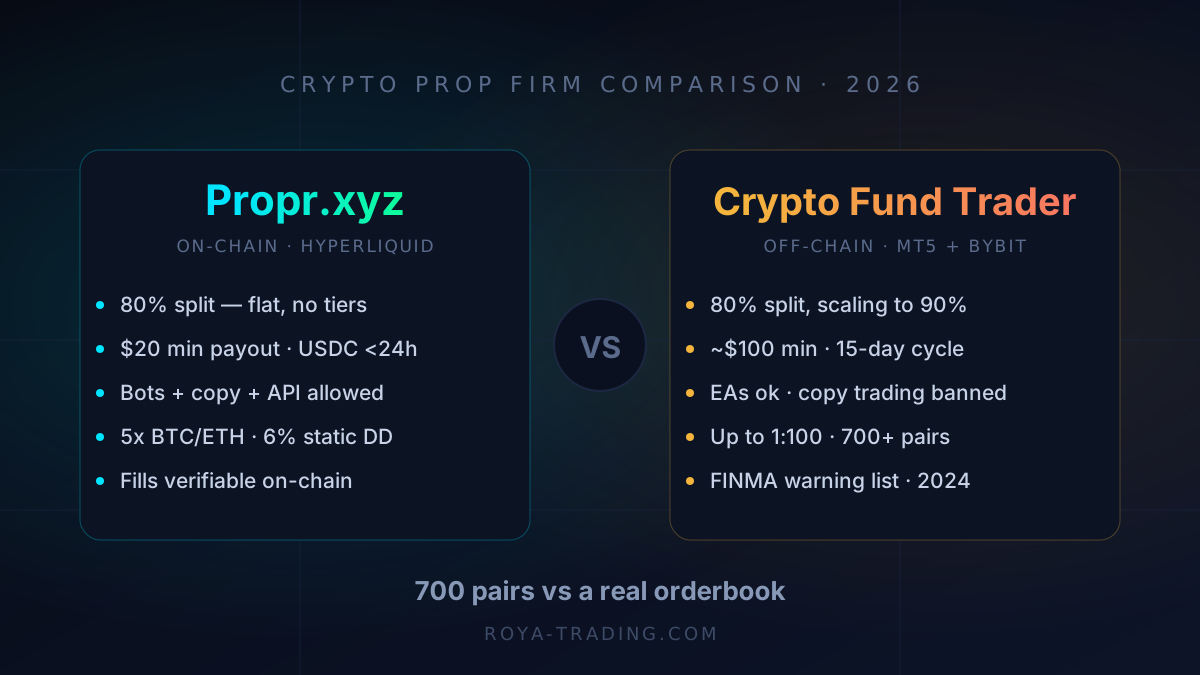
Both of these call themselves crypto prop firms, and on a comparison table they look like neighbours. Crypto Fund Trader is one of the oldest crypto-branded names in the space — launched in 2021, 700+ pairs, MT5, leverage up to 1:100, accounts to $200K. Propr.xyz launched into a completely different architecture: your challenge is a live account on Hyperliquid, and your payouts are USDC transactions you can look up on a block explorer. Same label, different machines. Here's the honest comparison, including the regulatory detail almost no review page puts above the fold.
The short answer
Crypto Fund Trader is the wider, looser, older product. More pairs, far more leverage, MT5 plus a proprietary platform, account sizes to $200K and scaling to $300K, entry fees from roughly $55, and a split that starts at 80% and can scale toward 90%. Propr is the crypto-native, verifiable, automation-legal one. Real Hyperliquid perps instead of a broker feed, a flat 80% split with no consistency rule, a $20 minimum payout in USDC on-chain settled in hours, a static 6% drawdown option, and a rulebook that permits bots, copy trading and API keys in writing. One more thing that belongs in the short answer: CFT sits on FINMA's public warning list since 23 August 2024. That's not proof of anything criminal — but it's a fact you should price in, and I explain exactly what it means below.
Two crypto prop firms, two completely different machines
Crypto Fund Trader launched in May 2021 and is operated by RLCRATES, S.L., a Spanish company, while marketing a Swiss corporate identity. It's an evaluation firm in the classic mould: you buy a challenge, you trade a simulated account, you get a funded simulated account, the firm pays you out of its own treasury. Platforms are MetaTrader 5 and a proprietary web/desktop/mobile app, with market conditions sourced through a Bybit partnership added in 2025. The catalogue is genuinely large: 700+ crypto pairs, plus forex, indices, stocks and commodities. Three routes in — a 1-Step at a 10% target, a 2-Step at 8% then 4%, and an instant-funding program — with sizes from $5K to $200K and scaling to $300K. Nothing about it is on-chain; there is no explorer to check.
Propr.xyz inverts the model. Your challenge account is a real account on Hyperliquid, the deepest on-chain perps venue in 2026, so you fill against the same orderbook as every other participant rather than a broker's synthetic price. Six sizes (5K / 10K / 25K / 50K / 100K / 200K), a public rulebook (read 10 September 2026), four evaluation formats: Classic 1-Step ($60 / $110 / $275 / $495 / $999 / $1,998) with a 10% target, a 3% daily loss of the start-of-day balance, recalculated daily and a 6% static drawdown; Classic 2-Step ($50 / $100 / $250 / $450 / $899 / $1,499) with 5% then 10% targets, a 5% daily loss of the start-of-day balance, recalculated daily and an 8% trailing drawdown; Turbo 1-Step, a 9% target behind a 3% static drawdown, from $25 to $899; and Pro 1-Step ($45 to $1,399). On the 2-Step 100K the rulebook prints $749 while the live checkout has shown $899 since 8 August 2026 — check the payment screen. Split is a flat 80%. Payouts are USDC on-chain, $20 minimum, processed inside 24 hours and around 5 hours on average. Leverage is 5x on BTC/ETH (side panel and changelog; the §12 table on the same page says 10x — unreconciled as of our reading on 12 September 2026), 2x on other crypto, 4x on stocks, 8x on gold, silver, CL and Brent, 5x on other commodities. No time limit. KYC only at funded. The largest single account is $200K; funded capital caps at $300K cumulative.
Head to head: the numbers
- Model: CFT — off-chain simulated accounts on MT5 and a proprietary platform · Propr — real accounts on Hyperliquid's on-chain perps book.
- Launched: CFT 2021, operated by RLCRATES S.L. (Spain) · Propr, crypto-native.
- Markets: CFT — 700+ crypto pairs plus forex, indices, stocks, commodities · Propr — Hyperliquid crypto perps plus stocks and commodities.
- Account sizes: CFT $5K–$200K, scaling to $300K · Propr $5K–$200K across six sizes, $300K cumulative funded cap.
- Entry fees: CFT from roughly $55 up to about $1,000+ at $200K · Propr Classic 2-Step $50–$1,499, Classic 1-Step $60–$1,998, Pro 1-Step $45–$1,399, Turbo 1-Step $25–$899.
- Targets: CFT — 10% on 1-Step, 8% then 4% on 2-Step · Propr — 10% on 1-Step, 5% then 10% on 2-Step, 9% on Turbo.
- Daily loss: CFT — roughly 4–5% depending on program · Propr — 3% of the start-of-day balance (1-Step) or 5% (2-Step), recalculated daily.
- Max drawdown: CFT — roughly 6–10% depending on program, with a trailing element on some · Propr — 6% static (1-Step), 3% static (Turbo), 8% trailing (2-Step).
- Leverage: CFT up to 1:100 · Propr 5x BTC/ETH (side panel and changelog; the §12 table on the same page says 10x — unreconciled as of our reading on 12 September 2026), 2x other crypto, 4x stocks, 8x gold/silver/CL/Brent, 5x other commodities.
- Profit split: CFT — 80% standard, scaling toward 90% · Propr — flat 80%, every payout, every cycle.
- Minimum payout: CFT reported around $100 on a 15-day cycle · Propr $20, no cycle.
- Payout rails: CFT — crypto or bank, roughly 24–48h once the window opens · Propr — USDC on-chain, under 24h, ~5h average, published.
- Automation: CFT — EAs allowed, copy trading across accounts banned, no HFT, no arbitrage · Propr — bots, copy trading and an official REST API with SDKs, explicitly allowed.
- Regulatory note: CFT — on FINMA's public warning list since 23 August 2024 · Propr — unregulated like every prop firm, but positions and payouts are on-chain and independently verifiable.
What Crypto Fund Trader genuinely gets right
Three things, and I'd rather name them than pretend this is a one-sided fight. First, breadth. 700+ crypto pairs is an order of magnitude beyond what an on-chain perps venue lists, and if your edge lives in small-cap alts that never make it to Hyperliquid, that's decisive. Propr's tradable universe is Hyperliquid's universe — deep and liquid on the majors, much narrower on the long tail. I go through which pairs actually survive a challenge in the best crypto pairs for a prop firm challenge.
Second, account size. CFT sells up to $200K in a single account against Propr's $100K ceiling per account, and while both cap total funded capital at $300K, getting there in one account instead of three is administratively simpler. Third, familiarity. MT5 is the platform most retail traders already know, with every indicator, EA and journal integration already built. That has real value if you're coming from forex and don't want to relearn a perps interface.
And it's been around. Four years of operation in a category where firms routinely disappear after eighteen months is a form of evidence, even without regulation behind it.
The FINMA entry: what it does and doesn't mean
On 23 August 2024, the Swiss Financial Market Supervisory Authority added www.cryptofundtrader.com to its public warning list, citing a Zug address and noting the entity was not entered in the Swiss commercial register. Read the fine print in both directions, because it cuts both ways. FINMA states plainly that inclusion on the warning list does not necessarily mean the company is conducting illegal activities — the list flags entities that appear to be providing financial services without the required authorisation and are not supervised by FINMA. It is not a fraud verdict.
What it does mean is concrete: the Swiss framing in CFT's branding does not correspond to a registered Swiss entity, and the operating company is Spanish. That's a marketing-versus- structure gap, and it's the kind of thing worth knowing before you send money to a firm that holds your profit on its own books until a payout window opens. Traders do get paid — the public payout record exists. But an unregulated off-chain firm asks you to trust two things at once: that the numbers on the dashboard are real, and that the treasury behind them is solvent.
This is exactly the structural argument for on-chain firms, and it's why I keep coming back to it. With Propr on Hyperliquid, your position exists on a public venue and your payout is a USDC transaction with a hash. You don't have to believe a dashboard. Prop firms are still unregulated as a category — I set out the honest version of that in are crypto prop firms legit — but verifiability is a different axis from regulation, and it's the one where the architecture actually helps you.
The automation clause: EAs yes, external signals no
This is where the comparison stops being close for anyone running a system. CFT allows Expert Advisors — that part is genuinely permissive, and better than several bigger firms. But its rules also prohibit copy trading across accounts, high-frequency trading, arbitrage, cross-account hedging and exploiting platform errors. Take those together and the shape becomes clear: your own automation on your own account is fine; an external executor relaying a signal into your account is not.
That rules out the whole category of third-party execution layers that run a DCA ladder on your account, and copying an external signal is exactly the relationship that clause forbids. Propr's rulebook does the opposite: bots, copy trading and API keys are permitted in writing, and the firm ships an official REST API with Python and JS SDKs as first-party infrastructure — the plumbing is documented in the Propr API guide. If you want the running list of who permits what across the category, I maintain it in the best prop firm for trading bots & API, and the general legal picture is in is copy trading allowed on prop firms.
One clarification I repeat because the wording matters: what works here is semi-auto, not autopilot. You choose the trade — pair, direction, conviction — and the bot runs the execution: the DCA legs, the take-profit ladder, the hard stop sitting above the daily loss line. That division of labour is the part that survives a challenge, which is why a fully autonomous bot usually doesn't. But semi-auto is still third-party execution, and that's the side of CFT's clause you don't want to be on.
1:100 leverage is a feature that kills accounts
CFT's leverage — up to 1:100 — is its loudest selling point and the one I'd treat with the most suspicion. Propr caps you at 5x on BTC and ETH and 2x on other crypto. On paper CFT gives you twenty times more room. In practice, both firms judge you on the same two numbers: a daily loss limit and a max drawdown. Leverage doesn't change those limits; it changes how fast you reach them.
Run the arithmetic on a $10K account with a 3% daily loss line, which is $300. At Propr's 5x cap on BTC, a full-size $50,000 position breaches that line on a 0.6% adverse move — already uncomfortably tight for crypto. At 1:100, a $1,000,000 position breaches it on a 0.03% move — noise, a single wick, a bad fill. The leverage number that reads as generosity is the same number that converts an ordinary five-minute candle into a failed challenge. I break down how position size and leverage interact with the daily line in crypto prop firm leverage explained.
Propr's low caps annoyed me at first. Two hundred challenges later I read them as a design choice: the firm removed the single fastest way for a trader to destroy an account, and the trade-off is that you need real position sizing rather than a big lever.
Payouts: $100 every 15 days vs $20 whenever
CFT runs a 15-day payout cycle, processing in roughly 24–48 hours once the window opens, with a minimum withdrawal reported around $100, paid by crypto or bank transfer. Propr has no cycle at all: request whenever, $20 minimum, USDC on-chain, under 24 hours and around 5 hours on average per its public transparency page.
The minimum is the part that changes behaviour, especially on small accounts. On a $5K funded account, a 2% month is $100 gross and $80 to you at an 80% split — under CFT's floor, so it stays on the firm's books and you wait for the next window with more profit. At Propr, $80 is four times the minimum: you take it the day you make it. Getting paid early and often isn't only psychological, it's risk management — money in your wallet can't be lost to a breach, a rule change or a treasury problem. The full mechanics are in how Propr payouts actually work.
Targets and drawdown, side by side
On raw targets, CFT is the easier pass and I'll say so. Both ask 10% on the 1-Step, but the two-phase route totals 12% at CFT (8% then 4%) against 15% at Propr (5% then 10%). Three percentage points of extra profit is a real difference on a $100K account. Propr's counter is the Turbo 1-Step at a 9% target — the lowest single-phase bar of the three — though it pairs that with the tightest drawdown of the lot.
The loss rules are where I'd make my decision. CFT publishes roughly 4–5% daily and 6–10% total depending on program, with a trailing element on some of them — and reported figures differ between review sites, which by itself tells you to read the current terms rather than a comparison table. Propr's percentages are stable and short enough to memorise (the daily one is 3% of your start-of-day balance, recomputed at 00:00 UTC every day, not a fixed dollar amount): 3% daily and 6% static on the 1-Step, 5% daily and 8% trailing on the 2-Step, 3% static on the Turbo. A static drawdown is a floor under your starting balance that never moves; a trailing one follows your equity up and can breach you while you're still net-positive. That distinction ends more runs than any target does, and I unpack it in trailing vs static drawdown and in Propr 1-Step vs 2-Step.
The verdict
Pick Crypto Fund Trader if pair breadth is your constraint, you want MT5 and the tooling that comes with it, you want a single account above $100K, and you're comfortable with an off-chain unregulated firm that carries a FINMA warning entry. It has four years of operation and a real payout record, and for a discretionary alt trader the 700-pair catalogue is a genuine advantage.
Pick Propr if you want your crypto trading to be actually crypto: on-chain fills on Hyperliquid, on-chain USDC payouts from $20 with no cycle, a flat 80% split with no consistency rule, a static 6% drawdown option, and the written right to automate or copy-trade. It's the firm I run my own money on — the long-form version is my Propr.xyz review, and it sits at the top of my decentralized prop firm ranking. You can create your Propr.xyz account here — through that link you get 5% USDC cashback on your challenge fee, which takes a $275 25K 1-Step down to $261.25 net. Want a different matchup? See Propr vs Breakout, Propr vs Hypernova or the full field in the best crypto prop firm ranking.
Affiliate link. We earn a commission; it never changes what you pay — it is what funds your cashback.
FAQ — Propr vs Crypto Fund Trader
Is Crypto Fund Trader better than Propr for crypto trading?+
They solve different problems. Crypto Fund Trader gives you 700+ crypto pairs, leverage up to 1:100 and MT5 — a familiar, broad, off-chain environment priced from a broker feed, with account sizes up to $200K and scaling to $300K. Propr.xyz gives you a real account on Hyperliquid, so your fills happen on the same on-chain orderbook as everyone else's, with a flat 80% split, USDC payouts from a $20 minimum settled in hours, and bots, copy trading and API keys allowed in writing. If you want maximum pair choice and maximum leverage, CFT has the bigger menu. If you want verifiable on-chain execution and the legal right to automate, Propr is the closer fit.
Is Crypto Fund Trader on the FINMA warning list?+
Yes. On 23 August 2024 the Swiss Financial Market Supervisory Authority added www.cryptofundtrader.com to its public warning list, citing a Zug address and noting the entity was not entered in the Swiss commercial register. FINMA is explicit that inclusion on the list does not by itself mean a company is acting illegally — it means the entity is not authorised or supervised by FINMA and may be offering financial services without the required authorisation. It matters here because CFT markets a Swiss corporate identity while its operating company is Spanish. Traders have been paid; the point is that the Swiss badge is not what it looks like, so weigh it yourself before paying a fee.
Can I run a trading bot or copy trading on Crypto Fund Trader?+
Bots yes, copy trading essentially no. CFT allows Expert Advisors, but its rules prohibit copy trading across accounts, high-frequency trading, arbitrage, cross-account hedging and exploiting platform errors. That combination rules out the whole third-party pattern — an external executor relaying a signal into your account. Propr's published rulebook explicitly permits bots, copy trading and API keys, and the firm ships an official REST API with Python and JS SDKs. That single clause is why a third-party bot can run on Propr.
Which one pays out faster?+
Propr, by a wide margin, and the minimum is what changes the experience. Propr pays in USDC on-chain with a $20 minimum, processed inside 24 hours and around 5 hours on average, with no fixed cycle — you request, it settles. Crypto Fund Trader runs a 15-day payout cycle with a minimum withdrawal reported around $100 and processing in roughly 24–48 hours once the window opens. On a small funded account, a $20 floor with no cycle means you can bank a good week immediately; a $100 floor on a bi-monthly window means your first few weeks of profit stay on the firm's books.
Is 1:100 leverage on Crypto Fund Trader an advantage?+
It's an advantage for capital efficiency and a liability for survival, and most traders experience the second one first. At 1:100 you can put on a position 20x larger than Propr allows on BTC or ETH, which means a 0.05% adverse move does what a 1% move would do on Propr. Since both firms measure you on a daily loss limit and a max drawdown, high leverage mostly buys you a faster route to a breach. Propr's 5x cap on BTC/ETH (side panel and changelog; the §12 table on the same page says 10x — unreconciled as of our reading on 12 September 2026) and 2x on other crypto is a constraint I've come to see as protective rather than restrictive.
Which should I pick in 2026?+
Pick Crypto Fund Trader if you want the widest pair selection, MT5 familiarity, big leverage and account sizes up to $200K, and you're comfortable with an unregulated off-chain firm carrying a FINMA warning entry. Pick Propr if you trade crypto perps and want them real — on-chain fills, on-chain payouts from $20, a flat 80% split with no consistency rule, a static 6% drawdown option, and the written right to run a bot or a copy relationship. I trade systematically, so it's Propr — third-party automation is only possible there because the rulebook allows the API.
Trade the one that lets you automate.
Semi-auto is the pattern that survives: you choose the trade, a bot runs the DCA ladder, the take-profits and the hard stop on your own Propr account through the official API — non-custodial, and written into the rulebook rather than tolerated.
Get 5% USDC cashbackNot on Propr yet? Create your Propr.xyz account with 5% USDC cashback on your challenge fee.
Affiliate link. We earn a commission; it never changes what you pay — it is what funds your cashback.
⚠️ Trading carries risk. Propr figures come from the published rulebook (read 10 September 2026); Crypto Fund Trader figures come from its published terms and third-party review data as of August 2026, and reported values differ between sources — verify current rules on each firm's own site before paying any fee. The FINMA reference is to its public warning list entry dated 23 August 2024; FINMA states that inclusion does not by itself establish illegal activity. This article is informational, contains affiliate links, and is not investment advice. Only trade what you can afford to lose.