
It's the first setting everyone hunts for on a new venue: cross or isolated? The question arrives loaded, because on a personal exchange account the answer genuinely decides how you blow up — one bad trade taking its compartment versus one bad trade taking everything. Then people carry that instinct onto a Propr.xyz challenge, flip everything to isolated "to be safe", and discover the hard way that a challenge account plays by different physics. I trade these accounts daily and run my DCA execution through the same margin engine, so here's the honest version: what each mode actually does, the numbers showing why the toggle almost never decides your survival — and the one decision upstream of it that always does.
The short answer
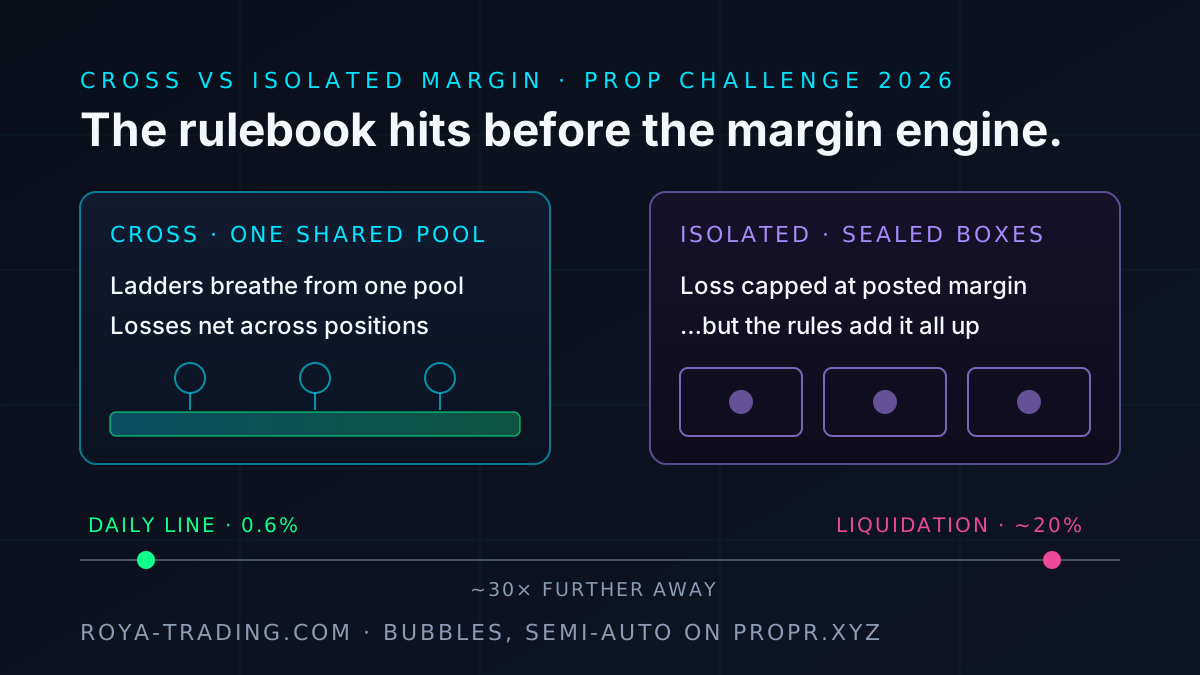
On a prop firm challenge, margin mode is a workflow choice, not a survival choice. Under Propr's leverage caps, liquidation sits very roughly 20% of adverse price move away — while the 1-Step's 3% daily loss line sits 0.6% away at maximum size. The rulebook reaches you about thirty times sooner than the margin engine does. Cross gives all your positions one shared pool: ladders breathe, losses net, and correlated positions quietly become one big trade. Isolated seals each position at the margin you posted — which at a 5x cap is at least 20% of the notional, a "cap" that on any meaningful position is larger than your entire drawdown budget. Neither mode protects the two lines that end challenges. My default is cross with every ladder sized to its worst case; the rest of this article is the math behind that, and the honest list of what each mode does and doesn't change.
The two modes, mechanically
Cross margin backs every open position with one shared collateral pool — your whole account balance. Unrealized profit on one position offsets unrealized loss on another in real time, and a position only dies when the account runs out of margin. It's the default on Hyperliquid, whose engine Propr challenges execute on, and it's why margin is shared across the account — a point I flagged in the leverage caps explained: a maxed BTC position plus a maxed altcoin position compound exposure faster than either alone, because they lean on the same pool.
Isolated margin is opt-in, per position: you allocate a fixed slice of collateral to one trade, and that slice is all the trade can consume. If price moves far enough against it, the position liquidates and the loss stops at the posted margin — the rest of the account never gets touched. On an exchange, that's the whole sales pitch: a sealed compartment per idea, damage capped by construction.
Both descriptions are true. What changes on a challenge account is that a third player sits above the margin engine — the rulebook — and it doesn't care which compartment a loss came from.
The wall you hit first: breach distance vs liquidation distance
Run the numbers on a $10,000 1-Step. The account has a 3% daily loss line — $300 on day one — and a 6% static max drawdown — a $600 floor. Now open BTC at the full 5x cap: $50,000 notional. A move of 0.6% against you costs $300 and ends your day. Liquidation at 5x, in either margin mode, sits very roughly 20% of adverse move away. You would need the market to travel thirty-odd times further to reach the margin engine than to reach the rulebook.
The 2x altcoin tier makes the gap wider, not narrower: at 2x you post at least half the notional as margin, which puts liquidation roughly 48% away — while a 1.5% adverse move at full size still breaches the same 3% daily line. Whatever the asset, the challenge ends in rule territory, not margin territory. That's the single most useful reframe for this whole question: on a prop account you are not managing liquidation distance, you are managing breach distance — and breach distance doesn't appear anywhere in the margin mode settings.
One honest nuance before someone quotes me a counterexample: distances shrink on positions held for days, because funding payments bleed the margin backing them — friction I've costed out here. An unattended weekend hold can walk a compartment closer to its edge. But that's a slow leak, not a different wall: the same hold is walking your equity toward the drawdown floor faster still.
What cross margin really does to a challenge account
Cross is my default, for one structural reason: it's the mode a DCA ladder wants. A ladder — my core method, laid out in DCA for prop firm challenges — enters in slices as price dips. In cross, every leg draws from the same pool the moment it fills: nothing to pre-allocate, nothing to top up at 2 a.m., no fill rejected mid-sequence because a compartment ran dry. The ladder behaves like what it actually is — one position built in stages — and its risk is judged where it should be, at the account level.
The honest cost of cross is that it connects everything to everything. Three "independently sized" longs on BTC, ETH and SOL share one margin pool and, more importantly, one regime — crypto majors move together. A single 2% correlated dip hits all three stops in the same hour, and three individually reasonable losses arrive as one daily-loss breach. That's not a margin mechanics problem — the same three stops cost the same three amounts in isolated — but cross makes the aggregation invisible until it lands. The fix lives in the risk budget, not the toggle: budget the day, divide it across correlated ideas, and treat clustered positions as one trade wearing three costumes.
What isolated margin really does — and the shield it isn't
Isolated earns its keep on personal accounts at silly leverage. On a challenge, three facts take most of its shine off.
1 — The "cap" is bigger than your budget. At a 5x cap, isolating a position means posting at least 20% of its notional as margin. Sized like the traders who actually pass — risk budget ÷ stop distance, call it $5,000 notional on our $10K account — the compartment holds $1,000. Let that position "ride to the cap" and the capped loss is $1,000 — past the $600 drawdown floor, account dead — with the margin engine never once involved. On an exchange, losing one compartment is a bad day. On a 1-Step, one fully consumed compartment of any meaningful size is the whole challenge. The Turbo's 3% total drawdown makes the same arithmetic twice as unforgiving.
2 — The rules add up your compartments. Isolated caps what a position can lose. It does nothing to what your account can lose today: every dollar of damage in every compartment counts against the same daily line — computed on your start-of-day balance — and the same drawdown. There is no pocket the rulebook can't see into. The trader who flips five positions to isolated hasn't built five firewalls; he's built five meters all wired to the same fuse.
3 — It fights the ladder. DCA in isolated means allocating margin to the compartment leg by leg as fills arrive. Under-allocate and the engine rejects the deeper fills — so the ladder you planned isn't the ladder you got, and your average entry sits higher than the plan assumed, with the stop unchanged. The plan was sized as one worst-case position; the execution delivered a different position. That gap between plan and fill is exactly the kind of quiet operational drift that turns a sound setup into an unexplained breach.
Is there a legitimate isolated use on a challenge? One, honestly: if a position is so scary you feel the urge to quarantine it, the urge is information — the position is mis-sized. Fix the size and the quarantine becomes redundant. "It's isolated, I'll let it ride" is how a 1R loss becomes a full-compartment loss, and point 1 already showed what a full compartment costs on a challenge.
The lines that actually bind, ranked
For a challenge account, this is the real hierarchy of walls, nearest first:
- The daily loss line — 3% (1-Step) / 5% (2-Step) of your start-of-day balance, snapshotted at 00:00 UTC and recomputed daily; the breach itself is measured on equity, floating P&L included (read 10 September 2026). Touching it is a breach, not a timeout. This is the wall that ends most runs.
- The max drawdown — 6% static on the 1-Step, 3% static on the Turbo, 8% trailing on the 2-Step. The trailing version follows your high-water mark and can breach you while net-positive — no margin mode has an opinion about that.
- Liquidation — a distant third at 5x, near-unreachable at 2x on fresh positions. If the margin engine ever decides your challenge, the two lines above were crossed conceptually long before.
Read the ranking once more and the cross-vs-isolated debate lands where it belongs: it's a debate about the third wall, on an account that dies at the first one.
The playbook: margin settings that pass challenges
My defaults on a 1-Step, in order of importance:
- Cross, by default. It's the mode the ladder wants, and the account-level risk view is the honest one — the rules judge you at account level too.
- Size every ladder as one worst-case position: all levels filled, price at the stop, and that number must fit inside one per-trade risk budget — well clear of the daily allowance. If the ladder-bottom loss equals the daily limit, it's a time bomb with good intentions.
- Budget the day, then divide: two or three max-risk losses must leave the 3% line untouched. Correlated ideas share one budget slot, not three.
- Don't quarantine — resize. Any position you're tempted to isolate is a position sized for hope. Cut the notional until the worst case is boring.
- Mind multi-day holds: funding drains margin and equity while you sleep; a weekend hold needs the sizing to survive 60 unattended hours, not 60 minutes.
None of this is glamorous, and all of it is arithmetic — which is precisely why I automated it. A bot connected via the official API can run this exact discipline semi-auto on your own Propr account: you pick the coin, the direction and the entry zone, and it executes the DCA ladder, take-profit and stop-loss with the whole ladder pre-sized against the daily loss and drawdown limits. You keep the judgment; the machine keeps the compartment math from ever mattering. And if you're still choosing where to run the challenge itself, the criteria that separate serious firms — documented rules, real payouts, automation allowed — are the ones I rank in the decentralized prop firm comparison. Create the Propr.xyz account through my link and 5% of the challenge fee comes back as USDC cashback — the evergreen deal, no code needed.
FAQ — margin modes on a prop firm challenge
Does margin mode matter on a prop firm challenge?+
Far less than on a personal exchange account. Under Propr's leverage caps — 5x on BTC/ETH (side panel and changelog; the §12 table on the same page says 10x — unreconciled as of our reading on 12 September 2026), 2x on other crypto — liquidation sits very roughly 20% of adverse price move away, while the 1-Step's 3% daily loss line is breached after a ~0.6% adverse move at maximum size. The rulebook is the margin engine that matters. Cross vs isolated changes how losses travel through your account — it does not change the two lines that end challenges.
Should I use cross or isolated margin for a DCA strategy?+
Cross, sized as one worst-case position. A DCA ladder fills in slices, and cross lets the whole ladder breathe from one shared pool — no compartment to top up leg by leg, no risk of a fill being rejected mid-sequence for lack of allocated margin. The discipline that makes it safe is upstream of the toggle: the entire ladder — every level filled, price at the stop — must cost less than one daily allowance. That pre-sizing is exactly what a semi-automatic bot on the official API can do for you.
Does isolated margin protect my daily loss limit?+
No — and this is the most expensive misunderstanding in the whole topic. Isolated margin caps what one position can lose at the margin you posted; it does not cap what your account can lose today. Every dollar an isolated position loses still counts against the daily loss line and the max drawdown. The rules add up your compartments. On a challenge there is no pocket the rulebook can't see into.
Can I get liquidated before I breach the challenge rules?+
At Propr's caps, practically never on a fresh position. A 5x position liquidates roughly 20% of adverse move away, and a 2x altcoin position roughly 48% away — while a 1-Step account breaches its daily line after 0.6% at maximum size. Long unattended holds are the one nuance: funding payments drain margin over days, which shortens the distance. Either way, a liquidation is not a separate risk category — the realized loss counts against the same rules.
What margin mode does Hyperliquid use by default?+
Cross — one shared pool backs all your positions, and unrealized PnL nets across them. Isolated is opt-in per position: you allocate margin to that position alone, and only that margin is at stake in it. Propr challenges execute on Hyperliquid's engine, with the firm's own leverage caps sitting on top — 5x on BTC/ETH (side panel and changelog; the §12 table on the same page says 10x — unreconciled as of our reading on 12 September 2026), 2x on other crypto, 4x on equities, 8x on gold, silver, CL and Brent — identical across evaluation and funded accounts.
Can automation manage margin mode for me?+
The useful automation handles the thing that actually decides survival: the sizing. A semi-automatic bot on the official API lets you pick the coin, the direction and the entry zone, then executes the DCA ladder, take-profit and stop-loss on your own Propr account with the whole ladder pre-sized against the daily loss and drawdown limits. Once the worst case of a ladder fits inside your risk budget, the margin mode toggle becomes what it should have been all along: an implementation detail.
You pick the trade. Pre-sizing does the compartment math.
Size the whole DCA ladder against the daily loss and drawdown limits before the first order goes out — by hand or through a bot on the official API. Exact sizing, no margin surprises, no 2 a.m. top-ups.
Get 5% USDC cashbackNo Propr account yet? Create it here with 5% USDC cashback on your challenge fee.
Affiliate link. We earn a commission; it never changes what you pay — it is what funds your cashback.
⚠️ Facts cited — leverage caps, daily loss and drawdown rules, fees, split and payout terms — were checked against Propr's published rulebook on 13 August 2026 and can change. Liquidation distances are approximations that vary with margin mode, maintenance requirements and funding; worked examples use illustrative assumptions, not firm data. This is general information, not financial advice. Trading carries substantial risk — only spend what you can afford to lose.