
The blog
Prop firm & Propr.xyz guides — page 2
Everything you need to pass a challenge without cracking: strategy, automation, rules and psychology. No bullshit.
Showing 24 of 89 articles
Guides·Reviews·Comparison·Airdrop·The Radar
 Guides
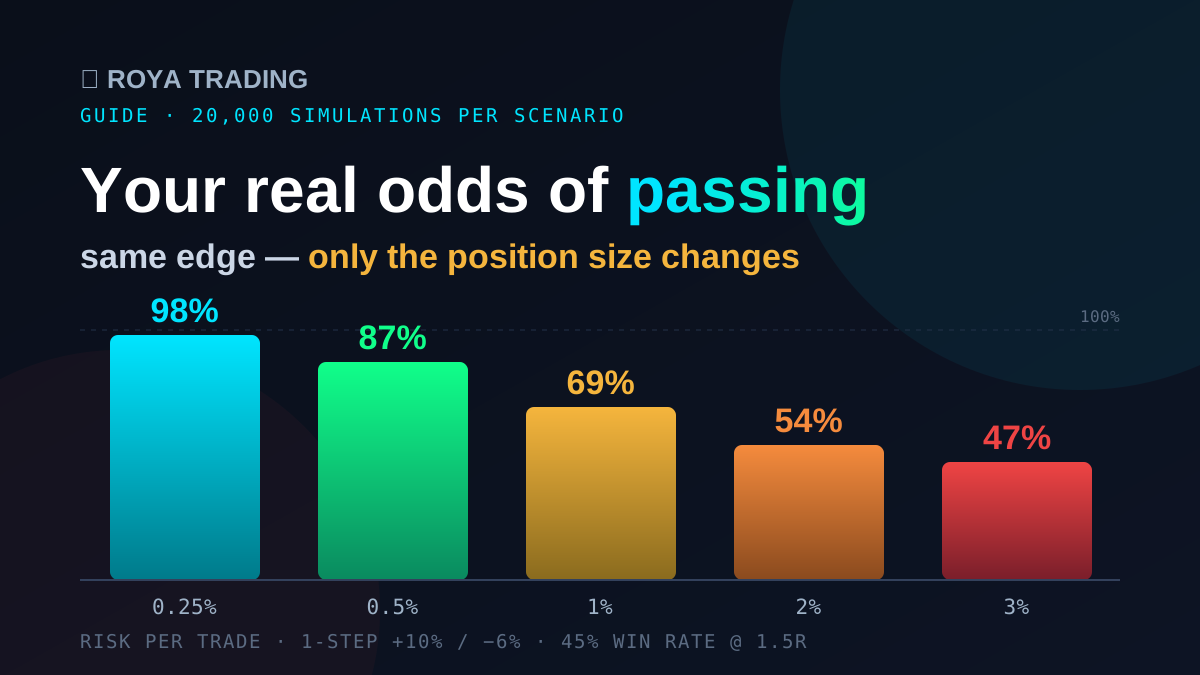
What are your real odds of passing a prop firm challenge?
20,000 simulations per scenario. A zero-edge trader passes a 1-Step 37% of the time, a thin-edge trader moves from 98% to 47% purely by changing position size, and the trailing drawdown quietly costs honest traders 15 points. The tables, the impatience tax, and the only number worth shopping with: fee divided by probability.
 Guides
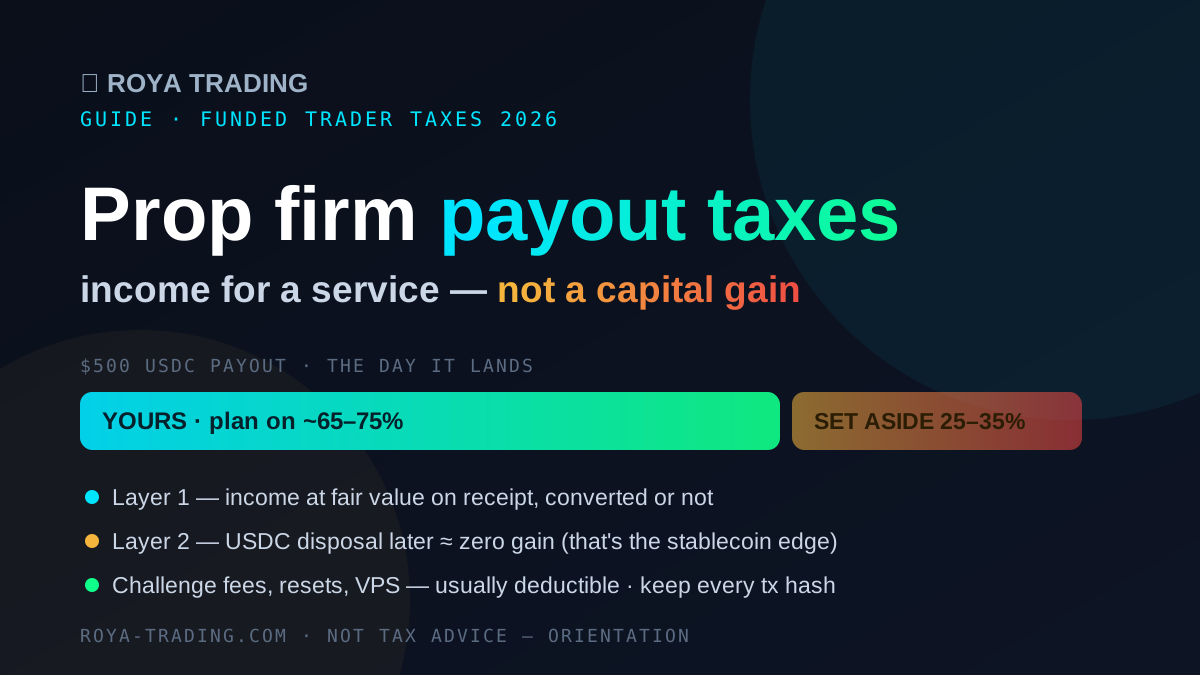
Crypto prop firm taxes: how funded payouts are taxed
A payout is income for a service — not a capital gain — and that one classification decides everything: the form, the rate, the deductions. US, France and UK treatment in 2026, why challenge fees are usually deductible, and the seven-column USDC ledger that saves you a forensic weekend in April.
 Guides
Propr adds a Pro 1-Step and a $200K account — and quietly raised a price
Propr's catalogue now has three 1-Step formats and six account sizes up to $200K. It also moved the 2-Step 100K fee from $749 to $899 without announcing it. What changed, what it costs, and who the Pro tier is actually for.
- Guides
How big is Propr, really? Reading the traffic numbers
Propr's CEO published the firm's Cloudflare dashboard: 228,860 unique visitors and 201.26M requests in 30 days. What that actually measures, what it suggests about the firm's real size — and the caveats the screenshot doesn't show.
- Guides
Aster x Propr Trading Tournament: free entry, $10,000 in ASTER
Free to enter, no requirements, $50,000 simulated equity and 50 paid places over seven days. The rules, the cap — and the $600 gap in Propr's own prize table.
 Guides
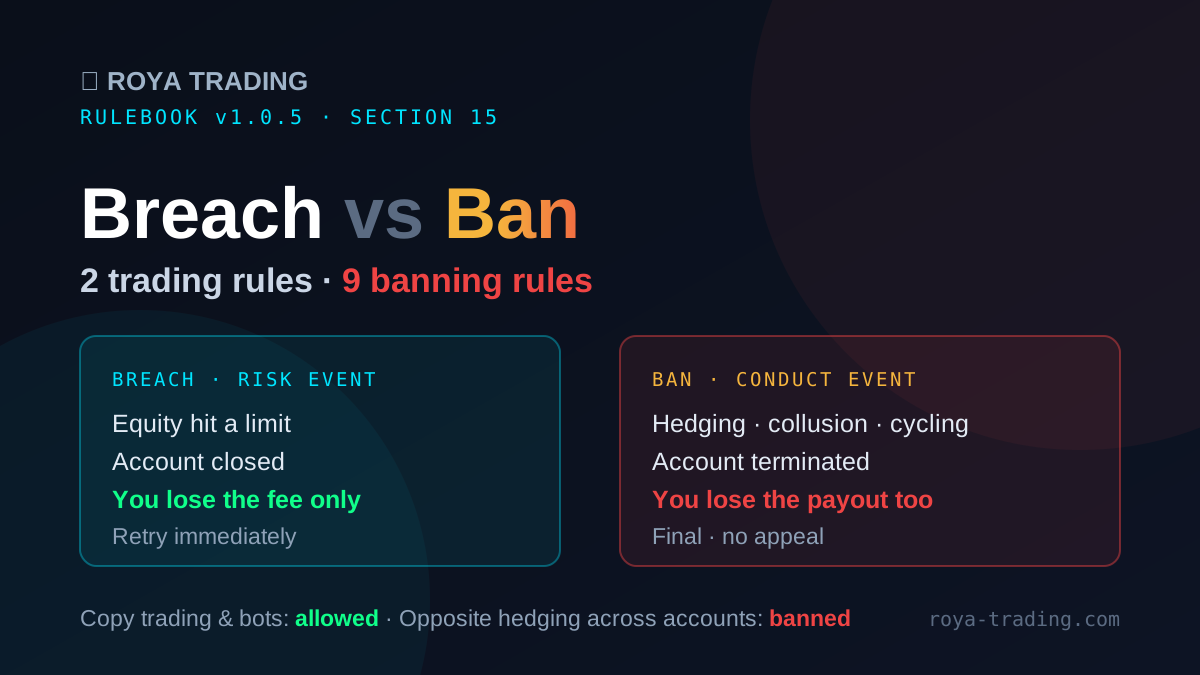
What gets your prop firm account banned
Everyone reads the daily loss limit. Almost nobody reads section 15. A breach costs you the fee you already spent; a ban costs you the payout you already earned. I went through Propr's nine prohibited behaviours and marked the three that catch honest traders — starting with the one that contradicts a rule two pages earlier.
 Guides
Best time of day to trade a crypto prop firm challenge
Crypto is open 24/7 but liquid for about four hours a day. The London-NY overlap, the pre-dawn window where wicks end challenges, the daily reset boundary that decides what counts as today — and how to pass anyway when your only free hours are the illiquid ones.
 Guides
Best crypto pairs to trade in a prop firm challenge
Pair selection is upstream of every entry you'll ever take, and nobody examines it. Why the 5x vs 2x leverage tier is the firm publishing its own liquidity risk ranking, the sizing math that makes altcoins capital-inefficient under a 3% daily line, and the allocation I actually run.
 Guides
Prop firm accounts: real money or demo?
Your evaluation balance is simulated at essentially every firm — including the on-chain ones. The three layers people keep confusing (ledger, price feed, payout rail), what A-book vs B-book really means, and the three checks I run before paying a challenge fee.
 Guides
Passing a prop firm challenge with a full-time job
A 10% target is roughly 57 trades at 0.5% risk — two or three entries a week, not eight hours a day. The schedule, the sizing and the static drawdown that make an untimed evaluation compatible with a 9-to-5.
 Comparison
Instant funding vs challenge: what “no evaluation” really costs
Instant funding removes the profit target and keeps the loss limits — so you buy convenience, not safety. The only metric that settles it is fee divided by drawdown room: $0.18 per dollar on a $10K 1-Step, closer to $2.50 on a typical instant account.
 Guides
Trading fees, funding and slippage: the third rule nobody reads
The challenge fee is the one you shop for; execution is the one you pay. 0.045% taker vs 0.015% maker, a 0.01%/8h funding baseline and the slippage you can't see — how $600 to $1,800 of friction quietly decides whether a 10% target is reachable.
 Guides
Daily loss limit: the prop firm rule that ends most runs
Propr's daily loss is 3% (1-Step) / 5% (2-Step) of your start-of-day balance, snapshotted at 00:00 UTC and recomputed daily; the breach itself is measured on equity, floating P&L included — and touching it is a breach, not a timeout (rules read 10 September 2026). The divide-by-four budget math, the correlation trap, and the circuit breakers that end sessions instead of accounts.
- Guides
Propr Polymarket prop firm: prices & rules (waitlist)
Propr's prediction-market prop firm: the published grid ($200–$1,600), 20% target, 10% static drawdown, 80% split — what's confirmed, what isn't, and what to check before joining the waitlist.
 Guides
Prop firm drawdown recovery: the math of digging out
Down 3–4% mid-challenge with the account still alive? The asymmetric math of the climb back, the divide-by-eight resize formula, how static vs trailing changes the recovery, and the honest threshold where a reset beats the grind.
 Guides
Does Propr have a consistency rule? The honest answer
Propr's rulebook settles it: no consistency rule, no best-day cap, no minimum trading days. Why the absence of that rule is a real edge for DCA and bot traders, where the two equity limits actually bite, and how it stacks up against firms that cap your best day.
 Guides
Weekend trading on a crypto prop firm: the 24/7 edge
Propr's rulebook settles it in one word — no weekend restriction, crypto trades 24/7. What thin Saturday books, hourly funding and the 00:00 UTC reset do to a challenge account, the 2-Step trailing trap, and the sizing that survives a 60-hour unattended hold.
 Guides
Failed your prop firm challenge? The reset playbook
The account closed, the fee is gone — what you do in the next 48 hours decides whether that was tuition or a donation. The 15-minute autopsy by breach type, the honest retry math from $25, and the one change to make before attempt two.
 Guides
Crypto prop firm for beginners: the realistic starter plan
Can a beginner pass a crypto prop firm challenge? Yes — with the $50 starter setup, not the $1,998 one (fee grid read 10 September 2026). The five numbers that decide everything on a $5K account, the honest attempt math, and a 30-day plan that treats the first fee as tuition.
 Guides
News trading on a prop firm: CPI, FOMC & the rules
Propr's rulebook has no news-trading restriction — 'trade during any market event.' What CPI and FOMC actually do to a crypto book in 90 seconds, why the daily loss — 3% (1-Step) / 5% (2-Step) of your start-of-day balance, snapshotted at 00:00 UTC and recomputed daily, with the breach measured on equity, floating P&L included (read 10 September 2026) — is the real referee, and the sizing that survives the wick.
 Comparison
Prop firm vs your own money: the honest math
The same $275 buys a $25,000 Propr challenge or $275 of Hyperliquid margin. The 91x capital math, the rules tax, the leverage illusion — and the honest cases where keeping your money in your own wallet wins.
 Airdrop
$PROPR TGE delayed: no date anymore — two milestones instead
August 24 passed without a token. At Propr's second official AMA (12 Aug 2026), the TGE date was replaced by two conditions: a $5M treasury reserve and 5 third-party integrations, targeted before end of 2026. What it means for your points.
 Airdrop
$PROPR token: supply, airdrop & the milestone-gated TGE
The reference page on the $PROPR token before its milestone-gated TGE (targeted before end of 2026): confirmed supply, the 32.5% airdrop, the 100% unlock at launch, and what's still unannounced. Updated as facts drop.
 Airdrop
$PROPR airdrop eligibility: who qualifies & how to check
Who actually qualifies for the $PROPR airdrop, how to read your points balance before the snapshot (no date anymore — the TGE is milestone-gated), the restricted countries, and the referral boost that moves the needle.